
A town of three long ridges in the Fairfield County hills, first spelled Reading, where Putnam's army wintered in 1778, Georgetown's mill turned cattle hair and wire into sieves and screens, and Mark Twain spent his last years.
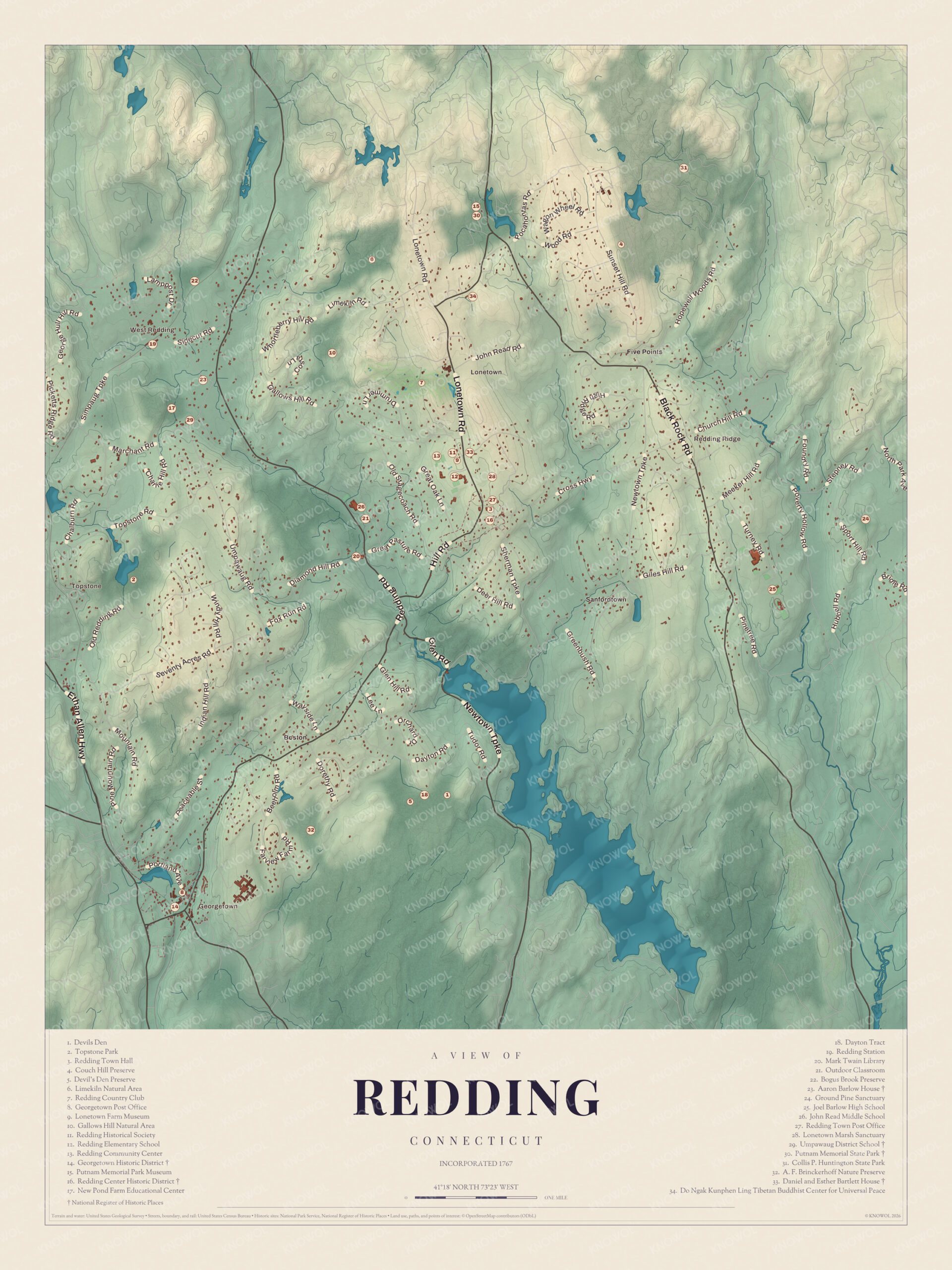
Redding on the map
Click the map to look closer.
Redding today
By KNOWOL
Three shaded ridges running north and south from Sunset Hill to the Saugatuck Reservoir, every street with West Redding, Redding Ridge and Georgetown by name, and a guide of 34 numbered landmarks with the National Register sites marked.4
The story of Redding
The lord of Lonetown
Redding started out as the back country of Fairfield, and one of its first big landholders had a sense of humor. In 1714 John Read, an educated man who later became an eminent Boston lawyer, drew up a deed for land in Lonetown signed by Chickens, also called Sam Mohawk, and Naseco. In it he named himself Lord Justice and Sovereign Pontiff of the place. In 1722 the leftover common lands were auctioned off in Fairfield with a pocket watch on the table and ten minutes to bid, and the settlers' protest that the sale was unfair went nowhere. The parish of 1729 became a town in 1767. In the bill that made it, the name Reading was crossed out and Redding written in, and a year later the new town asked to be made a county town.56781
Putnam's camp
In the winter of 1778 to 1779, Israel Putnam put some 3,000 men into three camps in Redding, the main one at the foot of the bluffs above the Little River. They were cold and badly paid, and the Connecticut brigades once formed up to march on Hartford with their grievances. Putnam rode down to the camps and talked them out of it. When state lawmakers came to see the ground in 1887, they counted forty-five heaps of stone from the huts' chimneys, set in two rows along an avenue about 500 feet long. Aaron Treadwell sold the first 12 acres to the state for a dollar, the monument went up in the summer of 1888, and gifts of land grew the camp to 102 acres by 1906. It's Connecticut's oldest state park.291011
Hats, buttons and wire cloth
Long before the summer people came, Redding was a busy little mill town. Jesse Banks made hats in Sanfordtown with as many as thirty men and shipped them to the South and the West Indies. Oliver Sanford smelted iron there until the great freshet of 1805 wrecked his works. On the Aspetuck, the Sanford brothers' three button factories could turn out three to four hundred gross a day, and the Hill limekiln in Lonetown was thought to be perhaps the oldest in the state. In Georgetown, Benjamin Gilbert began in 1818 with sieves of cattle hair woven on a loom his wife worked. In 1837 his firm wove wire on a neighbor's carpet loom, and by 1906 the Gilbert and Bennett works had nearly 600 people making wire cloth, netting and fencing.121314151617
Through the years
25 moments from 1668 to today.
- 1668Fairfield buys the tract called Northfield, which takes in much of today's Redding.1
- 1714John Read writes a joking deed for Lonetown that makes him its Lord Justice.5
- 1722The common lands are auctioned in Fairfield with ten minutes on a pocket watch to bid.6
- 1729The settlement becomes a parish of Fairfield.1
- 1767Redding becomes a town. In the bill, the name Reading is crossed out and Redding written in.7
- 1768The new town asks the General Assembly to make it a county town.8
- 1777British troops halt on Redding Ridge on the way to Danbury, and a soldier shoots the weathercock off the church spire.18
- 1778Israel Putnam brings some 3,000 men to Redding for the winter.2
- 1789Jesse Lee forms the second Methodist society in New England here.19
- 1790The Umpawaug District School is built.20
- 1791Bishop Francis Asbury preaches in Redding.21
- 1805The great freshet destroys Oliver Sanford's iron works in Sanfordtown.13
- 1809Redding gets its first post office, kept in Billy Comstock's house.22
- 1817The town sends a committee to stock Umpawaug Pond with pike.23
- 1818Benjamin Gilbert starts weaving sieves from cattle hair in Georgetown.16
- 1834Gilbert and Bennett buy an old comb mill on the Norwalk River in Georgetown.1
- 1837Fine wire is woven into cloth on a neighbor's carpet loom.16
- 1852The Danbury and Norwalk Railroad opens, with a station in West Redding.1
- 1874Fire levels the Gilbert and Bennett works in an hour and twenty minutes.17
- 1876Mica mining begins at Branchville, where new minerals turn up, among them reddingite.1
- 1887The camp ground becomes Putnam Memorial State Park, Connecticut's oldest state park.2
- 1888The monument at Putnam's camp goes up.11
- 1906Mark Twain buys the old Davis-Sherwood farm.24
- 1908Twain moves to Redding, to the house he called Stormfield.4
- 1938The Saugatuck Reservoir floods part of the Saugatuck River valley.1
Places to see
The numbers match the landmark guide printed on the 2026 map.
- 5Devil's Den PreserveOn the Weston line. 1,746 acres with 20 miles of trails.
- 14Georgetown Historic DistrictGeorgetown. Gilbert and Bennett's wire mill village.
- 16Redding Center Historic DistrictRedding Center. Church of 1837 and town hall of 1834.
- 19Redding StationWest Redding. Opened with the railroad in 1852.
- 20Mark Twain LibraryWest of the center. Endowed by Twain himself.Visit their website
- 23Aaron Barlow HouseUmpawaug and Station Roads. A blacksmith's house of about 1730.
- 29Umpawaug District SchoolUmpawaug Road. One-room schoolhouse of 1790.Visit their website
- 30Putnam Memorial State ParkNorth of town. The winter camp of 1778 to 1779.Visit their website
- 31Collis P. Huntington State ParkNortheast. Shared with Newtown and Bethel.Visit their website
- 33Daniel and Esther Bartlett HouseLonetown Road. Shingled Federal farmhouse of 1796.
On the National Register
All 6 places in Redding on the National Register of Historic Places that still stand today, oldest first, and why each one matters.3
-
Redding Center Historic District
The old village center, 55 acres with 46 buildings. On the green stand the Greek Revival First Church of Christ of 1837, whose parish goes back to 1729, and the old town hall of 1834, still used for town meetings, with the Read Cemetery nearby.25
-
Aaron Barlow House
A Georgian house owned by 1750 by the blacksmith Aaron Barlow, who served in the Revolution and later in the legislature. His brother Joel, the poet, is said to have written The Vision of Columbus here in 1787.26
-
Putnam Memorial State Park
The site of Israel Putnam's winter camp of 1778 to 1779. Created in 1887 when Aaron Treadwell sold the first 12.4 acres to the state for one dollar, it is Connecticut's oldest state park.2
-
Umpawaug District School
A one-room schoolhouse used until 1931, and the only district schoolhouse left in town. The Redding Historical Society opens it once a year.20
-
Daniel and Esther Bartlett House
A well-preserved Federal house, unusual for its shingle siding, with an 18th-century barn. It was a working farm until 1973 and is now the home of the Redding Historical Society.27
-
Georgetown Historic District
The old Gilbert and Bennett wire works with the housing it built for its workers, private homes and the village business district. Its nomination called it a rare survival of rural industrial history.28
In their words
“No Revolutionary relic at all approaching in completeness the Israel Putnam Memorial Camp Ground in Redding can be found in America”
The history of Redding, Connecticut, 190611
“Like many of the New England villages, it is scattered, and beautifully shaded with elms, maples, and sycamores.”
Benson Lossing's Field-Book of the Revolution, as quoted in The history of Redding, 190629
“The "Glen" in the valley of the Saugatuck is widely famed for its beautiful and picturesque scenery.”
The history of Redding, Connecticut, 190630
Nearby towns
Sources
- Redding, Connecticut, Wikipedia
- Putnam Memorial State Park, Wikipedia
- National Register of Historic Places listings in Fairfield County, Connecticut, Wikipedia
- Map of Redding, Connecticut in 2026, KNOWOL (USGS elevation, Census Bureau roads)
- The history of Redding, Connecticut (1906), on John Read's deed of 1714, Internet Archive
- The history of Redding, Connecticut (1906), on the land auction of 1722, Internet Archive
- The history of Redding, Connecticut (1906), on the town's name, Internet Archive
- The history of Redding, Connecticut (1906), on the town meetings of 1768, Internet Archive
- The history of Redding, Connecticut (1906), on Putnam and the Connecticut brigades, Internet Archive
- The history of Redding, Connecticut (1906), on the camp ground in 1887, Internet Archive
- The history of Redding, Connecticut (1906), on the monument and the camp ground, Internet Archive
- The history of Redding, Connecticut (1906), on hat-making, Internet Archive
- The history of Redding, Connecticut (1906), on Oliver Sanford's iron works, Internet Archive
- The history of Redding, Connecticut (1906), on the button factories, Internet Archive
- The history of Redding, Connecticut (1906), on the Hill Limekiln, Internet Archive
- The history of Redding, Connecticut (1906), Edwin Gilbert on the Gilbert and Bennett company, Internet Archive
- The history of Redding, Connecticut (1906), on the fire of 1874, Internet Archive
- The history of Redding, Connecticut (1906), on the British march of 1777, Internet Archive
- The history of Redding, Connecticut (1906), on the Methodist church, Internet Archive
- Umpawaug District School, Wikipedia
- History of Fairfield County, Connecticut (1881), on Bishop Asbury in Redding, Internet Archive
- The history of Redding, Connecticut (1906), on the first post office, Internet Archive
- The history of Redding, Connecticut (1906), on old town votes, Internet Archive
- The history of Redding, Connecticut (1906), on the summer colony, Internet Archive
- Redding Center Historic District, Wikipedia
- Aaron Barlow House, Wikipedia
- Daniel and Esther Bartlett House, Wikipedia
- Georgetown Historic District (Georgetown, Connecticut), Wikipedia
- The history of Redding, Connecticut (1906), opening quotations, Internet Archive
- The history of Redding, Connecticut (1906), on the Glen, Internet Archive