
A big hill town on the Massachusetts line whose mineral springs drew visitors from John Adams on, whose bog iron fed a furnace that cast cannon, and whose woolen mills at Stafford Springs came back from fire and flood.
Then and now
The same town 148 years apart. Click either map to look closer.

The bird's-eye view
By O.H. Bailey
Stafford Springs drawn as if from the sky, with its street names and landmarks: St. Mary's Convent, the Mineral Springs Manufacturing Company, the Stafford National Bank, Stafford Granite Mills, the Converseville Company, the Phoenix Woolen Company, Warren's Block and Haymarket Square.5
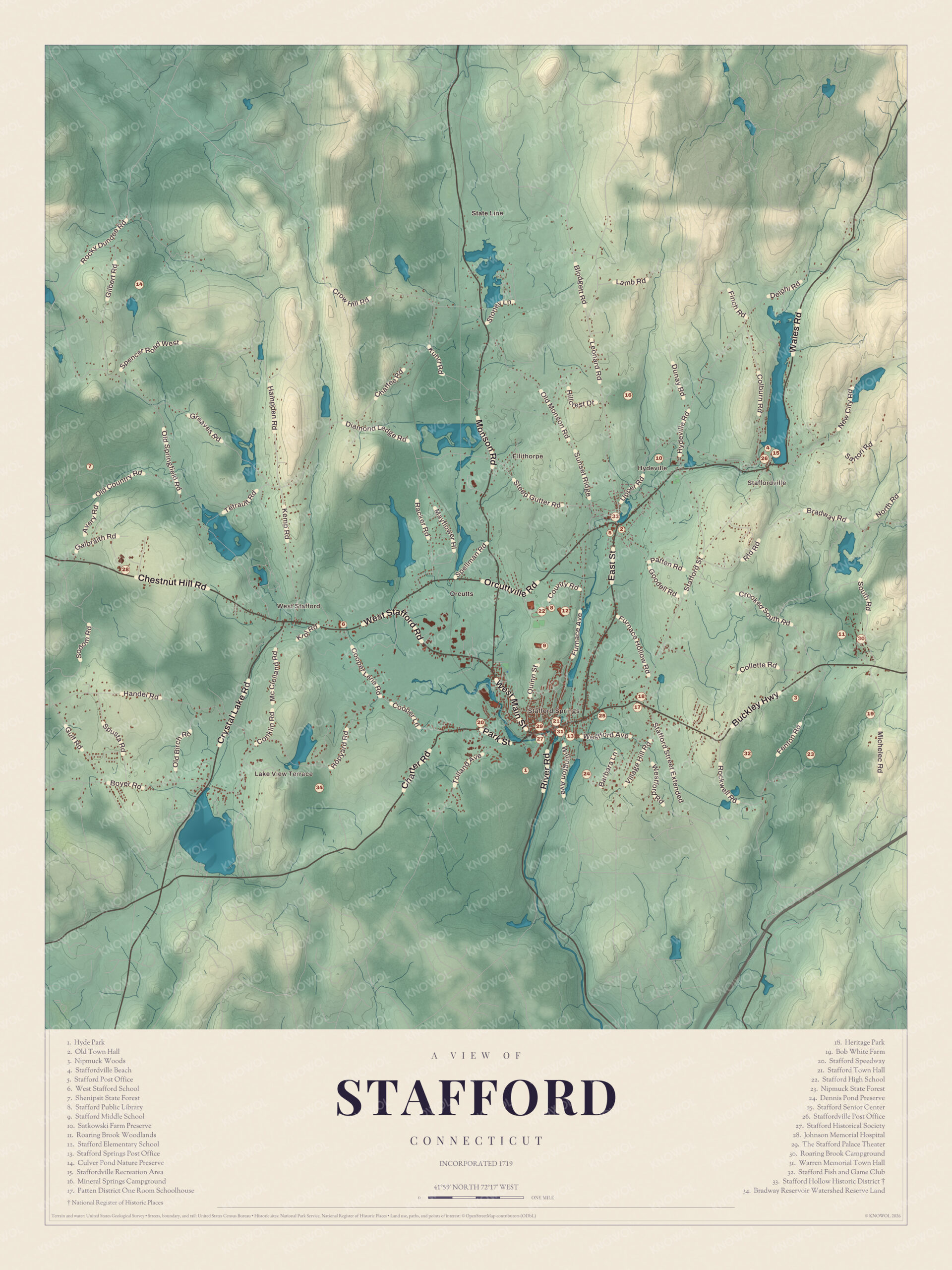
Stafford today
By KNOWOL
Shaded hills from Burley Hill, the highest ground in town, down to the Willimantic River at Stafford Springs, every street, Staffordville and Stafford Hollow, and a guide of 34 numbered landmarks with the National Register district marked.6
The story of Stafford
Water that lifted the spirits
Before Stafford had a single mill, it had its springs. The Native people who showed them to the first settlers in 1719 used the water to bathe their eyes, but said they drank it because it enlivened their spirits. About 1765 the springs cured a skin complaint no doctor had been able to touch, and their fame spread. In 1766 Dr. Joseph Warren looked them over and thought of buying the land, until the Revolution made him a soldier and he fell at Bunker Hill. In 1771 a young John Adams spent several days here getting over overwork, and later Dr. Willard carried out Warren's plan and built a large hotel. There were two springs, an iron spring that chemists ranked among the best of its kind and a sulphur spring Professor Silliman examined about 1810.782
The morning the reservoir broke
Early on March 27, 1877, the dam at the Staffordville reservoir gave way. It had just been raised several feet, and the reservoir was full for the first time since. The water tore down the valley for five miles, taking the smaller dams, the mills and the bridges with it. At Stafford Springs it swept away houses, a church, factories, stores and a bank, and two men standing on the church steps were drowned. About a thousand people were put out of work. The Granite Mills lost a keepsake from its office wall, two Civil War bills for bales of cotton. William Smith and Company lost its whole plant and rebuilt right away, and a Main Street merchant whose store washed off reopened in the new bank building.3891011
The Phoenix and the rabbit
Stafford was an iron town before it was a woolen town. John Phelps built a blast furnace at Furnace Hollow in 1779 that cast hollow ware, cannon and cannon shot, a second big furnace went up in 1796, and the business boomed until 1820. A blacksmith named Moses Newton and his son John made guns used in the Revolution. When the woolen mills came, they came with grit. The Hydeville mill burned in 1860 and was rebuilt so fast it was named the Phoenix. Julius Converse of the Mineral Springs mill turned a thicket so wild a rabbit couldn't run through it into the grounds of his house. And in the hard times of the 1890s, Cyril Johnson kept his mills running without cutting anyone's wages.12813141516
Through the years
25 moments from 1718 to today.
- 1718The General Assembly orders a town laid out "of seven mile square" east of Enfield, and it's surveyed.2
- 1719Stafford is incorporated and settled in the spring by twelve principal settlers.12
- 1723The first minister, Mr. Graham, is settled.12
- 1765A cure of a stubborn skin complaint makes the mineral springs famous.7
- 1766Dr. Joseph Warren, later killed at Bunker Hill, examines the springs and thinks of buying the land.8
- 1771A young lawyer named John Adams spends several days at the springs.2
- 1779John Phelps and others build a blast furnace at Furnace Hollow that casts hollow ware, cannon and cannon shot.12
- 1796A second large furnace goes up, and the iron business booms until 1820.8
- 1810Professor Silliman examines the newly valued sulphur spring.7
- 1839Solva Converse starts the Mineral Springs Manufacturing Company, the first woolen mill at Stafford Springs.2
- 1843The Granite Mills are founded at Stafford Springs.9
- 1853The Warren Mills are founded.6
- 1856D. E. Whiton opens a West Stafford shop making centering machines and lathe chucks.17
- 1860The Hydeville mill burns and is rebuilt so fast it's named the Phoenix.14
- 1867The Stafford News Letter, then Tolland County's only paper, becomes the Tolland County Press.18
- 1870The Stafford Springs Agricultural Park opens with a half-mile harness racing track, the start of Stafford Speedway.6
- 1873Stafford Springs becomes a borough with its own government.2
- 1877On March 27 the Staffordville reservoir breaks, and the flood sweeps through Stafford Springs, drowning two men.3
- 1878O.H. Bailey publishes his bird's-eye view of Stafford Springs.5
- 1894Charles Holt's widow and daughter give the granite fountain in Haymarket Square.19
- 1894Trains stop at Stafford Springs, Powder Track (or Orcutt's) and Ellithorpe, and a stage runs to the other villages.20
- 1959Stafford Speedway joins NASCAR.6
- 1987The Stafford Hollow Historic District is listed on the National Register.21
- 1991The borough of Stafford Springs is disincorporated.2
- 2025The Stafford Springs Historic District is listed on the National Register.2
Places to see
The numbers match the landmark guide printed on the 2026 map.
- 1Hyde ParkSouthwest of downtown. A park near Stafford Springs.
- 2Old Town HallStafford Hollow. In the town's old center.
- 4Staffordville BeachStaffordville. Small public beach on Staffordville Lake.
- 7Shenipsit State ForestWest side. State forest near the hospital.
- 20Stafford SpeedwayWest of downtown. Friday night races since the fairground days.
- 21Stafford Town HallStafford Springs. Beside Warren Memorial Town Hall.
- 27Stafford Historical SocietyStafford Springs. In Julius Converse's mill office of 1887.
- 29The Stafford Palace TheaterStafford Springs. Main Street's restored vaudeville theater.
- 31Warren Memorial Town HallStafford Springs. Beside Stafford Town Hall.
- 33Stafford Hollow Historic DistrictStafford Hollow. The old furnace village, listed 1987.
On the National Register
All 2 places in Stafford on the National Register of Historic Places that still stand today, oldest first, and why each one matters.4
-
Stafford Hollow Historic District
Stafford Hollow, once called Furnace Hollow, was the town center in the 1700s and 1800s, and the Phelps blast furnace here smelted bog iron from 1779 until 1840. The district takes in five of the town's most significant buildings, including the Pinney School of 1895, and the ruins of the Valley Cotton Mill.21
-
Stafford Springs Historic District
The heart of the old springs resort and mill village near the source of the Willimantic River, a borough from 1873 to 1991. It takes in the Holt Memorial Fountain and the former railroad station.2
In their words
“but gave, as their own particular reason for drinking it, that it enlivened their spirits.”
Connecticut historical collections, 1837, on the Native people and the springs7
“the beef and cider of the town, are said to be of a superior quality”
Benjamin Trumbull, A complete history of Connecticut, 181822
“Out of a section where it was difficult for a rabbit to run, on account of the wild and unchecked undergrowth, he has created beautiful grounds”
The historical, statistical and industrial review of the state of Connecticut, 1884, on Julius Converse15
Nearby towns
Sources
- Stafford, Connecticut, Wikipedia
- Stafford Springs, Connecticut, Wikipedia
- Bursting of the Staffordville Reservoir, Today in History: March 27, ConnecticutHistory.org
- National Register of Historic Places listings in Tolland County, Connecticut, Wikipedia
- Bird's-eye view of Stafford Springs, Connecticut from 1878, restored by KNOWOL
- Map of Stafford, Connecticut in 2026, KNOWOL (USGS elevation, Census Bureau roads)
- Connecticut historical collections, by John Warner Barber (1837), on the mineral springs, Internet Archive
- The historical, statistical and industrial review of the state of Connecticut (1884), on Stafford, Internet Archive
- The historical, statistical and industrial review of the state of Connecticut (1884), on the Granite Mills Company, Internet Archive
- Commemorative biographical record of Tolland and Windham counties, Connecticut (1903), on William Smith and Company, Internet Archive
- Commemorative biographical record of Tolland and Windham counties, Connecticut (1903), on L. W. Crane's store, Internet Archive
- Connecticut historical collections, by John Warner Barber (1837), on Stafford's settlers and furnaces, Internet Archive
- Newton genealogy (1915), on Moses Newton of Stafford, Internet Archive
- Commemorative biographical record of Tolland and Windham counties, Connecticut (1903), on Charles Holt and the Phoenix mill, Internet Archive
- The historical, statistical and industrial review of the state of Connecticut (1884), on Julius Converse, Internet Archive
- Men of progress (1898), on Cyril Johnson, Internet Archive
- A modern history of New London County, Connecticut (1922), on D. E. Whiton, Internet Archive
- Encyclopedia of Connecticut biography (1917), on James McLaughlin and The Press, Internet Archive
- Holt Memorial Fountain, Wikipedia
- Register and manual of the state of Connecticut (1894), Internet Archive
- Stafford Hollow, Connecticut (Stafford Hollow Historic District), Wikipedia
- A complete history of Connecticut, by Benjamin Trumbull (1818), Internet Archive