
A valley town between two ridges, once called Panthorn, where a Marion blacksmith's carriage bolts, Seth Peck's tinners' machines and Gad Andrews' cement built the shops of Southington, Plantsville and Milldale.
Then and now
The same town 157 years apart. Click either map to look closer.
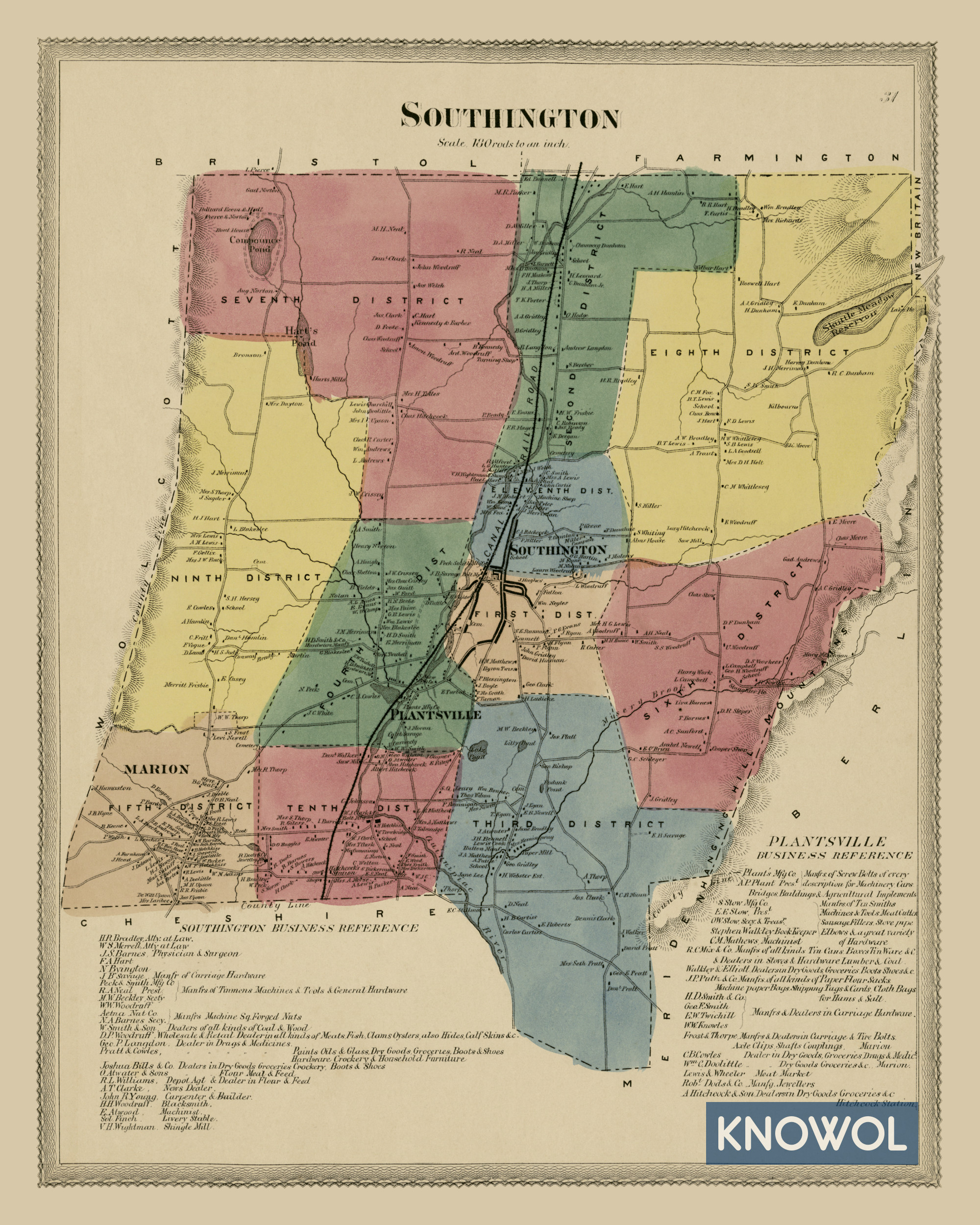
The landowners map
By Baker & Tilden
Every plot of land carries its owner's name, across eleven school districts, with business directories for Southington and Plantsville. Compounce Pond, Hart's Pond and mill, Smith Hardware Manufacturing, Dod's jewelry factory and the Southington Billiard Room and Hall are all on it.5
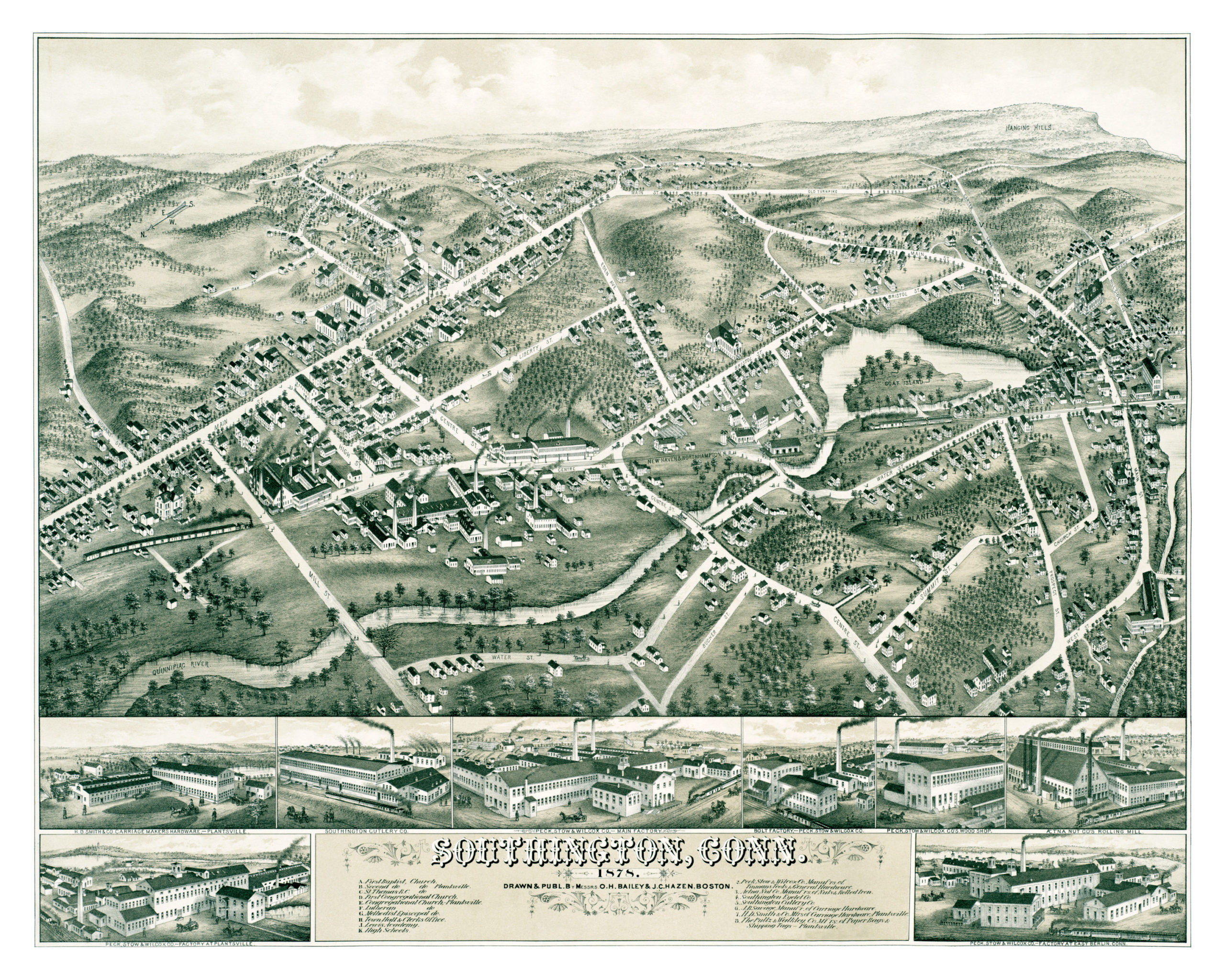
The bird's-eye view
By J.C. Hazen
Southington drawn as if from the sky, with its street names and landmarks including Southington High School, Lewis Academy, the First Baptist Church, Southington Cutlery, the Aetna Nut Company, Savage's Carriages, Goat Island and the Hanging Hills.6
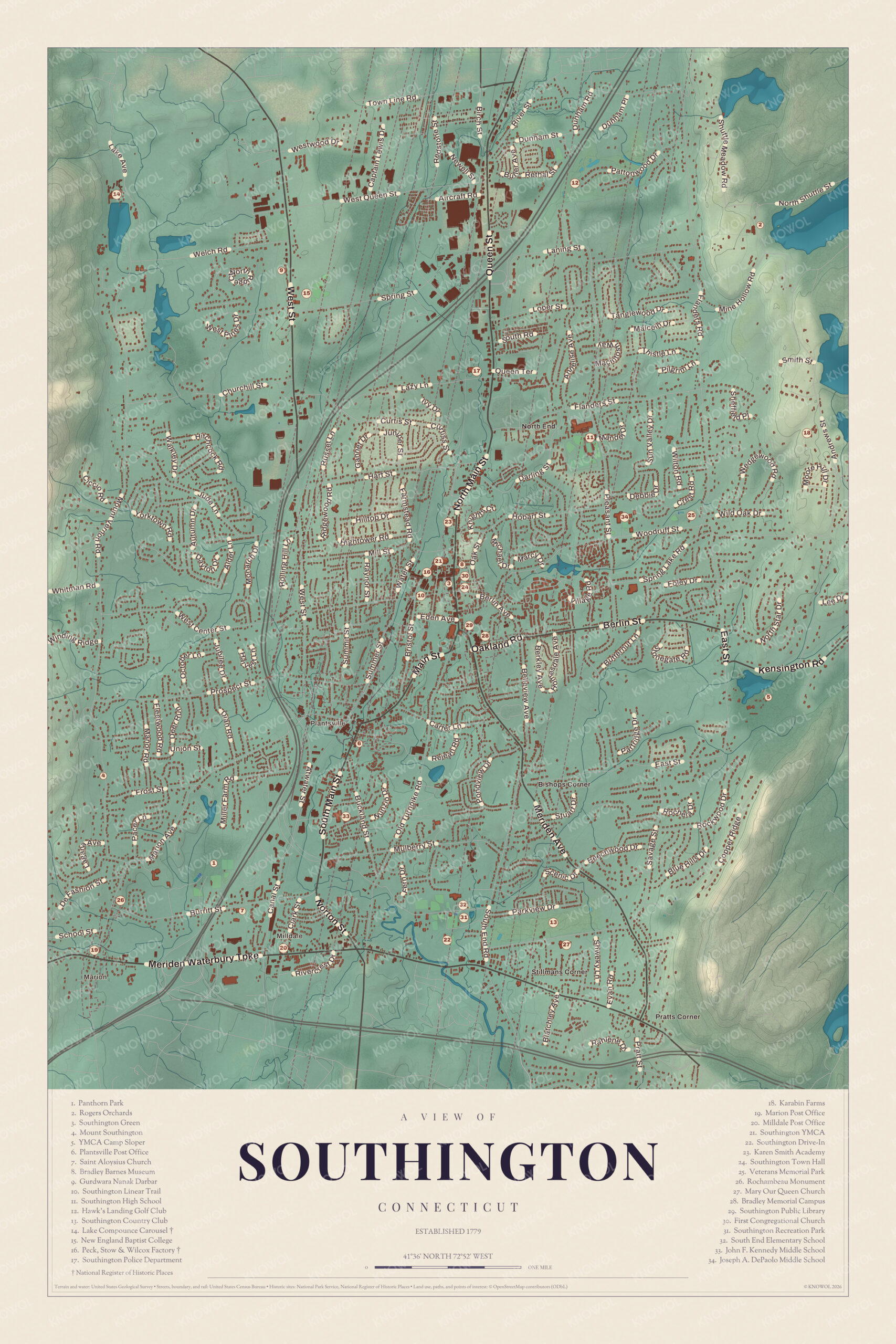
Southington today
By KNOWOL
Shaded hills from Mount Southington in the west across the valley to the ridge on the east side, every street, Plantsville, Marion, Stillmans Corner and Pratts Corner, and a guide of 34 numbered landmarks with the National Register sites marked.7
The story of Southington
Poor as Panthorn
Before it was Southington, this valley was Panthorn, a name written in a deed as early as 1706. Farmington people didn't think much of its sandy plains, and "poor as Panthorn" was a saying there before 1724. Nobody knows for sure where the name came from. One tradition says a Wallingford man plowing the Great Plain came home saying it was so hot his cattle panted clean up to the end of their horns. Wolves kept mostly to the west mountain, and as late as the 1750s farmers on West Street penned their cattle inside palisades at night. Lake Compounce is said to carry the name of John Compound, who drowned trying to cross it instead of walking around. And Shuttle Meadow got its name because, from a few spots, the valley looked just like a weaver's shuttle.891011
Bolts, tinware and cement
Southington's factories grew out of a blacksmith shop and a farm. In 1818 Micah Rugg set up as a blacksmith in Marion, where his scythes became famous and his steel traps sold in the South for catching otter. In 1839 he began making carriage bolts by hand, about a hundred a day per man, and the next year his partner Martin Barnes built the first machine for cutting bolt threads. They never got a patent, which the town historian said would have enriched the whole town. Seth Peck first made tinners' machines here in 1829, and by 1875 Peck, Stow and Wilcox had about five hundred hands. On Anson Merriman's farm young Gad Andrews made the state's first cement in 1824 and 1825. A mason at New York's Croton Reservoir said Southington's cement was judged the best of all.123213
The cat's head on West Peak
The Hanging Hills mark Southington's line with Meriden, and until about the 1820s the top of West Peak wore an extra rock. Seen from the road near Pratt's Corners, it looked like a cat's head. David Pratt, who was 85 in 1900, remembered the Fourth of July when a party from Meriden climbed up with blasting powder to clear a crack in it. The man who lit the fuse stumbled, and rock and man went over the cliff together. When the others crept back to the edge, they found him hanging by the tail of his coat from a dead tree. Not far away, on the road to Meriden, a big boulder got the name Capt. Fisk's tavern, after the captain, on his way home from a barn raising, pounded on it and demanded to be let in.141516
Through the years
24 moments from 1698 to today.
- 1698Samuel Woodruff moves his family down from Farmington and becomes Southington's first settler.1
- 1706The name Panthorn turns up in a deed, the first time it's written down.8
- 1726The settlement becomes the South Society of Farmington.1
- 1739The Little Plain, today's Marion, is surveyed and divided into farms.17
- 1765About this year Asa Barnes opens his tavern on the road from Bristol to New Haven.18
- 1770George Washington passes through on his way to Wethersfield.1
- 1779Southington becomes a town, and Deacon Jared Lee, known as All Southington, chairs the meeting to organize it.19
- 1781Rochambeau's French army camps four days in Marion, near Asa Barnes's tavern.1
- 1792The Baptists build their first meetinghouse, on the hill in Center Place.20
- 1818Micah Rugg sets up as a blacksmith in Marion.12
- 1824Gad Andrews begins the experiments that make the state's first cement.2
- 1829Seth Peck makes the first tinners' machines.3
- 1840Martin Barnes builds the first machine for cutting the threads of bolts.12
- 1840About this year the Plant brothers open their shops at Pearl's Corner, and the village takes the name Plantsville.21
- 1846Lake Compounce opens as an amusement park.7
- 1865Sixty-three members leave the Southington church to found a church at Plantsville.22
- 1870Three tool makers join to form Peck, Stow and Wilcox.7
- 1875Peck, Stow and Wilcox has about five hundred hands and pays a thousand dollars a day in wages.3
- 1902The town's first library building opens on Main Street.23
- 1911Charles Looff's carousel comes to Lake Compounce from Savin Rock.24
- 1942The War Department picks Southington for its booklet Southington, CT, Microcosm of America.1
- 1962A tornado tears through town on May 24, partly flattening Plantsville.1
- 1964Mount Southington opens for skiing on December 10.7
- 1969The first Apple Harvest Festival is held.1
Places to see
The numbers match the landmark guide printed on the 2026 map.
- 1Panthorn ParkSoutheast of Mount Southington. Carries the valley's old name.
- 2Rogers OrchardsNortheast. The same family's apple farm since 1807.
- 3Southington GreenTown center. The heart of the old center.
- 4Mount SouthingtonWestern hills. A dairy farm turned ski area in 1964.
- 10Southington Linear TrailWest of the center. On the old railroad line.
- 14Lake Compounce CarouselLake Compounce. Looff carousel here since 1911.
- 24Southington Town HallTown center. Beside the green.
- 26Rochambeau MonumentMarion. Marks the French army's 1781 camp.
- 29Southington Public LibrarySouth of the center. A public library since 1902.Visit their website
- 30First Congregational ChurchSouthington Green. Beside the green at the center.Visit their website
On the National Register
20 of the 37 places in Southington on the National Register of Historic Places that still stand today, oldest first, and why each one matters. See the full list of National Register places in Southington.4
-
Southington Center Historic District
The center of town, with the green and its Civil War, World War and Amon Bradley monuments, the Congregational church built from 1828 to 1832, and houses going back to colonial days.25
-
Jonathan Root House
Believed to be the oldest colonial building in town. Jonathan Root was chosen one of the five first selectmen when Southington became a town in 1779.26
-
Marion Historic District
The old Little Plain, settled in 1739, where Rochambeau's army camped in 1781 on what's now French Hill. Bolt making began here in the 1840s. A small part lies in Cheshire.17
-
Luman Andrews House
One of the oldest houses in town. Luman Andrews, who bought it in 1818, found the limestone here that made Southington an early center of cement, and the ruins of a lime kiln remain.27
-
Dr. Henry Skelton House
A Georgian saltbox built for Henry Skelton, the town's second doctor, who was born in England in 1688.28
-
Capt. Josiah Cowles House
Home of Captain Josiah Cowles, militia captain and justice of the peace, who was named at the first town meeting in 1779 to help the families of soldiers away at war. It's now a bed and breakfast.29
-
West Street School
The town's oldest school building, a one-room schoolhouse first built for a Farmington school district. It taught children until the 1940s and is kept today by the Southington Historical Society.30
-
Levi B. Frost House (Asa Barnes Tavern)
Asa Barnes's tavern, where Rochambeau and his officers stayed in 1781 and Landlord Barnes gave a ball in their honor. Levi Frost, a blacksmith and bolt maker, rebuilt it in the Greek Revival style after a fire in 1836.18
-
Roswell Moore II House
A Georgian house overlooking Wassell Reservoir, with a chimney built mostly of brownstone. Roswell Moore's son Sheldon helped start Southington's cement industry.31
-
Barnes-Frost House
A fine late colonial house in Marion, home to three generations of the Barnes family from 1810 and then to the Frosts, who owned a factory nearby.32
-
Farmington Canal-New Haven and Northampton Canal
At 86 miles New England's longest canal, which ran its full length only from 1835 to 1847 before becoming a railroad and now a trail. Lime from Southington was used to build and reline its locks. Shared with the towns along its route.33
-
Plantsville Historic District
A century of an industrial village's houses and mills along the Quinnipiac River, including the 1866 Plantsville Congregational Church by Josiah Cleveland Cady, one of the state's finest Gothic Revival churches.34
-
Meriden Avenue-Oakland Road Historic District
A neighborhood of 113 buildings from 1860 to 1936, from Italianate and Queen Anne to Four Square and bungalow. Byron Twiss, who owned a wood turning factory, may account for the fine millwork on his house.35
-
Pultz & Walkley Company
L.V. Walkley and J.P. Pultz invented machinery for making paper bags, and their Italianate brick factory turned out 3 million bags in 1899.36
-
H. D. Smith Company Building
Henry D. Smith invented machines to make carriage irons that had been made by hand. His factory beside the Eightmile River was a local showpiece, and it later made bicycle parts and automobile tool kits.37
-
Hurwood Company
Where solid-headed screwdrivers were first made, by George Wood and John Hurley beginning in 1901. Stanley Tools bought the company in 1905 and kept making screwdrivers and chisels here.38
-
Lake Compounce Carousel
Built by Charles I. D. Looff, it stood at Savin Rock in West Haven until 1911. Each horse has its own colors and face, and it's a rare Looff carousel still running.24
-
Hubbard Park
Walter Hubbard's 1,800-acre gift to the people of Meriden, laid out with help from Frederick Law Olmsted, with Mirror Lake and Castle Craig. Part of it reaches into Southington.39
-
Southington Public Library
A Classical Revival library paid for with a $5,000 challenge gift from Lucius V. Walkley of Pultz & Walkley. It now houses the Southington Historical Society.23
-
Clark Brothers Factory No. 2
The steam-powered plant of the Clark Brothers, who perfected machines for making carriage bolts in the 1850s and grew into one of the town's major employers.40
In their words
“We are all blessed with a native place, one which we always love to revisit, and to which we may point with something of pride.”
A native son at the old church's anniversary, Ecclesiastical and other sketches of Southington, 187541
“He taught the people of Southington how to live.”
Roger Whittlesey on Rev. William Robinson, in The Connecticut Magazine, 190042
“The cement from Southington was pronounced to be the best of all.”
A letter recalling a mason at New York's Croton Reservoir, in the 1924 history of Southington cement13
Nearby towns
Sources
- Southington, Connecticut, Wikipedia
- Ecclesiastical and other sketches of Southington, Conn. (1875), on the first cement, Internet Archive
- Ecclesiastical and other sketches of Southington, Conn. (1875), on tinners' machines, Internet Archive
- National Register of Historic Places listings in Southington, Connecticut, Wikipedia
- Landowners map of Southington, Connecticut from 1869, restored by KNOWOL
- Bird's-eye view of Southington, Connecticut from 1878, restored by KNOWOL
- Map of Southington, Connecticut in 2026, KNOWOL (USGS elevation, Census Bureau roads)
- Ecclesiastical and other sketches of Southington, Conn. (1875), on the name Panthorn, Internet Archive
- Ecclesiastical and other sketches of Southington, Conn. (1875), on Wolf Hill, Internet Archive
- Ecclesiastical and other sketches of Southington, Conn. (1875), on Lake Compounce, Internet Archive
- Ecclesiastical and other sketches of Southington, Conn. (1875), on Shuttle Meadow, Internet Archive
- Ecclesiastical and other sketches of Southington, Conn. (1875), on Micah Rugg and the bolt business, Internet Archive
- History of the discovery of water-limestone and early manufacture of cement at Southington, Connecticut (1924), Internet Archive
- Glimpses of Southington, Past and Present, The Connecticut Magazine (1900), on West Peak, Internet Archive
- Glimpses of Southington, Past and Present, The Connecticut Magazine (1900), on the blast at West Peak, Internet Archive
- Glimpses of Southington, Past and Present, The Connecticut Magazine (1900), on Capt. Fisk's tavern, Internet Archive
- Marion, Connecticut (Marion Historic District), Wikipedia
- Levi B. Frost House, Wikipedia
- Glimpses of Southington, Past and Present, The Connecticut Magazine (1900), on Jared Lee, Internet Archive
- The memorial history of Hartford County, Connecticut (1886), on the Southington Baptists, Internet Archive
- Ecclesiastical and other sketches of Southington, Conn. (1875), on Plantsville, Internet Archive
- Ecclesiastical and other sketches of Southington, Conn. (1875), on the Plantsville church, Internet Archive
- Southington Public Library, Wikipedia
- Lake Compounce Carousel, Wikipedia
- Southington Center Historic District, Wikipedia
- Jonathan Root House, Wikipedia
- Luman Andrews House, Wikipedia
- Dr. Henry Skelton House, Wikipedia
- Josiah Cowles House, Wikipedia
- West Street School, Wikipedia
- Roswell Moore II House, Wikipedia
- Barnes-Frost House, Wikipedia
- New Haven and Northampton Canal, Wikipedia
- Plantsville, Connecticut (Plantsville Historic District), Wikipedia
- Meriden Avenue-Oakland Road Historic District, Wikipedia
- Pultz & Walkley Company, Wikipedia
- H. D. Smith Company Building, Wikipedia
- Hurwood Company, Wikipedia
- Hubbard Park (Meriden, Connecticut), Wikipedia
- Clark Brothers Factory No. 2, Wikipedia
- Ecclesiastical and other sketches of Southington, Conn. (1875), anniversary address, Internet Archive
- Glimpses of Southington, Past and Present, The Connecticut Magazine (1900), on Rev. William Robinson, Internet Archive