
A small hill town in western Litchfield County, once the parish of East Greenwich in Kent, with a Federal church on its green, the old lookout of Above All, and a share of Lake Waramaug.
Warren on the map
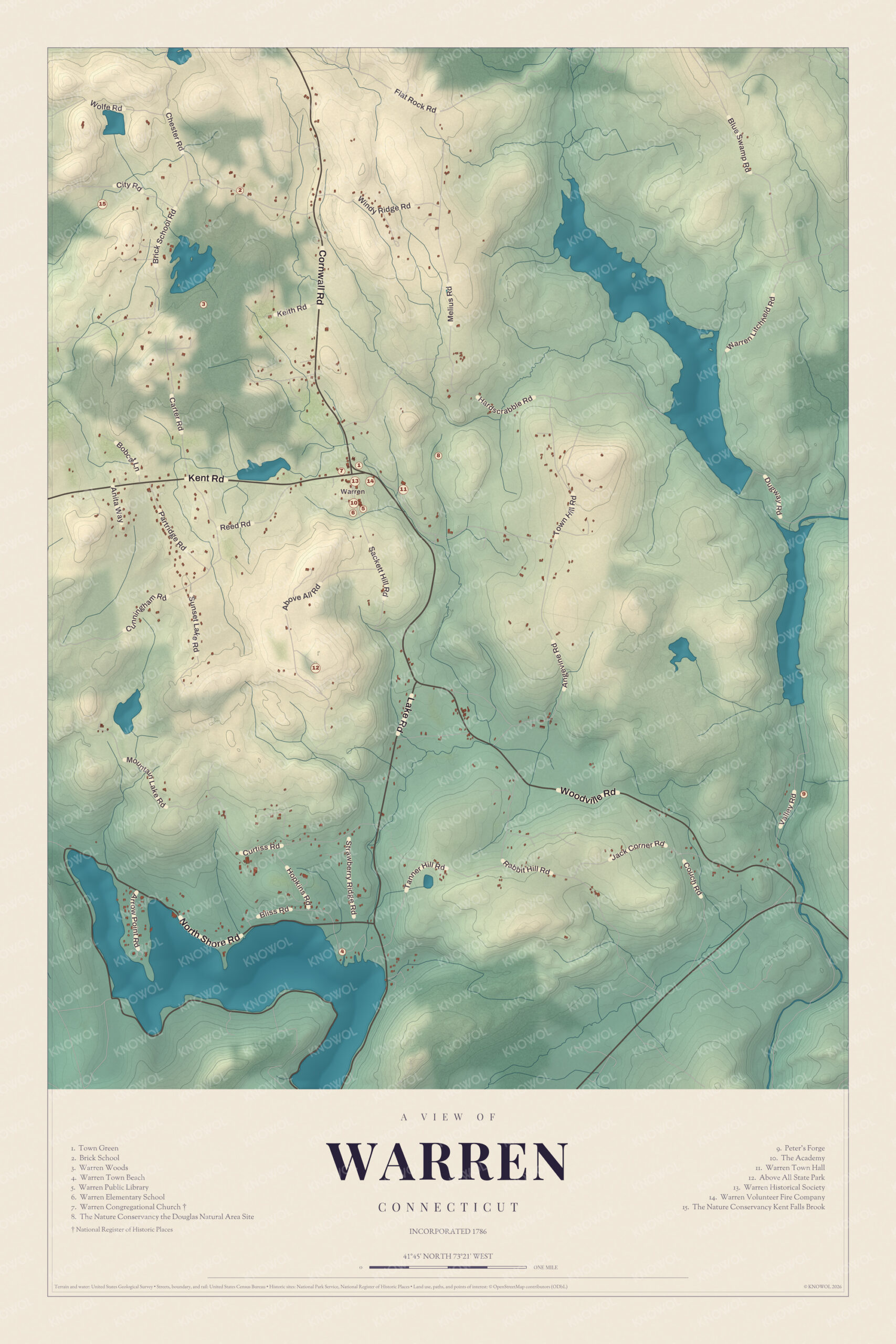
Click the map to look closer.
Warren today
By KNOWOL
Shaded hills with the peak at Above All, every road from Kent Road to Rabbit Hill Road, the town green and church in the middle, and a guide of 15 numbered landmarks with the National Register site marked.6
The story of Warren
Our two deacons
Warren's first meetinghouse went up in 1769, and it was plain: a high pulpit, doors on three sides, no steeple, no chimney and no paint. Inside, people sat face to face in the pews. Rev. Peter Starr preached there from 1772 until he died in 1829, more than fifty-seven years, and still found time for three preaching tours into Vermont. The town liked to tell of a doctor who spent a Sunday here, heard two fine sermons, and said Warren had an abundance of clergy. Those, he was told, were the two deacons. Julian Sturtevant, who grew up here, remembered that when someone fell seriously ill, Sunday service didn't end until nurses were found for every night of the week.73
The mail by buckboard
In 1899 a writer named William White Leete watched a woman drive an open buckboard along the edge of Lake Waramaug every day. She carried the mail between Warren and New Milford, fourteen miles each way, for seventy-five dollars a year. He wondered what Warren could be, and walked seven miles to see. He found a town named for the hero of Bunker Hill, and learned that a Warren man, Major Eleazer Curtis, had caught General Wooster as he fell at Ridgefield in 1777. Charles Finney was born here, and a neighbor's mother remembered going to the Warren Academy with him. Julian Sturtevant spent his first ten years here before he went west to lead a college in Illinois. Left off the railroad map, Leete wrote, Warren had still played its part in the world.71
Above All and the lake
Above All has been a lookout for a long time. A wooden observation tower stood on the hilltop before the Civil War, and a resort with a 125-foot tower was planned in the 1880s but never built. The heirs of Seymour Strong gave three acres to the state in 1927, and from 1957 to 1968 the hill held a Cold War radar station. Lake Waramaug, 656 acres, takes its name from Chief Waramaug, who wintered in the country around it. Summer people found it early. In 1895 George C. Hopkins of Warren farmed some 450 acres on the north side of the lake and, as his father had, took in summer guests. His two houses were being enlarged to hold about a hundred people.489
Through the years
24 moments from 1737 to today.
- 1737Warren is first settled, as the northern part of Kent.2
- 1750About this year Thomas Carter brings nearly all his large family from Hebron and takes up a large part of what becomes Warren.10
- 1750The people here form their own church society, East Greenwich.11
- 1752Sixteen people of East Greenwich protest a new society next door, saying no families can be spared.12
- 1757Sylvanus Osborn is called as East Greenwich's first pastor.3
- 1767Lorenzo Carter, later the first permanent settler of Cleveland, Ohio, is born in Warren.1
- 1769A plain meetinghouse goes up, with a high pulpit, doors on three sides and no steeple.7
- 1772Rev. Peter Starr is ordained. He'll stay more than fifty-seven years.3
- 1777At the Battle of Ridgefield, General Wooster falls into the arms of a Warren man, Major Eleazer Curtis.7
- 1786Warren is incorporated and named for Joseph Warren, the general killed at Bunker Hill.1
- 1787The Warren Baptist Church is formed on November 15, meeting in private houses.13
- 1791Town meeting gives a doctor leave to inoculate against smallpox.14
- 1792Charles G. Finney, the preacher and later president of Oberlin College, is born in Warren.1
- 1805Julian M. Sturtevant, a future college president in Illinois, is born and spends his first ten years here.7
- 1810Warren has five private schools and an academy.2
- 1818Work begins on the church that still stands on the green. It's finished in 1820.11
- 1865Deacon William Hopkins dies at 97.7
- 1891Lightning damages the church steeple.6
- 1895George C. Hopkins enlarges his two houses on the north side of Lake Waramaug to hold about a hundred summer guests.9
- 1899A woman carries the mail by buckboard from Warren to New Milford, fourteen miles each way, for $75 a year.7
- 1927The heirs of Seymour Strong give three acres on Above All to the state.4
- 1957A Cold War radar station opens on Above All. It runs until 1968.4
- 1959The church spire is restored to its original design.6
- 1991Warren Congregational Church is listed on the National Register.5
Places to see
The numbers match the landmark guide printed on the 2026 map.
- 1Town GreenCenter of town. The heart of Warren village.
- 2Brick SchoolBrick School Road. Up in the north of town.
- 4Warren Town BeachSouth of town. The town's swimming spot.
- 5Warren Public LibraryNear the green. A short walk from the church.Visit their website
- 7Warren Congregational ChurchTown Green. Federal church begun in 1818.Visit their website
- 9Peter's ForgeSoutheast of town. Down in the southeast corner.
- 10The AcademyNear the green. A short walk from the church.
- 11Warren Town HallAcross from the church. The seat of town government.
- 12Above All State ParkSouthwest of the center. Old lookout and Cold War radar site.
- 15Kent Falls BrookNortheast of the center. A Nature Conservancy preserve.
On the National Register
All 1 places in Warren on the National Register of Historic Places that still stand today, oldest first, and why each one matters.5
-
Warren Congregational Church
Begun in 1818 and finished in 1820 to replace the meetinghouse of 1769, it's a well-preserved Federal church in the style of Asher Benjamin's pattern books. Its pulpit is one of only three Federal-period pulpits documented in Connecticut.11
In their words
“Many a city could be proud to have its name and history.”
William White Leete, The Connecticut magazine, 1899, after reading Warren's records7
“Left off from the map of the railroads, it has yet played its part in the life of the world.”
William White Leete, The Connecticut magazine, 18997
“When serious illness came to any home, the benediction would not be pronounced on Sunday till nurses were supplied for each night in the week.”
The Connecticut magazine, 1899, retelling Julian Sturtevant's memories of his Warren boyhood7
Nearby towns
Sources
- Warren, Connecticut, Wikipedia
- Warren, ConnecticutHistory.org
- The clergy of Litchfield County (1909), Internet Archive
- Above All State Park, Wikipedia
- National Register of Historic Places listings in Litchfield County, Connecticut, Wikipedia
- Map of Warren, Connecticut in 2026, KNOWOL (USGS elevation, Census Bureau roads)
- The Connecticut magazine (1899), "Away from the railroad in Connecticut" by William White Leete, Internet Archive
- Lake Waramaug, Wikipedia
- Evening post annual: biographical sketches of the General Assembly of Connecticut (1895), on George C. Hopkins, Internet Archive
- Encyclopedia of Connecticut biography (1917), on Thomas Carter, Internet Archive
- Warren Congregational Church, Wikipedia
- History of ancient Woodbury, Connecticut (1854), Internet Archive
- Historical records of the town of Cornwall, Litchfield County, Connecticut (1904), Internet Archive
- Proceedings of the Connecticut Medical Society (1892), extracts from the town records of Warren, Internet Archive