
A hill town in the old Green Woods whose village of Winsted grew up where Highland Lake spills down into the Mad River, and where those falls once turned scythes, wire, clocks and hosiery out of mills packed along the stream.
Winchester on the map
Click the map to look closer.
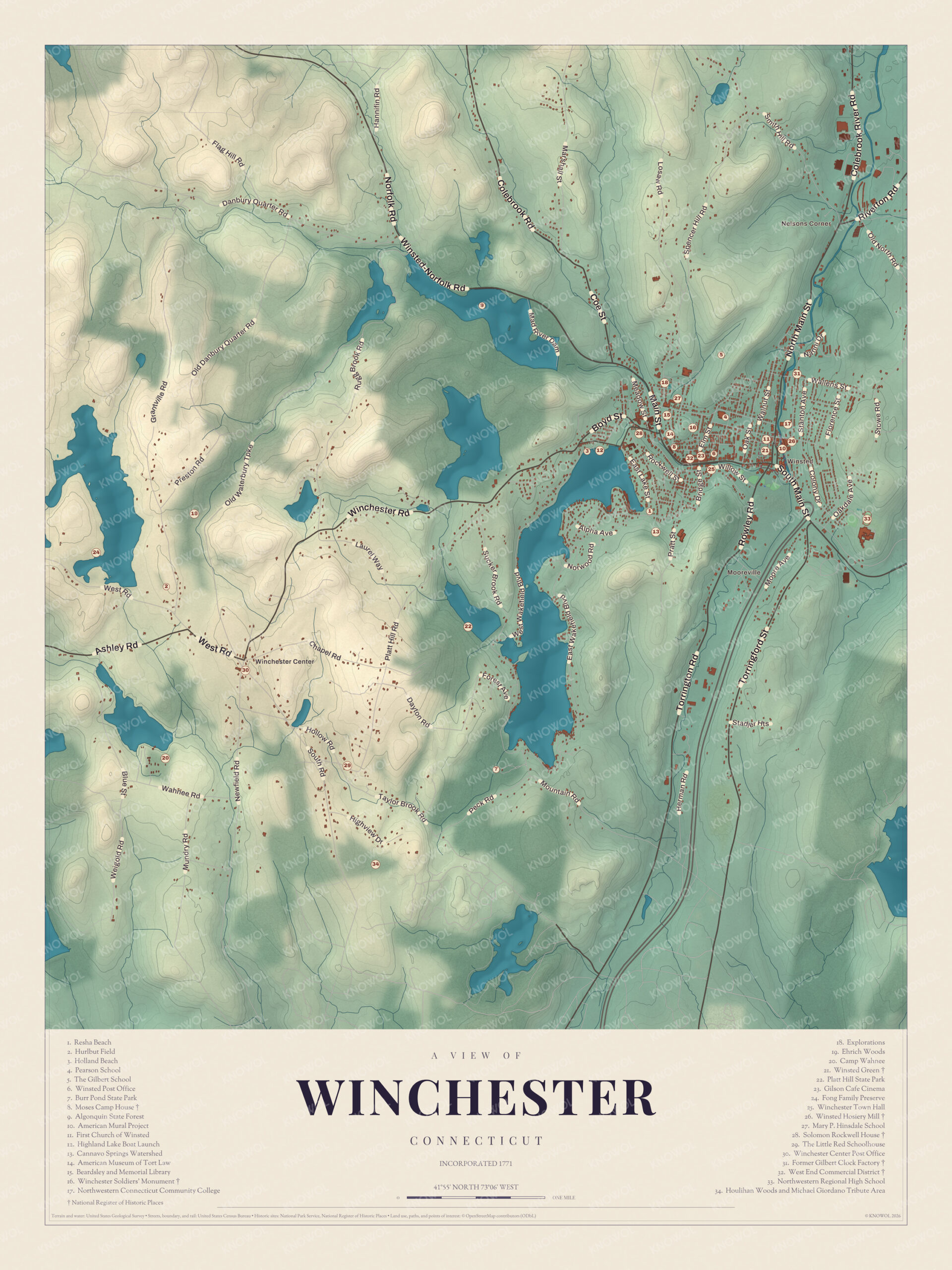
Winchester today
By KNOWOL
Shaded hills from downtown Winsted out toward Nelsons Corner, every street down to Boyd Street, Winsted, Winchester Center and Highland Lake, and a guide of 34 numbered landmarks with the National Register sites marked.2
The story of Winchester
Clocks, wire and a secret bell
In 1803 the brothers Samuel and Luther Hoadley came to Winsted and bought the old Doolittle corn mill site on the Still River. They put up a sawmill and a grist mill, and built the town a wooden bridge over the chasm. About 1807, with their brother-in-law Riley Whiting, they began making wooden clocks in a little factory at the end of that bridge. Around 1810 they started casting clock bells by a secret process, in a separate building where outsiders weren't allowed. In 1812 they and James Boyd built a wire factory at the clock factory dam, which the family history counts among the first in the country to draw iron wire from the rod, down to the width of a hair.5
Settling the Green Woods
Early travelers called this country the Green Woods, a forest of hemlock so thick it nearly shut out the sun. Hartford's proprietors owned the land from 1732 but didn't divide it until 1758, by lottery, and not one of them ever moved here. Caleb Beach came first, about 1750, and built his shanty on Hall Meadow thinking he was in Goshen. Adam Mott kept an inn of logs roofed with hemlock bark for passing hunters. When the town was organized in 1771 it had 32 families. That same year David Austin cut a cart path to the outlet of Long Pond, now Highland Lake, built a grist mill where the water falls toward the Mad River, and became known as the Founder of Winsted.678
A dam every twenty rods
Highland Lake sits about 150 feet above downtown Winsted, and its outlet tumbles down a narrow ravine into the Mad River. That drop built the town. In 1884 there was a dam about every twenty rods along the Mad River through the borough, and Winsted was the largest place in Litchfield County. The Beardsley works on Lake Street made 14,000 dozen scythes and knives a year, the Henry Spring Company shipped carriage springs abroad, and William L. Gilbert's clock shops grew to more than 500 workers. In 1893 the borough built new dams, a canal and a tunnel aqueduct to keep both its faucets and its mills supplied. The Gilbert mills are apartments now, and the hosiery mill holds artists' studios.9310111213
Through the years
24 moments from 1732 to today.
- 1732Hartford becomes owner of the western lands that include Winchester, valued at ten shillings an acre.7
- 1750Caleb Beach buys a right in Winchester and builds a shanty on Hall Meadow, thinking he's in Goshen.7
- 1758The proprietors divide the town's land by lottery.7
- 1771Winchester is incorporated on May 21, with just 32 families on its two roads.18
- 1771David Austin builds a grist mill at the outlet of Long Pond, and the 1904 history calls him the Founder of Winsted.7
- 1774The colonial census counts 339 people in Winchester.8
- 1792The Winsted Manufacturing Company starts making scythes.14
- 1798The Higley Tavern goes up, the first frame house on what becomes Winsted's Main Street.7
- 1799The long, narrow Winsted green is laid out above the Still River.15
- 1807About this year the Hoadley brothers and Riley Whiting start making wooden clocks by the Still River bridge.5
- 1812The Hoadleys and James Boyd build a wire factory, and Merritt Bull starts the scythe works later run by the Beardsleys.53
- 1813Solomon Rockwell builds his house with its two-story temple portico.16
- 1836John Warner Barber counts four scythe factories and five forges in the west village of Clifton.6
- 1840William L. Gilbert moves to Winchester and starts making low-cost clocks.11
- 1849The railroad reaches Winsted.17
- 1857The Hurlbut Bank opens, and its five-dollar notes carry a picture of Lemuel Hurlbut's Devon bull.18
- 1858Winsted becomes a borough within the town of Winchester.17
- 1872John G. Wetmore builds the Winsted Opera House, with seats for 1,200.19
- 1882Gilbert founds the Winsted Hosiery Company.13
- 1890The 44-foot granite Soldiers' Monument is finished at the end of Crown Street.20
- 1893Work begins on new dams, a canal and a tunnel aqueduct for Winsted's water, finished with Crystal Lake dam in 1895.12
- 1895The Gilbert School opens.2
- 1955Two hurricanes a week apart flood the Mad River and Still River through downtown.14
- 2015Ralph Nader opens the American Museum of Tort Law in the old Winsted Savings Bank.14
Places to see
The numbers match the landmark guide printed on the 2026 map.
- 5The Gilbert SchoolWilliams Avenue. Endowed town academy, opened 1895.Visit their website
- 8Moses Camp House682 Main Street. Greek Revival merchant's house of about 1840.
- 10American Mural ProjectHolabird Avenue. A five-story mural honoring American workers.Visit their website
- 14American Museum of Tort Law654 Main Street. Ralph Nader's museum in the old bank.Visit their website
- 16Winchester Soldiers' MonumentEnd of Crown Street. Granite Civil War tower, 44 feet tall.
- 21Winsted GreenEast Winsted. Laid out in 1799.
- 22Platt Hill State ParkToward Winchester Center. 159 acres of trails and views.
- 26Winsted Hosiery MillHolabird Avenue. Now Whiting Mills, artists' studios.
- 28Solomon Rockwell HouseLake and Prospect Streets. The historical society's museum since the 1920s.
- 31Former Gilbert Clock FactoryNorth Winsted, near Route 8. Clock mills of the 1870s, now apartments.
On the National Register
All 8 places in Winchester on the National Register of Historic Places that still stand today, oldest first, and why each one matters.4
-
Winsted Green Historic District
The long green was laid out in 1799 above the Still River after the turnpike that is now Main Street opened. The district holds 77 historic buildings on 28 acres, from houses of the 1810s to the Romanesque First Congregational church of 1903.15
-
Solomon Rockwell House
Built for Solomon Rockwell, who owned two iron forges in town, to a design by the early Connecticut architect William Swift, with a two-story Greek Revival temple portico. The Winchester Historical Society has kept it as a museum since the 1920s.16
-
Moses Camp House
A fine Greek Revival house probably built for Moses Camp, whose family firm was one of the largest merchant businesses in Litchfield County. The Camps also built the Camp Block, Winsted's first brick commercial building.21
-
Gilbert Clock Factory
William L. Gilbert's clock company grew to four large buildings and more than 500 workers and ran until 1964. The two four-story brick mills north of Wallens Street survive as apartments; the buildings south of the street burned in 1975.11
-
Winchester Soldiers' Monument
A 44-foot granite tower honoring Winchester's Civil War soldiers, designed by Robert Hill of Waterbury, with a bronze soldier holding the colors by George Bissell. It's one of Connecticut's most elaborate memorials to that war.20
-
Winsted Water Works
Stone dams, dikes, a canal, a tunnel aqueduct and the Rugg Brook and Crystal Lake reservoirs, built 1893 to 1895 to supply both the borough and its mills. Its tunnel aqueduct was the first of its kind in Connecticut.12
-
West End Historic District
Eight brick commercial buildings, the largest group of late 1800s and early 1900s business blocks in Winsted to survive the 1955 flood and the widening of Main Street. The biggest is the Winchester Hotel of 1898.17
-
Winsted Hosiery Mill
The Winsted Hosiery Company, founded by William L. Gilbert in 1882, rebuilt here after its first mill burned in 1900 and was long one of the town's largest employers. It's now Whiting Mills, with studios and the American Mural Project.13
In their words
“Winsted, whose name is derived from the Alpha of Winchester and the Omega of Barkhamsted”
The Connecticut Magazine, 19047
“These "Green Woods" present one of the most impressive scenes which can be found in an American forest.”
John Warner Barber, Connecticut Historical Collections, 18366
“For a place the size of Winsted its manufactured products are numerous in kind.”
The historical, statistical and industrial review of the state of Connecticut, 18849
Nearby towns
Sources
- Winchester, Connecticut, Wikipedia
- Map of Winchester, Connecticut in 2026, KNOWOL (USGS elevation, Census Bureau roads)
- The historical, statistical and industrial review of the state of Connecticut (1884), on the Beardsley Scythe Company, Internet Archive
- National Register of Historic Places listings in Litchfield County, Connecticut, Wikipedia
- The Hoadley genealogy (1894), on Samuel and Luther Hoadley in Winsted, Internet Archive
- Connecticut Historical Collections, by John Warner Barber (1836), on Winchester, Internet Archive
- Winsted, the development of an ideal town, The Connecticut Magazine (1904), Internet Archive
- Chapter sketches, Connecticut Daughters of the American Revolution (1901), on Winchester, Internet Archive
- The historical, statistical and industrial review of the state of Connecticut (1884), on Winchester and Winsted, Internet Archive
- The historical, statistical and industrial review of the state of Connecticut (1884), on the Henry Spring Company, Internet Archive
- Gilbert Clock Factory, Wikipedia
- Winsted Water Works, National Register nomination, Connecticut State Historic Preservation Office
- Winsted Hosiery Mill, Wikipedia
- Winsted, Connecticut, Wikipedia
- Winsted Green Historic District, Wikipedia
- Solomon Rockwell House, Wikipedia
- West End Commercial District (Winsted, Connecticut), Wikipedia
- The Connecticut Magazine (1904), on the Hurlbut Bank, Internet Archive
- Representative men of Connecticut, 1861-1894 (1894), on John G. Wetmore, Internet Archive
- Winchester Soldiers' Monument, Wikipedia
- Moses Camp House, Wikipedia