
A hill town northwest of New Haven that began as the parish of Amity, where the regicide judges hid in 1661, the friction match had its start, and old doctors sent sick babies up for the air.
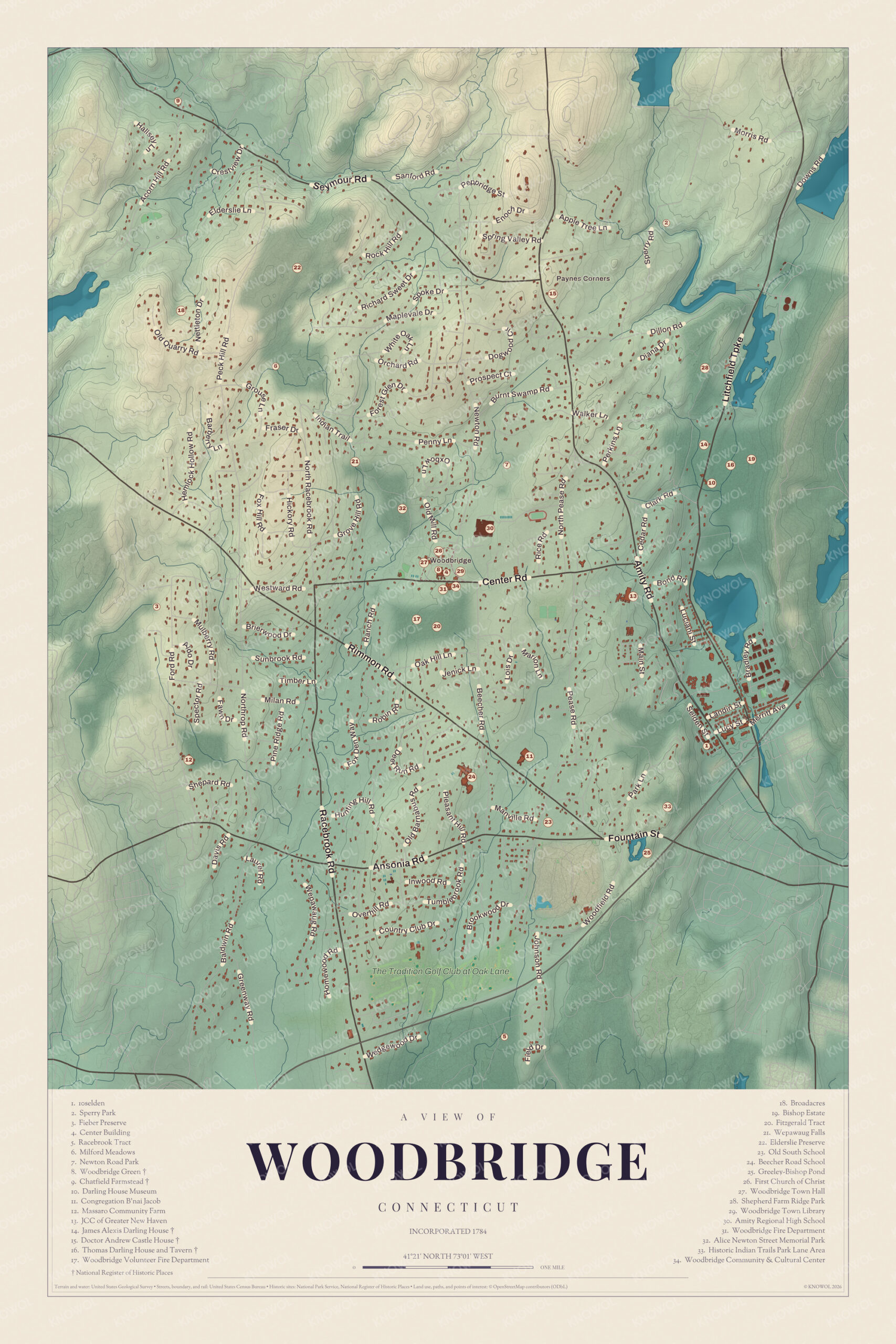
Woodbridge on the map
Click the map to look closer.
Woodbridge today
By KNOWOL
Shaded hills from the town green up to Paynes Corners, every street and the town line, and a guide of 34 numbered landmarks with the National Register sites marked.5
The story of Woodbridge
Take them up to Woodbridge
In 1892 the town's minister, Rev. S. P. Marvin, wrote the Woodbridge chapter of the county history, and he wrote it like a man who loved the place. From its hills, he said, you could see more than fifty miles of Long Island Sound, and Yale's President Woolsey, taking in the view, said New Haven had nothing to equal it. Old New Haven doctors told parents of sick babies to take them up to Woodbridge, because the air was better than any medicine. The spring water was so cold that ice was hardly needed. Farmers here sent milk to New Haven, Ansonia, Birmingham and Seymour, and the town was once famous for its beef, until the big Chicago and Kansas City packers made raising beef cattle pay less.26
Hatchet Harbor
In the summer of 1661 two of the judges who had signed the death warrant of King Charles I, Goffe and Whalley, were hiding in the woods northwest of New Haven. John Warner Barber wrote in 1836 that they had several hiding places inside Woodbridge. The best known was the Lodge, a stone cabin about ten feet long built against a ledge of rock some twenty feet high, with a spring a few rods off. Tradition says that at another spring one of them wished to God they had a hatchet, then found one, likely left by hunters, and cut boughs for a shelter. The spot has been called Hatchet Harbor ever since. Richard Sperry, the first settler in town, brought them food. In August they moved on to Milford.78910
The parish that named itself for its minister
Before 1738 the farmers here went to church in New Haven or Milford, some of them ten or twelve miles each Sabbath. That October the new parish of Amity voted to build its own meetinghouse, fifty-five feet by forty. There were no stoves, so families built little Sabba-day houses with fireplaces along the green to warm up at noon. Years later, when some were being rented to tramps, men tore them down in one Saturday night and chalked "Be ye also ready" on the last one. Amity's first minister, Benjamin Woodbridge, served more than forty years. He was suspected of being a Tory but took the oath once independence was won, and in 1784 the new town took his name. He thanked it with a book of Bible commentary.1112137
Through the years
24 moments from 1661 to today.
- 1661The regicide judges Goffe and Whalley hide at the Lodge and Hatchet Harbor, then leave for Milford in August.7
- 1661Richard Sperry, the first settler, brings food to the hiding judges.9
- 1738The parish of Amity holds its first meeting and votes to build a meetinghouse fifty-five feet by forty.11
- 1739Amity becomes a parish, carved from land of New Haven and Milford.1
- 1742Rev. Benjamin Woodbridge is installed as Amity's first minister.11
- 1762The north part of the parish is set off as the parish of Bethany.12
- 1774Thomas Darling takes possession of his new house in Amity Parish.14
- 1779Captain Stephen Sanford dies, leaving most of his estate, 930 pounds, to support the ministry.15
- 1784Amity and Bethany become the town of Woodbridge, named for their minister, and hold the first town meeting on February 17.16
- 1785Rev. Benjamin Woodbridge dies after more than forty years as pastor.13
- 1787The town meets in its new town house, built the size of Milford's for seventy pounds.3
- 1798The Straits Turnpike Company lays its highway partly over the town roads.3
- 1832Bethany becomes its own town, and the First Congregational Church goes up at today's green.17
- 1835Samuel Beecher and Thomas Sanford invent the sulfur match in Woodbridge.1
- 1838Dr. Andrew Castle buys the land on Amity Road where his Greek Revival house soon stands.18
- 1842The James Alexis Darling House is built for Thomas Darling's grandson.19
- 1862Captain David Lines of Woodbridge, who crossed the Atlantic nearly 240 times, dies at Niagara.20
- 1874The New England Cement Company's stone kiln is built near Litchfield Turnpike.21
- 1880About this year the Chatfield farmhouse is built for Henry Chatfield.22
- 1890Woodbridge has 926 people and no railroad within its bounds.3
- 1950Architectural historian Vincent Scully designs and builds his modern house on Orchard Road.23
- 1961Congregation B'nai Jacob moves from New Haven into its new synagogue on Rimmon Road.5
- 1973The Darling family's house passes to the town, furniture and account books and all.14
- 2003The Woodbridge Green Historic District is listed on the National Register.17
Places to see
The numbers match the landmark guide printed on the 2026 map.
- 8Woodbridge GreenTown center. The civic center around the church.
- 9Chatfield FarmsteadSeymour Road and Bear Hill Road. Farm of about 1880, now Bladen Valley Farm.
- 10Darling House MuseumLitchfield Turnpike. Thomas Darling's house of 1774.Visit their website
- 11Congregation B'nai JacobRimmon Road. Synagogue with walls of stained glass.
- 14James Alexis Darling HouseLitchfield Turnpike. Greek Revival farmhouse of 1842.
- 15Doctor Andrew Castle HouseAmity Road. Greek Revival home of three doctors.
- 21Wepawaug FallsWest of the green. 22 acres near the river's source.
- 26First Church of ChristWoodbridge Green. Greek Revival meetinghouse of 1832.
- 27Woodbridge Town HallWoodbridge Green. West of the church.
- 32Alice Newton Street Memorial ParkWest of the green. 93 acres of trails.
On the National Register
All 7 places in Woodbridge on the National Register of Historic Places that still stand today, oldest first, and why each one matters.4
-
Thomas Darling House and Tavern
Thomas Darling hired Abiel Gray of West Hartford to build this gambrel-roofed house, finished in 1774, with richly detailed paneling and imported Bible-scene tiles over one fireplace. The Darlings owned it until 1973, and it's now the Darling House Museum of the Amity and Woodbridge Historical Society.14
-
Woodbridge Green Historic District
The town center grew up around the Greek Revival First Congregational Church of 1832. Most of the buildings around the green, the town hall, library, old school and fire station, went up between the world wars in the Colonial Revival style, a good example of early 1900s town planning.17
-
Dr. Andrew Castle House
A high-style Greek Revival house probably built soon after Dr. Andrew Castle bought the land in 1838, credited to the local master builder George Sperry. Three doctors have owned it.18
-
James Alexis Darling House
A rural Greek Revival farmhouse built for Thomas Darling's grandson, who moved to Woodbridge to run his grandfather's farm. It has up-to-date styling outside but is framed the old 18th-century way.19
-
New England Cement Company Kiln and Quarry
An industrial archaeological site with a stone cement kiln of 1874 and a hand-dug limestone quarry, on a ridge along Litchfield Turnpike. The business failed, partly because hauling cement to New Haven ate up the profits.21
-
Chatfield Farmstead
A Gothic Revival farmhouse built for Henry Chatfield and a three-level bank barn, still large for the area though only a third of its biggest size. It's run today as Bladen Valley Farm.22
-
Vincent J. and Susannah K. Scully House
A mid-century modern box house designed and built by the Yale architectural historian Vincent Scully and his wife, the only surviving house where Scully himself was the designer. Its open plan reached even into the bedrooms.23
In their words
“Take them up to Woodbridge. The Woodbridge air is better than any medicine I can give them.”
Old New Haven doctors, as remembered in the History of New Haven County, 18922
“We have no view in the vicinity of New Haven to equal this.”
Yale's President Woolsey on the Woodbridge hills, in the History of New Haven County, 18922
“It is evident that to Woodbridge and its inhabitants, as much as to any other place or people, the regicides owed their escape”
History of New Haven County, 18928
Nearby towns
Sources
- Woodbridge, Connecticut, Wikipedia
- History of New Haven County, Connecticut (1892), on the hills, air and water of Woodbridge, Internet Archive
- History of New Haven County, Connecticut (1892), on the town house and roads, Internet Archive
- National Register of Historic Places listings in New Haven County, Connecticut, Wikipedia
- Map of Woodbridge, Connecticut in 2026, KNOWOL (USGS elevation, Census Bureau roads)
- History of New Haven County, Connecticut (1892), on Woodbridge farming, Internet Archive
- Connecticut Historical Collections, John Warner Barber (1836), on Woodbridge, Internet Archive
- History of New Haven County, Connecticut (1892), on the regicides' Lodge, Internet Archive
- The British invasion of New Haven, Connecticut (1879), on Richard Sperry, Internet Archive
- History of New Haven County, Connecticut (1892), on Richard and Enoch Sperry, Internet Archive
- History of New Haven County, Connecticut (1892), on the Ecclesiastical Society of Amity, Internet Archive
- History of New Haven County, Connecticut (1892), on the Sabba-day houses, Internet Archive
- History of New Haven County, Connecticut (1892), on Rev. Benjamin Woodbridge, Internet Archive
- Darling House Museum, Wikipedia
- History of New Haven County, Connecticut (1892), on Captain Stephen Sanford, Internet Archive
- History of New Haven County, Connecticut (1892), on the naming of the town, Internet Archive
- Woodbridge Green Historic District, Wikipedia
- Dr. Andrew Castle House, Wikipedia
- James Alexis Darling House, Wikipedia
- History of New Haven County, Connecticut (1892), on Captain David Lines, Internet Archive
- New England Cement Company Kiln and Quarry, Wikipedia
- Chatfield Farmstead, Wikipedia
- Vincent J. and Susannah K. Scully House, Connecticut Creative Places (from the 2025 National Register nomination)