
An inland South Shore town where meeting-house bells and Revolutionary cannon were cast, where tack machines and shoe shops shod nearly half the Union Army, and where crowds gathered under the pines at Island Grove to hear the case against slavery.
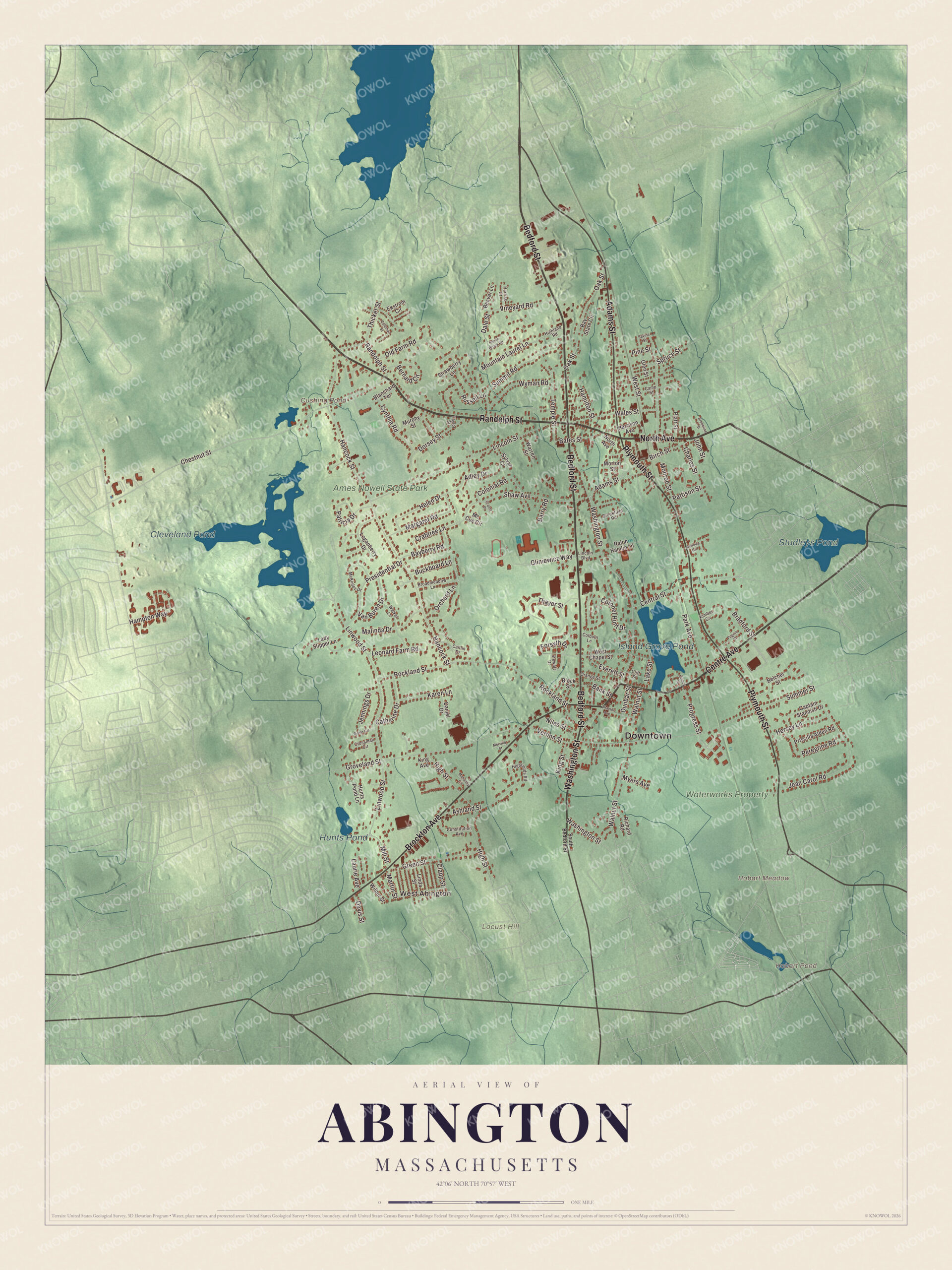
Abington on the map
Click the map to look closer.
Abington today
By KNOWOL
Shaded terrain around Locust Hill and Hobart Meadow, every street from Washington Street to Randolph Street, Ames Nowell State Park around Cleveland Pond, and Island Grove in the southeast.5
The story of Abington
Bells, cannon and tacks
Long before the shoe shops, old Abington worked iron. About 1769 a British Army deserter named Gallimore, a bell founder by trade, came to town and cast meeting-house bells for Col. Aaron Hobart, and an 1887 history claims they were the first made in the country. When the Revolution began, Hobart turned to cannon and cannon balls. He lost heavily at first by molding in sand instead of clay, then got it right. Ezekiel Reed built a machine that raised one man's day from a thousand nails to eight thousand, and his son Jesse improved on it. By 1837 the town made 1,832 million tacks and brads in a single year, and over half a million pairs of shoes.6781
Under the pines at Island Grove
Island Grove Pond was made around 1700 by damming the Shumatuscacant River, and the peninsula of tall white pines reaching into it became one of the best-loved gathering places in Massachusetts. After the Old Colony line opened in 1845, special trains brought crowds from Boston and Plymouth. From 1846 to 1865, William Lloyd Garrison, Sojourner Truth, Frances Ellen Watkins Harper, William Wells Brown and many others spoke here against slavery, some of them people who had escaped it. The town held its 150th birthday in the grove in 1862, and the last meeting, in July 1865, welcomed its soldiers home. A boulder set in 1909 marks where the speakers stood.391011
Blackbirds, bonnets and a gale
Abington's old town meetings voted on more than roads. In 1716 every man sixteen and older was told to kill twelve blackbirds or pay two shillings more than his share of town costs. In 1775 the meeting declared it improper for women to sit through worship in their hats and bonnets. Storms in October 1804 and September 1815 blew down thousands of fruit and forest trees and unroofed scores of barns and houses. Much of this was saved by Benjamin Hobart, who wrote most of his 450-page town history after he turned eighty. He also helped fix the railroad's route through town, and once lost an election to the legislature by a single vote.121314
Through the years
24 moments from 1668 to today.
- 1668English settlement begins, with Andrew Ford of Weymouth the first settler of record.5
- 1706Governor Joseph Dudley names the town for the Countess of Abingdon.1
- 1711Rev. Samuel Brown comes to preach in Abington on December 8.15
- 1712Abington is incorporated on June 10, with fewer than 300 people.2
- 1714Brown is ordained, and the First Church is probably organized with eight founding men.15
- 1716Town meeting votes that every man sixteen and older must kill 12 blackbirds or pay a fine.12
- 1769A bell founder named Gallimore, a British Army deserter, casts meeting-house bells for Col. Aaron Hobart.6
- 1775Town meeting declares it improper for women to wear hats and bonnets in worship.12
- 1775About this time Col. Hobart begins casting cannon and cannon balls for the Revolution.6
- 1804A destructive storm in October blows down trees and unroofs barns and houses. Another strikes in September 1815.12
- 1815Jesse Reed invents a machine that mass-produces tacks.1
- 1837The town turns out 1,832 million tacks and brads and more than half a million pairs of shoes in a year.8
- 1845The Old Colony Railroad opens through North Abington in November.3
- 1846William Lloyd Garrison leads the first open-air anti-slavery meeting at Island Grove on August 1.3
- 1858Abington shoemaker Lyman R. Blake patents a machine to sew soles to uppers.16
- 1862The town celebrates its 150th birthday at Island Grove on June 10.10
- 1865The last Island Grove meeting, on July 27, welcomes Abington's soldiers home.3
- 1866Benjamin Hobart publishes his town history, most of it written after he turned eighty.13
- 1874East Abington becomes the town of Rockland, and South Abington follows as Whitman in 1875.1
- 1893After the North Abington riot over a streetcar crossing, the railroad builds the granite depot.17
- 1909Captain Moses N. Arnold's boulder marking the abolitionists' speaking place is dedicated on Memorial Day.3
- 1926Abington counts 5,960 acres, 1,343 dwellings and 2,341 voters.18
- 2002Island Grove Park is listed on the National Register of Historic Places.3
- 2012Abington marks the 300th anniversary of its incorporation on June 10.5
Places to see
Places worth a visit in Abington today.
- Island Grove ParkSoutheast Abington. Abolitionist meeting ground, 1846 to 1865.
- Island Grove PondSoutheast Abington. Dammed from the Shumatuscacant River.
- Ames Nowell State ParkNorthwest corner. 612 acres around Cleveland Pond.
- Cleveland PondAmes Nowell State Park. Man-made pond for boating and fishing.
- North Abington DepotNorth Abington. The railroad's 1893 peace offering.
- Dyer Memorial LibraryAbington. Keeper of the town's history.Visit their website
- Beaver BrookEastern Abington. Water power for the shoe factories.
- Shumatuscacant RiverWestern border. The town line with Brockton.
- Washington StreetAcross town. Once the native Satucket Path.
- Locust HillAbington. Shaded high ground on the map.
On the National Register
All 2 places in Abington on the National Register of Historic Places that still stand today, oldest first, and why each one matters.4
-
Island Grove Park National Register District
A 17-acre peninsula in a pond made about 1700 by damming the Shumatuscacant River. From 1846 to 1865 it was a center of anti-slavery meetings, where Garrison, Sojourner Truth, Frances Ellen Watkins Harper and many others spoke, and a 1909 boulder marks the speakers' place.3
-
North Abington Depot
A granite and brownstone station in the Richardsonian Romanesque style, designed by Bradford Lee Gilbert. The New Haven railroad built it right after the North Abington Riot over the town's right to run a streetcar line across its tracks.17
In their words
“Beneath the lordly white pine trees which form Island Grove in Abington the abolitionists were wont to gather in the days previous to the Civil War.”
History of Plymouth, Norfolk and Barnstable counties, 19289
“the name of Abington is bound to lead all the rest in any list of towns of Plymouth County or Massachusetts, if the alphabet is to determine the line of succession.”
History of Plymouth, Norfolk and Barnstable counties, 1928, under the heading "Abington Shod Half an Army"18
“is it strange, that once or twice in a century we come together to honor the memory of our fathers”
Levi Reed, opening the town's 150th anniversary, 186219
Nearby towns
Sources
- Abington, Massachusetts, Wikipedia
- Official program of the commemorative exercises of the two hundredth anniversary of the incorporation of the town of Abington (1912), Internet Archive
- Island Grove Park, Wikipedia
- National Register of Historic Places listings in Plymouth County, Massachusetts, Wikipedia
- Map of Abington, Massachusetts in 2026, KNOWOL (USGS elevation, Census Bureau roads)
- An historical sketch of Abington, Plymouth County, Massachusetts (1839), on bells and cannon, Internet Archive
- Ancient landmarks of Plymouth (1887), Internet Archive
- An historical sketch of Abington, Plymouth County, Massachusetts (1839), on tacks and shoes, Internet Archive
- History of Plymouth, Norfolk and Barnstable counties, Massachusetts (1928), on Island Grove, Internet Archive
- History of the town of Abington, Plymouth County, Massachusetts (1866), on the 1862 celebration, Internet Archive
- Official program of the commemorative exercises of the two hundredth anniversary of the incorporation of the town of Abington (1912), on the Island Grove boulder, Internet Archive
- The Plymouth County directory, and historical register of the Old Colony (1867), on Abington's old town votes, Internet Archive
- History of Plymouth County, Massachusetts (1884), on Benjamin Hobart, Internet Archive
- History of the town of Abington, Plymouth County, Massachusetts, from its first settlement (1866), Internet Archive
- History of Plymouth County, Massachusetts (1884), on the First Church of Abington, Internet Archive
- About us, Dyer Memorial Library
- North Abington station, Wikipedia
- History of Plymouth, Norfolk and Barnstable counties, Massachusetts (1928), on Abington, Internet Archive
- Celebration of the one hundred and fiftieth anniversary of the incorporation of Abington, Massachusetts, June 10, 1862 (1862), Internet Archive