
A lake town in the southwest corner of Norfolk County, once the plantation of Wollomonopoag, where straw bonnets were braided by hand, the French army camped by Lake Archer, and Helen Keller took her walks.
Then and now
The same town 138 years apart. Click either map to look closer.
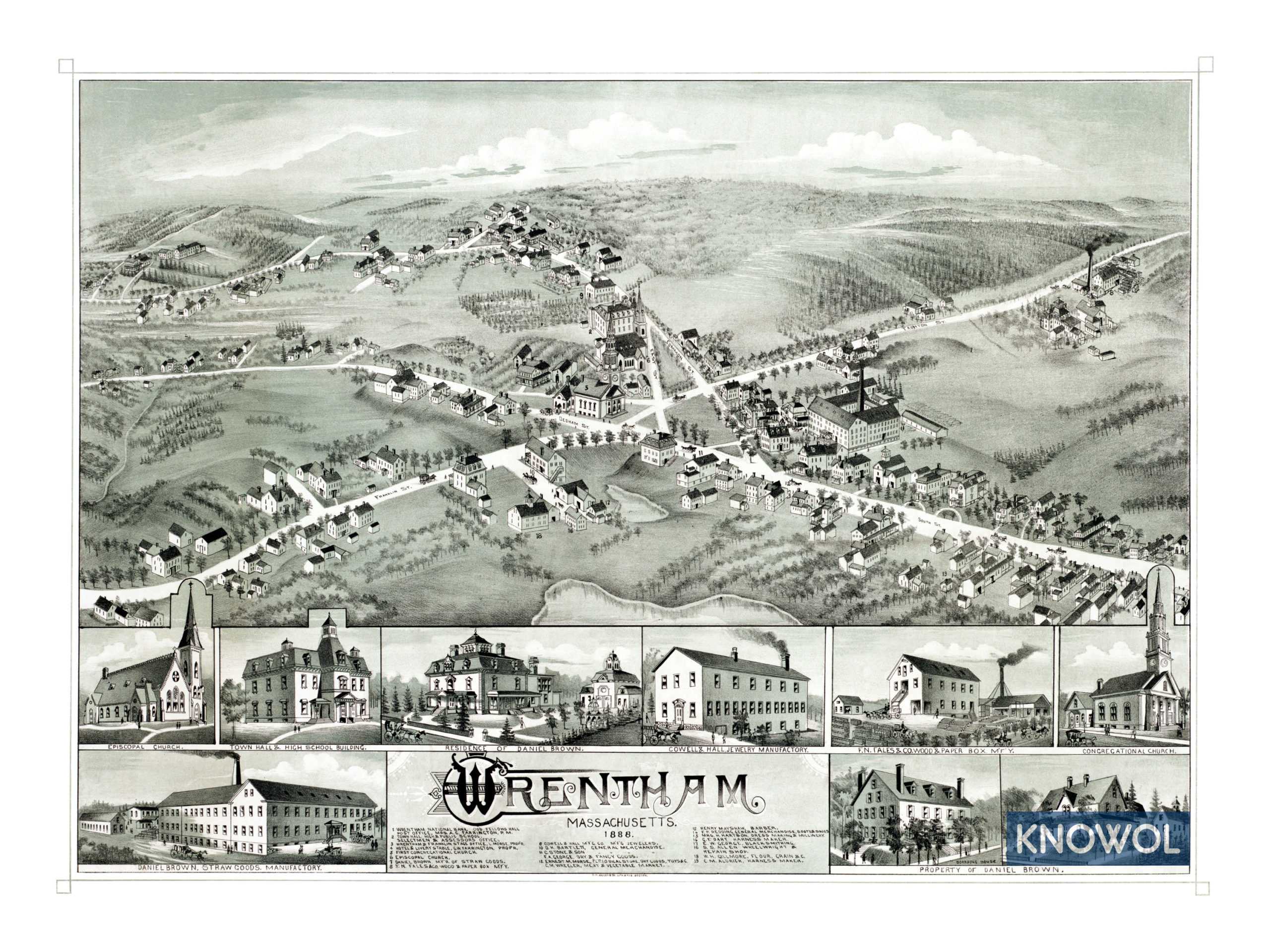
The bird's-eye view
By O.H. Bailey
Wrentham drawn as if from the sky in 1888, with street names and landmarks like Wheeler's Meat and Vegetable Market, Mrs. Hartson's Dress Making, Odd Fellows Hall, the Wrentham Hotel, the Episcopal Church, E.W. George Blacksmithing and Cowell and Hall Jewelry.5
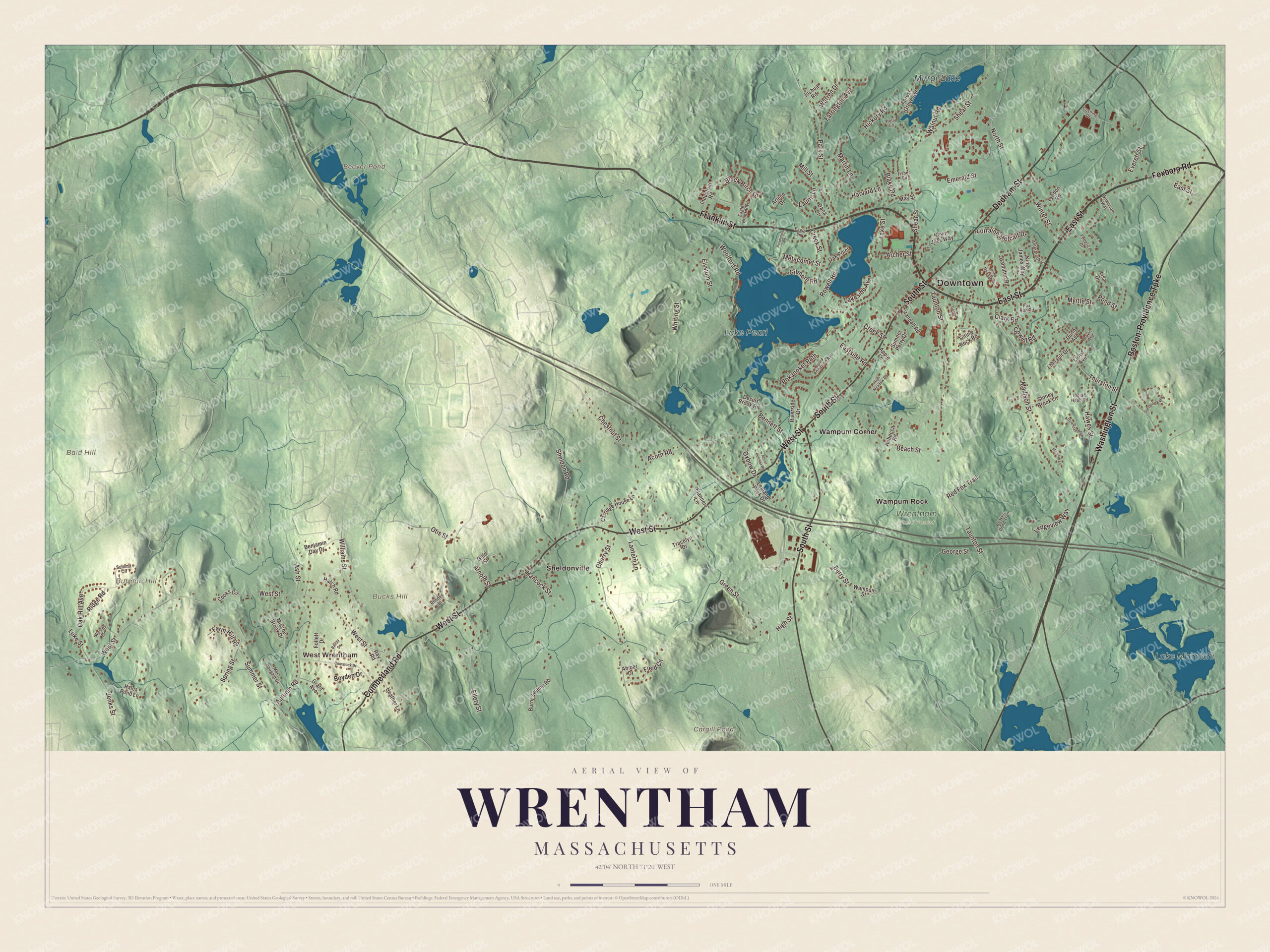
Wrentham today
By KNOWOL
Downtown, West Wrentham, Sheldonville, Wampum Corner and Wampum Rock on shaded terrain, with Lake Pearl, Lake Mirimichi, Beaver Pond and Cargill Pond, and Bald, Bucks and Butman hills.6
The story of Wrentham
Bonnet Hall and the straw shops
Around 1802 Amariah Hall of Wrentham began making straw bonnets, and he did it so well that people called him Bonnet Hall. Women and children braided the straw at home and brought the bonnets to his store, where they traded them for groceries and dry goods. A 1928 county history calls straw the most important of all the town's trades. Later, Daniel Brown, who started out in William E. George's straw hat shop in Wrentham Center, invented a hydraulic press for shaping hats. In 1879, sixty days after he went into business with Hiram A. Cowell, their factory burned, so they moved into the old Day's Academy and kept going. Brown later gave the town Trout Pond.78910
The lakes in the middle of town
Wrentham's two big lakes sit near the middle of town. Lake Archer was once named for King Philip, and late in 1782 the French army that had fought at Yorktown made its fifty-third camp near its shore, on the march to Boston. The state sent Col. Jabez Hatch to meet the army at Wrentham, its first stop in Massachusetts. A century later the lakes turned to pleasure. After 1886 Whiting Pond, by then also called Lake Pearl, grew into a resort, and cottages went up almost all the way around Lake Archer. In 1918 a county history called them two beautiful little bodies of water, frequented by large numbers of pleasure seekers.211121314
Coming back to Wollomonopoag
In 1660 Dedham sent five men to look over the lakes near Wollomonopoag, and by 1671 a handful of families had settled there. Samuel Shears came first, and his daughter Mehitabel was the first English child born in the town. Wrentham became its own town in 1673. During King Philip's War the settlers left, and all but two houses were burned; the old story says those two were spared because people inside had smallpox. In August 1680 the Rev. Samuel Man came back with many of the settlers. In 1692 he gathered a church of ten people and preached his own ordination sermon. Seven years later his house burned in the night, and the church records with it.11516
Through the years
23 moments from 1660 to today.
- 1660Dedham sends five men to explore the lakes near Wollomonopoag.1
- 1671Six men settle at Wollomonopoag, and Samuel Shears's daughter Mehitabel becomes the first English child born there.115
- 1673The General Court sets Wrentham off from Dedham as its own town.1
- 1676The settlers leave during King Philip's War, and all but two houses are burned.15
- 1680The Rev. Samuel Man and many of the settlers come back to Wrentham.16
- 1692A church of ten people is gathered, and Man preaches his own ordination sermon.16
- 1699Man's house burns in the night, and the church records burn with it.1617
- 1707Samuel Sewall rides to Wrentham and lodges at the Ware house.18
- 1782The French army camps near Lake Archer on its march to Boston.211
- 1795David Fisher builds the Roebuck Tavern on the Boston and Providence stage road.19
- 1799Elisha Fisk, the church's forty-ninth candidate, is ordained; he marks fifty years as pastor in 1849.20
- 1802About this year Amariah Hall, later called Bonnet Hall, starts making straw bonnets.7
- 1806Day's Academy is chartered, named for its biggest giver, Benjamin Day.3
- 1823Rhodes Sheldon, a boat builder from Cumberland, Rhode Island, moves to West Wrentham.21
- 1834The congregation builds its Greek Revival church on the town center.17
- 1867A fire takes Mr. Gilmore's livery stable, and neighbors raise nine hundred dollars to keep him in town.22
- 1870North Wrentham becomes the town of Norfolk.1
- 1874About this year the town hall facing the common is finished, ending town meetings in the meetinghouse.23
- 1879Daniel Brown's straw hat factory burns, and the business moves into the old Day's Academy.10
- 1886After this year Whiting Pond, now Lake Pearl, grows into a pleasure resort.13
- 1905Plainville splits off as its own town.1
- 1910The Wrentham State School opens north of the town center.24
- 1915The Civil War soldiers' monument goes up on the common.23
Places to see
Places worth a visit in Wrentham today.
- DowntownWrentham Center. The common and the 1834 church.
- Lake PearlCenter of town. Once Whiting Pond, later a resort lake.
- SheldonvilleWestern leg of town. Orchards and its own ZIP code.
- West WrenthamWestern part of town. Where Rhodes Sheldon built boats from 1823.
- Wampum CornerWrentham. A crossroads village on the map.
- Wampum RockWrentham. Named spot on the map.
- Beaver PondWrentham. One of the town's many ponds.
- Bald HillWrentham. One of the town's named hills.
On the National Register
All 4 places in Wrentham on the National Register of Historic Places that still stand today, oldest first, and why each one matters.4
-
Roebuck Tavern
David Fisher, from one of the town's earliest families, built this Federal tavern when Wrentham was a stop on the stagecoach road between Boston and Providence. It stayed in the Fisher family until 1910.19
-
Original Congregational Church of Wrentham
Wrentham's first congregation, formed in 1692, built this Greek Revival church with a Doric portico in the center of town. Its four-stage tower was rebuilt after the hurricane of 1938.17
-
Plimpton-Winter House
Wrentham's finest Italianate house, with a low hip roof and bracketed eaves. Its first owner, Francis Plimpton, was president of the First National Bank of Wrentham for forty years.25
-
Wrentham State School
Authorized by the state in 1906 and opened in 1910 as its second school for children with developmental disabilities, it reached 2,163 residents in 1965. It's still a state-run center, now the Wrentham Developmental Center.24
In their words
“I soberly supposed Canterbury and Byfield to be very near the two ends of the continent, and Wrentham to be exactly in the centre.”
A minister remembering his first night away from home, in Wrentham jubilee, 185026
“Lake Archer and Lake Pearl in the central part are two beautiful little bodies of water, frequented by large numbers of pleasure seekers”
History of Norfolk County, Massachusetts, 191814
“Wrentham people knew well Helen Adams Keller and her devoted instructress, Anne Sullivan Macy, when they took rides and walks about the town”
History of Plymouth, Norfolk and Barnstable counties, 192827
Nearby towns
Sources
- Wrentham, Massachusetts, Wikipedia
- Massachusetts Historical Society Proceedings, vol. 58 (1924), French marches and camp sites, Internet Archive
- History of Norfolk County, Massachusetts (1884), on Day's Academy, Internet Archive
- National Register of Historic Places listings in Norfolk County, Massachusetts, Wikipedia
- Bird's-eye view of Wrentham, Massachusetts from 1888, restored by KNOWOL
- Map of Wrentham, Massachusetts in 2026, KNOWOL (USGS elevation, Census Bureau roads)
- History of Norfolk County, Massachusetts, 1622-1918 (1918), on straw bonnets, Internet Archive
- History of Plymouth, Norfolk and Barnstable counties, Massachusetts (1928), on straw bonnets, Internet Archive
- History of Plymouth, Norfolk and Barnstable counties, Massachusetts (1928), on Wrentham's trades and lakes, Internet Archive
- Genealogical and personal memoirs relating to the families of the state of Massachusetts (1910), on Daniel Brown, Internet Archive
- The story of Walpole, 1724-1924 (1925), on the French march of 1782, Internet Archive
- Resolves of the General Court of the Commonwealth of Massachusetts, November 1782, on Col. Jabez Hatch, Internet Archive
- Reports of town officers of the town of Attleborough (1908), on the Wrentham lakes, Internet Archive
- History of Norfolk County, Massachusetts, 1622-1918 (1918), on Lake Archer and Lake Pearl, Internet Archive
- Historical collections, relating to the history and antiquities of every town in Massachusetts (1844), on Wrentham's first settlers, Internet Archive
- Biographical sketches of graduates of Harvard University (1873), on the Rev. Samuel Man, Internet Archive
- Original Congregational Church of Wrentham, Wikipedia
- Collections of the Massachusetts Historical Society, Diary of Samuel Sewall, on his 1707 visit, Internet Archive
- Roebuck Tavern, Wikipedia
- A centurial history of the Mendon association of Congregational ministers (1853), on Elisha Fisk, Internet Archive
- Genealogical and biographical records of American families, representative citizens: Massachusetts (1928), on the Sheldons, Internet Archive
- Genealogical and personal memoirs relating to the families of the state of Massachusetts (1910), on Mr. Gilmore's stable fire, Internet Archive
- History of Norfolk County, Massachusetts, 1622-1918 (1918), on the town hall and monument, Internet Archive
- Wrentham Developmental Center, Wikipedia
- Plimpton-Winter House, Wikipedia
- Wrentham jubilee: a sermon preached in Wrentham, Mass., June 12, 1849, by Rev. Elisha Fisk (1850), Internet Archive
- History of Plymouth, Norfolk and Barnstable counties, Massachusetts (1928), on Helen Keller, Internet Archive