
A mill city on the falls of the Spicket River, set off from Haverhill in 1725, where an English mechanic's homemade air pump started an early lyceum and the Nevins, Tenney and Searles families built the library, castle gates and organ hall of the old center.
Then and now
The same town 144 years apart. Click either map to look closer.
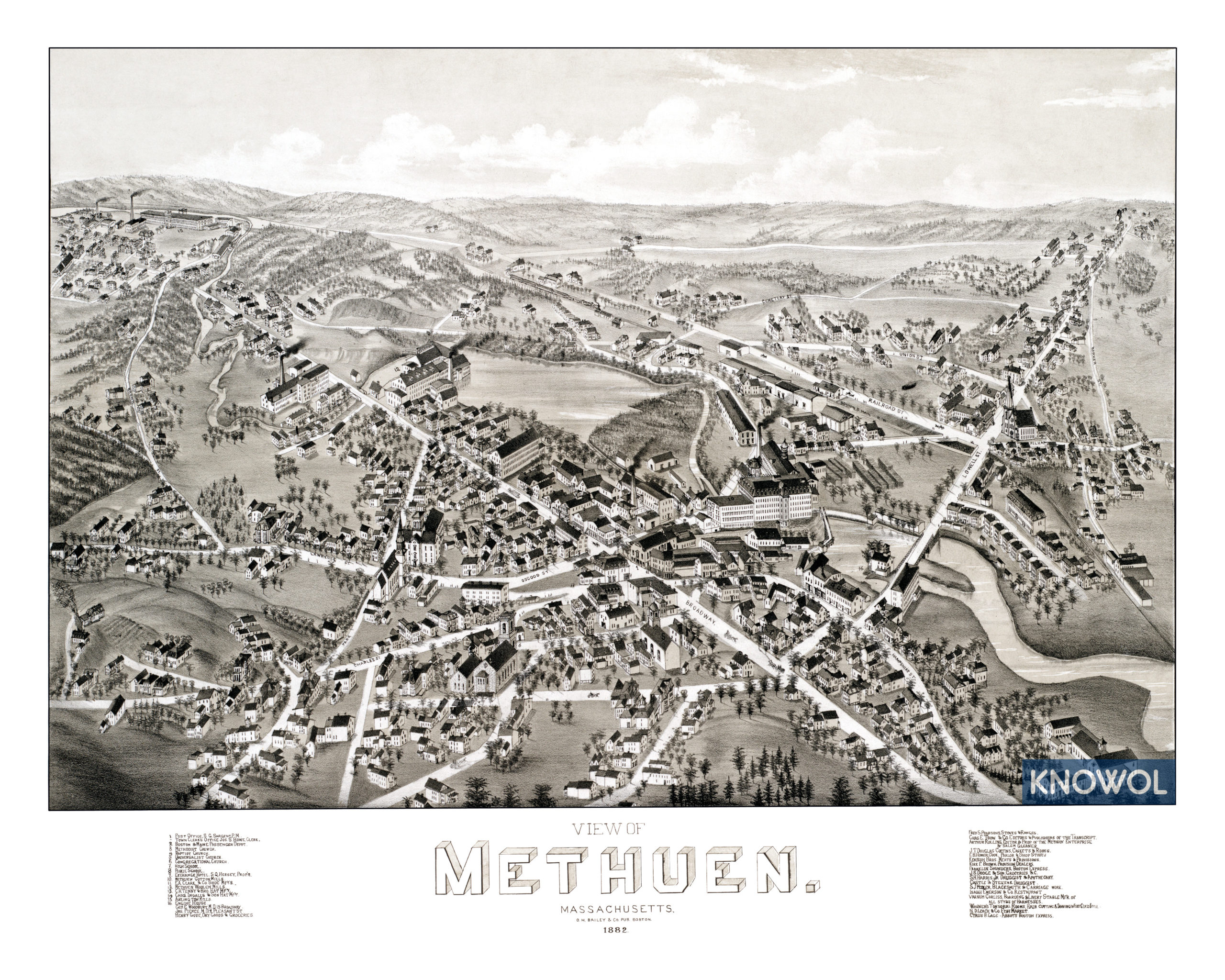
The bird's-eye view
By O.H. Bailey
Methuen drawn as if from the sky in 1882, with the Boston and Maine depot, the Exchange Hotel, the Methuen Cotton Mills and Woolen Mills, the Tenney and Brothers hat factory, the Arlington Mills and the engine house.5
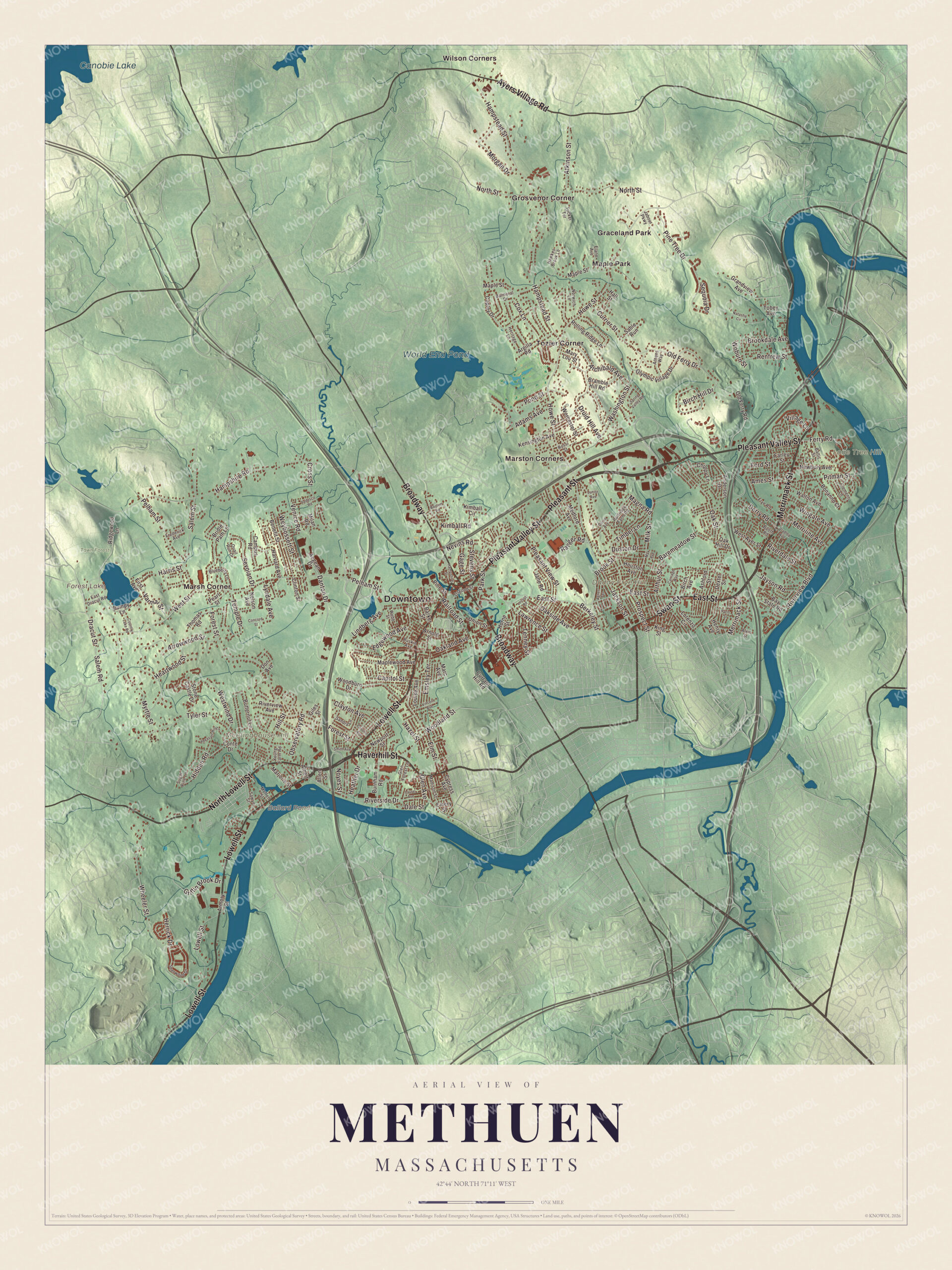
Methuen today
By KNOWOL
Hills and low ground across the whole city from USGS elevation data, every street, the Spicket River, Forest Lake, World End Pond, Daddy Frye Hill and Lone Tree Hill, and the corners from Marsh Corner to Tozier Corner.3
The story of Methuen
The mechanic and the air pump
In September 1823 an English mechanic named Timothy Claxton came to work in the machine shop of the cotton mill at Spicket Falls. He found a small reading society at a low ebb, its members taking turns reading aloud. When they asked if he could give a lecture, he said he'd try. He'd brought a little air pump from Russia, made from a piece of gas tubing, and he ground glass to fit it on the hearthstone of his room and turned a wash tub into a cistern. It put new life into the society. Debates, lectures and a library followed, and members built a hall of their own. Robert Rantoul saw in it the root of the American Lyceum. Later members took up acting, and the town history says a performance of Richard III finished the society off.267
Methuen marches
Methuen was slow to send anyone to the legislature. The town was fined in 1770, 1772 and 1773 for not choosing a representative at all. When the trouble with Britain came, though, it moved fast. In October 1774 dozens of men signed a pledge to form a company and learn the manual exercise. On April 19, 1775, by the county history's count, more than half of the town's poll-tax payers shouldered their muskets and marched. Two months later Captain John Davis's company stood in the redoubt at Bunker Hill and was among the last to leave it, and three Methuen men died of that day's fighting. Years later James Ordway, poor and lame, got a gallon of rum from a neighbor, sent, the story goes, to pay for throwing stones at the British when the powder ran out.8910
The falls that built a town
When William Bentley rode up from Andover in April 1796, he found the Spicket pouring over a fall of fifty feet, with a grist mill and fulling mill on one side and a wheel for grinding scythes on the other. Mills had worked those rocks since at least 1709, when a deed sold a quarter share of a sawmill there. Stephen Minot built the first cotton factory about 1812, and the Methuen Company took over in 1821 and built in brick. David Nevins bought the mills in 1864, added jute, and grew the workforce from about 150 people to 650. The hat maker Charles H. Tenney gave the soldiers' monument, and Edward Searles, born in Methuen in 1841, built the hall for the Great Organ, finished in 1909.11121314153
Through the years
24 moments from 1642 to today.
- 1642Haverhill's settlers buy from Passaquo and Saggahew a tract that takes in most of what is now Methuen.16
- 1659Haverhill lays out meadow at 'Mistake Meadow,' the place later called Mystic.17
- 1709A deed sells a quarter share of a sawmill at Spicket Falls, the first mill there.12
- 1725On December 8 the General Court sets off the west part of Haverhill as the town of Methuen.1
- 1726The first town meeting is held on March 9, in a resident's home.1
- 1727The General Court orders the new meetinghouse frame moved to Meeting-House Hill.18
- 1741The new province line puts most of the north parish in New Hampshire.1
- 1770The town is fined for not choosing a representative, and again in 1772 and 1773.8
- 1775On April 19 more than half of the town's poll-tax payers march on the alarm.9
- 1775Captain John Davis's Methuen company fights in the redoubt at Bunker Hill.10
- 1780Methuen votes for John Hancock as governor, 64 votes to James Bowdoin's 2.19
- 1793A company forms to bridge the Merrimack at Bodwell's Falls, something people had called impossible.20
- 1796The first meetinghouse, never painted inside or out, is taken down to make way for a new one.21
- 1805The town votes for the first time that pigs may not run loose.22
- 1812About this year Stephen Minot builds the first cotton factory at Spicket Falls.13
- 1824Timothy Claxton's lectures revive a village reading society, an early root of the American Lyceum.2
- 1847Lawrence is incorporated, taking a large part of Methuen along the Merrimack.23
- 1864David Nevins buys the Methuen Company mills at the falls.14
- 1876On September 7 Methuen celebrates 150 years as a town.24
- 1884The Nevins Memorial opens to the public on June 11.25
- 1889Edward Searles commissions Thomas Ball's colossal statue of Washington for Methuen.26
- 1909Serlo Organ Hall, now the Methuen Memorial Music Hall, is finished at 192 Broadway.3
- 1921After the state's high court finds its city charter invalid, Methuen becomes a town again on January 8.27
- 1978Fire destroys Grey Court, the Tenney mansion on the hill.3
Places to see
Places worth a visit in Methuen today.
- Spicket Falls Historic DistrictGaunt Square and the falls. Mill complex on both banks of the Spicket.
- Methuen Memorial Music Hall192 Broadway. Searles' hall for the Great Organ.Visit their website
- Nevins Memorial Library305 Broadway. The Nevins family's memorial library of 1883.Visit their website
- Pleasant-High Historic DistrictPleasant and High streets. First neighborhood built away from the farms.
- Greycourt State ParkOff Pleasant Street. Ruins of Charles Tenney's Grey Court.Visit their website
- Tenney Castle Gatehouse37 Pleasant Street. Gatehouse museum of Historic Methuen.Visit their website
- Daddy Frye's Hill CemeteryEast and Arlington streets. The city's oldest cemetery, from 1728.
- Forest LakeBeside the town forest. Fishing, canoeing and swimming.
- Searles Tenney Nevins Historic DistrictThe old center. Protects what the three families built.
On the National Register
22 of the 44 places in Methuen on the National Register of Historic Places that still stand today, oldest first, and why each one matters. See the full list of National Register places in Methuen.4
-
Asie Swan House
Built about 1720, it is one of the oldest buildings in the city. It first stood on Prospect Hill, in what is now Lawrence, where the town's first meetings were held from 1726, and it was moved here in 1808.28
-
Daddy Frye's Hill Cemetery
Set up in 1728 on Meeting House Hill, it is the city's oldest cemetery and the last major piece of the first town center. Edward Searles built its stone memorial chapel, honoring his aunt and uncle, and the stone wall around it.29
-
Moses Morse House
A rare surviving farmhouse with 18th century origins, its oldest parts dating to about 1762, built around a massive central chimney.30
-
Capt. Oliver Emerson Homestead
Oliver Emerson, a local leader of Revolutionary War forces, built this Georgian house about 1775 around a large central chimney. It stands on one of Methuen's early roads, one of the few houses older than the town's mid 1800s growth.31
-
Pleasant-High Historic District
Methuen's first neighborhood of houses built away from the farms, laid out by 1810 on the rise above the mills after the Turnpike, now Broadway, came through. It runs along High and Pleasant streets and takes in the First Church.32
-
Spicket Falls Historic District
The industrial and commercial heart of Methuen around Gaunt Square and both banks of the Spicket falls, one of the lower Merrimack's best-preserved 19th century mill complexes. Its oldest buildings are the brick mills of 1825 and 1826, and David Nevins added six buildings and a new dam between 1879 and 1882.33
-
George A. Waldo House
Built in 1825 and altered somewhat around 1900 by local philanthropist Edward Searles, it is one of Methuen's finest examples of Federal period architecture. It was added to the National Register of Historic Places in 1984, and is currently occupied by the Methuen Family Funeral Home.34
-
Tenney Castle Gatehouse
Richard Whittier built it as a stone farmhouse in 1830. Charles H. Tenney bought it in 1882 and had it made over into the Queen Anne gatehouse of his Grey Court estate, the only part of that estate still standing, and it now holds Historic Methuen's museum.35
-
Lawrence Street Cemetery
Methuen's third oldest cemetery, it was founded in 1832 when the center of town was shifted west from Meeting House Hill to Gaunt Square. Late in the 19th century, wealthy industrialist Edward Searles built the 8 foot granite wall on the sides facing his estate.36
-
Double-arch Sandstone Bridge
A dry stone arch bridge over the Spicket on the old Dracut Path, laid without mortar in 1835 to replace a plank bridge the town kept up from at least 1730. It carried traffic toward Salem, New Hampshire, until Interstate 93 came through in 1963.37
-
Stephen Barker House
Built in 1839, it is one of several handsome houses built at the periphery of the Methuen settlement in the mid-19th Century, and remains a well conserved "country Residence". Reportedly, surveyor Stephen Barker built "Woodland Cottage" in imitation of antebellum mansions he had seen in the South.38
-
Old Town Farm
The brick two story building was built in 1846, after Methuen lost its earlier poor farm due to the loss of part of its territory to newly founded Lawrence. The building is five bays wide and deep, with entries on the front and side; the front entrance is recessed with a fanlight and sidelights.39
-
Walnut Grove Cemetery
The still active cemetery sits on 14 acres (5.7 ha) and is privately funded with a board of directors. The cemetery was established in 1853, and was laid out in the then-popular rural cemetery style.40
-
First Church Congregational
Methuen's first congregation, gathered in 1729, moved its meetinghouse down from Daddy Frye's Hill in 1832 and built this granite Gothic Revival church in 1855. A John La Farge window of the Resurrection was installed in 1895.41
-
Arlington Mills Historic District
A great textile complex of 23 mostly brick buildings straddling the Lawrence line beside the Spicket River, built up between 1865 and 1925. Its 1896 wool-combing mill is 750 feet long, and during World War I the mills supplied flannel and wool shirting to the Army.42
-
First Baptist Church
Built in 1869 for a congregation formed in 1815, after the 1840 church on this site burned. Designed by Rufus Sargent of Newburyport, it is one of the town's finest Carpenter Gothic buildings.43
-
Nevins Memorial Library
Built in 1883 to honor David Nevins Sr., a gift of his widow Eliza and his sons David and Henry C. Nevins. Its historic collection holds manuscripts, vital records and the library's own stained glass windows.44
-
Methuen Water Works
Built in 1893 or soon thereafter, it was one of the city's first major public works project. The surviving building, designed by Ernest N. Boyden, is a distinctive local example of Romanesque architecture.45
-
Searles High School
Henry Vaughan designed this English Renaissance Revival school, a 1904 gift of Edward Searles to his hometown. It was the high school until 1957 and now holds the offices of the City of Methuen.46
-
Henry C. Nevins Home for Aged and Incurables
Built in 1905 and 1906 with $100,000 left by Julie F. H. Nevins, on the site of the house of Charles Ingalls, one of Methuen's early hat makers. It was a home for the aged from 1906 until 1997 and now holds apartments for older residents.47
-
Methuen Memorial Music Hall
Edward Searles built it as Serlo Organ Hall, finished in 1909 to designs by Henry Vaughan, to hold the Great Organ he bought at auction for $1,500. Made by E. F. Walcker of Ludwigsburg, Germany, the organ was the first concert organ in the United States when it went into the Boston Music Hall in 1863.48
-
Park Lodge
A Craftsman house of 1910 designed by Henry Vaughan near Edward Searles' Pine Lodge estate, one of the many buildings Searles left in his hometown.49
In their words
“A name of distinction has Methuen town, for it is the only township of its name in the world.”
Old paths and legends of New England, 190350
“It would have been hard to find a spot in Methuen, where in the still summer days, the sound of the shoemaker's hammer did not penetrate.”
History of Essex County, 1888, on the days when every neighborhood had a shoe shop51
“As seen from the village the picturesque Tenney tower resembles that of a castle on the Rhine.”
Old paths and legends of New England, 1903, on Grey Court50
Nearby towns
Sources
- Methuen, Massachusetts, Wikipedia
- History of Essex County, Massachusetts (1888), Robert S. Rantoul on the early lyceums, Internet Archive
- Map of Methuen, Massachusetts in 2026, KNOWOL (USGS elevation, Census Bureau roads)
- National Register of Historic Places listings in Methuen, Massachusetts, Wikipedia
- Bird's-eye view of Methuen, Massachusetts from 1882, restored by KNOWOL
- History of Essex County, Massachusetts (1888), Timothy Claxton on his air pump, Internet Archive
- History of Essex County, Massachusetts (1888), on the end of the Methuen society, Internet Archive
- History of Essex County, Massachusetts (1888), on the fines of the 1770s, Internet Archive
- History of Essex County, Massachusetts (1888), on April 19, 1775, Internet Archive
- History of Essex County, Massachusetts (1888), on Methuen at Bunker Hill, Internet Archive
- The diary of William Bentley, D.D., pastor of the East Church, Salem, Massachusetts (1905), on Methuen in 1796, Internet Archive
- History of Essex County, Massachusetts (1888), on the first mill at Spicket Falls, Internet Archive
- History of Essex County, Massachusetts (1888), on the first cotton factory, Internet Archive
- History of Essex County, Massachusetts (1888), on David Nevins, Internet Archive
- History of the First Regiment of Heavy Artillery, Massachusetts Volunteers (1917), on Charles H. Tenney, Internet Archive
- History of Essex County, Massachusetts (1888), on the 1642 Haverhill deed, Internet Archive
- History of Essex County, Massachusetts (1888), on Mistake Meadow, Internet Archive
- History of Essex County, Massachusetts (1888), on the first meetinghouse, Internet Archive
- History of Essex County, Massachusetts (1888), on the 1780 vote for governor, Internet Archive
- History of Essex County, Massachusetts (1888), on the bridge at Bodwell's Falls, Internet Archive
- The diary of William Bentley, D.D., pastor of the East Church, Salem, Massachusetts (1905), on the first meetinghouse, Internet Archive
- History of Essex County, Massachusetts (1888), on the town votes of 1805, Internet Archive
- History of Essex County, Massachusetts (1888), on the founding of Lawrence, Internet Archive
- History of Essex County, Massachusetts (1888), on the 1876 anniversary, Internet Archive
- History of Essex County, Massachusetts (1888), on the Nevins Memorial, Internet Archive
- Encyclopedia of Massachusetts, biographical, genealogical (1916), on Thomas Ball, Internet Archive
- Municipal history of Essex County in Massachusetts (1922), on Methuen, Internet Archive
- Asie Swan House, Wikipedia
- Daddy Frye's Hill Cemetery, Wikipedia
- Moses Morse House, Wikipedia
- Capt. Oliver Emerson Homestead, Wikipedia
- Pleasant-High Historic District, Wikipedia
- Spicket Falls Historic District, Wikipedia
- George A. Waldo House, Wikipedia
- Tenney Castle Gatehouse, Wikipedia
- Lawrence Street Cemetery, Wikipedia
- Double-arch Sandstone Bridge, Wikipedia
- Stephen Barker House, Wikipedia
- Old Town Farm, Wikipedia
- Walnut Grove Cemetery, Wikipedia
- First Church Congregational, Wikipedia
- Arlington Mills Historic District, Wikipedia
- First Baptist Church, Wikipedia
- Nevins Memorial Library, Wikipedia
- Methuen Water Works, Wikipedia
- Searles High School, Wikipedia
- Henry C. Nevins Home for Aged and Incurables, Wikipedia
- Methuen Memorial Music Hall, Wikipedia
- Park Lodge, Wikipedia
- Old paths and legends of New England (1903), on Methuen, Internet Archive
- History of Essex County, Massachusetts (1888), on Methuen's shoemakers, Internet Archive