
A planned mill city on the Connecticut River, laid out around a dam and three levels of canals at Hadley Falls, that grew from the farms of Ireland Parish into the Paper City and the birthplace of volleyball.
Holyoke then and now
The same town 149 years apart. Click either map to look closer.
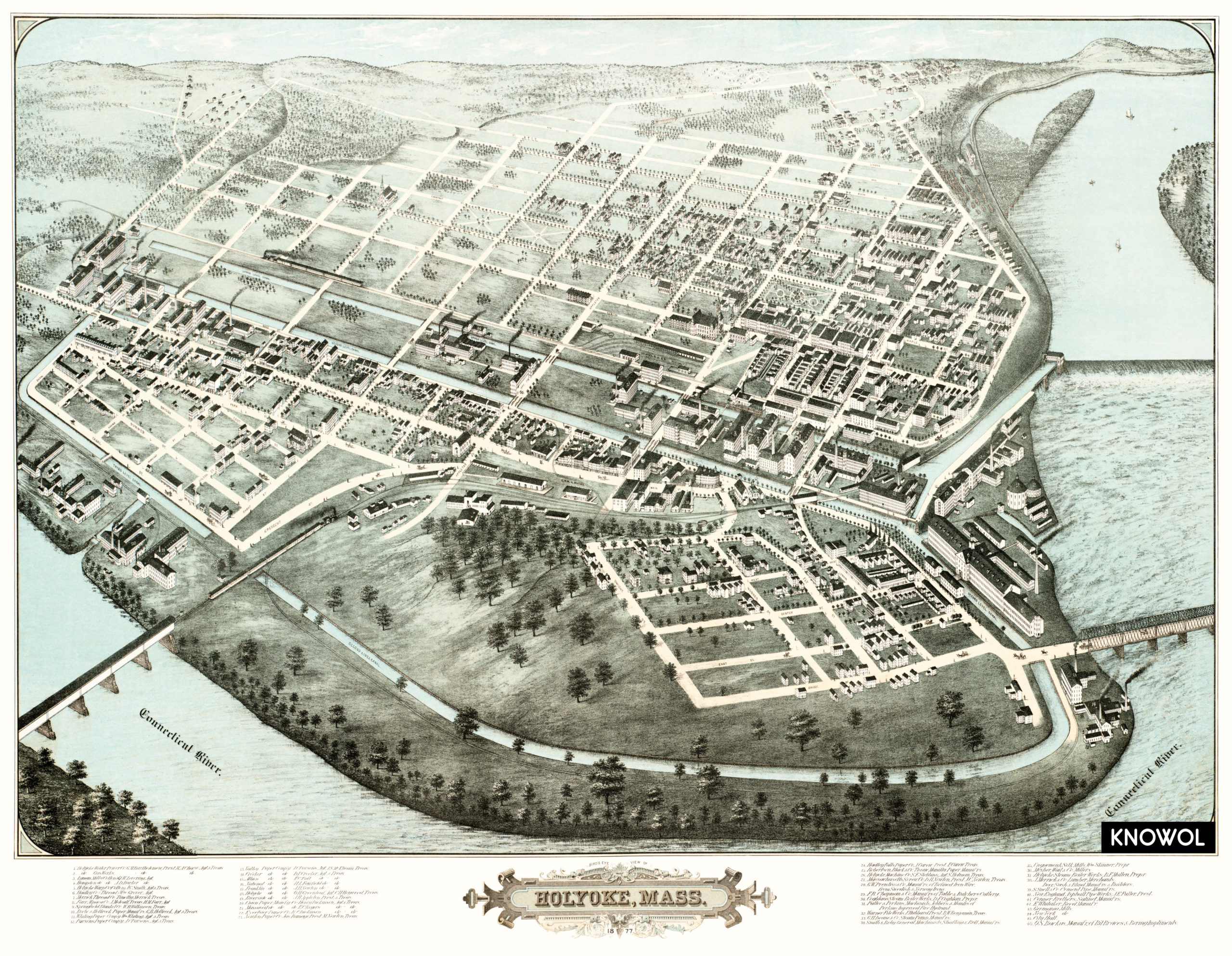
Holyoke in 1877
By H.H. Bailey & J.C. Hazen
Holyoke as it looked in 1877, with the Holyoke Water Power Company, the Lyman Mills, the Springfield Blanket Company, City Hall and more than ten paper companies.4
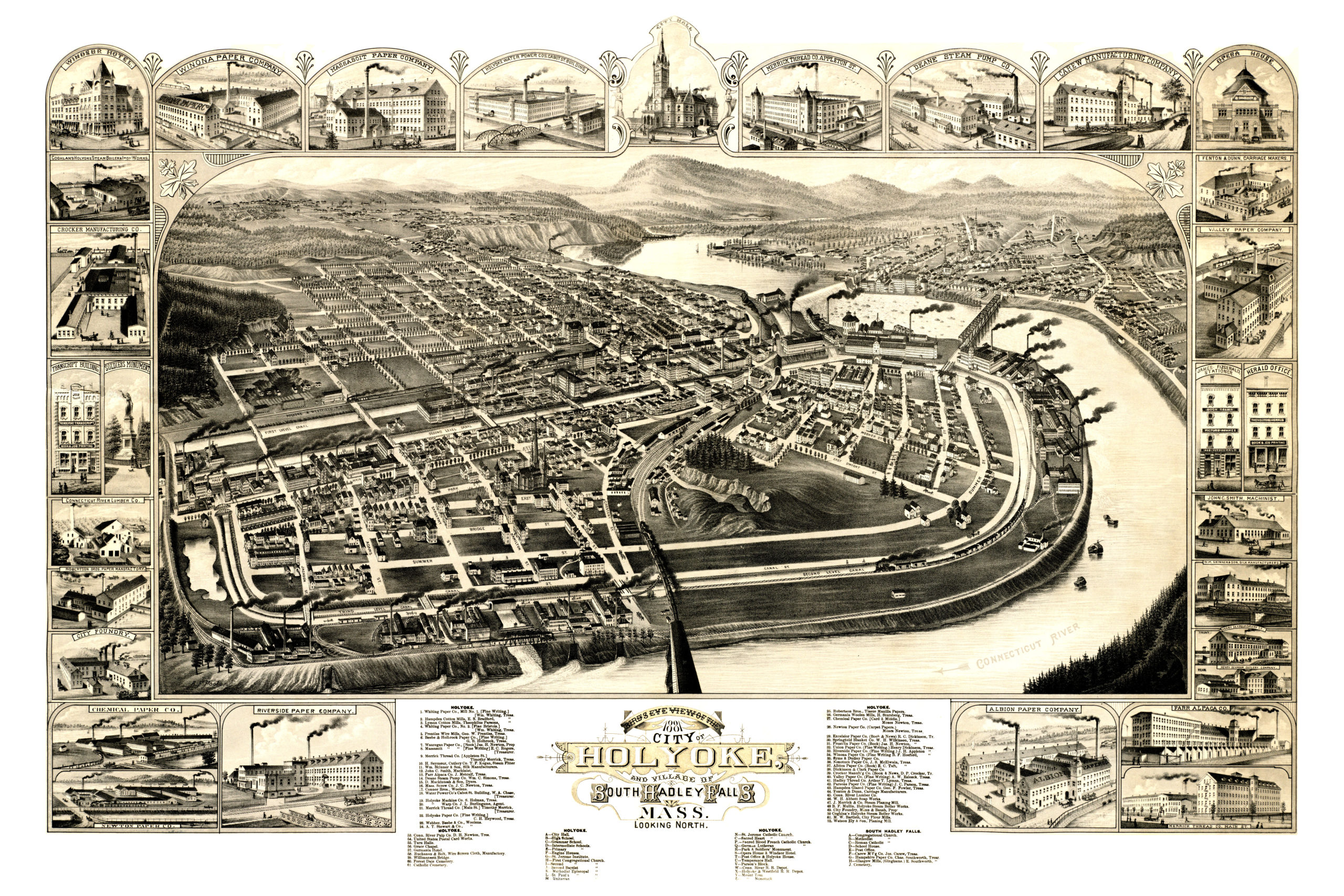
Holyoke in 1881
By J.J. Stoner
Holyoke in 1881, when about 22,000 people lived here, with the Soldiers Monument, the Holyoke Transcript Building, the Whiting Paper Mill, Grace Chapel, the Connecticut River Lumber Company and many paper companies.5
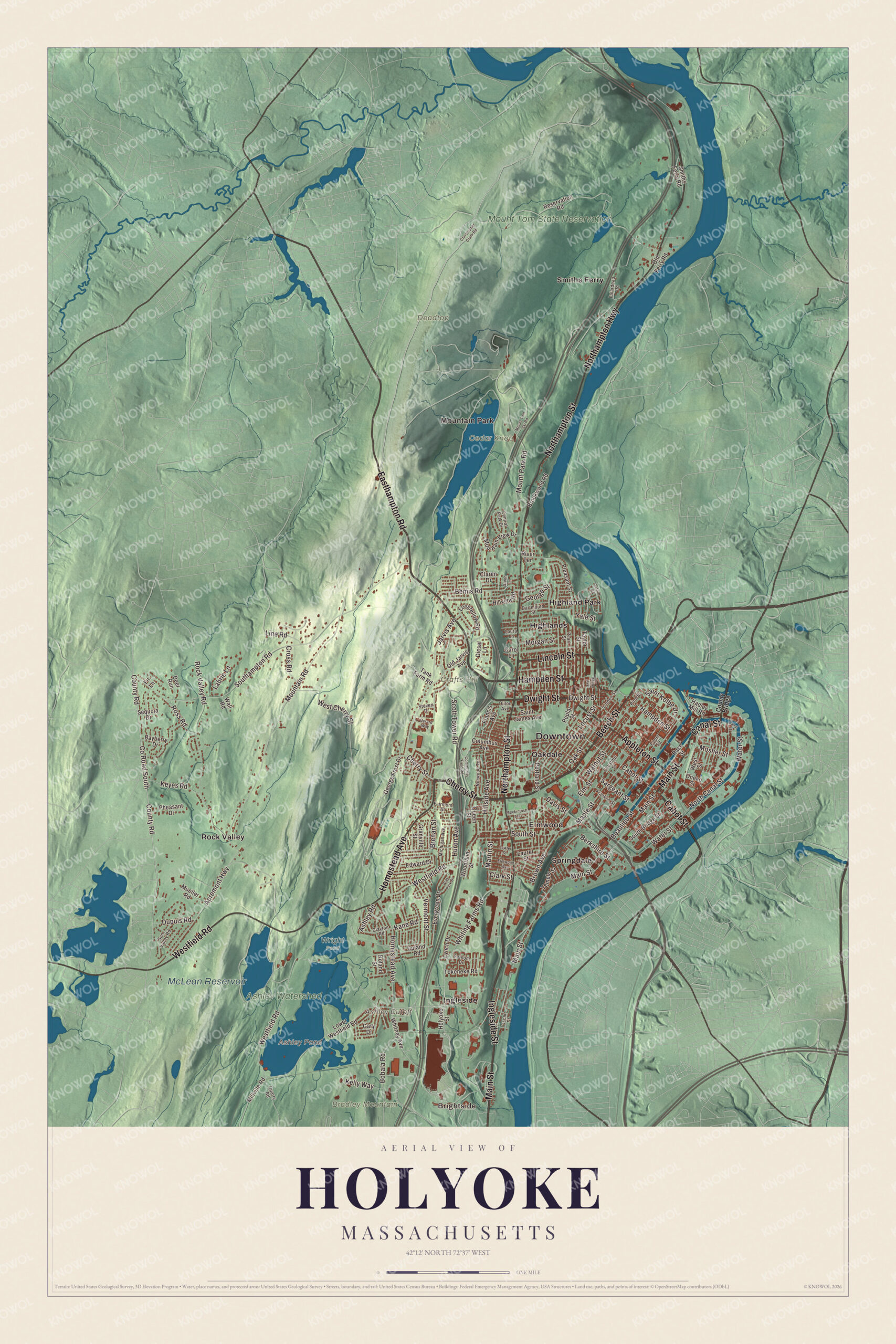
Holyoke today
By KNOWOL
Holyoke from the canals and the Connecticut River up to the cliffs of Mount Tom, with Main, Hampden, Lincoln, Cabot, Canal and Beech streets, Mountain Park, Highland Park, Ashley Pond, McLean Reservoir and the Mount Tom State Reservation.6
The history of Holyoke, Massachusetts
The dam that lasted one afternoon
In 1847 the Connecticut was measured at the falls and found to hold thirty thousand horsepower. An 1892 history says a gold mine could not have surprised the measurers more. The investors' agent bought 1,100 acres for $119,000, everything he wanted except one tract owned by Samuel Ely, and they believed the river could run a city of two hundred thousand people. On November 19, 1848, the timber dam was finished and the gates were closed. By the middle of that afternoon it had given way and gone down the river. By tradition, the telegrams to the Boston office went from "Dam leaking badly" to word that it had gone by way of Willimansett. The company built a stronger dam, and on October 22, 1849, it held. Holyoke became a town the next March.27891
Why it was called Ireland
Before the mills, this was a farming district of West Springfield known as Ireland Parish. A 1902 county history passes on the tradition of how it got the name. An early settler named Riley, "a son of Ireland," made his home on the brook that still carries his name and still marks the line with West Springfield, and so many others from Ireland followed that they outnumbered everyone else. In 1749 Capt. John Miller built an inn on the County Road. In 1783 the Morgans put up a sawmill above the rapids, and Caleb Humeston of New Haven opened a boot shop on Tannery Brook. Baptist families gathered at Elmwood, then called Baptist Village, and opened a seminary there in 1808. The parish took the name Holyoke in 1850.10111213141
From office boy to the Paper City
William Whiting came to Holyoke in 1847 as a boy of six, and the schoolhouse he went to stood where the canals run now. In 1858, at seventeen, he started as office boy at the Holyoke Paper Company's mill, then making a ton and a half of folded paper a day, for $25 a month. The Whiting Paper Company was incorporated in 1865, and by 1886 its mills on the First Level Canal employed 650 people and could make twenty-one tons a day. A trade review that year called it the largest maker of the finest writing papers in the world. In the late 1800s Holyoke made an estimated 80 percent of the writing paper used in the United States, and people still call it the Paper City.15161
Holyoke, Massachusetts through the years
23 moments from 1745 to today.
- 1745Benjamin Ball, one of the earliest settlers, makes his home on what is now Northampton and Cherry streets.17
- 1749Capt. John Miller, a veteran of the capture of Louisburg, builds the Miller Inn, later Crafts Tavern, on the County Road.11
- 1774West Springfield, which takes in the district known as Ireland, becomes its own town.1
- 1783Titus and Erastus Morgan build a sawmill above the rapids, believed to be the first use of water power there.12
- 1786Ireland becomes the third parish of West Springfield on July 7.1
- 1799The First Congregational Church, later called the Church on the Hill, is gathered in Ireland Parish.18
- 1808A Baptist Seminary opens in Elmwood, then called Baptist Village.14
- 1822The Ireland post office opens, with Martin Chapin as postmaster.1
- 1847The river at the falls is measured and found to hold thirty thousand horsepower.2
- 1848On November 19 the first dam is finished, and by the middle of the afternoon it has given way.8
- 1849On October 22 the new, stronger dam fills and holds.8
- 1850Holyoke is set off as a town on March 14, with 3,245 people.19
- 1859Alfred Smith buys the failed Hadley Falls Company's dam and canals at auction and forms the Holyoke Water Power Company.20
- 1861The Holyoke Water Power Company gives Hampden Park, today's Veterans Park, to the town.21
- 1873Holyoke becomes a city on April 7, the same year the Farr Alpaca Company begins.22
- 1875On May 27 the Precious Blood Church on Park Street burns during a service, and more than seventy people die.23
- 1876The Gothic Revival City Hall of Monson granite is finished.24
- 1884The Holyoke Street Railway opens a two-mile horse-car line from South Holyoke to South Hadley Falls.25
- 1885John T. Lynch, remembered as the hero of the Precious Blood fire, is appointed chief of the Holyoke Fire Department.26
- 1891The street railway runs on electricity across the whole system, and the Elmwood and Oakdale lines open.27
- 1895William G. Morgan invents volleyball at the Holyoke YMCA.1
- 1909Smith's Ferry, cut off from the rest of Northampton, becomes the north end of Holyoke.1
- 1911The city opens a municipal milk station on Sargeant Street, by the city history's count the first in New England.28
Places to see in Holyoke, Massachusetts
Places worth a visit in Holyoke today.
- Holyoke DamHadley Falls. The dam the city was built around.
- Holyoke Canal SystemThe Flats. Canals on three levels, 4.5 miles long.
- Wistariahurst238 Cabot Street. The Skinner family home, a museum since 1959.Visit their website
- International Volleyball Hall of FameDowntown. Honoring the game invented here in 1895.Visit their website
- ElmwoodNeighborhood. The oldest neighborhood, once Baptist Village.
- Highland ParkNeighborhood. Streetcar suburb with an Olmsted Brothers park.
- Mountain ParkSide of Mount Tom. Old trolley park, now outdoor concert grounds.
- Ashley PondAshley Reservoir. Part of the city's water supply since 1897.
- McLean ReservoirCity water works. Named for commissioner Hugh McLean.
- Mount Tom State ReservationMount Tom Range. Trails up the 1,202-foot traprock peak.Visit their website
Holyoke on the National Register of Historic Places
All 16 places in Holyoke on the National Register of Historic Places that still stand today, oldest first, and why each one matters.3
-
Hadley Falls Company Housing District
Five brick rowhouses built by the Hadley Falls Company in 1847 and 1848 for its mill workers. They are among the earliest and largest surviving examples of company-built worker housing in the state.29
-
Holyoke Canal System
Power canals on three levels fed by the Holyoke Dam, first dug by men with picks and shovels and horse teams. With the dam, they are a Historic Mechanical Engineering Landmark for the work that produced Clemens Herschel's Venturi meter and John B. McCormick's turbine.20
-
Hampden Park Historic District
Set aside as a park when the city's grid was laid out in 1848 and given to the city by the Holyoke Water Power Company in 1861, the park, now Veterans Park, holds the Civil War monument of 1876. The district also takes in St. Jerome's Church, built in the late 1850s.21
-
North High Street Historic District
The heart of downtown High Street between Dwight and Lyman streets, built up between 1850 and 1885 and lined with masonry buildings in the Italianate and Second Empire styles.30
-
Wistariahurst
Built in 1868 in Williamsburg for the silk manufacturer William Skinner and moved to Holyoke in 1874, after a flood swept away his first mills. Named for its wisteria vines, it has been the Wistariahurst Museum since 1959.31
-
Central Churchill Historic District
Brick and stone apartment blocks of the late 1800s and early 1900s around the Church of the Sacred Heart, begun in 1870. After the German Reformed Church went up nearby in 1890, the area became known as Church Hill, later shortened to Churchill.32
-
Essex Street Historic District
Three blocks of Essex Street, laid out by 1870, with a century of housing, from the Italianate Newton House of about 1877 and Queen Anne brick rowhouses of the 1880s on Walnut Street to the brick apartment blocks of the early 1900s.33
-
Holyoke City Hall
A Gothic Revival city hall of Monson granite, begun in 1871 to a design by Charles B. Atwood and finished in 1876 under Henry F. Kilburn, with a tower 220 feet tall. It has housed city offices ever since.24
-
Farr Alpaca Company Mills #1 and #3 Historic District
Mills of the Farr Alpaca Company, which the 1923 city history called Holyoke's largest industry. Herbert M. Farr moved his small factory here from Hespeler, Ontario, and the company began in 1873, the same year Holyoke became a city.22
-
Caledonia Building
Built in 1874, it is one of the finest Victorian buildings in the High Street commercial district and a rare reminder of the city's Scottish immigrant community. It is also part of the North High Street Historic District.34
-
Clovis Robert Block
Built in 1881 and enlarged in 1888, it is an early work of the local architect George P. B. Alderman and a reminder of the growing French Canadian community it served.35
-
Maplewood Hotel
Two late 1800s buildings that made up the city's first residential hotel, built by the industrialist Frank Beebe, who lived in one of its units. It offered furnished and unfurnished homes with full service and is still used for residences.36
-
Prospect Park
Laid out in 1884 on land given by the Holyoke Water Power Company, with a design by the Olmsted Brothers, on ground the city's Irish residents had called Kerry Park. It was renamed Pulaski Park in 1939.37
-
Friedrich Block
A Renaissance Revival building of 1908 by the local architect George P. B. Alderman, associated with the E.H. Friedrich Company, a maker of metal architectural parts.38
-
US Post Office-Holyoke Main
A limestone Art Deco post office that opened in 1935, a rare style in Holyoke. Its lobby mural of the early settlement of Holyoke was painted by Ross Moffett in a Depression-era program for artists.39
-
War Memorial Building
Built in 1936 with help from the Public Works Administration, it is one of only two Moderne buildings in the city and a memorial to its veterans, with an auditorium and meeting rooms.40
Holyoke in their words
“Both 'mother and child are doing well,' especially the child.”
Holyoke's mayor, answering for his young city at Springfield's 250th anniversary in 1886, in Springfield, 1636-1886 (1888)41
“May Holyoke continue to grow as long as her schools are a reservoir of so great a power and so noble an influence.”
The Massachusetts Teacher, August 186442
“We know of no spot to which we would take a stranger so readily as this.”
A writer on the view from the Ingleside House, quoted in the Gazetteer of the State of Massachusetts, 187443
Towns near Holyoke, Massachusetts
Sources for the history of Holyoke
- Holyoke, Massachusetts, Wikipedia
- Massachusetts of today: a memorial of the state (1892), on Holyoke's water power, Internet Archive
- National Register of Historic Places listings in Hampden County, Massachusetts, Wikipedia
- Stunning old map of Holyoke, Mass from 1877, restored by KNOWOL
- Old map showing Holyoke, Massachusetts in 1881, restored by KNOWOL
- Map of Holyoke, Massachusetts in 2026, KNOWOL
- Holyoke: past and present, progress and prosperity, souvenir 1910 (1910), on the land purchase of 1847, Internet Archive
- "Our county and its people": A history of Hampden County, Massachusetts (1902), on the dams of 1848 and 1849, Internet Archive
- Holyoke old and new: a chronological history (1923), on the dam of 1848, Internet Archive
- "Our county and its people": A history of Hampden County, Massachusetts (1902), on the name Ireland Parish, Internet Archive
- Holyoke old and new: a chronological history (1923), on the Miller Inn, Internet Archive
- Holyoke old and new: a chronological history (1923), on the Morgan sawmill, Internet Archive
- Holyoke old and new: a chronological history (1923), on Caleb Humeston's boot shop, Internet Archive
- Holyoke old and new: a chronological history (1923), on the Baptist Seminary, Internet Archive
- Transcript industrial edition: great industrial establishments of the Paper City (1897), on William Whiting, Internet Archive
- Leading manufacturers and merchants of central and western Massachusetts (1886), on the Whiting Paper Company, Internet Archive
- Holyoke: past and present, progress and prosperity, souvenir 1910 (1910), on the first settlers, Internet Archive
- "Our county and its people": A history of Hampden County, Massachusetts (1902), on the First Congregational Church, Internet Archive
- Holyoke old and new: a chronological history (1923), on the new town of 1850, Internet Archive
- Holyoke Canal System, Wikipedia
- Hampden Park Historic District, Wikipedia
- Holyoke old and new: a chronological history (1923), on the Farr Alpaca Company, Internet Archive
- Transcript industrial edition: great industrial establishments of the Paper City (1897), on the Precious Blood parish, Internet Archive
- Holyoke City Hall, Wikipedia
- Holyoke old and new: a chronological history (1923), on the Holyoke Street Railway, Internet Archive
- Holyoke old and new: a chronological history (1923), on John T. Lynch, Internet Archive
- Holyoke old and new: a chronological history (1923), on the electric street railway, Internet Archive
- Holyoke old and new: a chronological history (1923), on the Municipal Milk Station, Internet Archive
- Hadley Falls Company Housing District, Wikipedia
- North High Street Historic District, Wikipedia
- Wistariahurst, Wikipedia
- Central Churchill Historic District, Wikipedia
- Essex Street Historic District, Wikipedia
- Caledonia Building, Wikipedia
- Clovis Robert Block, Wikipedia
- Maplewood Hotel, Wikipedia
- Prospect Park, Wikipedia
- Friedrich Block, Wikipedia
- US Post Office-Holyoke Main, Wikipedia
- War Memorial Building, Wikipedia
- Springfield, 1636-1886: history of town and city (1888), Holyoke's toast at the 1886 celebration, Internet Archive
- Massachusetts Teacher, August 1864, on the schools of Holyoke, Internet Archive
- Gazetteer of the State of Massachusetts (1874), on Holyoke and the Ingleside House, Internet Archive