
A Middlesex County farm town, long nicknamed Hoptown for its hop-yards, where the first Baldwin apple tree grew on the Butters farm and Bond's crackers were baked for three generations.
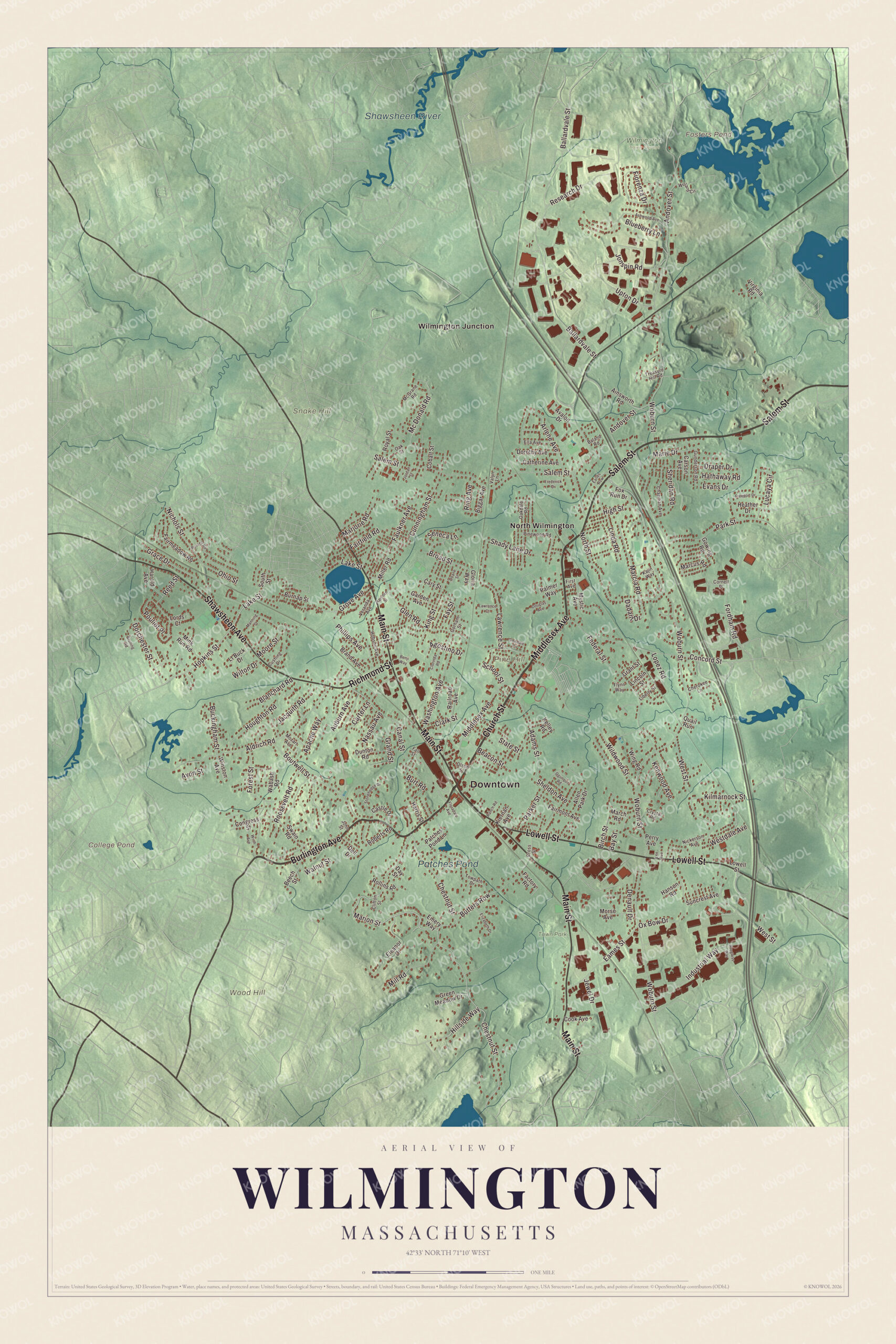
Wilmington, Massachusetts on the map
Click the map to look closer.
Wilmington today
By KNOWOL
Wilmington's streets, buildings, ponds and terrain in one view, from Downtown and North Wilmington out to Wilmington Junction, with the Shawsheen River, College Pond, Fosters Pond, Patches Pond, Town Park, Pine Hill, Snake Hill and Wood Hill named on the map.5
The history of Wilmington, Massachusetts
Hoptown and the cranberry teams
In the last half of the 1700s, hops made Wilmington money. The 1880 county history says there was scarcely a farmer in town without a hop-yard, people from nearby towns came to buy hop roots, and the place was long called Hoptown. Travelers in 1825 still called it famous for hops. Then hop growing spread across New England and New York, and the price fell from twenty-five cents a pound to four. The town's meadows had another crop. In 1790 a Cape Cod captain bound for Baltimore wanted Wilmington cranberries, so young James Walker and his older brother offered twenty cents a bushel and filled two four-ox teams. Walker believed the whole cranberry trade grew from that one shipment. A century later the town was raising about three thousand barrels a year.362
Travelers on the Wilmington roads
Wilmington sat on the roads between Boston, Salem, Haverhill and Lowell, and the people passing through wrote it down. Riding to Braintree in November 1787, young John Quincy Adams reached the tavern in Wilmington about noon and noted that the landlord was against the proposed Constitution. The Middlesex Canal, finished in 1803, crossed the west side of town with two locks a mile apart, each with a house for the boatmen. In 1810 Salem's Rev. William Bentley stopped at Harnden's Inn beyond Nod Mills and asked after the people he'd known here during the siege of Boston, only to find the old folks gone. And Captain Joseph Bond's bakery, started in 1798, kept its teams and bread-drivers busy until fire destroyed it in February 1864.7893
The schoolmasters of Wilmington
Wilmington's first schools were named for their corners of town: Nod in the north, City in the east, Butters Row in the south and Goshen in the west. The Centre didn't get a schoolhouse until 1840. A schoolmistress kept the summer term and a master the winter one, often a Harvard student. Benjamin Thompson, later Count Rumford, taught here before the Revolution, and William Bentley kept school during the siege of Boston. Charles W. Upham spent the winter of his second year at Harvard teaching here, nearly half a century after Rumford. The town was too small for the law to require a high school, but it voted to pay for one anyway. In 1902 the Ex-High School Associates of 1863 paid for the soldiers' monument with money they'd raised putting on plays.1031911212
Wilmington, Massachusetts through the years
25 moments from 1658 to today.
- 1658Places here already carry the names Goshen, Nod, Lebanon and Ladder-Pole, still in use more than two centuries later.3
- 1704About this year, by the deeds, the Ephraim Buck House is built in the east part of what will be Wilmington.13
- 1720About this year the Butters family's farmhouse on Chestnut Street goes up, on land granted to William Butters.14
- 1730Wilmington is made a town from the north part of Woburn and the west part of Reading.2
- 1733The church is gathered with seventeen men, and Rev. James Varney is ordained, a year after the first meeting-house goes up.3
- 1741Rev. Isaac Morrill is ordained and stays until his death in 1793, a ministry of more than half a century.3
- 1758Morrill serves as a chaplain in the French war and has his pay in silver dollars made into a communion tankard.3
- 1760Ephraim Buck shoots the last wild bear in the area, from under an old oak east of the Centre.3
- 1764Samuel Jaques runs a mill that presses cornstalks for their juice to make sugar.3
- 1768Benjamin Thompson, the future Count Rumford, teaches school in Wilmington.1
- 1770About this year Joshua Harnden's house goes up on Salem Street; after the Revolution he opens it as a tavern.15
- 1775During the siege of Boston, young William Bentley, later Salem's famous diarist, lives in Wilmington as a schoolmaster.9
- 1787John Quincy Adams stops at the tavern in Wilmington and finds the landlord against the proposed Constitution.7
- 1790The Walker brothers buy two four-ox teams of wild cranberries in Wilmington for a sloop bound to Baltimore.3
- 1798Captain Joseph Bond opens the bakery that makes Bond's crackers known for three generations.3
- 1803The Middlesex Canal opens, running through the west side of town with two locks about a mile apart.8
- 1810Bentley comes back and stops at Harnden's Inn beyond Nod Mills, to find the old people he knew have died.9
- 1825Travelers find the town still famous for hops, and a tornado wrecks an old farmer's hop-yards.6
- 1835The Boston and Lowell Railroad opens, with four and a half miles of track in Wilmington.8
- 1840The Centre gets its first schoolhouse.10
- 1864In February the meeting-house burns, and fire destroys Bond's bakery, which moves to Boston.3
- 1872Perry, Cutler and Company open a big tannery at North Wilmington.16
- 1890The town raises about 3,000 barrels of cranberries and keeps a high school that the law doesn't require.2
- 1895The Rumford Historical Association puts up a monument to the first Baldwin apple tree on the Butters farm.14
- 1902On Memorial Day the soldiers' monument is dedicated, paid for with money a group of former high school students raised giving plays.12
Places to see in Wilmington, Massachusetts
Places worth a visit in Wilmington today.
- DowntownChurch Street and Middlesex Avenue. Town center since the 1730s meeting house.
- North WilmingtonNorth of the Centre. Tannery village by the Boston and Maine.
- Wilmington JunctionNorthern edge of town. Village named for its railroad junction.
- Shawsheen RiverBillerica line. Forms part of the line with Billerica.
- Patches PondJust south of the Centre. Small pond close to the town center.
- Pine HillNortheast of the Centre. High ground about a mile out.
- Snake HillNorth of Silver Lake. Hill in the north part of town.
- Wood HillSouthwest of the Centre. Named in a Wilmington deed of 1750.
Wilmington on the National Register of Historic Places
All 12 places in Wilmington on the National Register of Historic Places that still stand today, oldest first, and why each one matters.4
-
Buck's Corner Historic District
Six houses and three barns on Woburn and Wildwood Streets, built from the late 1600s to the late 1800s, many of them tied to the descendants of Roger Buck. The oldest is the Ephraim Buck House.17
-
Ephraim Buck House
A First Period house dated by deeds to about 1704, said to have been built by Roger Buck and his son Ephraim and first lived in by two families. It has unusual 'Beverly jogs' on both sides, and its front was restyled about 1770.13
-
Butters-Avery House
A First Period farmhouse on land granted to William Butters about 1665, recognized as the origin site of the Baldwin apple. The Rumford Historical Association put up a monument to the tree here in 1895, and in 2006 town meeting voted to buy the house to save it.14
-
Wilmington Centre Village Historic District
The old town center along Church and Middlesex Streets, from the common to the Old Burial Ground. It began in the 1730s with the meeting house and cemetery and grew in the early 1800s around a factory-style bakery.18
-
Boutell-Hathorn House
A farm whose Georgian house dates in part to before 1754, with an Italianate barn of the mid-1800s and rare remnants of the slaughterhouse N. B. Eames ran here in the second half of the 1800s.19
-
Harnden Tavern
Col. Joshua Harnden's late-Georgian house in the Land of Nod, which he opened as a tavern after the Revolution. There's a credible tradition that it was a station on the Underground Railroad, and it's now the Wilmington Town Museum.15
-
Middlesex Canal
The 27-mile barge canal that linked the Merrimack River with Boston, one of the first civil engineering works of its kind in the United States. It carried freight until 1851, when the railroads took its trade.20
-
Middlesex Canal Historic and Archaeological District
The Middlesex Canal's surviving sections and archaeological sites at many places along its old route, listed together as one district in 2009.21
-
Gowing-Sheldon Historic District
Two houses on one of the oldest roads in town: a Federal house built about 1809 by Joel Tweed, a shoemaker, and across the street the 1893 Lucy and Henry Sheldon House, one of the most elaborate Queen Anne houses in Wilmington.22
-
Church Street Historic District
The town's largest cluster of high-style homes, mostly Queen Anne houses of the 1880s and 1890s, along Church Street from Hanover and Clark Streets up to the town common. The oldest is the Maynard Spaulding House of the early 1850s.23
-
High Street Historic District
Seventeen houses along High Street east of Salem Street, most built in the second half of the 1800s in all the popular revival styles of the time.24
-
West Schoolhouse
It is the best-preserved of Wilmington's remaining one-room schoolhouses. This single-story wood-frame building was probably (based on stylistic analysis) built in the 1860s or 1870s, although its resemblance in form to the c. 1840s Old Centre Schoolhouse suggests a possible earlier construction date and subsequent remodeling.25
Wilmington in their words
“Nothing just like the origin of the monument in Wilmington is found elsewhere in the Commonwealth.”
Monuments, tablets and other memorials erected in Massachusetts, 1910, on the soldiers' monument of 190212
“And from this single shipment grew the immense trade and culture of cranberries.”
James Walker, born in Wilmington in 1772, quoted in the History of Middlesex County, 18803
“It is at least safe to say that in none of them has the expenditure yielded better returns than in Wilmington.”
History of Middlesex County, 1880, on the town's schools3
Towns near Wilmington, Massachusetts
Sources for the history of Wilmington
- Wilmington, Massachusetts, Wikipedia
- History of Middlesex County, Massachusetts (1890), Wilmington chapter by William T. Davis, Internet Archive
- History of Middlesex County, Massachusetts (1880), Wilmington chapter by Lemuel C. Eames, Internet Archive
- National Register of Historic Places listings in Middlesex County, Massachusetts, Wikipedia
- Map of Wilmington, Massachusetts in 2026, KNOWOL
- History of Chelmsford (1917), a traveler's letter of 1825, Internet Archive
- Proceedings of the Massachusetts Historical Society, vol. 16 (1902), diary of John Quincy Adams, Internet Archive
- History of Middlesex County, Massachusetts (1880), on the canal and railroads in Wilmington, Internet Archive
- The diary of William Bentley, pastor of the East Church, Salem, Massachusetts (1905), entry of June 2, 1810, Internet Archive
- History of Middlesex County, Massachusetts (1880), another copy, on Wilmington's schools, Internet Archive
- Proceedings of the Massachusetts Historical Society, vol. 15 (1876), memoir of Charles W. Upham, Internet Archive
- Monuments, tablets and other memorials erected in Massachusetts to commemorate the services of her sons in the war of the rebellion (1910), Internet Archive
- Ephraim Buck House, Wikipedia
- Butters-Avery House, Wikipedia
- Harnden Tavern, Wikipedia
- History of Middlesex County, Massachusetts (1880), a third copy, on the North Wilmington tannery, Internet Archive
- Buck's Corner Historic District, Wikipedia
- Wilmington Centre Village Historic District, Wikipedia
- Boutell-Hathorn House, Wikipedia
- Middlesex Canal, Wikipedia
- Middlesex Canal Historic and Archaeological District, Wikipedia
- Gowing-Sheldon Historic District, Wikipedia
- Church Street Historic District, Wikipedia
- High Street Historic District, Wikipedia
- West Schoolhouse, Wikipedia