
A hilltop town at the head of the Charles, Sudbury and Blackstone rivers, bought with Edward Hopkins's legacy and rented to its first settlers, that grew on boots and shoes and now sends the Boston Marathon on its way every April.
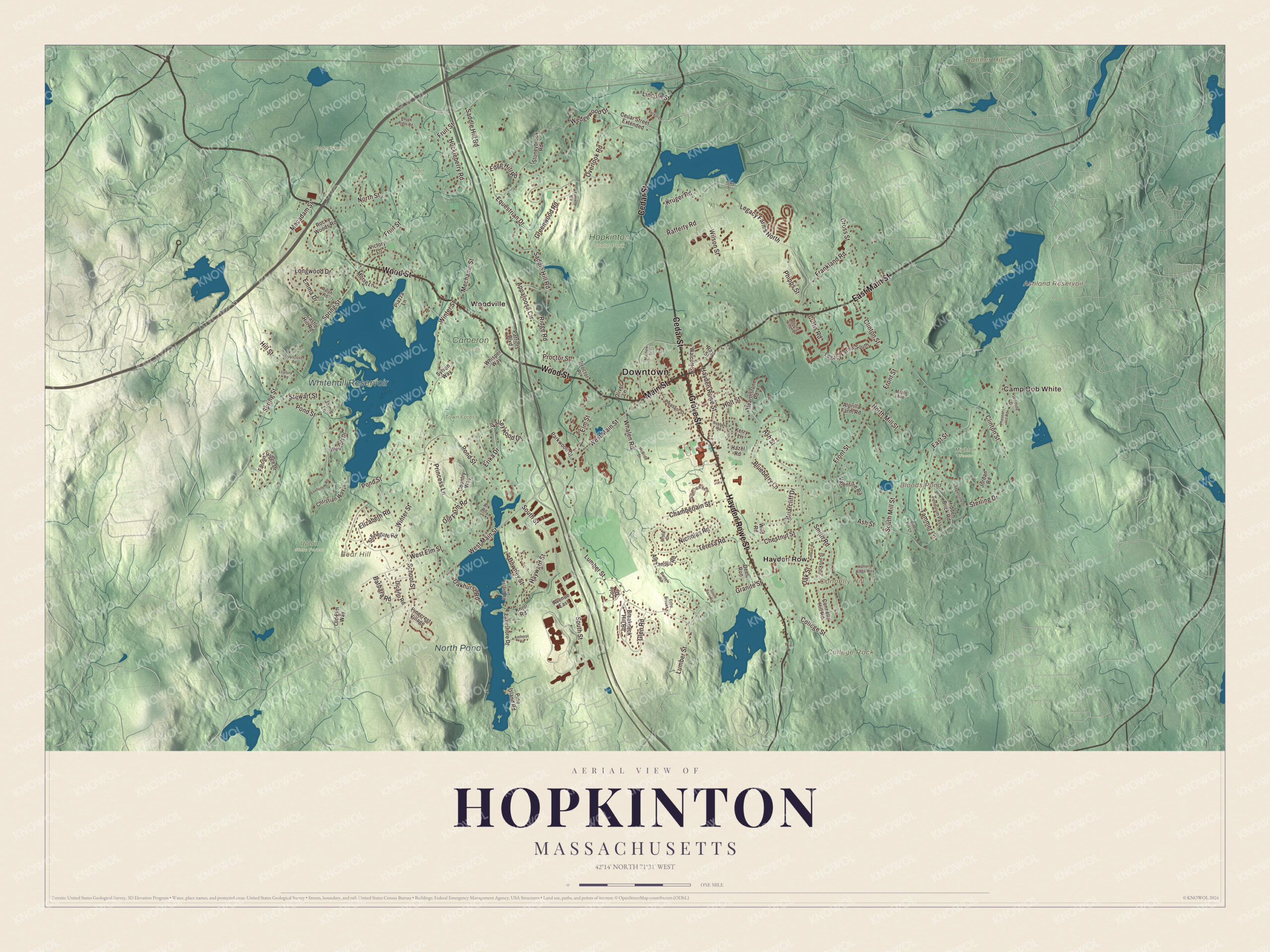
Hopkinton, Massachusetts on the map
Click the map to look closer.
Hopkinton today
By KNOWOL
Every street from Woodville to Hayden Row over shaded relief from USGS elevation data, with Whitehall Reservoir, North Pond, Bloods Pond, the Town Forest, Banner Hill, Bear Hill and College Rock printed on the artwork.3
The history of Hopkinton, Massachusetts
A town of tenants
Hopkinton started out as rented land. Edward Hopkins left money in trust for education, and in 1715 the Natick proprietors voted to sell the Magunkook lands to the trustees of his legacy, who added province land and had the whole tract made a town. The trustees leased farms to the settlers on 99-year leases from 1723, at three pence an acre a year. Tenants found the rent a burden, and after 1773 most of them stopped paying. When the leases ran out in 1823 the occupants refused again, saying the records were lost and nobody could tell rented land from common land. The trustees sued in 1826, the tenants defended themselves well, and in 1832 the state settled it by paying $10,000 out of its own treasury.5671
When word came from Lexington
Hopkinton had only 1,134 people in 1776, and it went all in. In February 1775 the town formed three companies and told every man to train under the captain he liked best. On April 19, when news came of the British march on Lexington, the minute men mustered at once and went, and the 1890 county history lists dozens of them at Roxbury that day. The next March the town let anyone make saltpetre for gunpowder from the dust under the meeting house, and on June 17, 1776 it voted for independence by, in the record's words, a very unanimous vote. Daniel Shays, born on Saddle Hill in 1747, was wounded at Bunker Hill and later led the uprising that carries his name.8910
Pegs, boots and the fire of 1882
The 1880 county history credits Hopkinton with showing the world that a shoe's sole could be held on with wooden pegs. About 1819 Joseph Walker began fastening soles with rows of pegs cut from seasoned birch or maple, and in 1826 his sons Leonard and Lovett set up their own shop and carried their boots and shoes to Boston and Providence in a one-horse wagon. Lee Claflin opened a shop in Hayden Row in 1840, and by 1850 the town had eleven factories. In Woodville the Wood brothers made shoes in their father's old stone cotton mill. Then at about two in the morning on April 4, 1882, fire took the heart of the village and its principal factory. The company didn't rebuild here; within months Bridges & Co. began a new factory in South Framingham.1112131
Hopkinton, Massachusetts through the years
25 moments from 1669 to today.
- 1669John Eliot's praying Indians at Magunkaquog, in the east end of the future town and now part of Ashland, are making cedar shingles and clapboards.5
- 1710English settlement begins about 1710 or 1712, on land leased from the trustees of the Hopkins legacy.14
- 1715On September 24 the Natick proprietors vote to sell the Magunkook lands to the trustees of the Hopkins legacy.5
- 1715Hopkinton is incorporated on December 13.1
- 1719Scotch-Irish families from the north of Ireland begin settling in town, about eighteen in all.15
- 1724On September 2 the church is gathered and the Rev. Samuel Barrett is ordained its pastor.16
- 1725Lots are cast to pick the meeting house site, and the frame is raised in December.17
- 1736A New Hampshire tract called Number Five, later New Hopkinton, is granted to Capt. John Jones and others, and several neighbors move there.18
- 1741Eleven men and a boy go on the expedition against Cartagena; only Gideon Gould and the boy come home.19
- 1745About this year the Rev. Roger Price of King's Chapel in Boston comes to town and builds a small Church of England meeting house.20
- 1747Daniel Shays is born at the Shays place on Saddle Hill.10
- 1775On April 19 the minute men muster and march as soon as news of the British advance on Lexington arrives.8
- 1776On June 17 the town votes for independence by, in the record's words, a very unanimous vote.8
- 1789A small social library is founded.21
- 1797The town asks the General Court to let shad and alewives past the mill dams to White Hall Pond.22
- 1815The Rev. Nathaniel Howe preaches his century sermon, full of plain words about the salary the town wouldn't raise.23
- 1816The Hopkinton Mineral Springs, west of Lake Whitehall, are discovered and become a fashionable resort.2
- 1819About this year Joseph Walker starts fastening shoe soles with wooden pegs.11
- 1832The state pays $10,000 to end the long fight over rents on the Hopkins legacy lands.7
- 1846On March 16 part of the town is taken to form Ashland.2
- 1850Hopkinton has eleven boot and shoe factories.1
- 1877The cornerstone of St. John the Evangelist, a granite church on Church Street, is laid on May 15.24
- 1882Fire sweeps the heart of the village and its principal factory on April 4.13
- 1894Boston takes Lake Whitehall for its water supply, and the factories on its shores close or move.1
- 1924The Boston Marathon's starting line moves to Hopkinton.3
Places to see in Hopkinton, Massachusetts
Places worth a visit in Hopkinton today.
- Town CommonHopkinton village. Heart of the Center Historic District.
- Town HallHopkinton village. Joined the Center district in 2000.
- Public Library13 Main Street. Founded in 1867, reopened here in 2017.Visit their website
- Center SchoolHopkinton village. Joined the Center district in 2001.
- Hayden RowSouth of the village. Lee Claflin's shoe shop opened here, 1840.
- WoodvilleWest of town. Village historic district of 97 properties.
- Whitehall State ParkWood Street, Route 135. Boston's water supply until 1947.Visit their website
- North PondSouthwest corner. Headwaters of the Mill River.
- Bear HillSouth of the village. Rocky hill, once rattlesnake country.
- Cedar Swamp Archaeological DistrictWestborough line. Shared with Westborough.
Hopkinton on the National Register of Historic Places
All 2 places in Hopkinton on the National Register of Historic Places that still stand today, oldest first, and why each one matters.4
-
Hopkinton Supply Co. Building
A one-story pressed metal storefront of 1906, ordered by mail from the George L. Mesker Company of Evansville, Indiana, and unusual in town. William Morse's Hopkinton Supply Company was the first tenant, and an A&P grocery used it from 1928 to 1954.25
-
Cedar Swamp Archeological District
More than 2,600 acres of wetlands at the headwaters of the Sudbury River, mostly in eastern Westborough and reaching into the northwest corner of Hopkinton. Surveys have found many Native American sites, and a hearth on an island in the swamp has been radiocarbon dated to about 200 BCE.26
Hopkinton in their words
“No people in the colonies caught the echo of the 'shot heard round the world' with a quicker or more responsive ear than the people of Hopkinton.”
History of Middlesex County, 1890, on April 19, 17759
“To this town belongs the credit of showing to the world that the bottoms of a boot or shoe might be put on by wooden pegs.”
History of Middlesex County, 189012
“The inhabitants of this town are generally much engaged in the education of their children, and the town yearly grants liberal supplies for that purpose.”
Dr. Jeremy Stimson of Hopkinton, writing in 179421
Towns near Hopkinton, Massachusetts
Sources for the history of Hopkinton
- Hopkinton, Massachusetts, Wikipedia
- History of Middlesex County, Massachusetts (1890), on Hopkinton's hills, ponds and springs, Internet Archive
- Map of Hopkinton, Massachusetts in 2026, KNOWOL
- National Register of Historic Places listings in Middlesex County, Massachusetts, Wikipedia
- History of Middlesex County, Massachusetts (1880), on Magunkaquog and the Natick sale, Internet Archive
- History of Middlesex County, Massachusetts (1890), on the Hopkins legacy leases, Internet Archive
- History of Middlesex County, Massachusetts (1880), on the quit rent dispute, Internet Archive
- History of Middlesex County, Massachusetts (1880), on Hopkinton in the Revolution, Internet Archive
- History of Middlesex County, Massachusetts (1890), on Hopkinton in the Revolution, Internet Archive
- History of Middlesex County, Massachusetts (1880), on the birthplace of Daniel Shays, Internet Archive
- History of Middlesex County, Massachusetts (1880), on Joseph Walker's wooden pegs, Internet Archive
- History of Middlesex County, Massachusetts (1890), on Hopkinton's boot and shoe factories, Internet Archive
- History of Middlesex County, Massachusetts (1890), on the fire of April 4, 1882, Internet Archive
- Collections of the Massachusetts Historical Society for 1795, Dr. Jeremy Stimson's topographical description of Hopkinton (1794), Internet Archive
- History of Middlesex County, Massachusetts (1890), on Hopkinton's early settlers, Internet Archive
- Collections of the Massachusetts Historical Society for 1795, Dr. Jeremy Stimson on Hopkinton's churches, Internet Archive
- History of Middlesex County, Massachusetts (1890), on Hopkinton's first meeting house, Internet Archive
- History of Middlesex County, Massachusetts (1880), on the New Hopkinton grant, Internet Archive
- History of Middlesex County, Massachusetts (1880), on the Cartagena expedition, Internet Archive
- History of Middlesex County, Massachusetts (1880), on Roger Price's church, Internet Archive
- Collections of the Massachusetts Historical Society for 1795, Dr. Jeremy Stimson on Hopkinton's schools and library, Internet Archive
- History of Middlesex County, Massachusetts (1880), on the shad and alewives petition, Internet Archive
- History of Middlesex County, Massachusetts (1880), on the Rev. Nathaniel Howe's century sermon, Internet Archive
- History of Middlesex County, Massachusetts (1890), on St. John the Evangelist Church, Internet Archive
- Hopkinton Supply Co. Building, Wikipedia
- Cedar Swamp Archeological District, Wikipedia