
Samuel Slater's mill town on the French River, made in 1832 from parts of Dudley, Oxford and the Oxford South Gore, beside the great lake the Nipmuc called Chaubunagungamaug.
Webster then and now
The same town 148 years apart. Click either map to look closer.
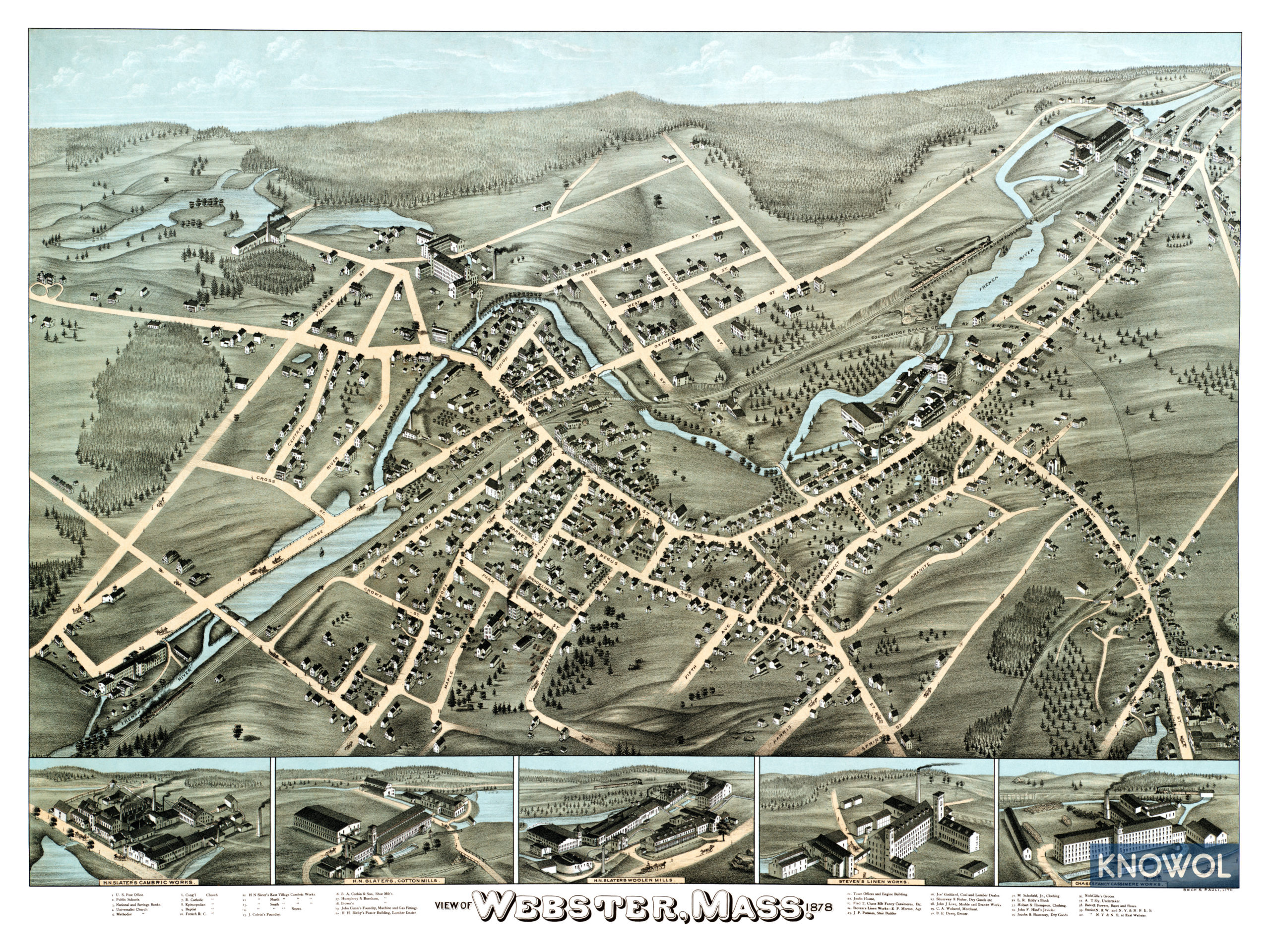
The bird's-eye view
By Beck & Pauli
Webster drawn as if from the sky in 1878, with its street names and old landmarks: Slater's Cambric Works and the cotton mills, Joe Goddard's Coal & Lumber, Shumway & Fisher Dry Goods, John Love's Marble & Granite Works, Hind's Jewelers and Bates & Powers Boots and Shoes.6
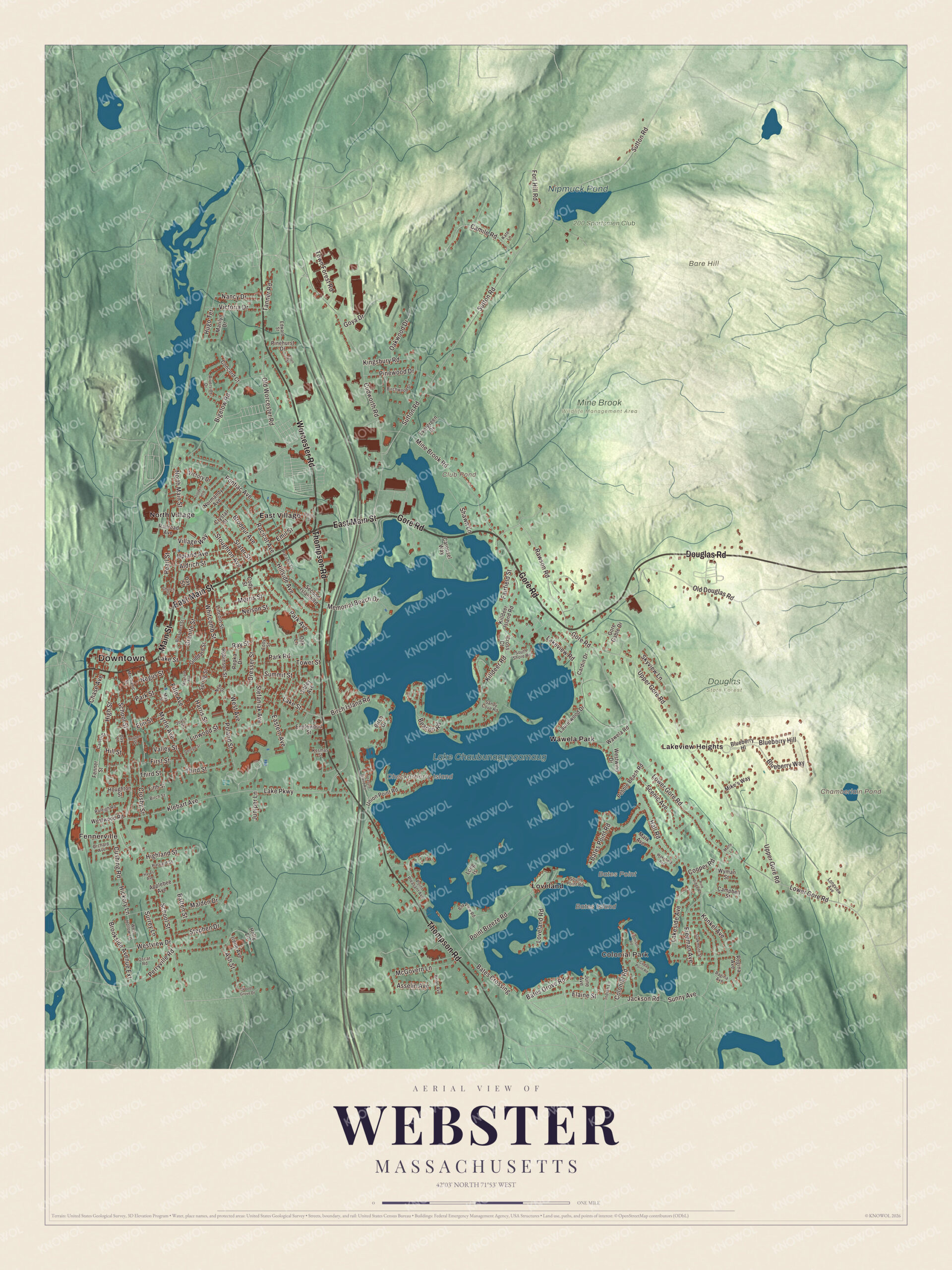
Webster today
By KNOWOL
The whole town as it looks today, from Downtown and Colonial Park out to Fennerville, East Village, Lakeview Heights, Loveland and North Village, with Gore Road, Main Street and Thompson Road, Bates Island, Checkerberry Island, Chamberlain Pond, Club Pond and Bare Hill.7
The history of Webster, Massachusetts
The great pond and its long name
Long before the mills, the big lake was a meeting ground. Daniel Gookin, writing of the Nipmuc praying towns in 1674, found about nine families at Chabanakongkomun, a village named for the very great pond beside it. A sworn statement of 1685 says a sachem named Tacomus gave Governor John Winthrop land along the pond's west side, and Stephen Day of Cambridge, the colony's first printer, received the deed. By 1853, a Dudley anniversary speech said, most people called it Slater's Pond. Historians puzzled over the old name. J. H. Trumbull read it as the boundary fishing place, a lake shared by Nipmuc and Mohegan fishermen, and an 1879 writer said hardly anyone spelled it the same way twice. By 1874 the town had stocked it with black bass.891011123
A most benighted region
In May 1811 Bela Tiffany wrote to Samuel Slater about the water power here. He found an unfinished house, a gristmill, a sawmill, a trip-hammer shop and thirteen or fourteen acres, half of it swamp, and called it a most benighted region, four miles from Oxford. The price was $4,000. Slater bought, and in 1812 he and Tiffany built the Green Mill at the East Village. Edward Howard, a Yorkshireman, started making broadcloth for Slater, and the 1879 county history believed it was the first attempt at American broadcloth. Israel Sibley built Howard a new kind of fulling mill and never patented it. In 1831 the settlers told the legislature the water power had made their rough land flourish, and Webster became a town in 1832.131415162
Rum, cheese and a box for 1976
Webster's early churches were raised by neighbors, and the bills tell on them. When the Baptists ordained Esek Brown in 1815, the schoolhouse they met in was too small, so Augustus Eddy built a big tent for the day. The Methodists' first meeting house of 1828 cost $1,467.40, and that included $2.92 for two and a half gallons of rum for the raising. At their second, in 1833, the crew got twenty-six pounds of cheese instead, which the 1879 historian called a noteworthy change in refreshments. Nathan Joslin opened the Webster Temperance House in 1844, and it was still run on strict temperance lines in 1879. On July 4, 1876, the town paraded, fired salutes at sunrise, noon and sunset, and sealed an account of the day in a metal box to be opened in 1976.171819
Webster, Massachusetts through the years
24 moments from 1642 to today.
- 1642About this year a sachem named Tacomus gives Governor John Winthrop land along the west side of the great pond.9
- 1674Daniel Gookin counts about nine Nipmuc families at the praying town of Chabanakongkomun, named for the pond.8
- 1713European settlement begins on land that will become Webster.7
- 1797A tract of 26 acres and 58 rods is deeded to the Commonwealth for the Nipmuc families of the Dudley reservation.20
- 1811Bela Tiffany looks over the water power for Samuel Slater and calls the region a most benighted one.13
- 1812Slater and Tiffany build the Green Mill at the East Village.14
- 1814The Baptist church is organized in a schoolhouse that stood where the Eddy Block is now.17
- 1815Esek Brown is ordained the Baptist pastor in a big tent built for the day.17
- 1823Irish newcomers Samuel Henderson and John McCausland help start the Methodist society.18
- 1828The Methodists raise their first meeting house, and the bill includes two and a half gallons of rum.18
- 1831People of Dudley, Oxford and the Oxford South Gore petition for a town of their own.2
- 1832Webster is incorporated on March 6, named in honor of Daniel Webster.21
- 1835Samuel Slater dies in Webster on April 20.22
- 1840The Norwich and Worcester Railroad is finished, with the station at what becomes the Depot Village.19
- 1841The post office, called South Oxford, moves from the East Village to the Depot Village.23
- 1843Henry E. Bugbee starts Webster's shoe business in a room under the Bradbury Tavern.24
- 1844Nathan Joslin opens the Webster Temperance House.19
- 1859The Webster Times begins publishing.25
- 1861The Slater Guards go to war as Company I of the 15th Massachusetts.4
- 1870The building holding the high school and the town hall burns in January, and a stone high school follows.26
- 1876Webster celebrates the Centennial and seals an account of the day in a box to be opened July 4, 1976.19
- 1878Beck & Pauli draw their bird's-eye view of Webster.6
- 1887Oscar Shumway builds the Shumway Block on Main Street.27
- 1928The Colonial Revival town hall on Main Street is completed.28
Places to see in Webster, Massachusetts
Places worth a visit in Webster today.
- DowntownMain Street. The old Depot Village, the business center.
- Main StreetDowntown. Brick business blocks from 1866 on.
- North VillageFrench River. Slater cotton mills by the river.
- East VillageLake outlet. Where the Green Mill rose in 1812.
- Bare HillEastern Webster. The Bear Hill of the old books.
- Gore RoadThe old Gore district. Recalls the old Oxford South Gore.
- Thompson RoadToward Connecticut. The old road south to Thompson.
- Worcester RoadToward Oxford. The road north toward Worcester.
Webster on the National Register of Historic Places
All 8 places in Webster on the National Register of Historic Places that still stand today, oldest first, and why each one matters.5
-
District Five Schoolhouse
Built in 1835 for $447.50, the one-room brick schoolhouse, also called the Fenner Hill School, was the first school the new town built. It closed in 1939, and since 1966 it has been the museum and headquarters of the Webster-Dudley Historical Society.29
-
Spaulding Block
One of the oldest commercial buildings in Webster, this three story brick building was built in 1866 by Cyrus Spaulding, and housed his hardware store. The Webster Times was also an early occupant, after its previous home was burned out.30
-
Rock Castle School
Webster's second high school building, built in 1871 of polychrome granite with high round-arch windows. It was the high school until 1905, served other schools off and on until 1972, and is now apartments.31
-
Eddy Block
Lyman R. Eddy built the three-story Gothic Revival brick block in 1878 on the site of an earlier block lost to fire. It has housed the post office, a district court, the Masonic Lodge and the Webster Times.32
-
Shumway Block
Oscar Shumway built this three-story brick block in 1887 after the wooden commercial building on the site burned in 1886. It's a well-preserved late Victorian block at the west end of downtown, near the railroad.27
-
Main Street Historic District
Fourteen brick and stone commercial buildings on Main Street between High and Church Streets, the heart of downtown Webster from the first commercial block of 1888 through the 1920s. Two of the district's buildings have been torn down since it was listed in 1982.33
-
Webster Municipal Buildings Historic District
The Colonial Revival town hall of 1927 and 1928 and the old Bartlett High School of 1903 to 1905 behind it, now senior housing, with the 1907 Soldiers' Monument and two Civil War-era howitzers on the town hall grounds. The district's 1920 Chester C. Corbin Library was torn down in 2016.28
-
Thompson School
The two-and-a-half-story English Revival brick school was built in 1912 and 1913 to a design by Walter F. Fontaine of Woonsocket, Rhode Island. It was named for Dr. John A. Thompson, who served on the school committee from 1907 until his death in 1916, and is now apartments.34
Webster in their words
“Near the centre of the town, at the base of a range of hills, lies as picturesque a lake as can be found in New England.”
History of Worcester County, 1879, Dr. Frederick D. Brown's chapter on Webster35
“If not the longest lake, it certainly has the longest name of any lake, in the county.”
A gazetteer of the state of Massachusetts, 187436
“Webster is distinguished for its excellent roads, its substantial bridges, and the pleasing variety of its natural scenery.”
History of Worcester County, 187937
Towns near Webster, Massachusetts
Sources for the history of Webster
- Webster, Massachusetts, Wikipedia
- History of Worcester County, Massachusetts (1889), on the petition and act of incorporation, Internet Archive
- A gazetteer of the state of Massachusetts (1874), on Lake Chaubunagungamaug, Internet Archive
- History of Worcester County, Massachusetts (1889), on Webster in the Civil War, Internet Archive
- National Register of Historic Places listings in Worcester County, Massachusetts, Wikipedia
- Beautifully detailed map of Webster, Mass in 1878, restored by KNOWOL
- Map of Webster, Massachusetts in 2026, KNOWOL
- The records of Oxford, Mass. (1894), on Chabanakongkomun, Internet Archive
- The Early Massachusetts Press, 1638-1711 (1907), on Stephen Day and Chapnacongoe Pond, Internet Archive
- An anniversary discourse, delivered at Dudley, Massachusetts, March 20, 1853 (1853), Internet Archive
- History of Worcester County, Massachusetts (1879), on the meaning of the lake's name, Internet Archive
- History of Worcester County, Massachusetts (1879), on the spellings of the lake's name, Internet Archive
- History of Worcester County, Massachusetts (1889), on Bela Tiffany's 1811 report, Internet Archive
- History of Worcester County, Massachusetts (1879), on the Green Mill, Internet Archive
- History of Worcester County, Massachusetts (1879), on Slater's broadcloth, Internet Archive
- The records of Oxford, Mass. (1894), on Israel Sibley's fulling mill, Internet Archive
- History of Worcester County, Massachusetts (1879), on the Baptist church, Internet Archive
- History of Worcester County, Massachusetts (1879), on the Methodist church, Internet Archive
- History of Worcester County, Massachusetts (1879), on the railroad, the Temperance House and the Centennial, Internet Archive
- Collections of the Worcester Society of Antiquity (1881), on the Dudley Nipmuc lands, Internet Archive
- A gazetteer of the state of Massachusetts (1890), on Webster, Internet Archive
- A gazetteer of the state of Massachusetts (1874), on Samuel Slater, Internet Archive
- History of Worcester County, Massachusetts (1889), on the post office and the depot village, Internet Archive
- History of Worcester County, Massachusetts (1879), on the shoe business, Internet Archive
- Leading manufacturers and merchants of central and western Massachusetts (1886), on the Town of Webster, Internet Archive
- History of Worcester County, Massachusetts (1879), on the high school fire, Internet Archive
- Shumway Block, Wikipedia
- Webster Municipal Buildings Historic District, Wikipedia
- District Five Schoolhouse, Wikipedia
- Spaulding Block, Wikipedia
- Rock Castle School, Wikipedia
- Eddy Block, Wikipedia
- Main Street Historic District, Wikipedia
- Thompson School, Wikipedia
- History of Worcester County, Massachusetts (1879), on Webster Lake, Internet Archive
- A gazetteer of the state of Massachusetts (1874), on the lake's long name, Internet Archive
- History of Worcester County, Massachusetts (1879), on Webster's roads and villages, Internet Archive