
An orchard town in Middlesex County that began as the praying town of Nashoba, argued its way through the Revolution, and kept its Lyceum lectures going every winter for close to a century after 1829.
Littleton, Massachusetts on the map
Click the map to look closer.
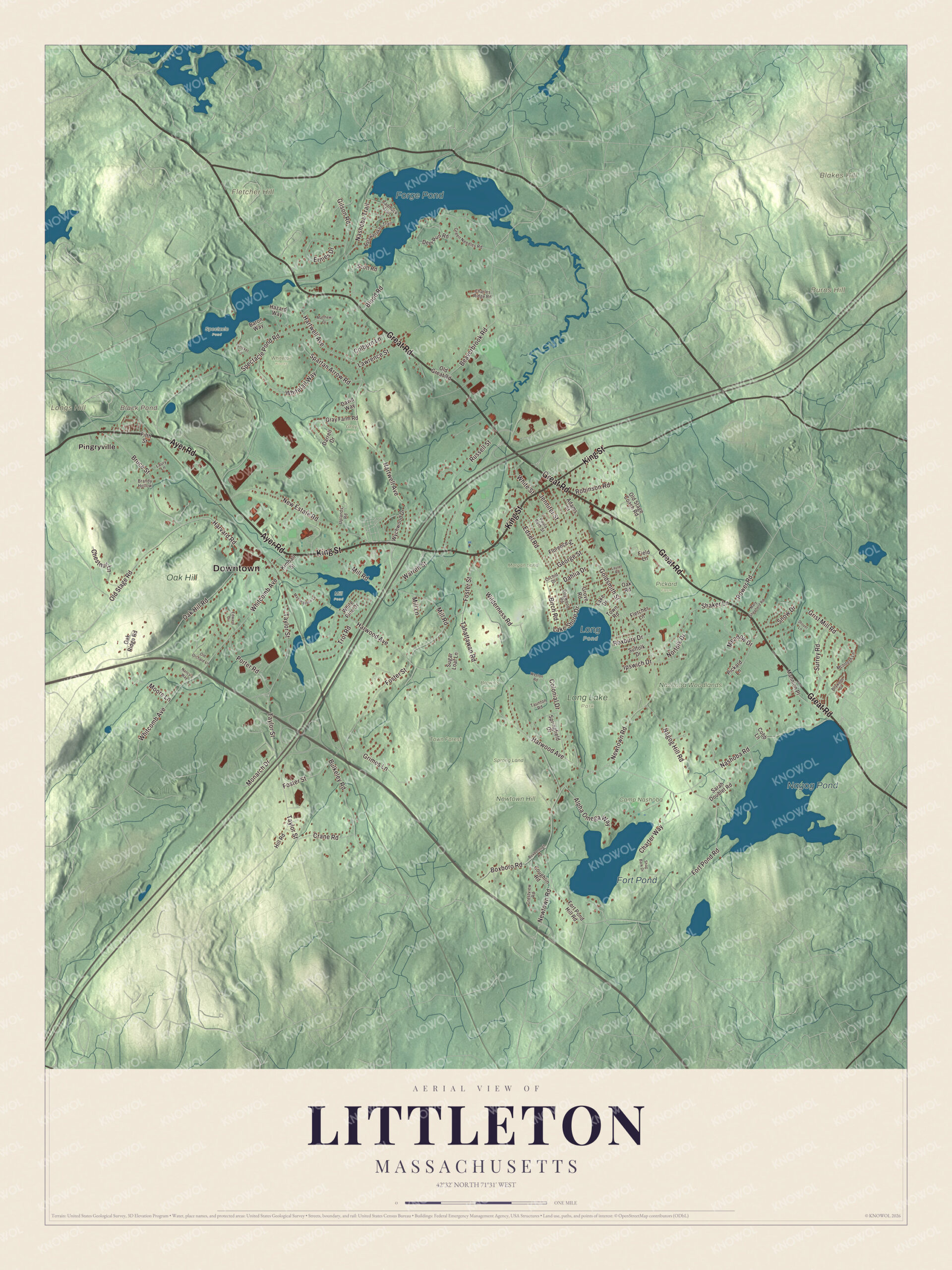
Littleton today
By KNOWOL
Shaded hills with Great Road, King Street, Ayer Road, Harvard Road, Taylor Street and Norfolk Drive, from Pingryville to the Common, with Nagog Pond, Fort Pond, Forge Pond, Black Pond, the Town Forest and Fletcher Hill.6
The history of Littleton, Massachusetts
Nashoba and the rumbling pond
Before it was Littleton it was Nashoba, a praying town that John Eliot asked the General Court to set up in May 1654. When Daniel Gookin described it in 1674, about ten families lived there, and they kept orchards of apples and made cider. Gookin also wrote of a nearby pond that made a strange rumbling noise at some seasons. Littleton's 1890 historian said that was surely Nagog, and that people still told of booms like cannon near Nashoba Hill. During King Philip's War the colony removed the Nashoba families, and very few ever came back. When the English township was made, 500 acres at its southeast corner were set aside as the Indian Farm, and the part of town called Newtown probably took its name from it.7819
The minister's door
Littleton took its time choosing a side, then chose firmly. On March 5, 1770, town meeting voted unanimously to shun anyone who bought from importers breaking the Boston merchants' agreement, and to drink no foreign tea. In the winter of 1772 to 1773 the cautious men on a town committee tried to let the Boston letters drop, but the town overruled them and chose its own Committee of Correspondence. Feeling ran high. The old minister, Rev. Daniel Rogers, was summoned out by an armed squad to declare his principles, and when he hesitated they fired a volley into his front door. People could still see the bullet holes in the casing in 1890. On April 19, 1775, the town handed out fourteen pounds of powder and thirty-eight pounds of bullets, and its men marched for Concord.10411
Tuesday night at the Lyceum
On December 21, 1829, Littleton people met in the Centre schoolhouse and formed the Littleton Lyceum, with their minister, Rev. William H. White, as its president for twenty-three years. The first winter brought readings, talks on astronomy and a debate. The 1890 town history says it met every year after that without a break, the only lyceum of its time in the state to do so. Ralph Waldo Emerson spoke there in 1854, 1857 and 1869, and Oliver Wendell Holmes, Bronson Alcott and Wendell Phillips took the platform too. In the 1869 to 1870 season Phillips was paid thirty dollars and Emerson twenty. Tuesday evenings in winter belonged to the Lyceum, and the historian warned that anyone who called another public meeting that night was rash indeed.312
Littleton, Massachusetts through the years
25 moments from 1654 to today.
- 1654John Eliot asks the General Court to make Nashoba a praying town.7
- 1674Daniel Gookin writes that the people of Nashoba keep apple orchards and make cider.8
- 1715The General Court orders that the new township be called Littleton.2
- 1716At the first recorded town meeting, Samuel Dudley is chosen town clerk and first selectman.2
- 1717Rev. Benjamin Shattuck is ordained the town's first minister on Christmas Day.13
- 1721The burying ground at the Common is laid out.14
- 1723The first meetinghouse on the Common is finally accepted as finished.13
- 1735The legislature lets Sarah Doublet sell the 500-acre Indian Farm to Elnathan and Ephraim Jones.9
- 1754Sarah Fox, widow of Capt. John Fox, is licensed to keep a public house in Littleton.15
- 1770Town meeting votes unanimously to drink no foreign tea.10
- 1775On April 19 the town's men march for Concord with powder and bullets from the town stock.11
- 1783Boxborough becomes its own town, taking almost a quarter of Littleton's land.1
- 1794The third meetinghouse, with a steeple and porches, is finished.16
- 1818Two stoves warm the meetinghouse for the first time.16
- 1822The Baptist Society organizes on March 14 and builds a brick meetinghouse.17
- 1829The Littleton Lyceum is formed on December 21 in the Centre schoolhouse.3
- 1844The Fitchburg Railroad reaches Littleton.1
- 1854Ralph Waldo Emerson lectures at the Lyceum on the English people.12
- 1862A new Tree Association sets out 106 trees along the town's roads on May 1.18
- 1875The Hoosac Tunnel is completed, with Benjamin D. Frost of Littleton as state engineer.19
- 1885The United States cattle quarantine station moves to Littleton from Waltham.20
- 1887The town hall and Reuben Hoar Library building is dedicated on July 28.21
- 1890A new line with Boxborough leaves the last two disputed farms mostly in Littleton.22
- 1895The Houghton Memorial Building is built as the town library.23
- 1930Arthur Rowse moves his Veryfine apple juice company to the Depot.1
Places to see in Littleton, Massachusetts
Places worth a visit in Littleton today.
- Littleton CommonKing Street. Old Common village and 1721 burying ground.
- Houghton Memorial BuildingRogers Street, the old Centre. 1895 library, now the historical society.Visit their website
- The DepotOn the Fitchburg Line. Railroad village that grew after 1844.
- Fox TavernFoster Street. Tavern house built around 1700.
- Liberty SquareBoxborough line. Where the minutemen mustered in 1775.
- Lake NagogActon line. Gookin's pond of strange rumbling noises.
- Fort PondOld Nashoba lands. One edge of the Nashoba plantation.
- Forge PondNorth Littleton. Once Stony Brook pond; old rail stop.
- PingryvilleToward Groton. Old village on the road to Groton.
Littleton on the National Register of Historic Places
All 3 places in Littleton on the National Register of Historic Places that still stand today, oldest first, and why each one matters.5
-
Old Burying Ground
Laid out in 1721, it was the town's first formal burying ground and its only one for about a hundred years. Its 340 markers date from 1721 to 1909, with the oldest graves near the front of the long, narrow lot.14
-
Reed-Wood Place
A connected New England farmstead. The main house was probably built before 1812 for Isaac and Mary Gardner Reed, and later generations gave it Federal, Greek Revival, Italianate and Gothic Revival touches; an ell links it to a shed and an early 1800s barn, now offices.24
-
Houghton Memorial Building
Perkins & Betton designed this yellow brick and terra cotta Colonial Revival library, a gift of Elizabeth and Clement S. Houghton, built in 1894 and 1895. It held the Reuben Hoar Library until the library moved to Shattuck Street in 1991, and it is now home to the Littleton Historical Society.23
Littleton in their words
“Littleton people are justly proud of this honored institution, which has been so well supported and has added much to the culture of the town.”
Herbert Joseph Harwood on the Littleton Lyceum, History of Middlesex County, 18903
“In Littleton the number of old families living on farms which have been handed down from sire to son for many generations is remarkable”
History of Middlesex County, 189025
“The meeting-house appears never to have been heated except by religious fervor or a town-meeting discussion until 1818”
Herbert Joseph Harwood, History of Middlesex County, 189016
Towns near Littleton, Massachusetts
Sources for the history of Littleton
- Littleton, Massachusetts, Wikipedia
- History of Middlesex County, Massachusetts (1890), on the naming of Littleton and the first town meeting, Internet Archive
- History of Middlesex County, Massachusetts (1890), on the Littleton Lyceum, Internet Archive
- History of Middlesex County, Massachusetts (1890), on Littleton before the Revolution, Internet Archive
- National Register of Historic Places listings in Middlesex County, Massachusetts, Wikipedia
- Map of Littleton, Massachusetts in 2026, KNOWOL
- History of Middlesex County, Massachusetts (1890), Littleton chapter by Herbert Joseph Harwood, on Eliot and Nashoba, Internet Archive
- History of Middlesex County, Massachusetts (1890), on Gookin's 1674 account of Nashoba, Internet Archive
- Proceedings of the Littleton Historical Society, No. 1 (1896), on the Indian Farm, Internet Archive
- History of Middlesex County, Massachusetts (1890), on the town votes of 1770 to 1773, Internet Archive
- History of Middlesex County, Massachusetts (1890), on April 19, 1775, Internet Archive
- Proceedings of the Littleton Historical Society, No. 1 (1896), on the Littleton Lyceum, Internet Archive
- History of Middlesex County, Massachusetts (1890), on Rev. Benjamin Shattuck and the first meetinghouse, Internet Archive
- Old Burying Ground, Wikipedia
- The acts and resolves, public and private, of the province of the Massachusetts Bay, vol. 15, on Sarah Fox's licence of 1754, Internet Archive
- History of Middlesex County, Massachusetts (1890), on the third meetinghouse, Internet Archive
- History of Middlesex County, Massachusetts (1890), on Littleton's churches, Internet Archive
- Proceedings of the Littleton Historical Society, No. 1 (1896), on the trees of Littleton, Internet Archive
- History of Middlesex County, Massachusetts (1890), on Littleton's business and people, Internet Archive
- History of Middlesex County, Massachusetts (1890), on the cattle quarantine station, Internet Archive
- History of Middlesex County, Massachusetts (1890), on Littleton's libraries, Internet Archive
- History of Middlesex County, Massachusetts (1890), on the Boxborough line and the Lawrence Tavern, Internet Archive
- Houghton Memorial Building, Wikipedia
- Reed-Wood Place, Wikipedia
- History of Middlesex County, Massachusetts (1890), on the Harwood family, Internet Archive