
The college town in the far northwest corner of Massachusetts, named under a soldier's will, where a free school paid for partly by a lottery grew into Williams College and the main street runs over three low rises under the maples.
Williamstown then and now
The same town 137 years apart. Click either map to look closer.
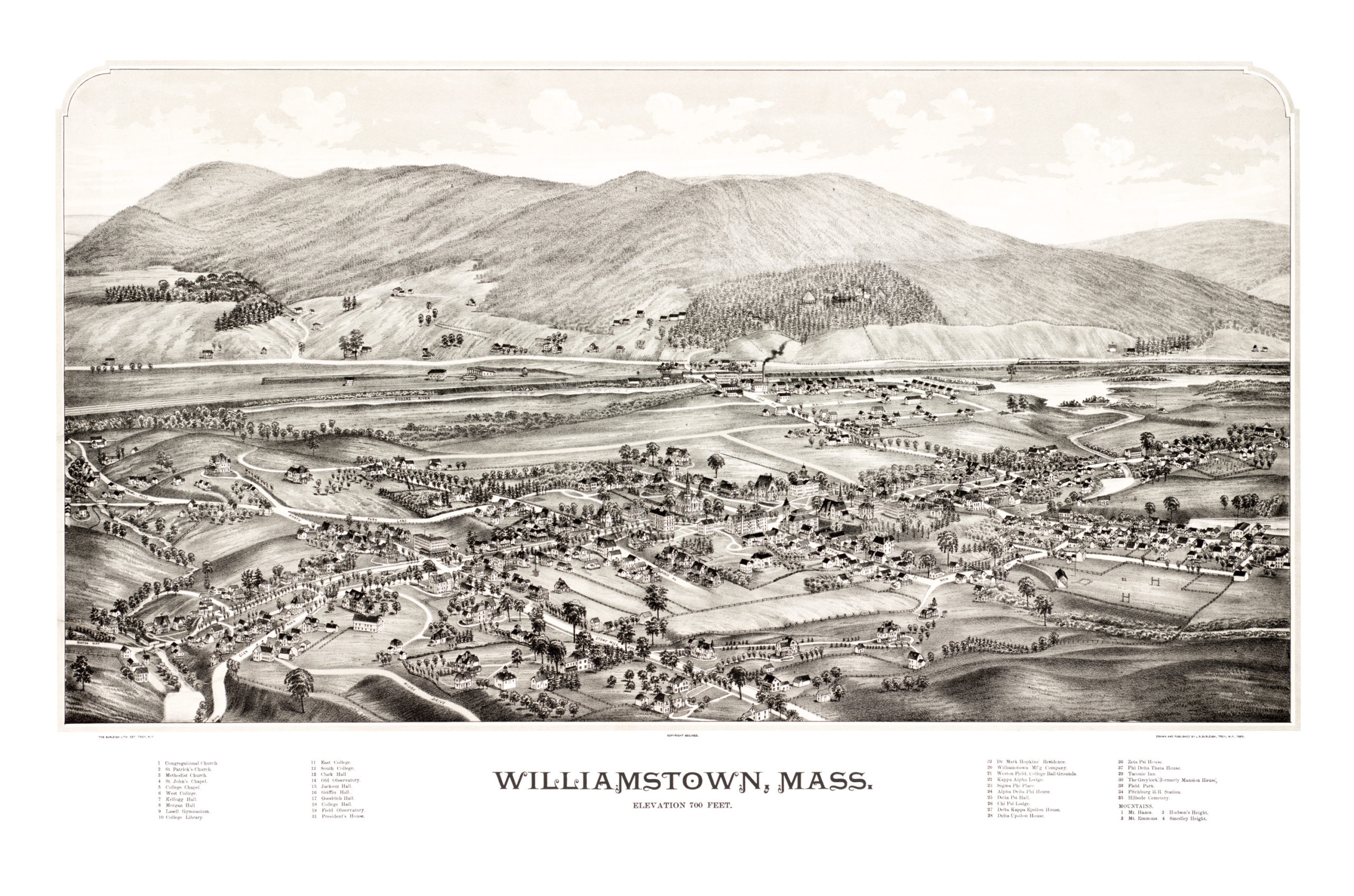
The bird's-eye view
By Lucien R. Burleigh
Williamstown drawn as if from the sky in 1889, with St. Patrick's Church, the College Chapel, West College, the Old Observatory, Weston Field, the Taconic Inn and The Greylock, and Williams College buildings such as Lasell Gymnasium and the President's House.5
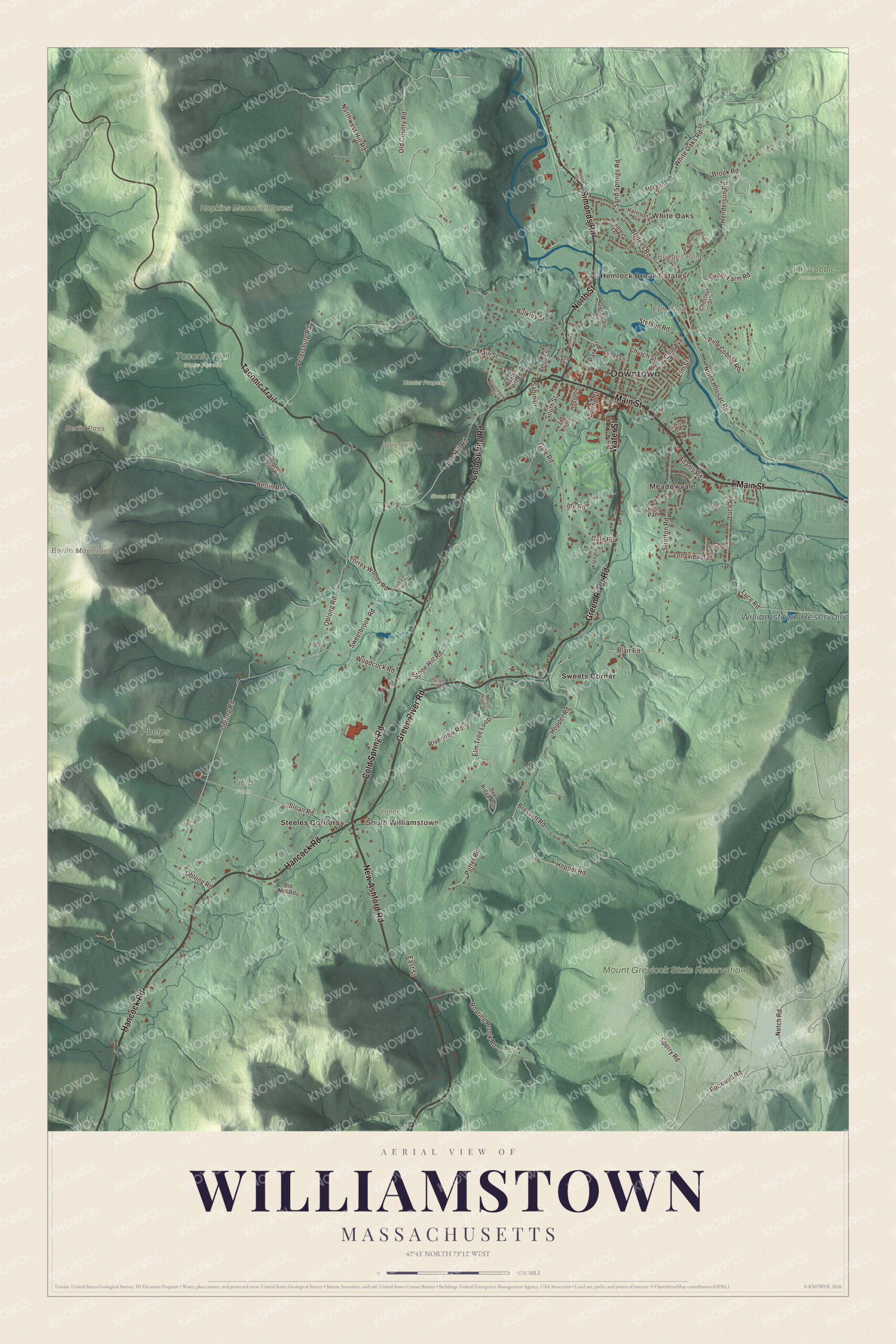
Williamstown today
By KNOWOL
Downtown, White Oaks, Meadowvale and South Williamstown with Main Street, Water Street, Cold Spring Road and the Taconic Trail, plus Bridges Pond, Eph Pond, Hopkins Memorial Forest, Mount Greylock State Reservation, Berlin Mountain and Berlin Pass printed on the artwork.6
The history of Williamstown, Massachusetts
Bread for Bennington
In the summer of 1777 Captain Nehemiah Smedley marched a company of 82 Williamstown men to Fort Edward, and they got home on July 24, only 21 days before the call came from Bennington. When it came, the town answered again. An 1892 Berkshire book says bread was baked for two days in the old oven in the cellar of the Smedley house for the soldiers, and young Levi Smedley carried some of it on horseback to Bennington. Families told it the same way for generations: nearly every able-bodied man in North Williamstown went to the fight. Afterward the General Court paid the town back for the powder, balls and flints it had taken from its own stock for the battle.7
A will, a lottery and a brick college
Col. Ephraim Williams commanded the frontier forts here and knew the first settlers well. In July 1755 he made his will at Albany, and in September he was killed near Lake George. He left the rest of his estate to a free school in a township west of Fort Massachusetts, on two conditions: the land had to fall inside Massachusetts once the line with New York was run, and the town had to be called Williamstown. Both came true. To pay for a building, the General Court granted the trustees a lottery, and the townspeople raised $2,000 more. In 1790 a brick building went up, 82 feet long and four stories high, with 28 rooms and a chapel. The school opened in October 1791 under Ebenezer Fitch, and it became Williams College in 1793.8931
The street under the maples
Williamstown's main street runs over three low rises. An 1844 history put East College and the chapel on the first, West College on the second and the Congregational church on the third. That church burned in the 1860s, and an 1869 guidebook said the street without it was a song without a cadence. Nearby, a marble shaft topped by a globe marked the spot where Samuel J. Mills and his friends met by a haystack to give their lives to foreign missions. Visitors kept noticing how open it all felt. One garden writer said there wasn't a fence to be seen in the village, as if every house had been set down in a large park, and a 1907 writer said you'd find a main street like it nowhere else.10111213
Williamstown, Massachusetts through the years
22 moments from 1749 to today.
- 1749On April 18 the General Court orders the West Township laid out, the land that becomes Williamstown.14
- 1755Col. Ephraim Williams makes his will at Albany, then is killed near Lake George on September 8.8
- 1756Fort West Hoosac, the westernmost blockhouse in Massachusetts, is built.1
- 1765West Hoosac is incorporated as Williamstown, and its first minister, Whitman Welch, is ordained that November.2
- 1777Bread is baked for two days in the Smedley house oven for the men gone to the Battle of Bennington.7
- 1790A brick building for the free school, now West College, goes up on the main street.3
- 1791The free school opens in October under Ebenezer Fitch.8
- 1793The free school becomes Williams College.1
- 1795Williams College holds its first commencement, on the first Wednesday in September.15
- 1806Samuel J. Mills and his friends meet by a haystack and pledge themselves to foreign missions.2
- 1808South Williamstown's first meeting-house is built by subscription, shared by Congregationalists and Baptists.16
- 1821Dr. Griffin, six feet three inches tall, comes to Williamstown at commencement, drawn by the haystack story.17
- 1826The First Congregational Church adds 133 members, the most in any year of its history.18
- 1838A wedge of land along the New York line is annexed to the town.14
- 1842East Lawn Cemetery opens on land given by Asahel Foote.19
- 1859The railroad reaches Williamstown.20
- 1866The Station Mill goes up on Cole Avenue for a textile business run by Williams College president Paul Chadbourne.21
- 1873Arthur Loop starts a cotton twine factory on the Green River at Water Street.22
- 1885The town's farms keep 2,361 sheep and 1,606 head of cattle.23
- 1889Lucien R. Burleigh publishes his bird's-eye view of Williamstown.5
- 1898A stone passenger station replaces the burned wooden one at the rail yard.20
- 1932The Classical Revival post office is built on Spring Street.24
Places to see in Williamstown, Massachusetts
Places worth a visit in Williamstown today.
- DowntownCenter of town. The village around the college.
- Main StreetDowntown. The old street over three rises.
- Water StreetAlong the Green River. The old mill street.
- White OaksNeighborhood. Once home to the Church of Christ.
- South WilliamstownSouth. The village at Five Corners.
- Cold Spring RoadSouth. The old stagecoach road south.
- Mount Greylock State ReservationSouthwest corner. Highest ground in town, 3,320 feet.Visit their website
- Berlin MountainTaconic Range, west. A peak on the western ridge.
- Taconic TrailWest. Route 2 climbing toward New York.
Williamstown on the National Register of Historic Places
All 7 places in Williamstown on the National Register of Historic Places that still stand today, oldest first, and why each one matters.4
-
Five Corners Historic District
The crossroads at the heart of South Williamstown, a center since about 1760 and a stop on the old north-south stagecoach road. It keeps the Sloan Tavern of about 1770, the 1868 South Center School and the Gothic Revival Second Congregational Church of 1875.25
-
Col. Benjamin Simond House
Benjamin Simonds first came here as a militia soldier at Fort Massachusetts in the 1740s, built this house and kept a tavern. He led the push to incorporate the town in 1765 and led a militia regiment at the Battle of Bennington. The house keeps much of its original woodwork.26
-
East Lawn Cemetery and Sherman Burbank Memorial Chapel
Opened in 1842 on land given by Asahel Foote when West Lawn Cemetery ran short of room, it grew to about 40 acres and is the town's largest cemetery. Its Late Gothic Revival chapel was designed in 1935 by Frank Rushmore Watson and dedicated in 1937.19
-
Williamstown Rail Yard and Station Historic District
Railroad service reached Williamstown in 1859, and this yard later staged the helper engines that pushed trains through the Hoosac Tunnel. The stone Richardsonian Romanesque passenger station of 1898 and the 1879 freight house still stand; the roundhouse does not.20
-
Mill Village Historic District
The workers' village of the Station Mill on Cole Avenue, with rows of company double houses built after the mill opened in 1866 for a textile business run by Williams College president Paul Chadbourne. A North Adams paper called it a model manufacturing community in 1878. The 1866 mill building was demolished after part of its roof fell in 2003, but the village stands.21
-
Boston Finishing Works
Arthur Loop started a cotton twine works on this Green River site in 1873, and its oldest surviving building dates from that year. The Boston Finishing Works finished cotton cloth here from 1892 to 1906, and later owners made corduroy, velvet and Cornish Wire's electrical cable until the plant closed in 2000.22
-
US Post Office, Williamstown Main
A brick Classical Revival post office with a Tuscan portico, built by the federal government in 1932 on the site of the town's old high school. Before it, the post office, opened in 1798, moved from one store to another.24
Williamstown in their words
“There is a novelty and beauty in this park-like main street of Williamstown which you will find nowhere else.”
In olde Massachusetts, 190713
“Williamstown street without the old church at the head of it, is a song without a cadence.”
From the Hub to the Hudson, 1869, after the old meeting-house burned11
“In the village of Williamstown there is not a fence to be seen in any direction. All the buildings seem to have been set down in a large park, and the effect is beautiful in the extreme.”
Transactions of the Worcester County Horticultural Society12
Towns near Williamstown, Massachusetts
Sources for the history of Williamstown
- Williamstown, Massachusetts, Wikipedia
- Haystack Prayer Meeting: the Haystack centennial celebration at Williamstown and North Adams, October 1906 (1906), Internet Archive
- A history of the early settlement of Newton (1854), on the Williamstown free school, Internet Archive
- National Register of Historic Places listings in Berkshire County, Massachusetts, Wikipedia
- Bird's eye view of Williamstown, Massachusetts in 1889, restored by KNOWOL
- Map of Williamstown, Massachusetts in 2026, KNOWOL
- Berkshire Book (1892), on Williamstown and Bennington, Internet Archive
- Historical collections relating to every town in Massachusetts (1844), on Col. Williams and the free school, Internet Archive
- History of Western Massachusetts (1855), on Col. Williams's will, Internet Archive
- Historical collections relating to every town in Massachusetts (1844), on the main street, Internet Archive
- From the Hub to the Hudson (1869), Internet Archive
- Transactions of the Worcester County Horticultural Society (1886), Internet Archive
- In olde Massachusetts (1907), Internet Archive
- Western Massachusetts: a history, 1636-1925 (1926), on the West Township, Internet Archive
- Encyclopedia of Massachusetts, biographical, genealogical (1916), on Ebenezer Fitch, Internet Archive
- Western Massachusetts: a history, 1636-1925 (1926), on the churches, Internet Archive
- Historic homes and institutions of Berkshire County, Massachusetts (1906), on Dr. Griffin, Internet Archive
- Proceedings in commemoration of the 150th anniversary of the First Congregational Church, Williamstown (1916), Internet Archive
- East Lawn Cemetery and Sherman Burbank Memorial Chapel, Wikipedia
- Williamstown Rail Yard and Station Historic District, Wikipedia
- Mill Village Historic District, Wikipedia
- Boston Finishing Works, Wikipedia
- A gazetteer of the state of Massachusetts (1890), Internet Archive
- US Post Office, Williamstown Main, Wikipedia
- Five Corners Historic District, Wikipedia
- Col. Benjamin Simond House, Wikipedia