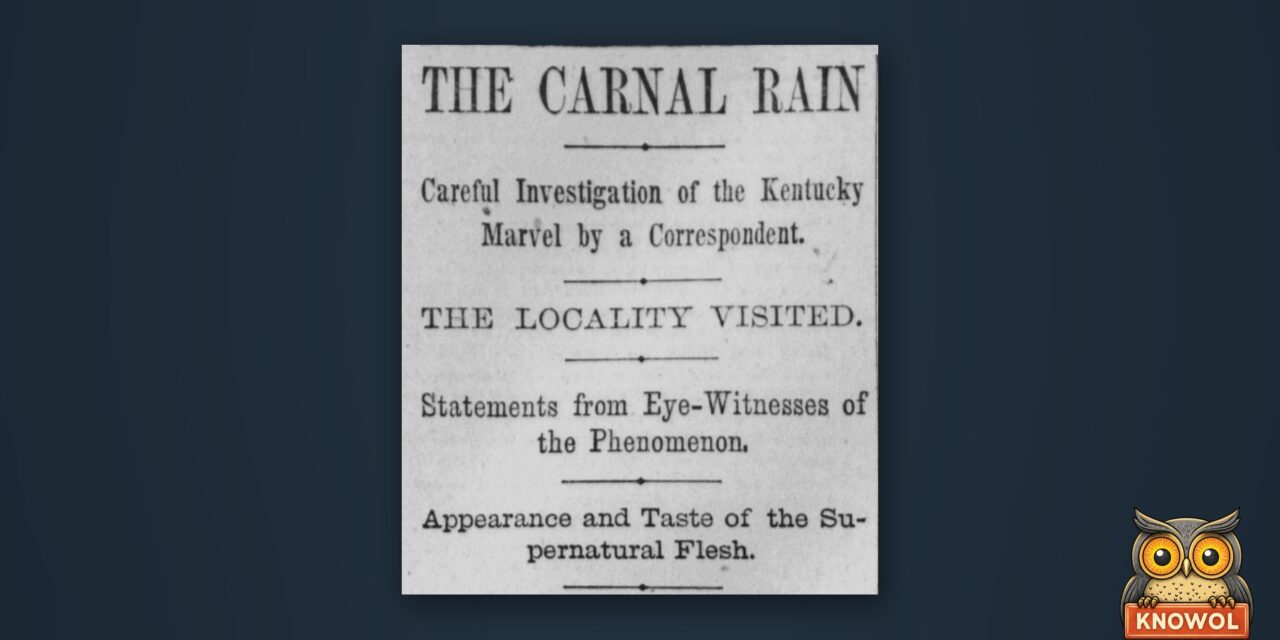
Late on the morning of Friday, March 3, 1876, Mrs. Crouch was out in the yard of her family’s hillside farm in Bath County, Kentucky, with her grandson, a boy of about eleven. The sky was clear and the sun was shining. Then something started coming down. “What is that falling, Allen?” she asked the boy. “He looked up and said, ‘Why, grandma, it’s snowing!'” It wasn’t snow. It was flakes of something that looked like raw meat.
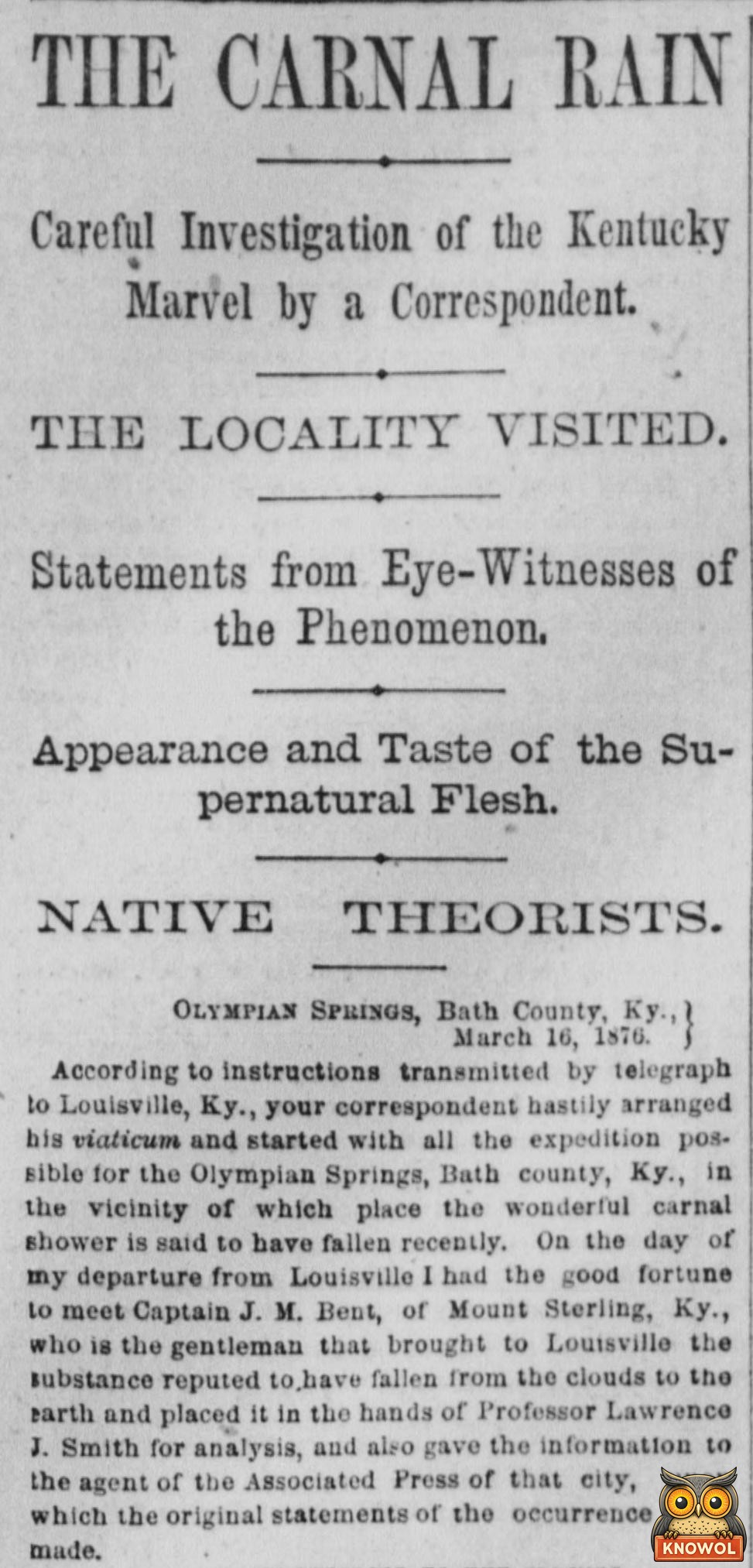
“The Carnal Rain,” the New York Herald, New York, New York, March 21, 1876. Library of Congress, Chronicling America. Click the clipping to read it full size.
A shower of flesh
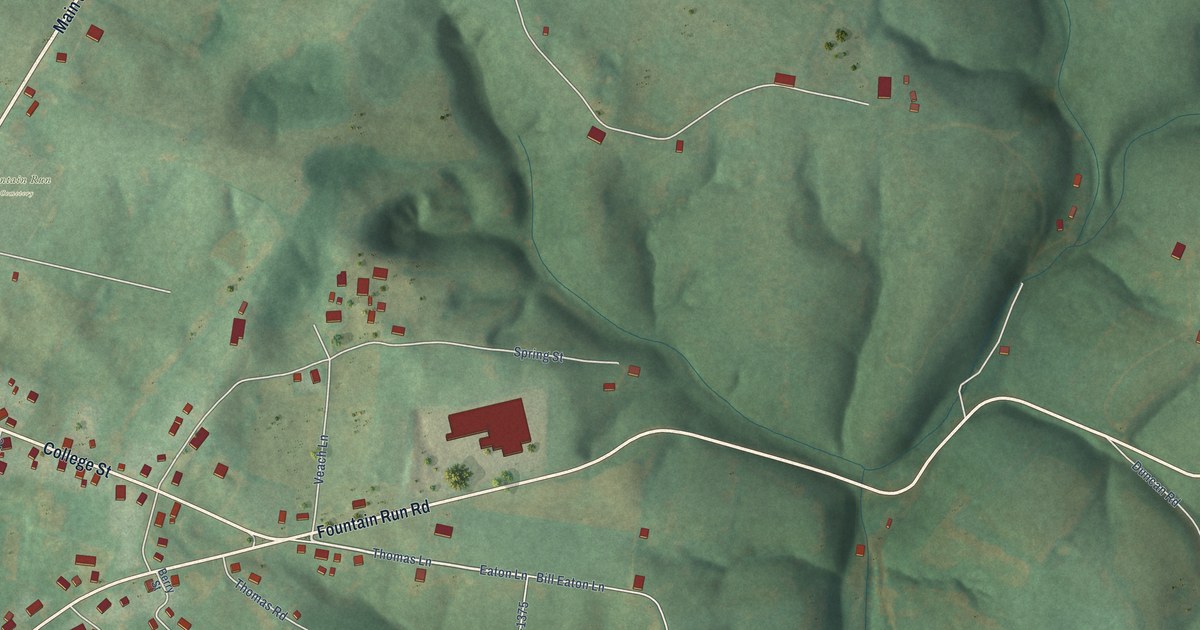
The Crouch farm sat about two miles from Olympian Springs, a mountain resort that the New York Herald said had once belonged to Henry Clay, and about seventeen miles east of Mount Sterling. “Men and women then went out and examined the flakes,” one early report said, “and discovered them to be flesh, resembling mutton. When picked up they quivered.” Pieces hung on the fences and trees, and dark stains marked the spots where they had landed.
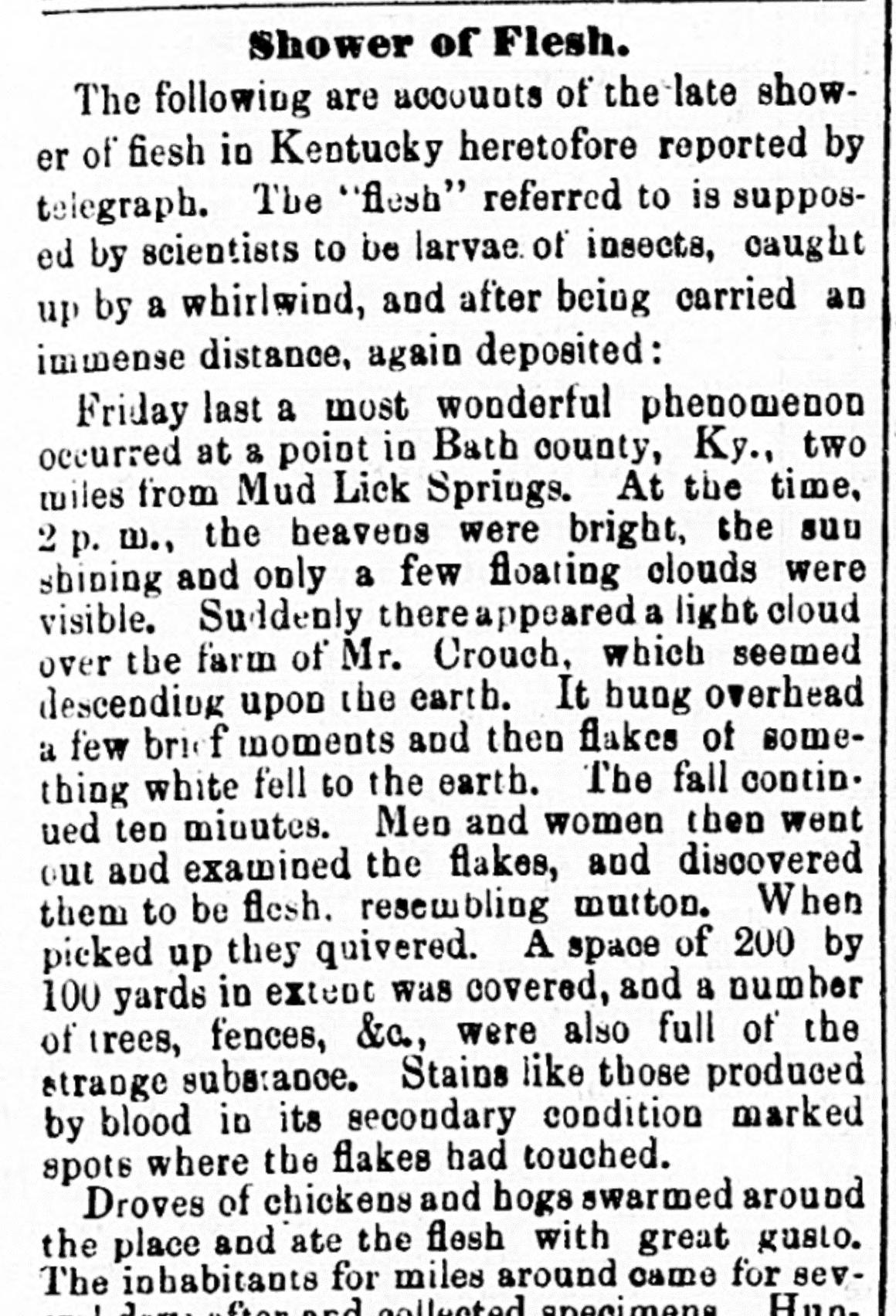
“Shower of Flesh,” Alexandria Gazette, Alexandria, Virginia, March 13, 1876, reprinting the first Kentucky reports. Library of Congress, Chronicling America. Click the clipping to read it full size.
The first telegraph reports put the fall at 2 o’clock and said it lasted ten minutes. When a New York Herald correspondent rode out through the mud about two weeks later, Mrs. Crouch told him it came between eleven and twelve and lasted only a minute or two. One piece hit the ground right behind her with a snap. The biggest one she saw “was as long as my hand, and about half an inch wide. It looked gristly, as if it had been torn from the throat of some animal.” The correspondent walked the yard, past the soap kettle, the ash hopper, the well and the hen house, where the flesh was said to have fallen. The kettle and the ash hopper, where wood ashes were turned into lye, meant the Crouches still made their own soap.
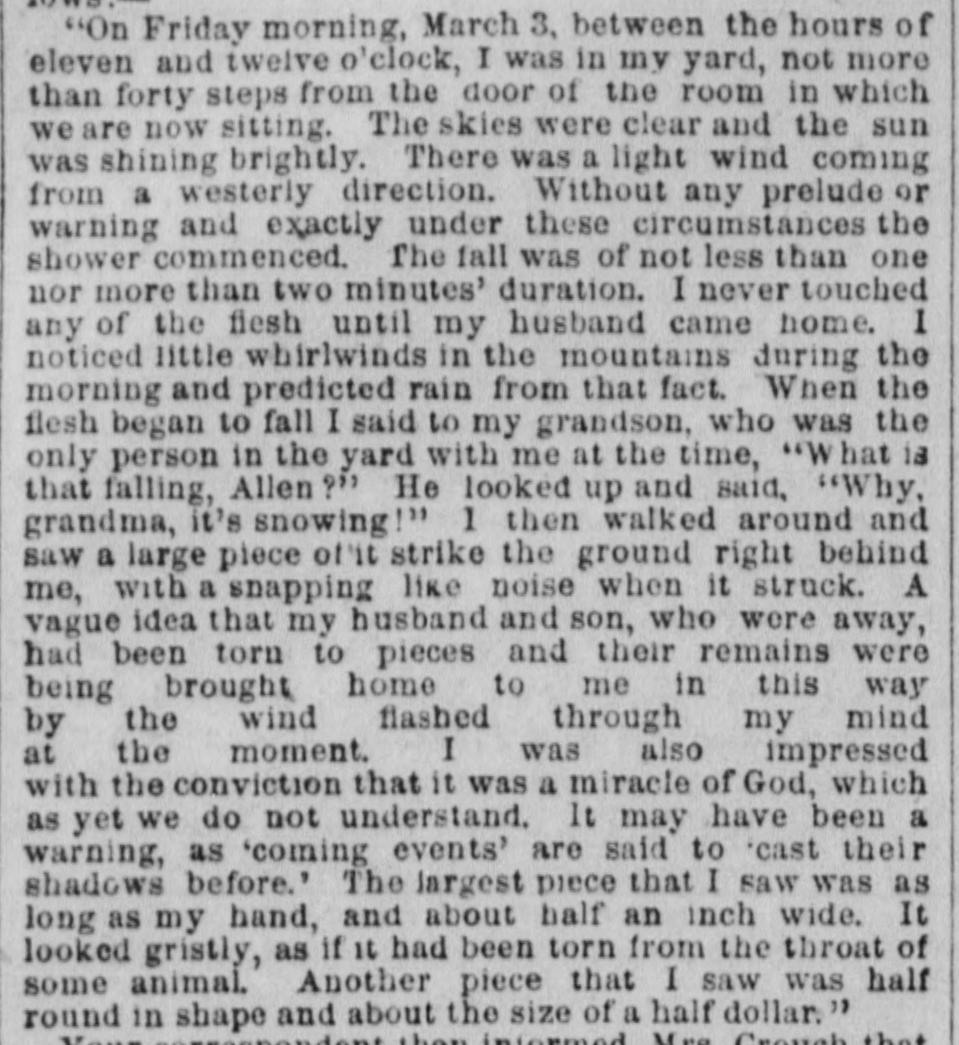
Mrs. Crouch’s own account, the New York Herald, March 21, 1876. Library of Congress, Chronicling America. Click the clipping to read it full size.
Hogs, chickens and one brave butcher
The chickens and hogs didn’t hesitate. They swarmed the yard and ate the flakes with gusto, the first report said. The neighbors were slower, and most of them refused to touch the stuff. Harrison Gill, who kept the springs, gathered pieces and put them up in alcohol for the experts.
Somebody did taste it. Captain J. M. Bent, a retired lawyer from Mount Sterling who carried samples to Louisville, told a reporter there that “a butcher of Mt. Sterling was in Bath county at the time, and shaved off a piece of the flesh with his knife. He roasted it and said the substance was palatable, but was not able to tell from what animal it came.”
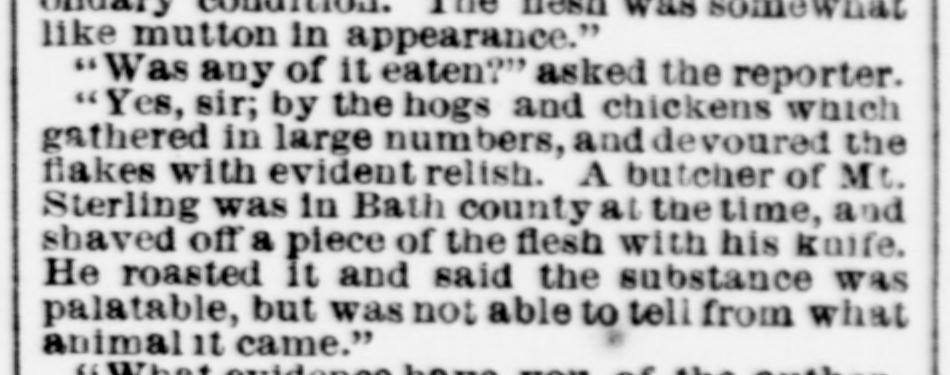
Captain Bent’s interview, from the Louisville Courier-Journal, reprinted in the Evening Star, Washington, D.C., March 13, 1876. Library of Congress, Chronicling America. Click the clipping to read it full size.
Frog spawn, a plant or buzzards
Professor J. Lawrence Smith of Louisville looked at the samples first. He called them dried frog spawn, blown in by the wind from ponds and swamps. The people who had seen the flesh, the Herald found, weren’t buying it. By May, a writer named L. Brandeis was arguing in a journal called the Sanitarian that it was Nostoc, a jelly-like plant that can spread fast over wet ground.
In June, a Georgia paper offered a third idea. Two men in Columbus said bits of flesh had come down around them in a back yard, and when they looked up they saw several buzzards about 100 feet above them. A Louisville professor had already suggested buzzards for the Kentucky shower, the paper added.
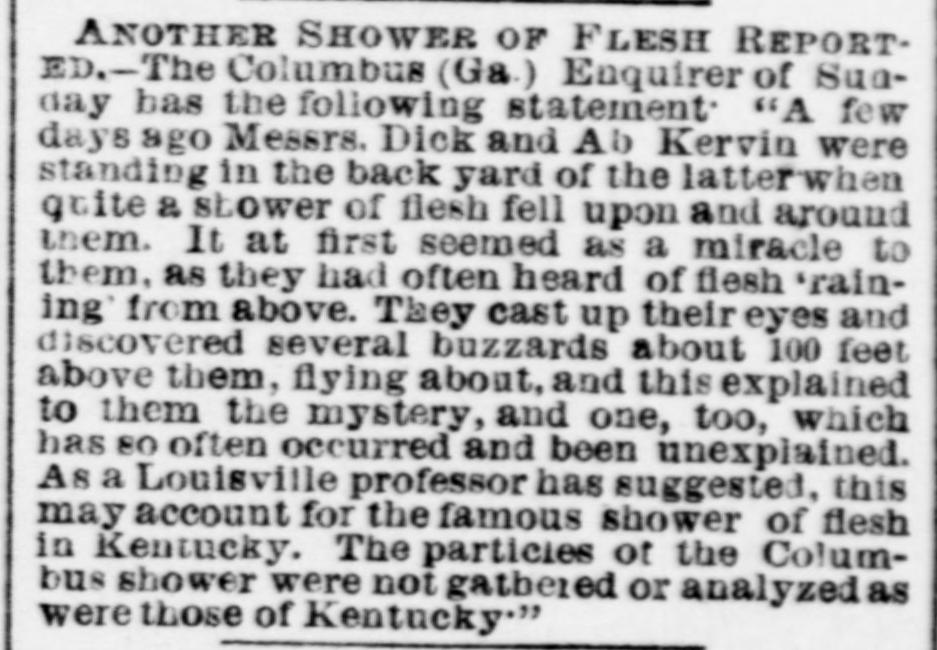
“Another Shower of Flesh Reported,” the Evening Star, Washington, D.C., June 21, 1876. Library of Congress, Chronicling America. Click the picture to see it full size.
Not everyone liked that answer. A Chicago reader who favored the Nostoc idea wrote to the Chicago Tribune that the Kentucky shower “was not caused by engorged buzzards flying over that particular place and disgorging themselves while in the air.”
Two witnesses
Through all the arguing, one fact stayed put. Mrs. Crouch and her grandson were the only two people who said they saw the flesh falling, Harrison Gill told the Herald. Everyone else came afterward and found it on the ground. The neighbors the correspondent talked to, from a basket maker down the road to a Mount Sterling butcher, said the Crouches were honest, churchgoing people. Mrs. Crouch never claimed to know what it was. She called it “a miracle of God, which as yet we do not understand.”
Sources
- The New York Herald (New York, N.Y.), March 21, 1876, page 4 (“The Carnal Rain”).
- Alexandria Gazette (Alexandria, Va.), March 13, 1876, page 1 (the first reports and Professor Smith’s finding, from the Louisville Courier-Journal).
- Evening Star (Washington, D.C.), March 13, 1876, page 3 (Captain Bent’s interview, from the Louisville Courier-Journal) and June 21, 1876, page 3 (the Columbus buzzards).
- Chicago Daily Tribune (Chicago, Ill.), June 25, 1876, page 7 (Brandeis and the Nostoc letter).
- All newspaper images: Library of Congress, Chronicling America. No known copyright restrictions.
- Cover: “The Carnal Rain,” the New York Herald, March 21, 1876, page 4. Library of Congress, Chronicling America.