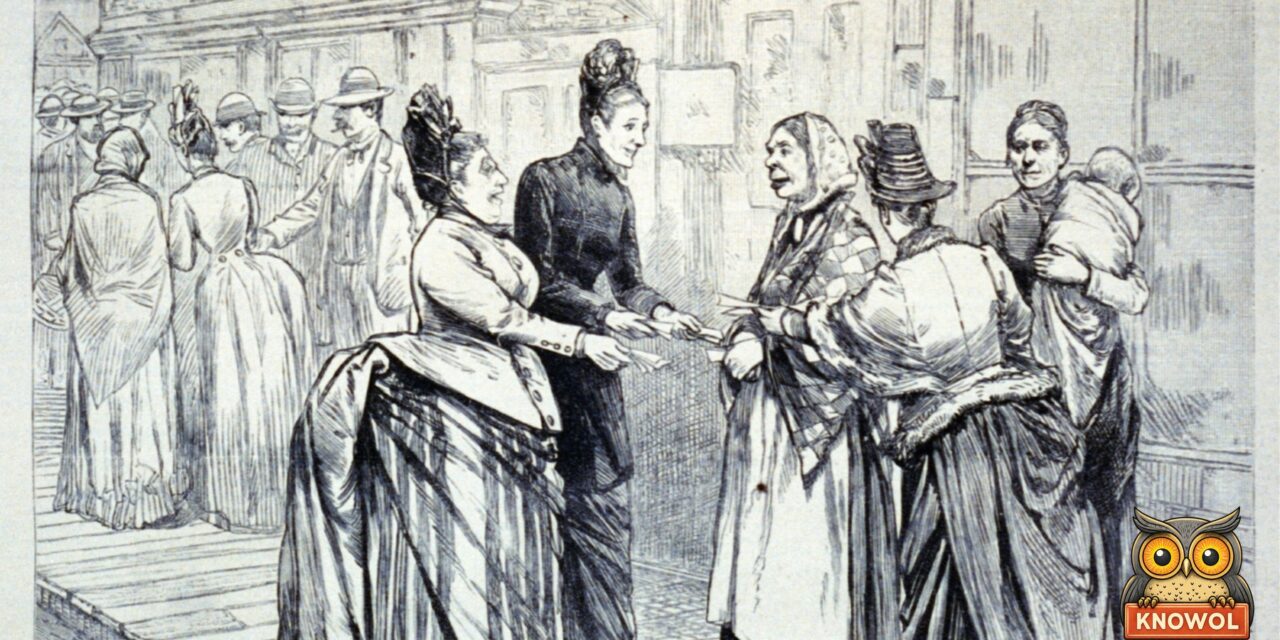
On Monday, April 4, 1887, election day in Argonia, Kansas, a few temperance workers went to see Susanna Madora Salter and found her at home doing the family wash. They brought bad news and a question. Someone in town had printed her name on the ballot for mayor as a joke, and they wanted to know if she would let them make it real.
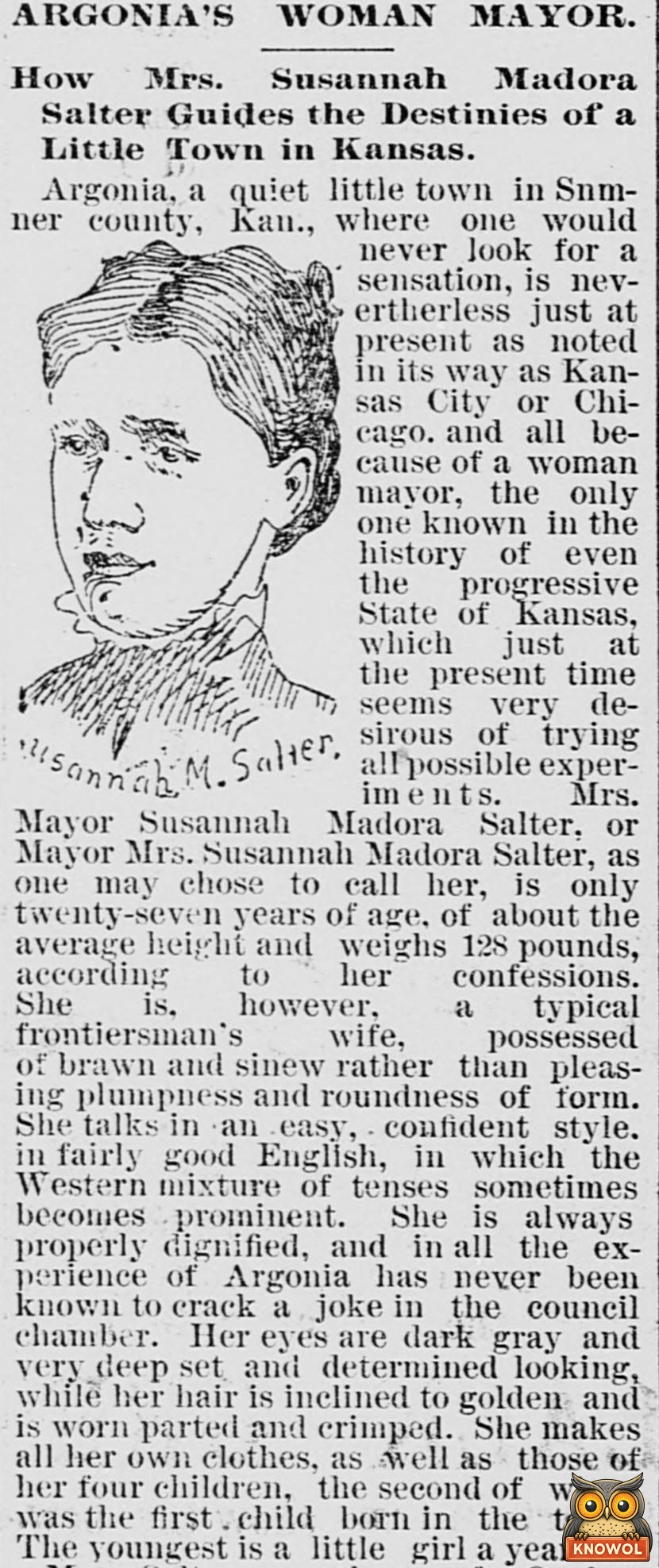
“Argonia’s Woman Mayor,” St. Paul Daily Globe, Saint Paul, Minnesota, September 11, 1887, page 21. Library of Congress, Chronicling America. Click the clipping to read it full size.
A ticket printed for a laugh
Argonia was a young town in Sumner County, southwest of Wichita. That spring was the first time Kansas women could vote in city elections, and the town’s Woman’s Christian Temperance Union, which wanted to keep liquor out, held a nominating meeting in the Baptist church on the Saturday night before the vote. Salter was 27, a mother of four, and one of its leaders.
The men on the other side had their own plan. On election day, the St. Paul Daily Globe later reported, the anti-Prohibitionists “ordered their tickets printed with Mrs. Salter’s name as the candidate for mayor as a burlesque.” The New-York Tribune put it more bluntly and blamed “an ill-bred wag,” who swapped her name onto the ticket in place of the temperance women’s own candidate for mayor. The idea was that a woman’s name at the top of the ballot would get laughed at.
“Finding her at the washtub”
The Globe told what happened next. “The temperance workers thereupon waited on Mrs. Salter, finding her at the washtub. She was exceedingly angry when informed of the insult, but after a council of war consented to take the office if elected.” Her friends spent the rest of the day bringing out voters, “and when the polls closed she had received three-fourths of the votes cast.” The Kansas Historical Society puts her share at about two-thirds. Either way, it wasn’t close.
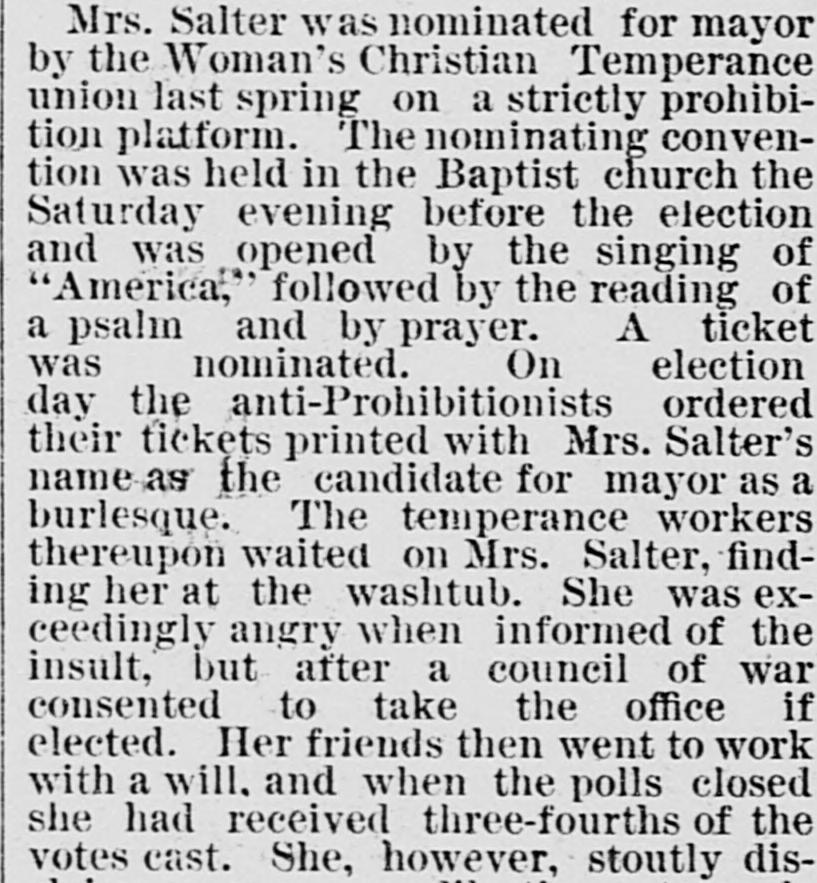
How the election was won, from “Argonia’s Woman Mayor,” St. Paul Daily Globe, September 11, 1887. Library of Congress, Chronicling America. Click the clipping to read it full size.
The joke had gone the wrong way for the joker. A little over two weeks after the vote, the Wichita Eagle passed the news along in five lines: “She is the first lady to be elected to that position in the United States.” Other Kansas towns elected women that spring, too. The Indianapolis Journal noted that Syracuse, Kansas, had just put five women on its city council, but Argonia was the one that made a woman its mayor.
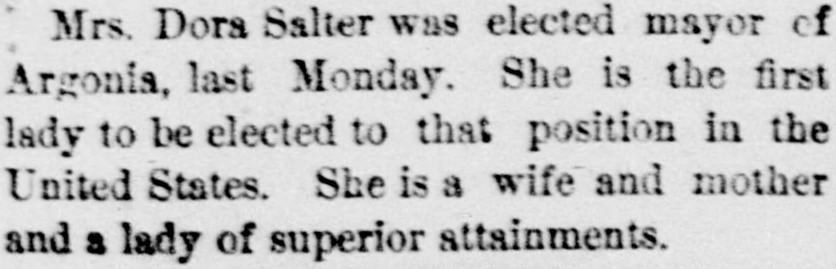
Wichita Eagle, Wichita, Kansas, April 20, 1887. Library of Congress, Chronicling America. Click the clipping to read it full size.
A corn house and a gasoline stove
Reporters who wrote about the new mayor were just as curious about her kitchen as her politics. Salter had grown up on a Kansas farm and met her husband at the state agricultural college. In 1883 the young couple moved to Argonia with her parents, and her father became the town’s first mayor. Their first home there was not much of one. “The first winter Mr. and Mrs. Salter lived in a deserted corn house, the windows of which were the chute holes,” the Globe said, “while the cooking was done on a gasoline stove, a portable heater furnishing warmth.”
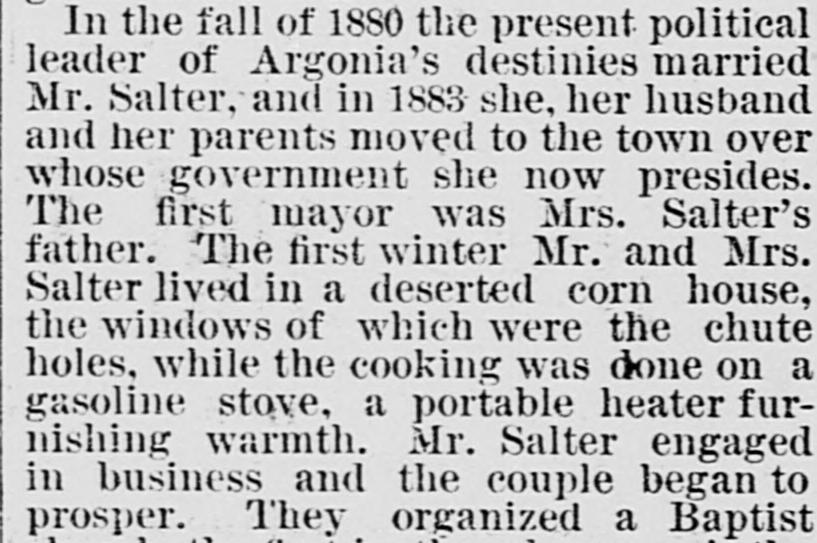
The Salters’ first winter in Argonia, St. Paul Daily Globe, September 11, 1887. Library of Congress, Chronicling America. Click the clipping to read it full size.
She sewed everything her family wore. “She makes all her own clothes, as well as those of her four children,” the paper reported, and she bragged that she had paid for the making of just one dress in her whole life. Being mayor didn’t make her rich, either. Her salary was one dollar a year.
“Magisterial frowns”
Salter ran the town council the way she had run her temperance meetings, by the rule book. The Globe said nobody had ever seen her crack a joke in the council chamber, and that “she presides with becoming severity, checking all inclinations to levity with magisterial frowns.” Some papers printed pen drawings of her face, like the one in the Globe. The Tribune didn’t think much of them. “We should be sorry to believe that she looks like it,” it said.
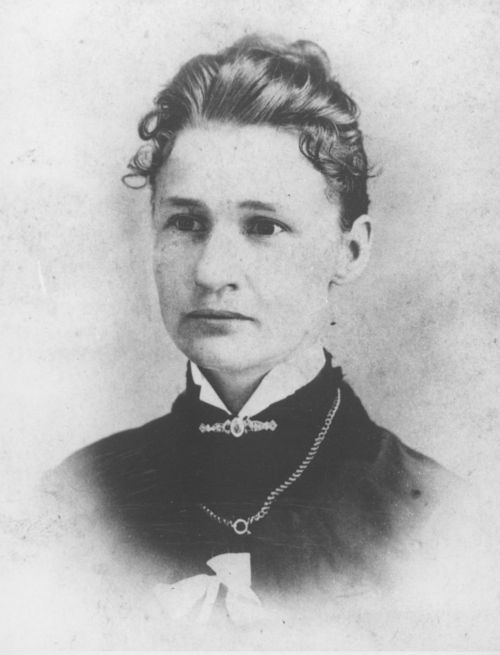
Susanna Madora Salter, 1887. Kansas Historical Society, via Wikimedia Commons (public domain). Click the picture to see it full size.
She never planned to keep the job. One term was all she wanted, the Globe reported, and whenever anyone asked, she said she would be glad to get back to private life.
One term and 101 years
She kept her word. Salter served her one-year term and never ran for office again. The family later moved to Oklahoma, and she died there in 1961, at the age of 101, according to the Kansas Historical Society.
The men who printed that ticket wanted a laugh at a woman’s name on the ballot. What they got was the first woman mayor in the United States.
Sources
- St. Paul Daily Globe (Saint Paul, Minn.), “Argonia’s Woman Mayor,” September 11, 1887, page 21.
- New-York Tribune (New York, N.Y.), August 28, 1887, page 4.
- Wichita Eagle (Wichita, Kan.), April 20, 1887, page 2.
- The Indianapolis Journal (Indianapolis, Ind.), April 24, 1887, page 2.
- All newspaper images: Library of Congress, Chronicling America. No known copyright restrictions.
- Kansas Historical Society, Kansapedia: Susanna Madora Salter, for the election date, the vote share, the new municipal vote for Kansas women, and her later life.
- Photograph: Susanna Madora Salter, 1887, unknown photographer, Kansas Historical Society, via Wikimedia Commons. Public domain in the United States.
- Cover: “Female suffrage in Kansas: fashionable ladies of Leavenworth soliciting votes at the polls, April 5th,” wood engraving after a sketch by J. Gibson, Frank Leslie’s Illustrated Newspaper, April 16, 1887 (cropped). Library of Congress Prints and Photographs Division, 2001696510. No known restrictions on publication.