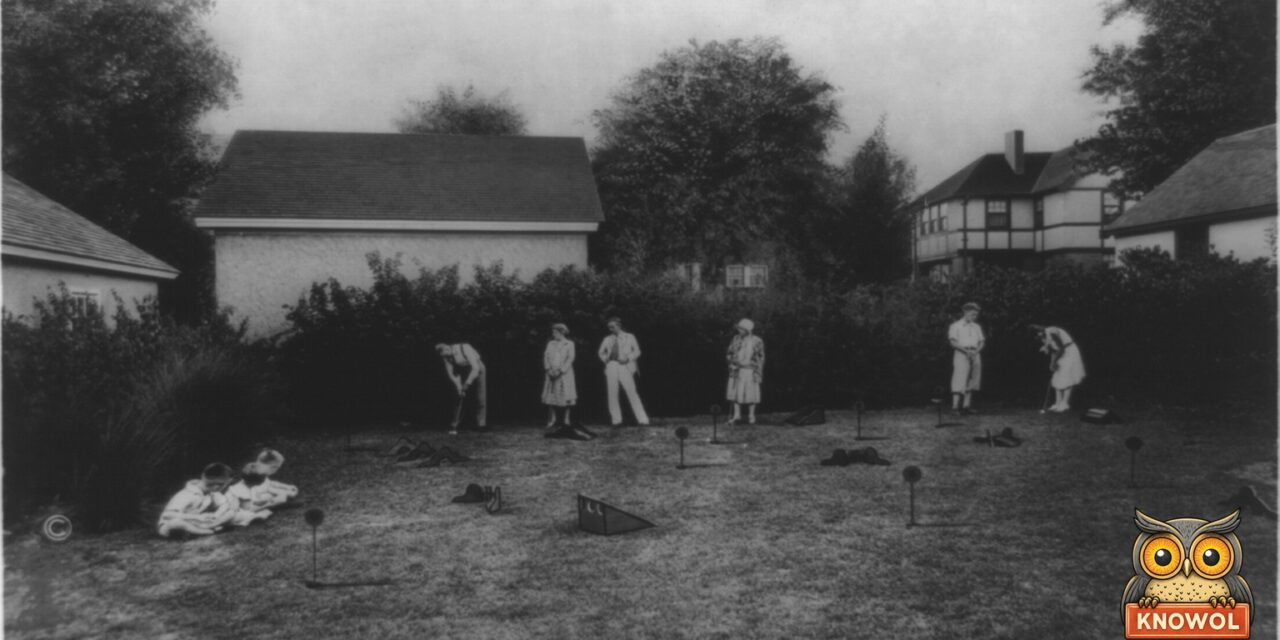
On Monday, October 20, 1930, players from more than 15 states lined up on top of Lookout Mountain, Georgia, for the first national miniature golf tournament. The course at Fairyland wound around mountain boulders, with holes 26 to 50 feet long and storybook gnomes and brownies standing among the greens. The men’s and women’s champions would each take home $2,000. The honorary sponsor was Garnet Carter, the Chattanooga real estate man who had started the whole craze by accident, and who had just sold out.
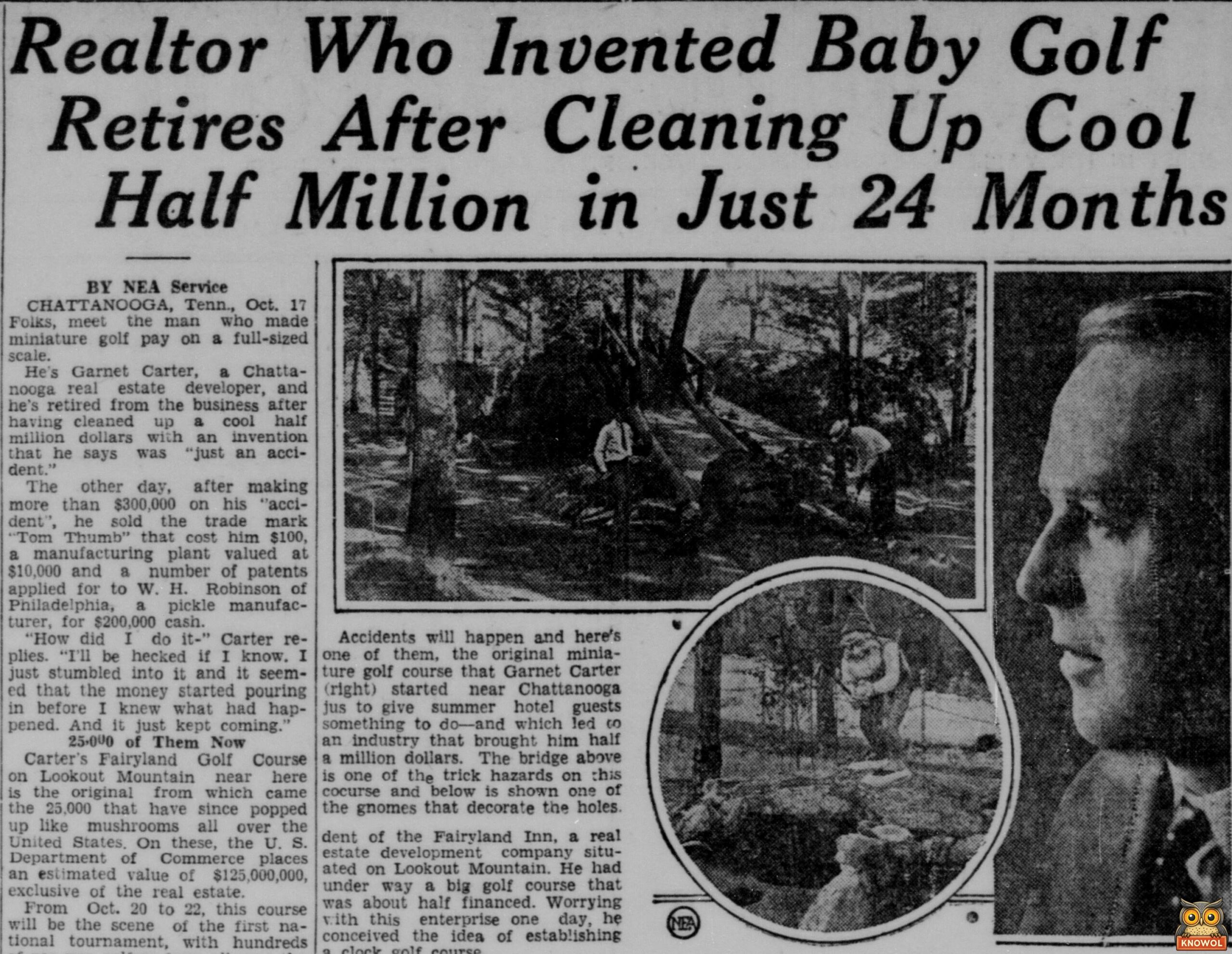
“Realtor Who Invented Baby Golf Retires,” an NEA Service story in the Brownsville Herald, Brownsville, Texas, October 17, 1930. The bridge is one of the trick hazards on the Fairyland course. Library of Congress, Chronicling America. Click the clipping to read it full size.
“A playground for children”
In 1924, Carter and a partner began building Fairyland, a neighborhood on the Georgia side of the mountain above Chattanooga. Buyers drew numbers from a hat to learn which lot they’d bought, the City of Lookout Mountain, Georgia, says. Carter opened the Fairyland Inn in 1925 and started a big golf course, but it was only about half paid for. While he worried over it, he began building putting greens around the boulders, with hazards and tunnels, for guests who didn’t want to play regular golf or dance. “Some of my friends jokingly inquired if I was building a playground for children,” he said later.
Hotel guests loved it, so he stretched it to 18 holes. A friend from Atlanta paid $2,000 for a copy and made his money back in three weeks. When Carter built one at the nearby Lookout Mountain Hotel, it took in more money the first day than the hotel’s fancy dining room.
25,000 little courses
Carter called it Tom Thumb Golf, built the courses in a factory and shipped them all over the country. By the fall of 1930 there were 25,000 miniature courses in the United States, and the Commerce Department valued them at $125 million, not counting the land. When a bond expert he knew asked how he was getting along, Carter answered, “I’m making over $1,000 a day in royalties.”
Fifteen cents for 18 holes
Courses went up on vacant lots, in backyards, indoors and even on a roof in Indianapolis. Washington’s first Tom Thumb course opened that spring at 17th and B streets, run by the government’s Office of Public Buildings and Parks. A round cost 15 cents on weekdays and 25 cents on Sundays, holidays and at night.
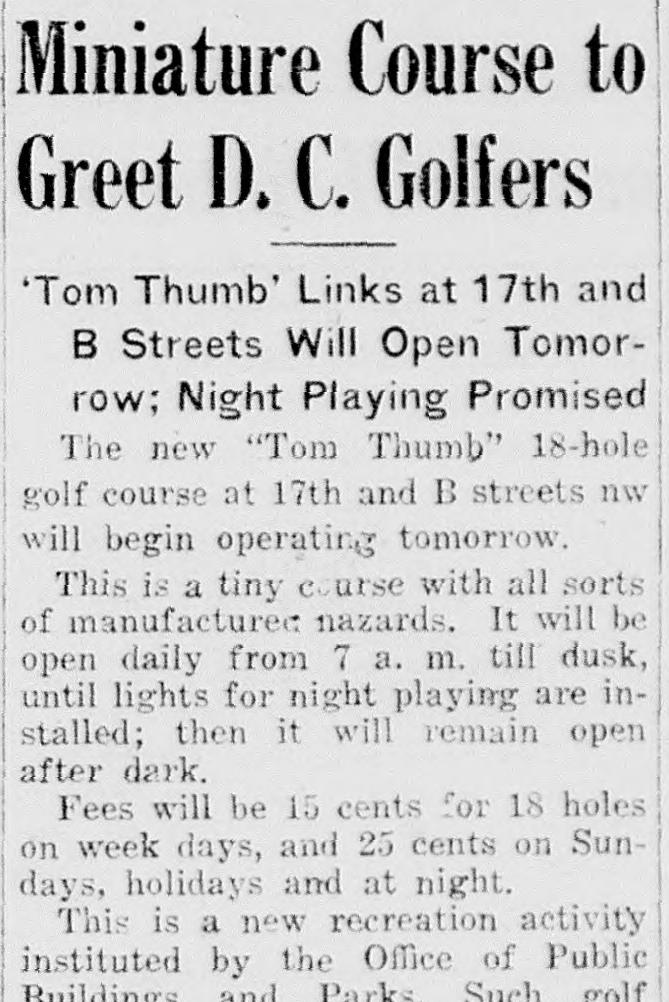
“Miniature Course to Greet D. C. Golfers,” the Washington Daily News, Washington, D.C., March 29, 1930. Library of Congress, Chronicling America. Click the clipping to read it full size.
In New Britain, Connecticut, two boys, 13 and 12, built a nine-hole course called the Putt-a-While and charged a nickel a round. They made nearly $2 the first day, and they hadn’t yet asked the man who owned the lot. In Chicago, an indoor course put palm trees under the ceiling.
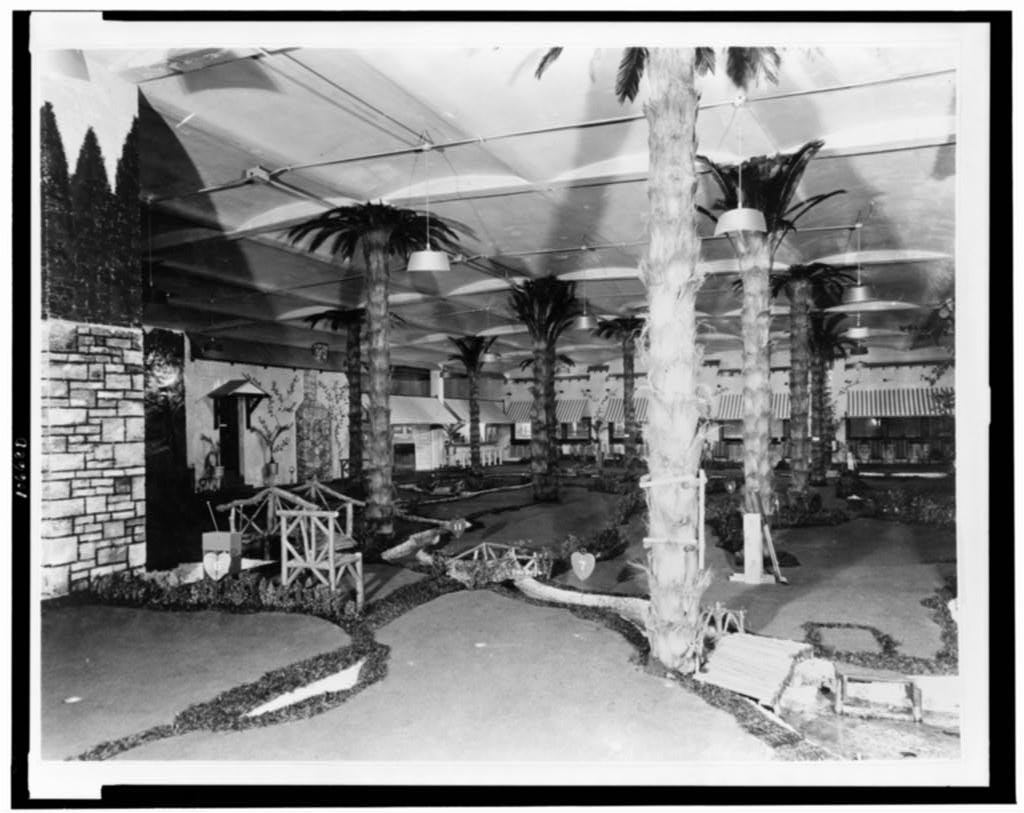
The Riviera Indoor Golf Course, 4845 Broadway, Chicago, Illinois, about 1930. Library of Congress Prints and Photographs Division. Click the picture to see it full size.
That August, Will Rogers counted 3,500 courses in Los Angeles alone. “Nothing only there is millions got a ‘putter’ in their hand when they ought to have a shovel,” he wrote. “Half of America is bent over.”
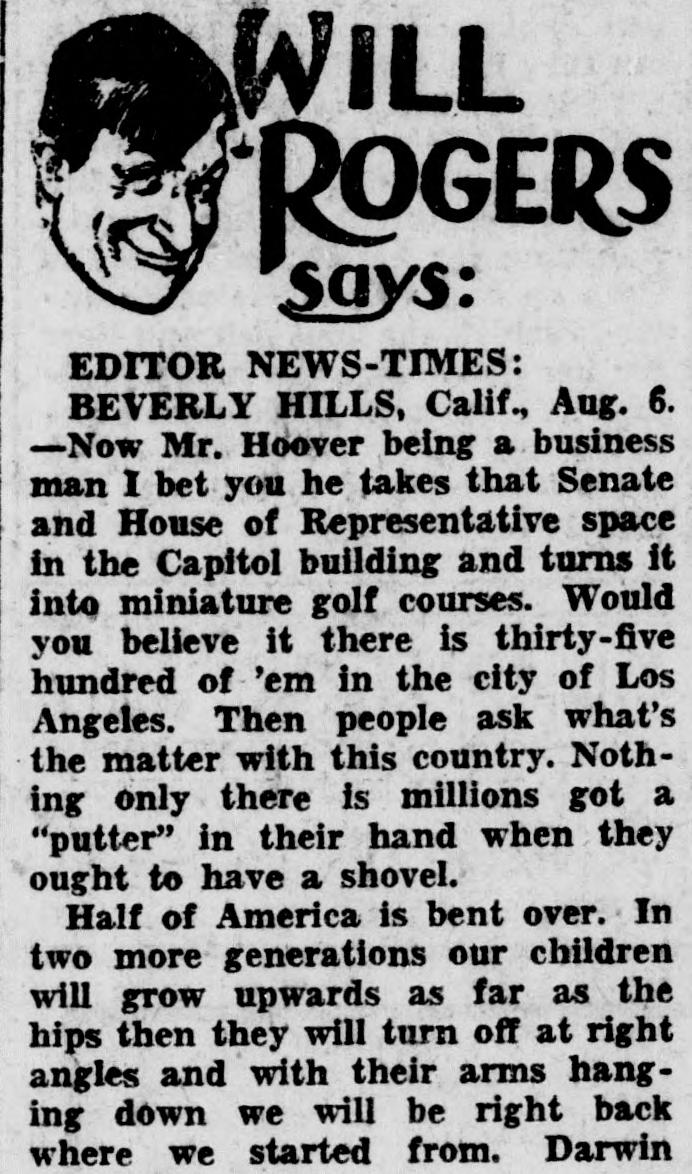
“Will Rogers Says,” the South Bend News-Times, South Bend, Indiana, August 7, 1930. Library of Congress, Chronicling America. Click the clipping to read it full size.
“They kidnaped me”
In September 1930, after making more than $300,000, Carter sold the Tom Thumb name, his factory and his patents to W. H. Robinson, a Philadelphia pickle maker, for $200,000 cash. The name had cost him $100. “They kidnaped me, brought me to Chattanooga in an auto and bought me out the very next day,” Carter said. Carter, born in 1883, had no children. “I have the finest collie dog you ever saw,” he told the reporter. A few weeks later, two players from Jacksonville, Florida, J. K. Scott and Mrs. J. E. Rankin, won the national titles on his Fairyland course.
Rock City
Carter didn’t stay retired. He and his wife turned to the rocky eastern brow of the mountain and opened Rock City Gardens on May 21, 1932. He died at home on Lookout Mountain in July 1954, at 71. By then, the Associated Press noted, he had put his black-and-white Rock City signs on barns throughout the country.
Sources
- Brownsville Herald (Brownsville, Tex.), October 17, 1930, page 2 (NEA Service story on Garnet Carter; the same story ran in the Indianapolis Times, September 29, 1930, page 1).
- South Bend News-Times (South Bend, Ind.), October 21, 1930, page 15 (the tournament) and August 7, 1930, page 1 (Will Rogers).
- New Britain Herald (New Britain, Conn.), August 26, 1930, page 11 (the Putt-a-While) and October 23, 1930, page 20 (the champions).
- The Washington Daily News (Washington, D.C.), March 29, 1930, page 3.
- The Indianapolis Times (Indianapolis, Ind.), August 6, 1930, page 6 (the Roof Garden Golf Course).
- Evening Star (Washington, D.C.), April 26, 1953, page 113 (Rock City’s founding date) and July 22, 1954, page 26 (Carter’s obituary, Associated Press).
- All newspaper images: Library of Congress, Chronicling America. No known copyright restrictions.
- “The Riviera Indoor Golf Course, 4845 Broadway, Chicago, Ill,” about 1930, Library of Congress Prints and Photographs Division, LC-USZ62-106680. No known restrictions on publication.
- City of Lookout Mountain, Georgia, “History”.
- Cover: “Happy hazard golf set at residence of George W. Humphrey,” photograph by H. P. Comstock, 1930. Library of Congress Prints and Photographs Division. No known restrictions on publication.