On Sunday night, October 30, 1938, James Anderson had already gone to bed in his farmhouse at Grovers Mill, a village of about 200 people four miles east of Princeton, in West Windsor, New Jersey. He and his wife lived on the old Wilson farm, one of three tenant families there. His wife had been listening to the Charlie McCarthy program, and she turned the dial to the Mercury Theater on the Air just in time to hear a news bulletin: a huge meteor had fallen in her barnyard. She woke her husband. He went out on the porch and looked around. “Durn fools,” he said, and went back to bed.
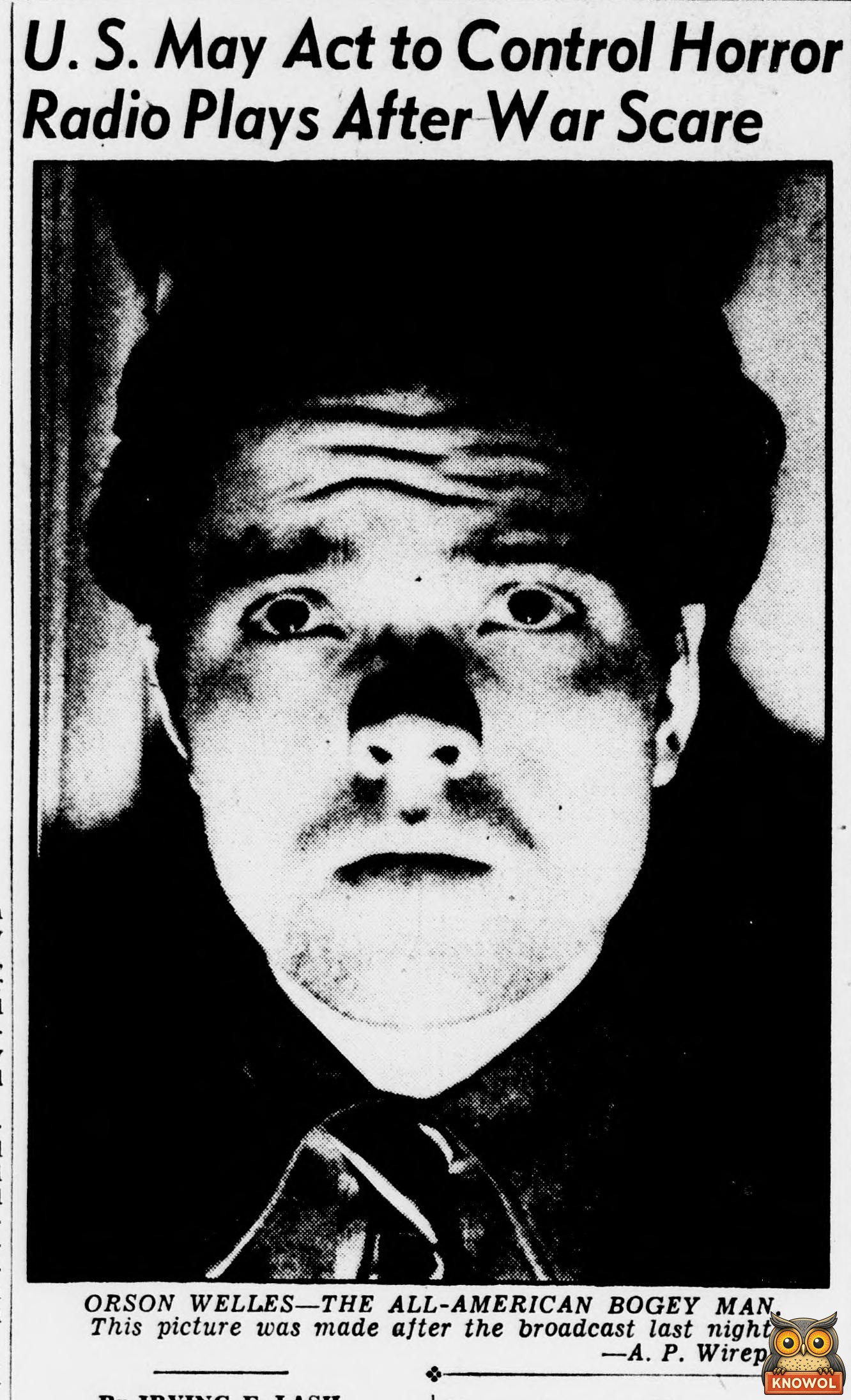
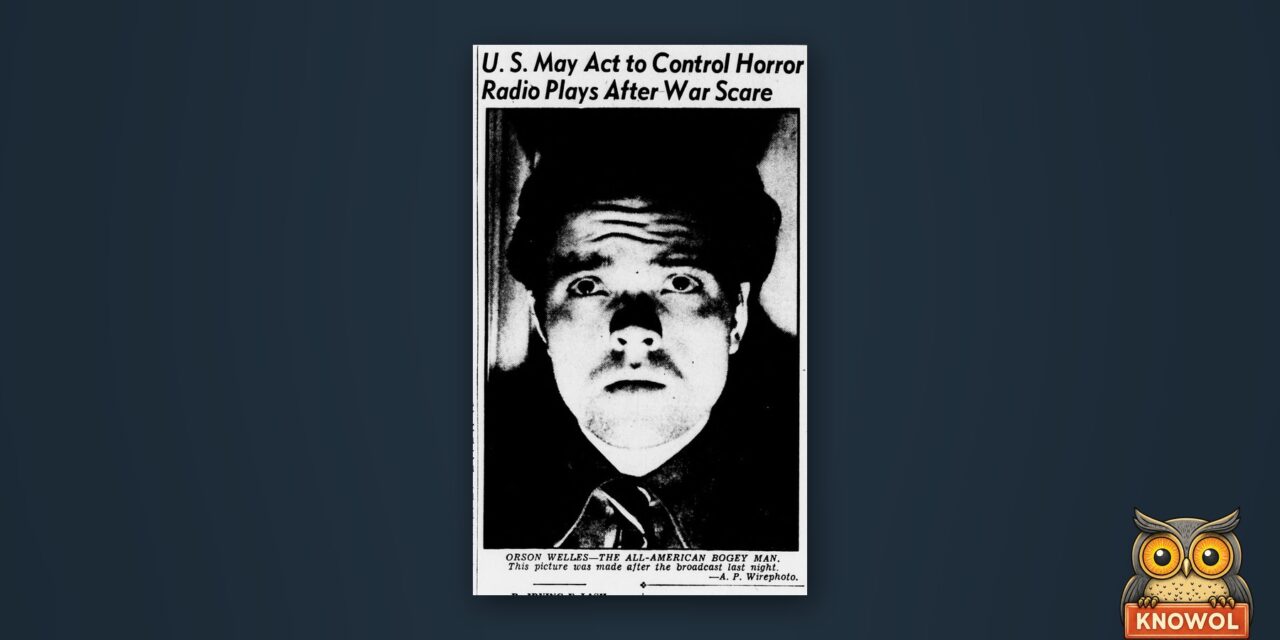
“U.S. May Act to Control Horror Radio Plays After War Scare,” with a photograph of Orson Welles taken after the broadcast, the Evening Star, Washington, D.C., October 31, 1938. Library of Congress, Chronicling America. Click the clipping to read it full size.
A play that sounded like the news
The bulletin was part of a play. At 8 o’clock that evening, Orson Welles, a 23-year-old Broadway director, and his Mercury Theater company went on the air over the Columbia network with a version of H. G. Wells’s old novel “The War of the Worlds.” They moved the story to New Jersey and told it as a string of news flashes breaking into a program of dance music. An observatory reported explosions on Mars, and an astronomer at Princeton tried to explain them. Then a “meteor” came down at Grovers Mill. It turned out to be a metal cylinder, its top unscrewed, and creatures from Mars crawled out with death rays.
The actors called the landing place the Wilmuth farm. Over the radio it sounded like “Wilson,” and Grovers Mill really had an old Wilson farm.
What the papers said the next day
Monday’s papers were full of it. Police stations and newspaper offices across the country had been swamped with telephone calls from people asking the same thing: “Is it true?” The Evening Star in Washington said it alone took more than 400 calls. In Newark, it reported, hundreds of people ran into the streets with towels and handkerchiefs around their heads to keep out the poison gas. In New York, an actress named Caroline Cantlon heard the play’s report of smoke in Times Square, rushed to the street, fell and broke her arm. In Richmond, Virginia, a father of eight was at the corner drugstore when one of his children phoned: “Mama says come home quick. The world’s coming to an end.” He hurried home and found the family in a circle, praying. The headlines talked about a nation in terror, and the Federal Communications Commission asked the Columbia network for a copy of the script.
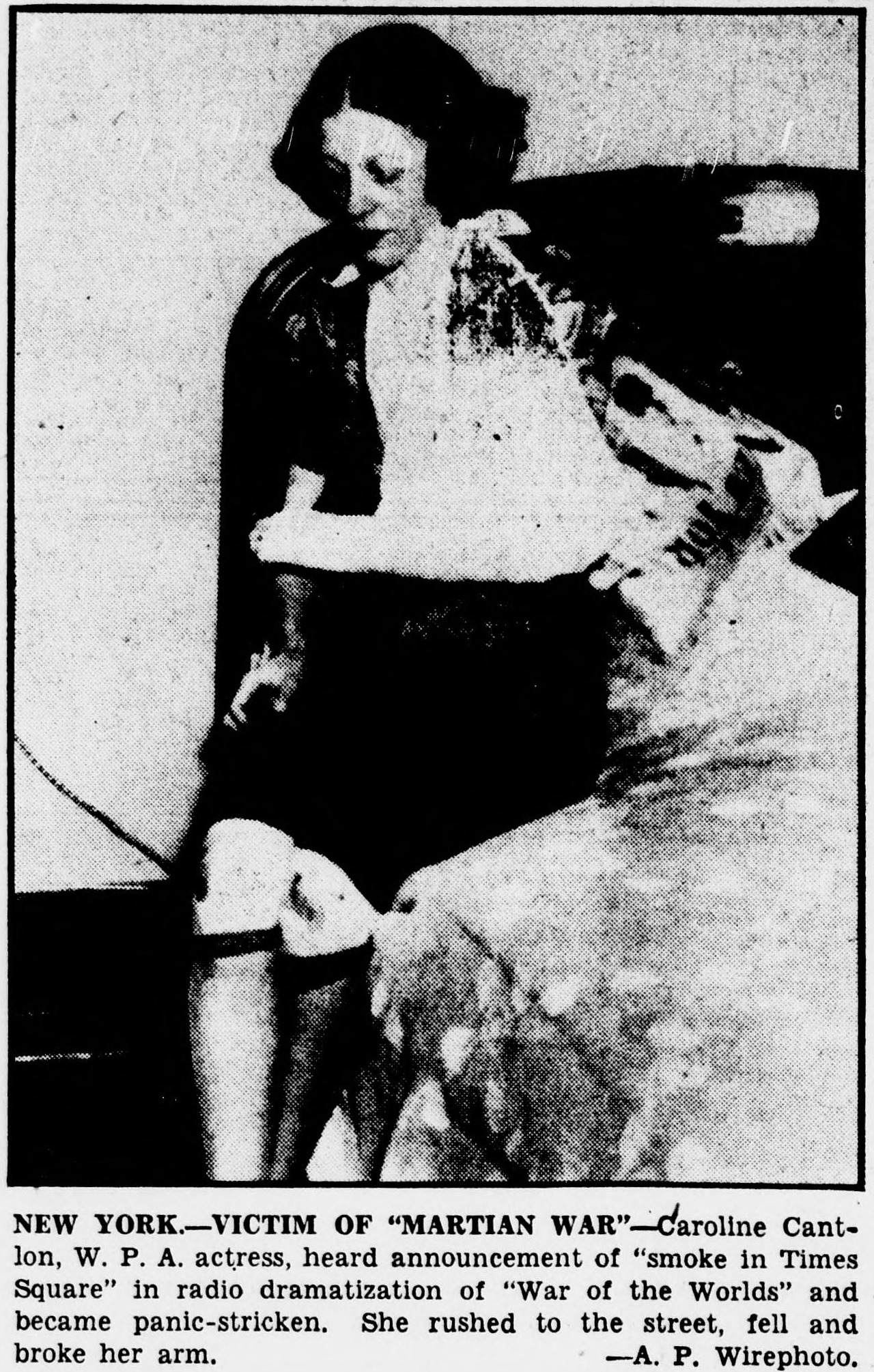
Caroline Cantlon of New York, who broke her arm running into the street during the broadcast. The Evening Star, Washington, D.C., October 31, 1938. Library of Congress, Chronicling America. Click the picture to see it full size.
Back in Grovers Mill
The United Press sent a reporter to the village itself. He found that Grovers Mill had come through better than most towns, because it found out faster that the Martians had not really come. Not everyone stayed calm. A 73-year-old neighbor, William Dock, listened until the creatures crawled out of their ship, then got out his shotgun and went looking for them. Philip Wassun of nearby Cranbury met a carload of National Guardsmen who had heard on the radio that they were ordered out to fight. “They were all dressed up to kill,” he said. Two hours later he saw them still driving around.
A corporal named Frank Wilson told the reporter he’d like to meet one of the six or eight people who had stopped him that night to describe, in terrifying terms, the landing of a space ship that “they personally had witnessed.” There was an explanation for some of it. A forest fire 15 miles away had left a pall of smoke over the village.
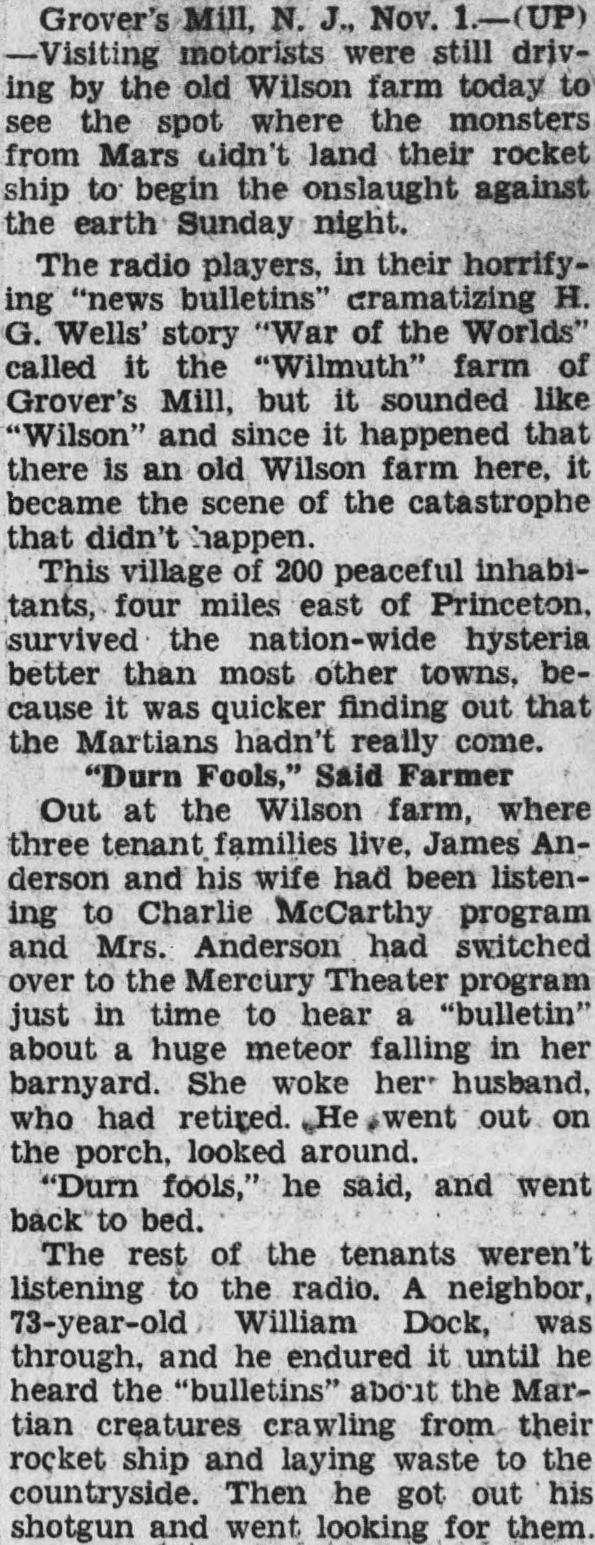
“Durn Fools,” Said Farmer: the United Press report from Grovers Mill, the Waterbury Democrat, Waterbury, Connecticut, November 1, 1938. Library of Congress, Chronicling America. Click the clipping to read it full size.
Smaller than the headlines
The panic was real for some people, but it was much smaller than the front pages made it sound. Even the Evening Star’s own story began by saying the near panic struck only “that part of the Nation which was not listening to the peace-loving Charlie McCarthy.” Charlie McCarthy was a wisecracking wooden dummy. His partner, the ventriloquist Edgar Bergen, had a top-rated Sunday night show on NBC, on the air at the same hour. So on the night of the Martian invasion, most of the country was listening to a ventriloquist it couldn’t see.
The Library of Congress notes that a telephone survey of 5,000 households that evening found only about 2 percent tuned in to the broadcast. Many of the frightened callers had caught only pieces of it, or heard about it secondhand. In Concrete, Washington, the power happened to fail in the middle of the play, and many people there thought the invasion had reached the West Coast. Even so, the Star wrote, there wasn’t a Martian in sight and “the hysteria subsided almost as quickly as it started.” By the next day, a Washington station said, people were calling to ask if the play could be broadcast again.
Princeton students had their own answer. They offered Orson Welles the honorary leadership of a “League of Interplanetary Defense.” And at Grovers Mill on Tuesday, visiting motorists were still driving past the old Wilson farm, to see the spot where the monsters from Mars didn’t land.
Sources
- Evening Star (Washington, D.C.), October 31, 1938, page A-1 and page A-3.
- The Waterbury Democrat (Waterbury, Conn.), November 1, 1938, page 1 and page 4 (United Press reports from Grovers Mill and Princeton).
- Library of Congress Magazine, “Page from the Past: War of the Worlds” (the survey of 5,000 households).
- Smithsonian National Museum of American History, “Original Charlie McCarthy ventriloquist dummy used by Edgar Bergen” and “Charlie McCarthy Radio Game” (the Sunday night NBC show).
- All newspaper images: Library of Congress, Chronicling America.
- Cover: the Evening Star’s front page, October 31, 1938, with the A.P. Wirephoto of Orson Welles made after the broadcast. Library of Congress, Chronicling America.