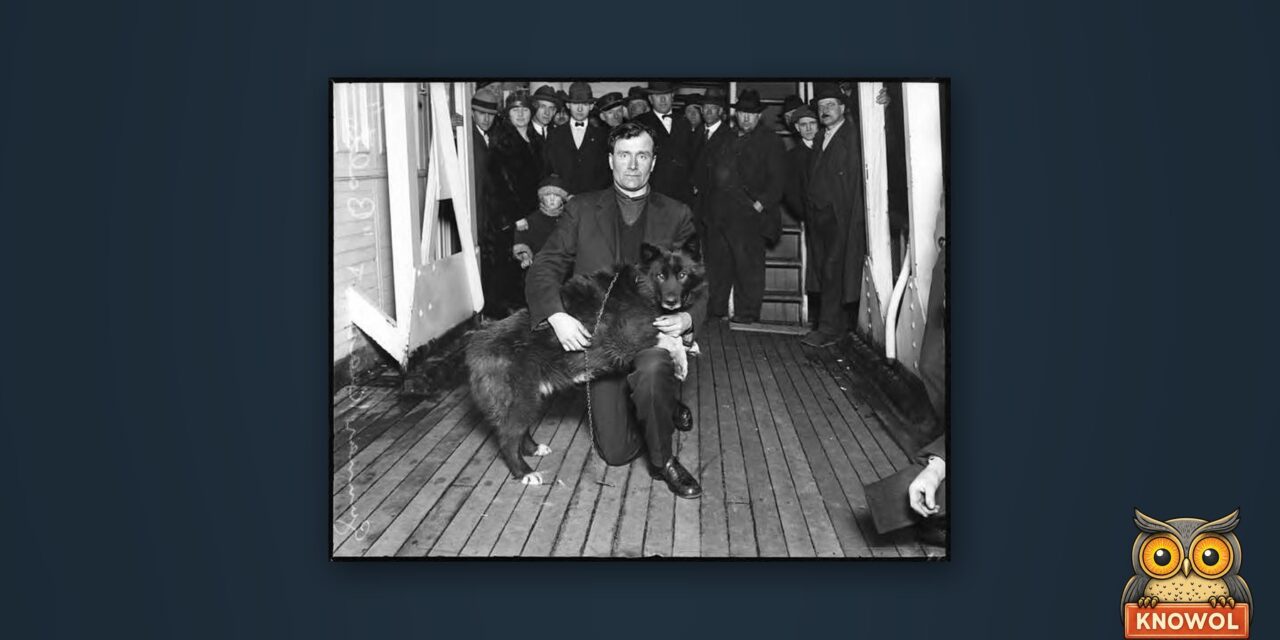
At half past five on the morning of Monday, February 2, 1925, a dog team came out of a blizzard and into Nome, Alaska. The driver, Gunnar Kaasen, went straight to Dr. Curtis Welch and woke him from his sleep. On his sled was a package of diphtheria antitoxin, 300,000 units of it, that had just crossed about 675 miles of frozen Alaska, passed from one dog team to the next.
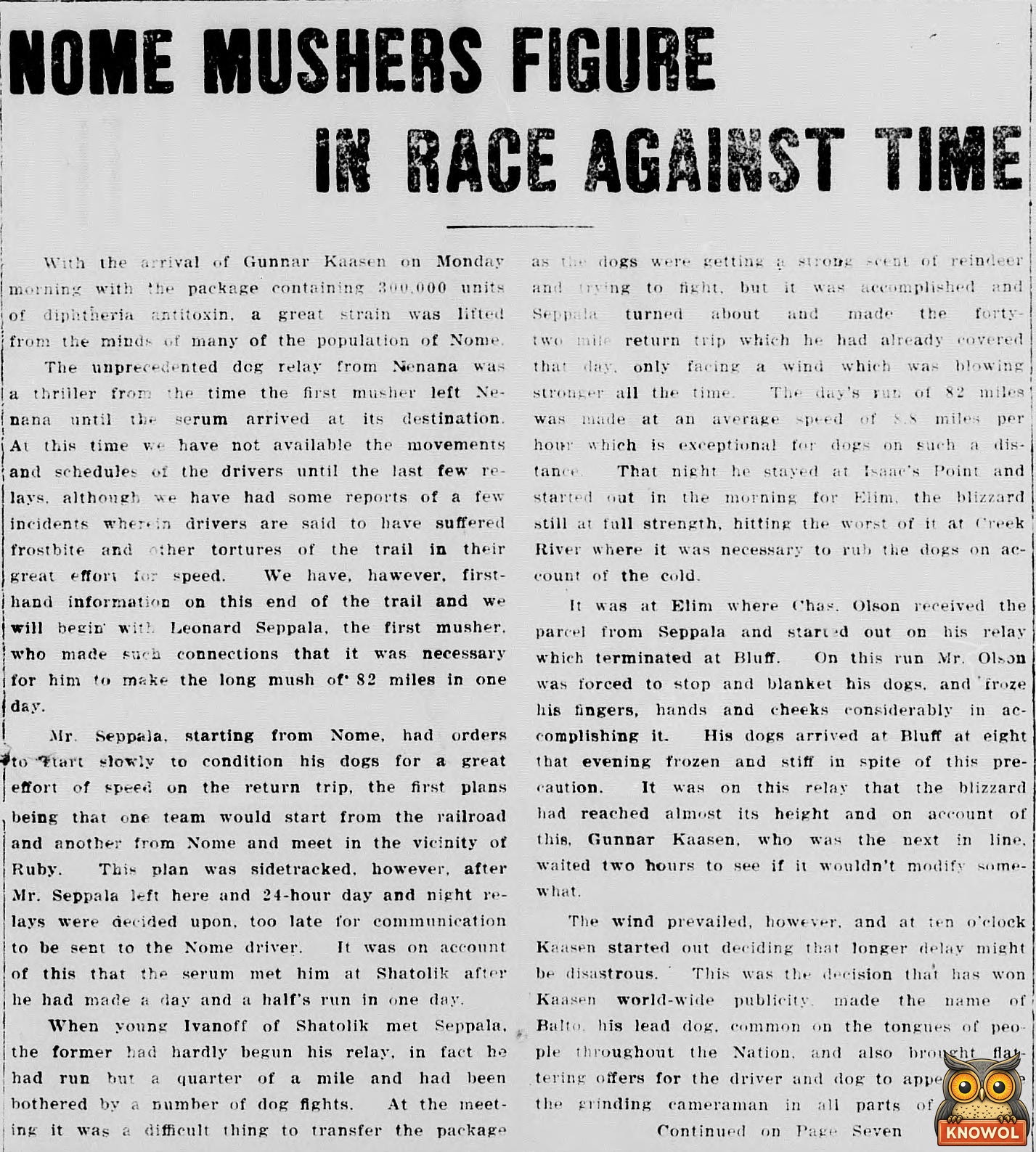
“Nome Mushers Figure in Race Against Time,” The Nome Nugget, Nome, Alaska, February 7, 1925, page 1. Library of Congress, Chronicling America. Click the clipping to read it full size.
A town waiting for medicine
In January 1925, diphtheria broke out in Nome. It’s a throat disease that hits children hardest. On January 20, Nome’s health officials radioed for help. Serum was found in Anchorage, but no airplane of the day could make that flight in the deep cold. So it went north by train to Nenana, as far as the railroad ran. From there, the only way to Nome in the middle of winter was by dog sled.
Twenty teams, day and night
Instead of two teams meeting near Ruby, as first planned, a relay running all day and all night was set up. William Shannon left Nenana first and drove 12 hours in bitter cold. Then the package passed from hand to hand: “Tolovana Jim” Kalland, Johnny Folger, Dave Corning, Sam Joseph, Harry Pitka, Bill McCarthy, Edgar Nollner, Charles Evans, Tommy Patsy and more. Most legs were 24 to 36 miles, at five to nine miles an hour.
Leonhard Seppala, Nome’s famous racer, had gone out to meet the serum with his lead dog, Togo. Near Shaktoolik, young Henry Ivanoff met him with the package. Seppala turned around and went back over the 42 miles he’d already covered that day, into a rising wind, for 82 miles in one day. At Elim he handed off to Charles Olson, who froze his fingers, hands and cheeks stopping to blanket his dogs in the storm.
Balto leads the last run
At Bluff, Gunnar Kaasen was next in line. The blizzard was near its worst, so he waited two hours for it to ease. It didn’t, and at ten o’clock he set out anyway. Kaasen said later it was the toughest trip he ever made. He couldn’t see the trail for miles, the Nugget said, “Balto keeping on the track and going for all the strength in that shabby-coated body of his.”
At Safety, where Ed Rohn was supposed to take the last leg, the roadhouse was dark. Officials had sent word to hold the relay until the wind died down, and Rohn had gone to bed. Kaasen never got that message, and rather than wake Rohn and risk more dogs in the cold, he kept going. He made 53 miles in seven and a half hours. When he handed over the package, the serum was frozen solid. Dr. Welch let it thaw slowly, and by noon it was going to the sick.
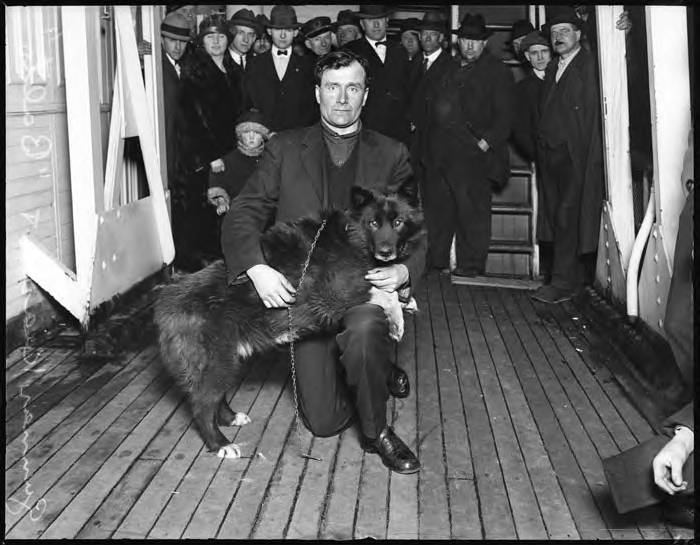
Gunnar Kaasen with Balto in Seattle, March 21, 1925. Seattle Post-Intelligencer photo, Museum of History and Industry (MOHAI 4619), via Wikimedia Commons. Public domain. Click the picture to see it full size.
Ice cream in a quarantined town
Nome was under quarantine, and cases climbed from 22 to 31 that week. The schools stayed closed, and the Nugget said they would stay closed until a second shipment of serum came, “whether by plane, dog team or submarine.” Still, ordinary life went on. In that same issue, The Nevada, across the street from the newspaper office, advertised ice cream made every day. It was February in Alaska.
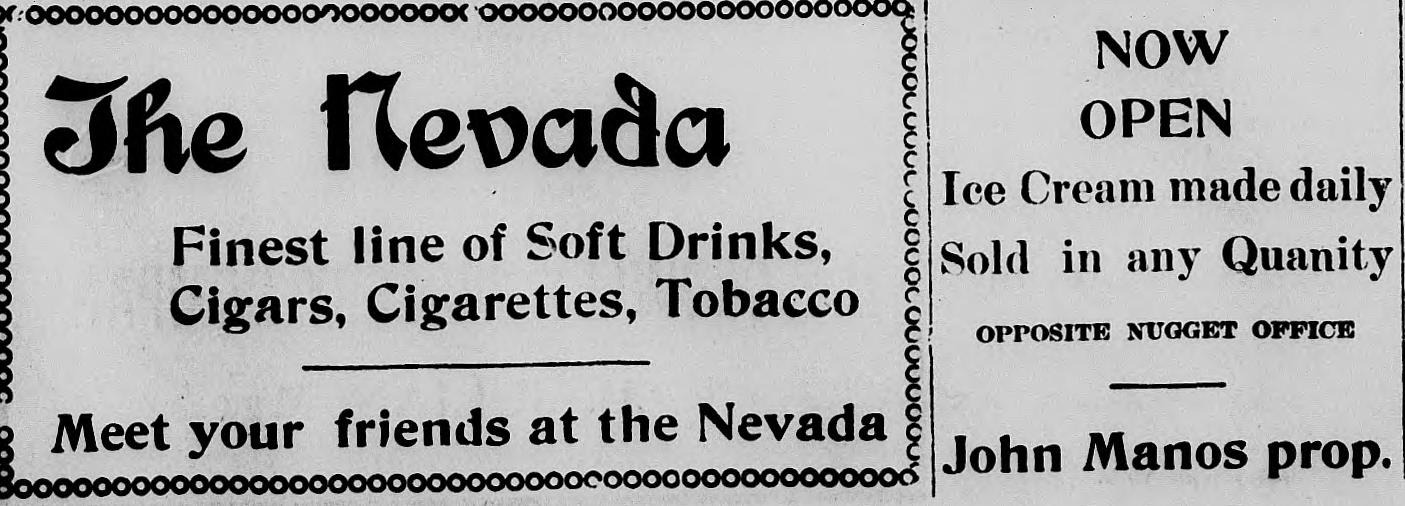
Ad for The Nevada, John Manos, proprietor, The Nome Nugget, February 7, 1925, page 7. Library of Congress, Chronicling America. Click the picture to see it full size.
Word of the run had gone around the world. One Nome man’s wife, visiting Portland, Oregon, with their daughter, wired home that the epidemic “had surely put Nome on the map.” Down in Portland, both of them had to take antitoxin before the girl could stay in school.
Togo goes missing
On the way home, Togo caught the scent of reindeer near Golovin and ran off, and two other dogs went with him. The Nugget called it the worst thing that happened on the whole run. Seppala said he “wouldn’t have taken $500 for Togo,” and he feared his dog had been shot or caught in a trap. A week later, the paper had happy news. Togo had come home to his kennel with the mail team, “after being away on a spree.”
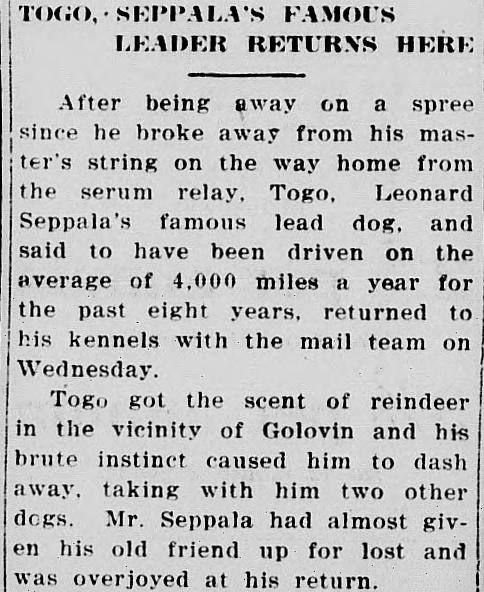
“Togo, Seppala’s Famous Leader Returns Here,” The Nome Nugget, February 14, 1925, page 8. Library of Congress, Chronicling America. Click the picture to see it full size.
The names Nome kept
Balto got the fame. By mid-February, a trophy named for him was planned in New York. On December 17, 1925, a bronze statue of Balto was unveiled in Central Park with Balto and Kaasen both there. Balto died in 1933 and is preserved today at the Cleveland Museum of Natural History.
The Nome Nugget made sure the other drivers weren’t forgotten. With help from U.S. Signal Corps men, it tracked down the name of every driver and printed them all. “These are the men to whom Nome owes a world of gratitude and who excited the world with their daring and courage.”
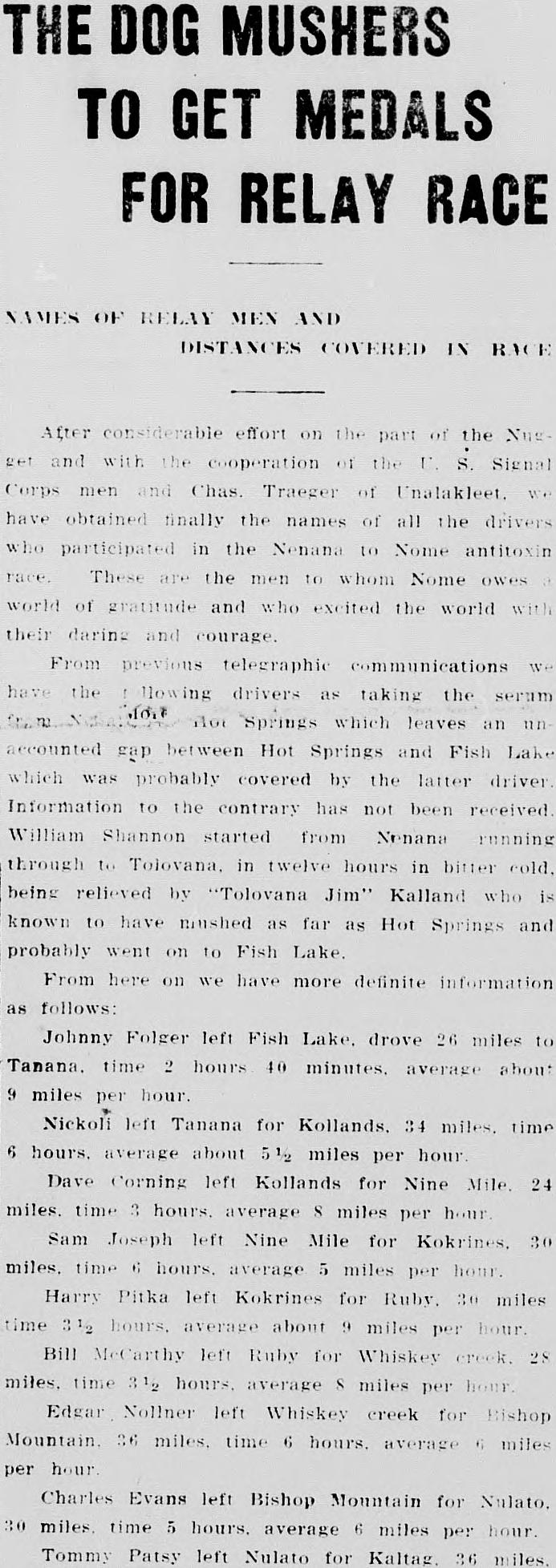
“The Dog Mushers to Get Medals for Relay Race,” The Nome Nugget, February 14, 1925, page 1. Library of Congress, Chronicling America. Click the clipping to read it full size.
Sources
- The Nome Nugget (Nome, Alaska), February 7, 1925, page 1 and page 7.
- The Nome Nugget (Nome, Alaska), February 14, 1925, page 1 and page 8.
- William B. Ashworth Jr., “Scientist of the Day: Balto,” Linda Hall Library, February 2, 2022, for the January 20 radio call, the train to Nenana, 20 teams and about 675 miles.
- Central Park Conservancy, “Balto”, for the statue’s unveiling on December 17, 1925, and Balto’s place at the Cleveland Museum of Natural History.
- Photo of Gunnar Kaasen and Balto: Seattle Post-Intelligencer, March 1925, Museum of History and Industry, Wikimedia Commons.jpg). Public domain.
- All newspaper images: Library of Congress, Chronicling America. No known copyright restrictions.
- Read more about Nenana, Alaska, where the relay began.
- Cover: Gunnar Kaasen and Balto in Seattle, March 21, 1925, Seattle Post-Intelligencer photo, Museum of History and Industry (MOHAI 4619), via Wikimedia Commons. Public domain.