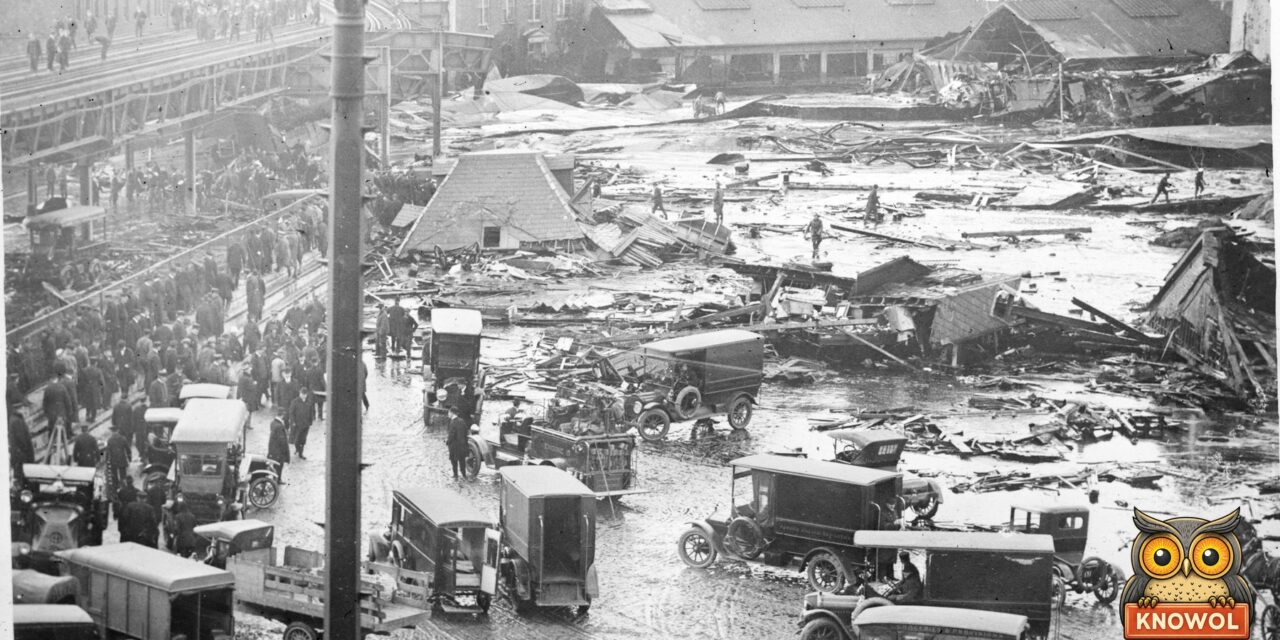
At lunchtime on Wednesday, January 15, 1919, about twenty city workers sat down to eat in a wooden building in a city yard on Commercial Street, on the waterfront of Boston‘s North End. Beside the yard stood a huge iron tank full of molasses, unloaded from steamers and waiting to be hauled to a distillery in Cambridge and made into alcohol. Upstairs in the firehouse of fireboat Engine 31, two firemen were playing cards. Nearby, a boy named Pasquale Iantosco was collecting wood.
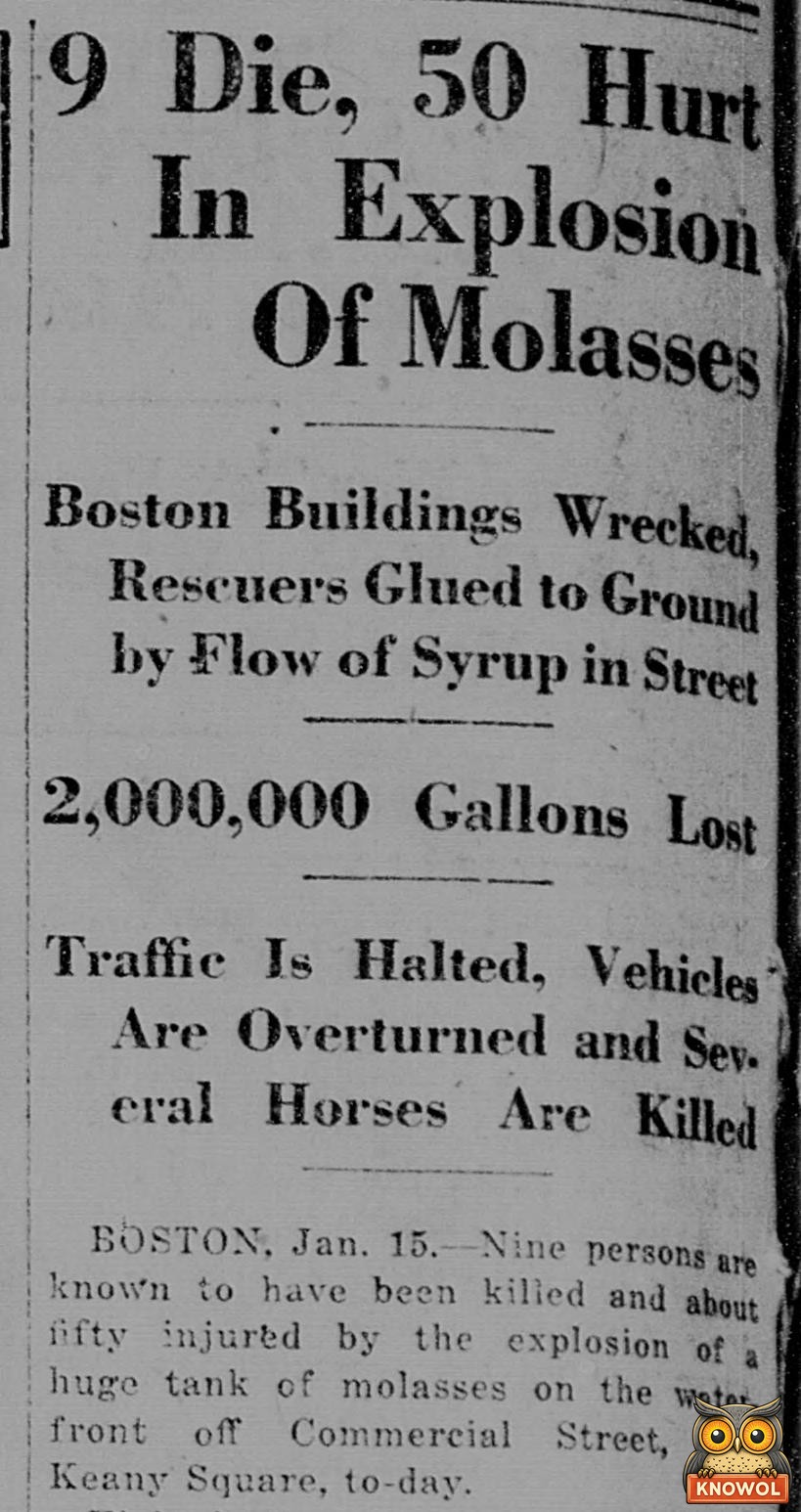
“9 Die, 50 Hurt in Explosion of Molasses,” New-York Tribune, New York, January 16, 1919. Library of Congress, Chronicling America. Click the clipping to read it full size.
A mighty stream
“A dull, muffled roar gave but an instant’s warning,” the Springfield Republican reported. The top of the tank flew into the air, and its round wall split into two great pieces of iron that flew in opposite directions. About two million gallons of molasses rushed over the streets in a mighty stream.
The building where the city men were eating was torn apart, and the wreckage was thrown 50 yards onto the North End playground. One piece of the tank wall came down on the firehouse and crushed it. Fireman George Leahy was killed. Another fireman was thrown through a window into the water and picked up alive. A third lay pinned under the iron, still conscious, and directed his own rescue while men cut a hole with a gas torch to reach him.
The other half of the wall slammed into the elevated railway over Commercial Street and broke three spans. A train had passed over that spot a moment before, and the next one was stopped in time by the block signal. Up on Copps Hill Terrace, a small house slid down into the street, pulled along, the papers thought, as the molasses drained back. Bridget Clougherty, who lived there, was thrown through a window and killed.
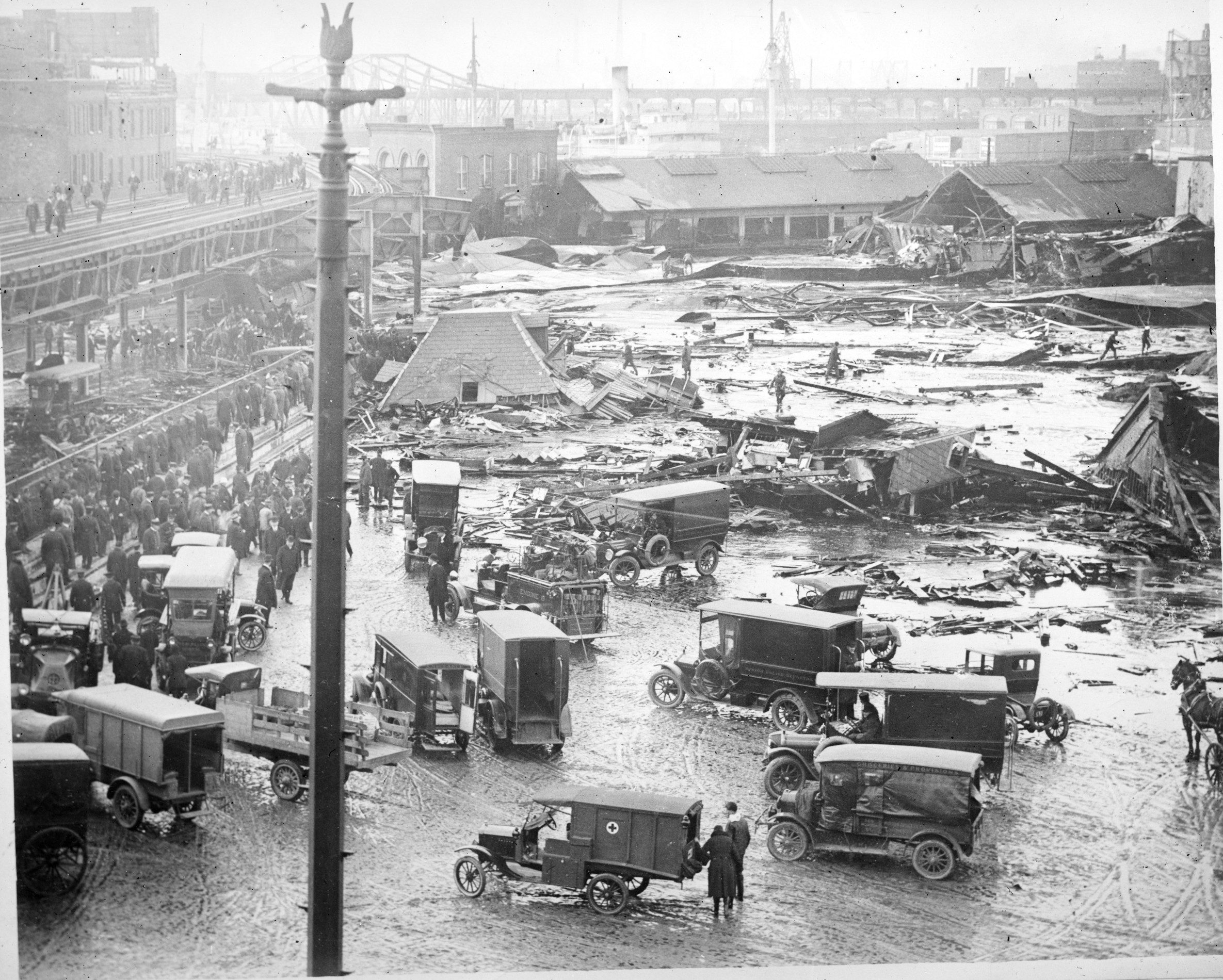
A Red Cross ambulance and rescue wagons stand in the molasses after the tank gave way, with crowds on the elevated railway at left and wrecked buildings behind, Boston, 1919. American National Red Cross photograph, Library of Congress Prints and Photographs Division. Click the picture to see it full size.
Glued to the ground
The first help came from sailors on the state school ship Nantucket, anchored at the playground pier. Soon there were police, soldiers and scores of ambulances. The molasses lay several inches deep across the neighborhood, and two or three feet deep in places. Wagons and trucks had been tipped over, and about a dozen horses were dead.
“If a worker stood still for a minute he found himself glued to the ground,” the Republican said. Firemen turned their hoses on the street to wash the molasses toward the harbor. Superintendent of Police Michael H. Crowley gave orders from the top of a sand pile in the playground, which “emerged like an island from the dirty brown sea.” Red Cross women and girls in short skirts and leather leggings waded through it, carrying hot coffee and doughnuts to the firemen, police, soldiers and sailors.
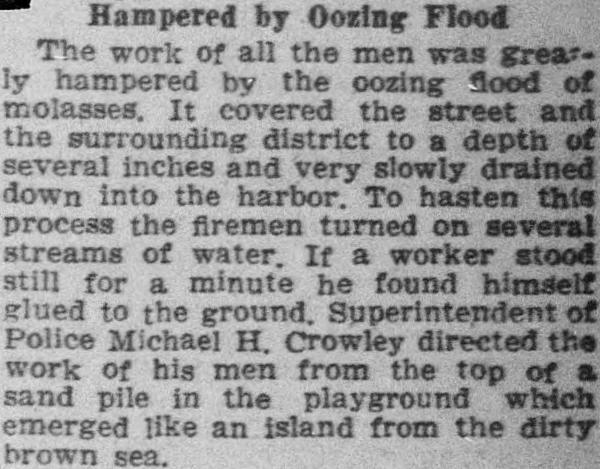
“Hampered by Oozing Flood,” Springfield Weekly Republican, Springfield, Massachusetts, January 16, 1919. Library of Congress, Chronicling America. Click the clipping to read it full size.
The names
By that night the dead who had been identified included James Lennon, a motorman from Roxbury and the brother-in-law of the prizefighter John L. Sullivan; John M. Seiberlich, a blacksmith; and city laborers William A. Duffee, James Kenneally, Peter Francis and Thomas Noonan. One body, a girl about 12 years old, had not yet been named. The next night police were still digging for three expressmen whose wagons and horses had been found in pieces, and for Pasquale. He had been gathering wood near the tank when it gave way. The count kept rising for days.
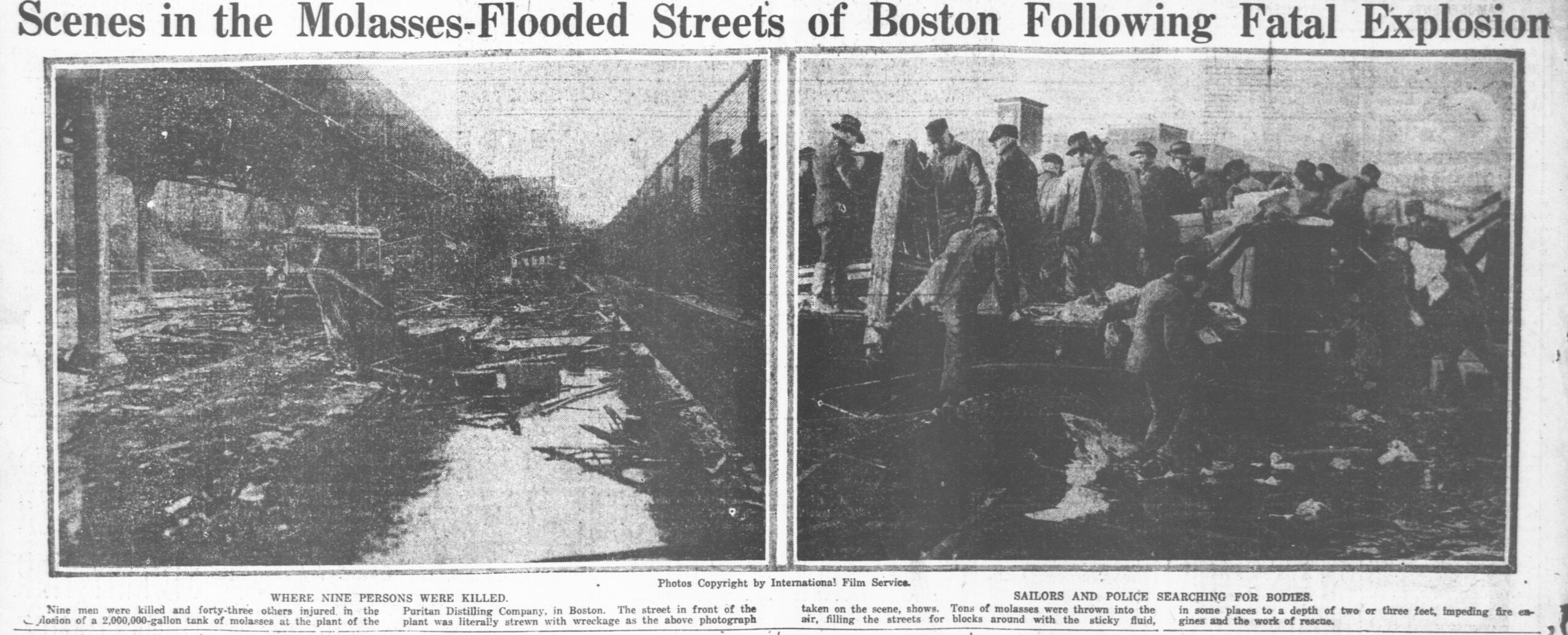
“Scenes in the Molasses-Flooded Streets of Boston Following Fatal Explosion,” the Washington Times, Washington, D.C., January 18, 1919. Library of Congress, Chronicling America. Click the picture to see it full size.
“Enemies of the United States”
The first headlines called it an explosion, and a state police expert guessed that gas from fermenting molasses had blown the tank apart. The owner, the Purity Distilling Company, part of the United States Industrial Alcohol Company, said that was impossible. Its lawyer pointed out that the company had made alcohol for munitions during the war. “It is possible the tank may have been broken by enemies of the United States,” he said.
Within a day, state and city investigators had a plainer answer. They believed the walls of the tank had simply given way under the weight of the molasses, and that there had been no explosion at all.
Six years later
Families and businesses went to court. A court-appointed auditor, Colonel Hugh W. Ogden, sat for 351 days and heard 940 witnesses, whose testimony filled 20,000 typed pages. Engineers, metallurgists and steel experts came from all over the country. On January 15, 1925, six years to the day, he turned in his findings. The flood had cost 21 lives. Each family that had lost someone was awarded about $6,000.
He found the company responsible. The tank had come apart, the New Britain Herald reported, because it was “not structurally strong enough to withstand the pressure of the molasses it contained.”
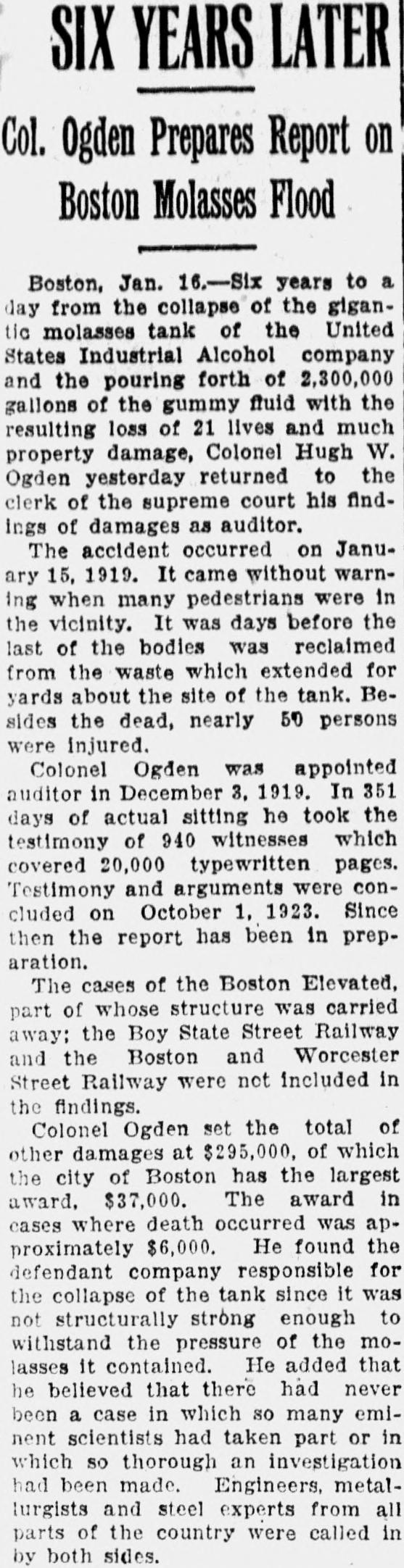
“Six Years Later,” New Britain Herald, New Britain, Connecticut, January 16, 1925. Library of Congress, Chronicling America. Click the clipping to read it full size.
Sources
- New-York Tribune (New York, N.Y.), January 16, 1919, page 16.
- Springfield Weekly Republican (Springfield, Mass.), January 16, 1919, page 7.
- Daily Kennebec Journal (Augusta, Me.), January 17, 1919, page 1 (the boy and the investigators’ finding).
- The Washington Times (Washington, D.C.), January 18, 1919, page 2.
- The Evening World (New York, N.Y.), January 15, 1919, page 1, and Evening Public Ledger (Philadelphia, Pa.), January 15, 1919, page 1 (horses killed).
- New Britain Herald (New Britain, Conn.), January 16, 1925, page 15.
- “Boston, Mass. Boston molasses explosion,” American National Red Cross photograph collection: Library of Congress Prints and Photographs Division, LC-DIG-anrc-14968. No known restrictions on publication.
- Death toll of 21: Massachusetts Historical Society, “The Great Boston Molasses Flood of 1919”, and the New Britain Herald report above.
- All newspaper images: Library of Congress, Chronicling America. No known copyright restrictions.
- Cover: the same American National Red Cross photograph (cropped), Library of Congress Prints and Photographs Division, LC-DIG-anrc-14968. No known restrictions on publication.