In September 1861, a company of soldiers from Eau Claire, Wisconsin, marched through the gate of Camp Randall in Madison while the band played “Yankee Doodle.” Above their heads, on a perch at the top of a pole, rode a young eagle. He had already been “mustered into the United States service by putting around his neck red, white and blue ribbons, and on his breast a roset of the same colors.”
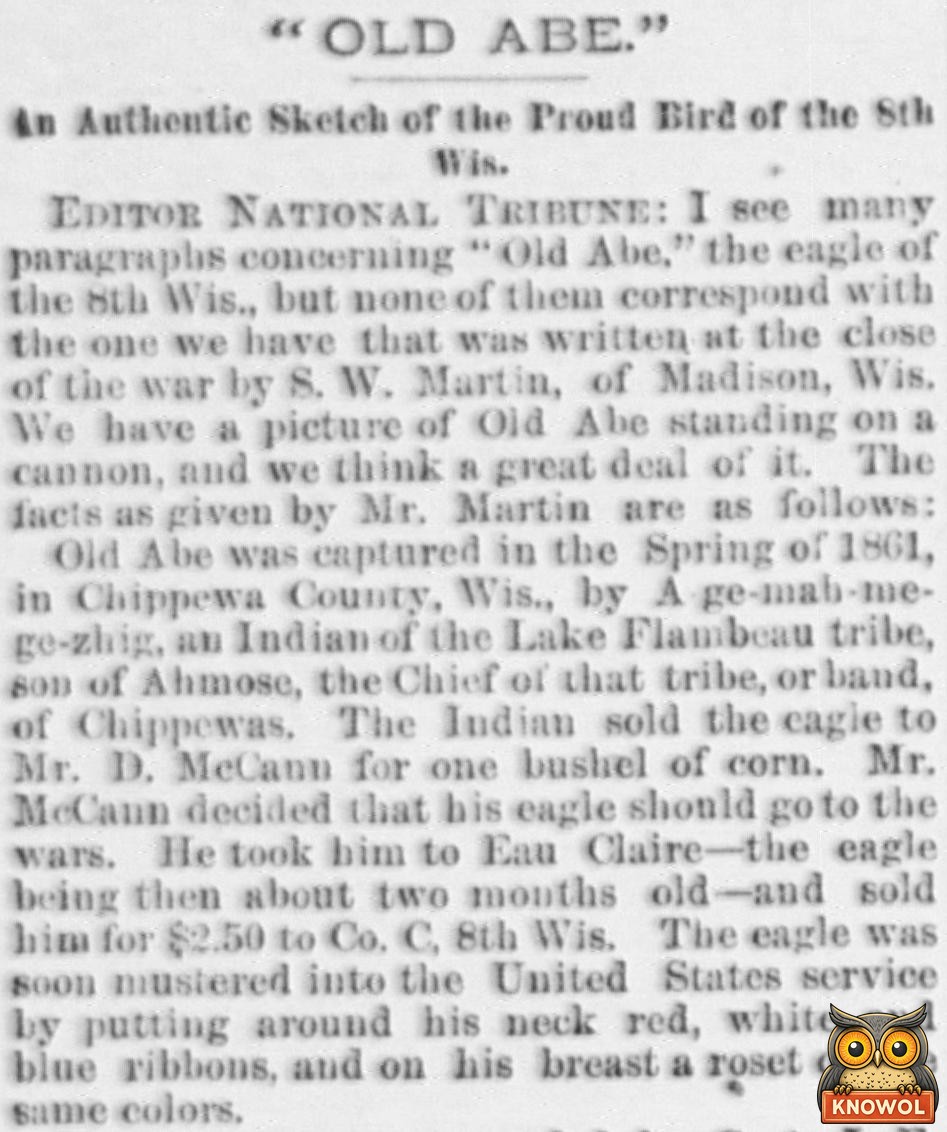
“Old Abe,” National Tribune, Washington, D.C., June 16, 1887, page 3. Library of Congress, Chronicling America. Click the clipping to read it full size.
As the company came through the gate, an account printed in 1887 said, the eagle “spread his wings,” grabbed one of the little flags on his perch in his beak, and carried it “in that position to the Colonel’s quarters.” The crowd roared. Captain John E. Perkins named the bird “Old Abe,” in honor of President Lincoln.
A bushel of corn and $2.50
Old Abe had come cheap. In the spring of 1861, the 1887 account said, an Ojibwe man of the Lac du Flambeau band, whose name the paper spelled A-ge-mah-me-ge-zhig, caught the eaglet in Chippewa County. He sold him to a man named D. McCann “for one bushel of corn.” McCann took the two-month-old bird to Eau Claire and sold him to Company C of the 8th Wisconsin for $2.50. The company voted to change its name from the Eau Claire Badgers to the Eau Claire Eagles, and the whole 8th Wisconsin became the Eagle Regiment.
“Heard of again”
In October the regiment passed through Chicago on its way south, and the Chicago Tribune noticed the bird right away. “He is a majestic bird, well trained and docile, permitting people to pat his regal head and smooth down his feathers without resistance,” it reported. The men, it said, “swear it shall never be taken by the enemy. No doubt the Chippewa Eagles and their pet will be heard of again.”
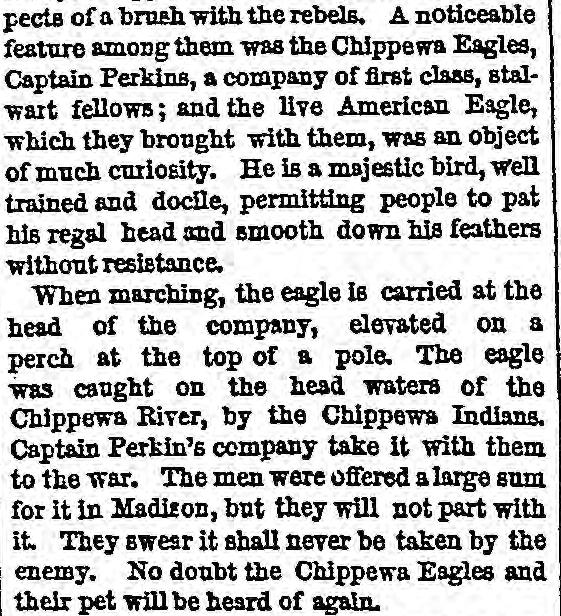
The 8th Wisconsin’s eagle passes through Chicago, Chicago Daily Tribune, October 14, 1861, page 4. Library of Congress, Chronicling America. Click the clipping to read it full size.
In the streets of St. Louis, he “broke from his perch, flew up majestically, and alighted upon one of the aristocratic buildings of the city.” He came down when he pleased, and a gentleman there offered the company $500 for him. The men kept their eagle, but not his feathers. “Soldiers say his feathers are scattered all over the Union,” the 1887 account said, and so many were taken that “at one time he looked bare and deformed.”
“Uttering wild screams”
Under fire, he was a sight. “In the midst of the roar of cannon, the crack of muskets and the clouds of smoke, Old Abe, with spread pinions, would jump up and down on his perch, uttering wild screams.” At Farmington, near Corinth, Mississippi, in May 1862, the men were ordered to lie down, and Old Abe went down on the ground with them until they rose. Captain Perkins, who had named him, was mortally wounded in that fight.
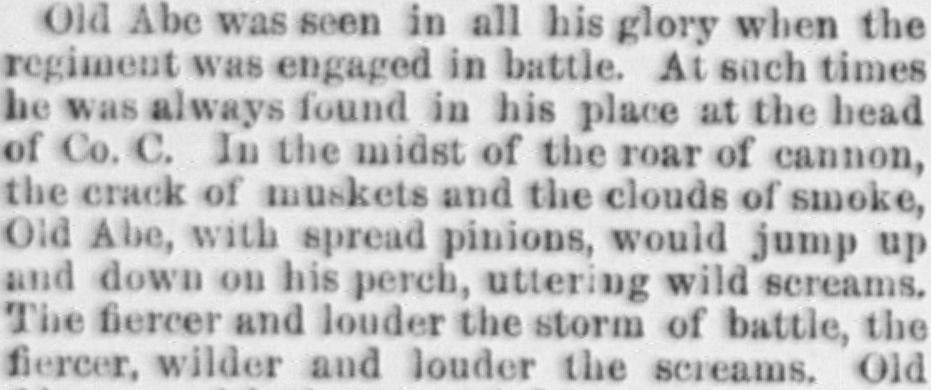
Old Abe under fire, National Tribune, June 16, 1887. Library of Congress, Chronicling America. Click the clipping to read it full size.
In June 1864, the men who had signed up again came home to Madison on furlough. The city’s bells rang, and the Mineral Point Weekly Tribune reported, “The live Eagle, ‘Old Abe,’ and the tattered and riddled colors of the regiment attracted all eyes.” He had “once or twice had some of his feathers shot away, but has never received a scratch from a rebel bullet sufficient to draw blood.”
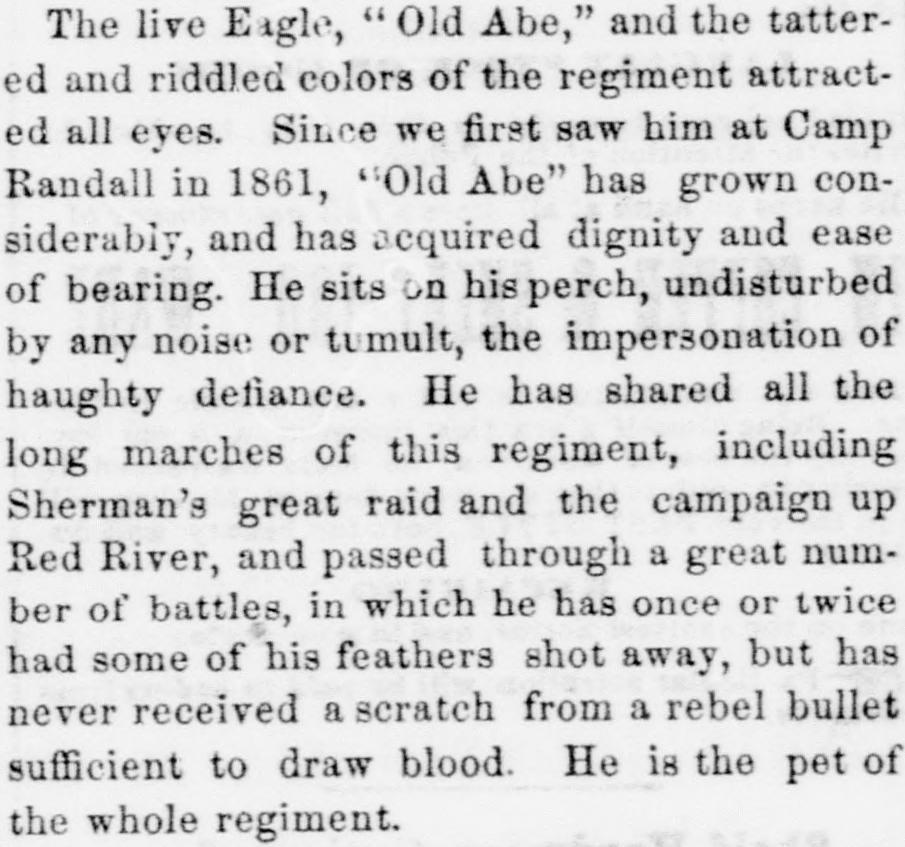
The 8th Wisconsin’s veterans come home on furlough, Mineral Point Weekly Tribune, Mineral Point, Wisconsin, June 29, 1864, page 3. Library of Congress, Chronicling America. Click the clipping to read it full size.
Sixteen thousand dollars in pictures
The company gave Old Abe to the State of Wisconsin, and he got a room in the basement of the Capitol in Madison, where he “received the best of care,” the Chicago Tribune said. He also went on tour. At “the great fair in Chicago, in 1865,” the Madison Democrat recalled, he was shown off “and his photographs disposed of, realizing the amount of $16,000.” In 1876 he spent four months at the Centennial Exposition in Philadelphia.
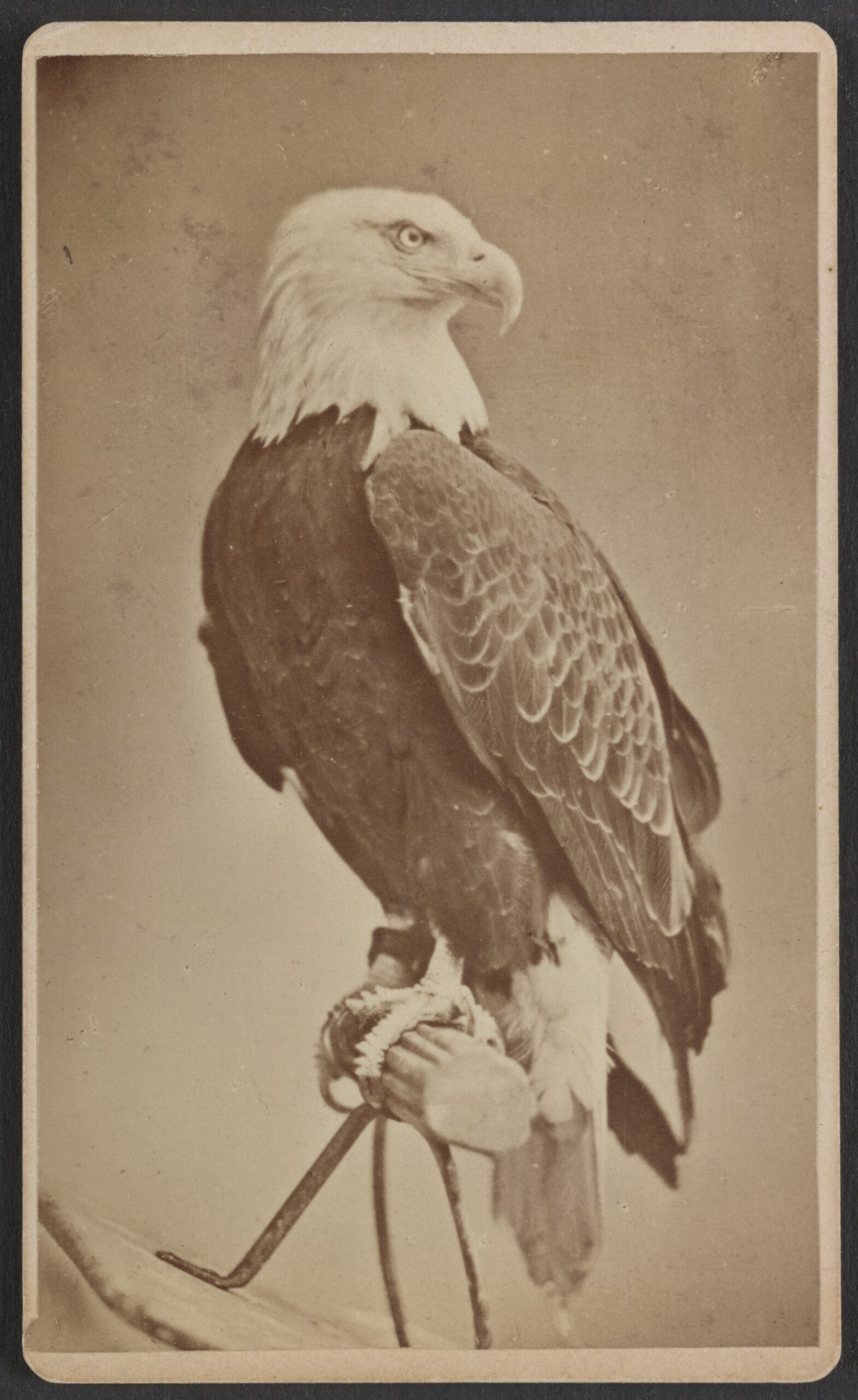
“Old Abe, the live war eagle of Wisconsin, from the Centennial,” carte de visite photograph, 1876. Library of Congress, Liljenquist Family Collection of Civil War Photographs. Click the picture to see it full size.
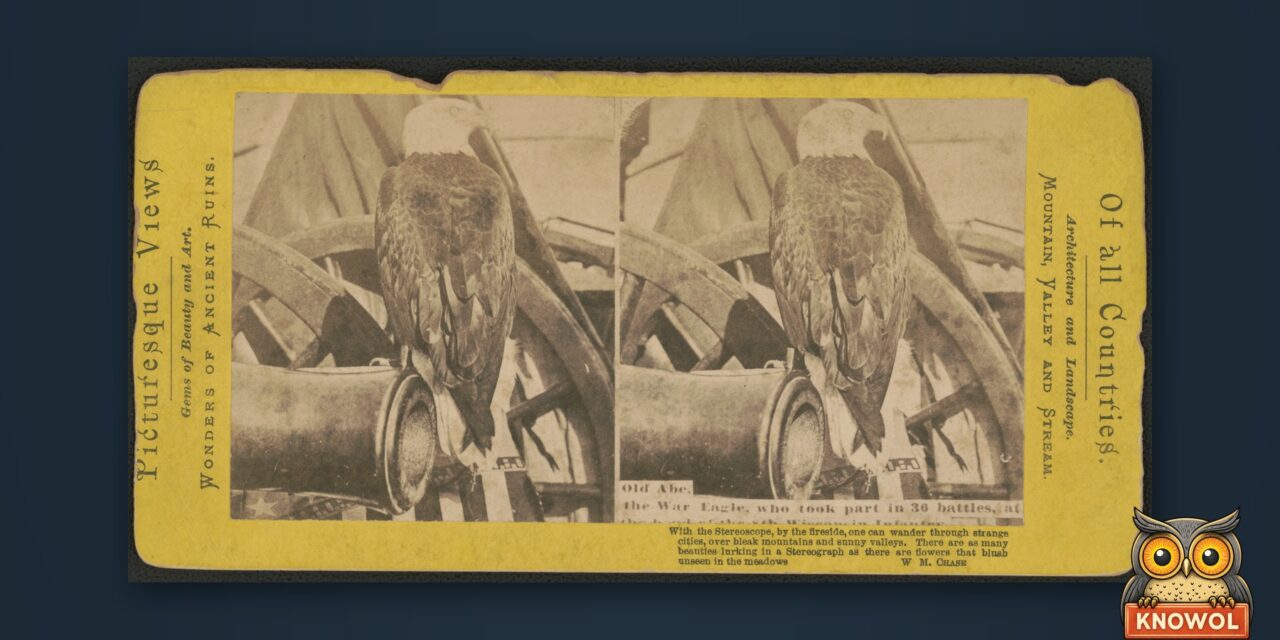
People treasured those pictures. The reader who sent in the 1887 account wrote, “We have a picture of Old Abe standing on a cannon, and we think a great deal of it.”
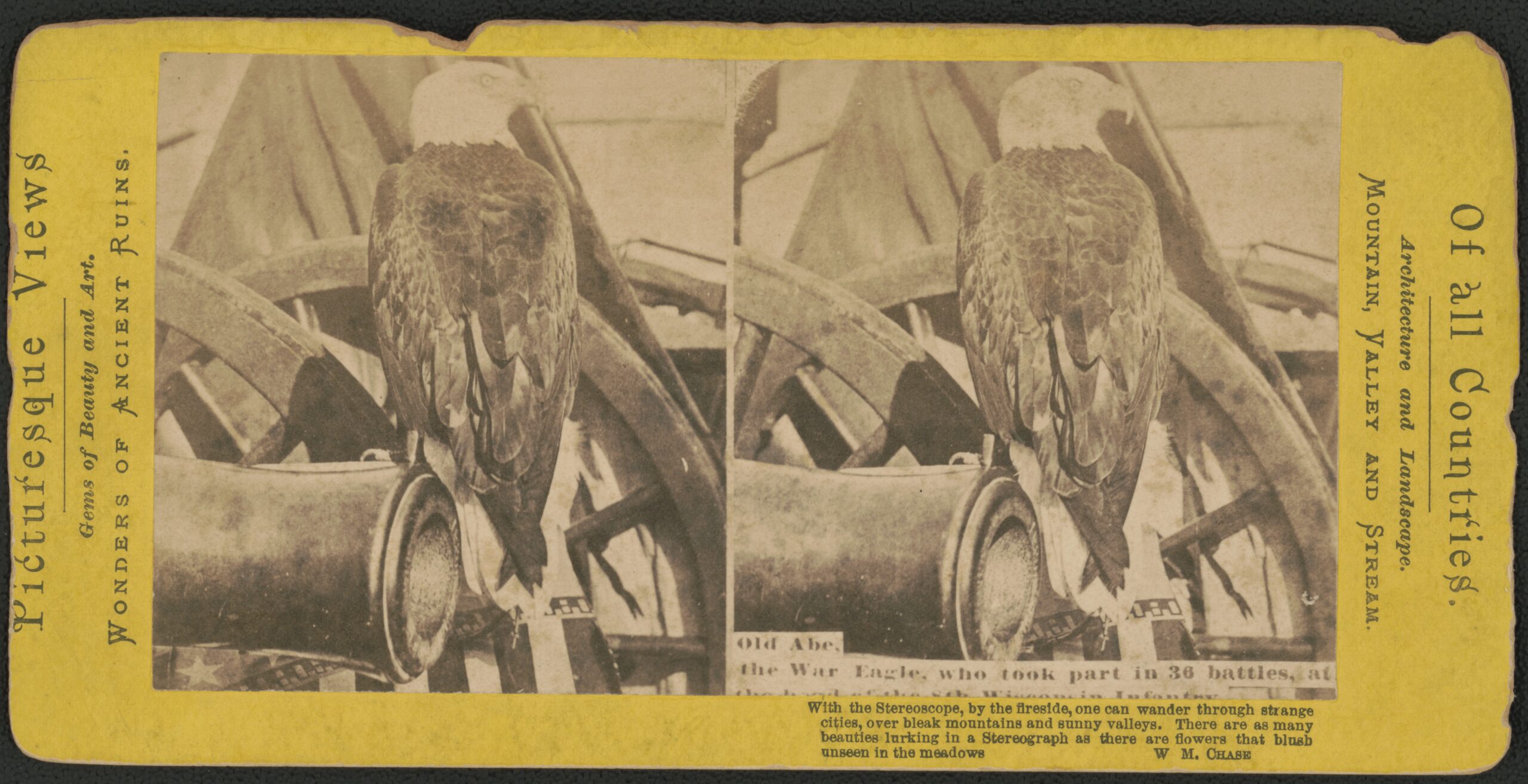
“Old Abe, the War Eagle, who took part in 36 battles,” stereograph by W. M. Chase, made between 1861 and 1881. Library of Congress, Liljenquist Family Collection of Civil War Photographs. Click the picture to see it full size.
Fire at the Capitol
Old Abe died at the Capitol on Saturday, March 26, 1881, “about four o’clock,” after a few days of sickness. The governor and other officials came down to view his body. “There was sadness depicted upon the countenances of the old soldiers about the capitol when they heard of the departure of their old pet,” the Madison Democrat said. The U.S. Army’s history of the bird says fumes from a fire near his quarters a month earlier had weakened him.
His body was stuffed and kept with the Civil War relics in the Capitol. Then, on the morning of Saturday, February 27, 1904, fire swept through the building. “The G. A. R. records and relics were all destroyed together with Wisconsin’s famous war eagle, ‘Old Abe,'” the Wausau Pilot reported.
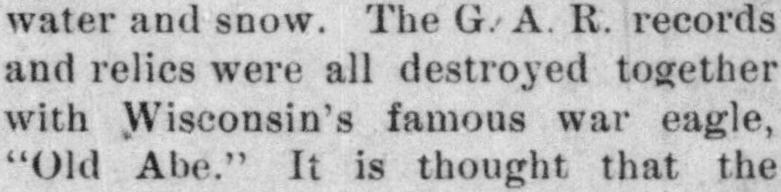
Wausau Pilot, Wausau, Wisconsin, March 1, 1904, page 1. Library of Congress, Chronicling America. Click the clipping to read it full size.
Soldiers still carry him. In the 1920s, the Army says, Old Abe’s head in profile became the shoulder patch of the 101st Division. It’s still the patch of the 101st Airborne Division, the Screaming Eagles.
Sources
- Chicago Daily Tribune (Chicago, Ill.), October 14, 1861, page 4.
- Mineral Point Weekly Tribune (Mineral Point, Wis.), June 29, 1864, page 3.
- Chicago Daily Tribune (Chicago, Ill.), “Old Abe,” March 28, 1881, page 2.
- Wood County Reporter (Grand Rapids, Wis.), quoting the Madison Democrat, “Old Abe” is Dead, March 31, 1881, page 3.
- The National Tribune (Washington, D.C.), “Old Abe,” June 16, 1887, page 3.
- Wausau Pilot (Wausau, Wis.), March 1, 1904, page 1.
- Grant County Herald (Lancaster, Wis.), March 2, 1904, page 1.
- All newspaper images: Library of Congress, Chronicling America. No known copyright restrictions.
- Photographs: Library of Congress Prints and Photographs Division, Liljenquist Family Collection, “Old Abe, the live war eagle of Wisconsin, from the Centennial” and “Old Abe, the War Eagle, who took part in 36 battles”. No known restrictions on publication.
- U.S. Army, “The Story of ‘Old Abe,’ famous Wisconsin War Eagle on 101st Airborne Division patch,” November 15, 2012, for Captain Perkins’s first name, the 1881 fire and the shoulder patch.
- Cover: “Old Abe, the War Eagle, who took part in 36 battles,” stereograph by W. M. Chase. Library of Congress Prints and Photographs Division, Liljenquist Family Collection. No known restrictions on publication.