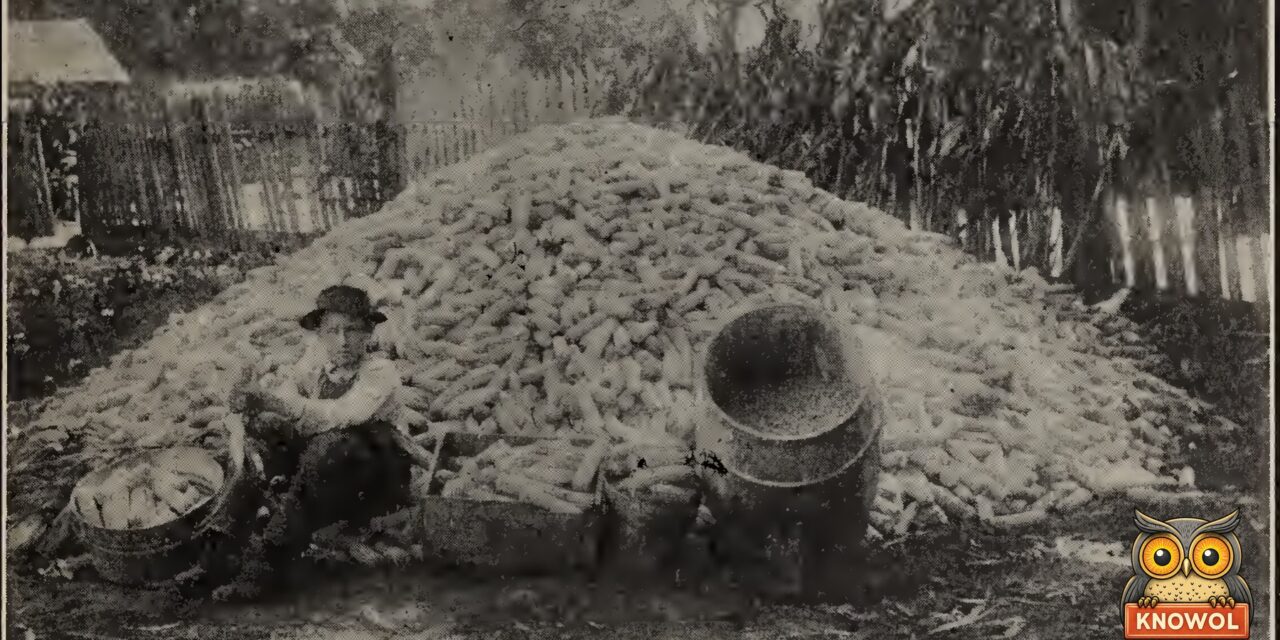
On June 10, 1910, a storm swept over Winona, a small community in Florence County, South Carolina, and blew down a patch of corn on the Methodist parsonage land. The corn stood about six feet high and was just beginning to silk. The next day the boy who had planted it, 15-year-old Jerry H. Moore, set it back up. He wrote that down, along with nearly everything else he did to that one acre, and in November newspapers across the state printed his notes. His acre had made 228 bushels and 3 pecks of corn.
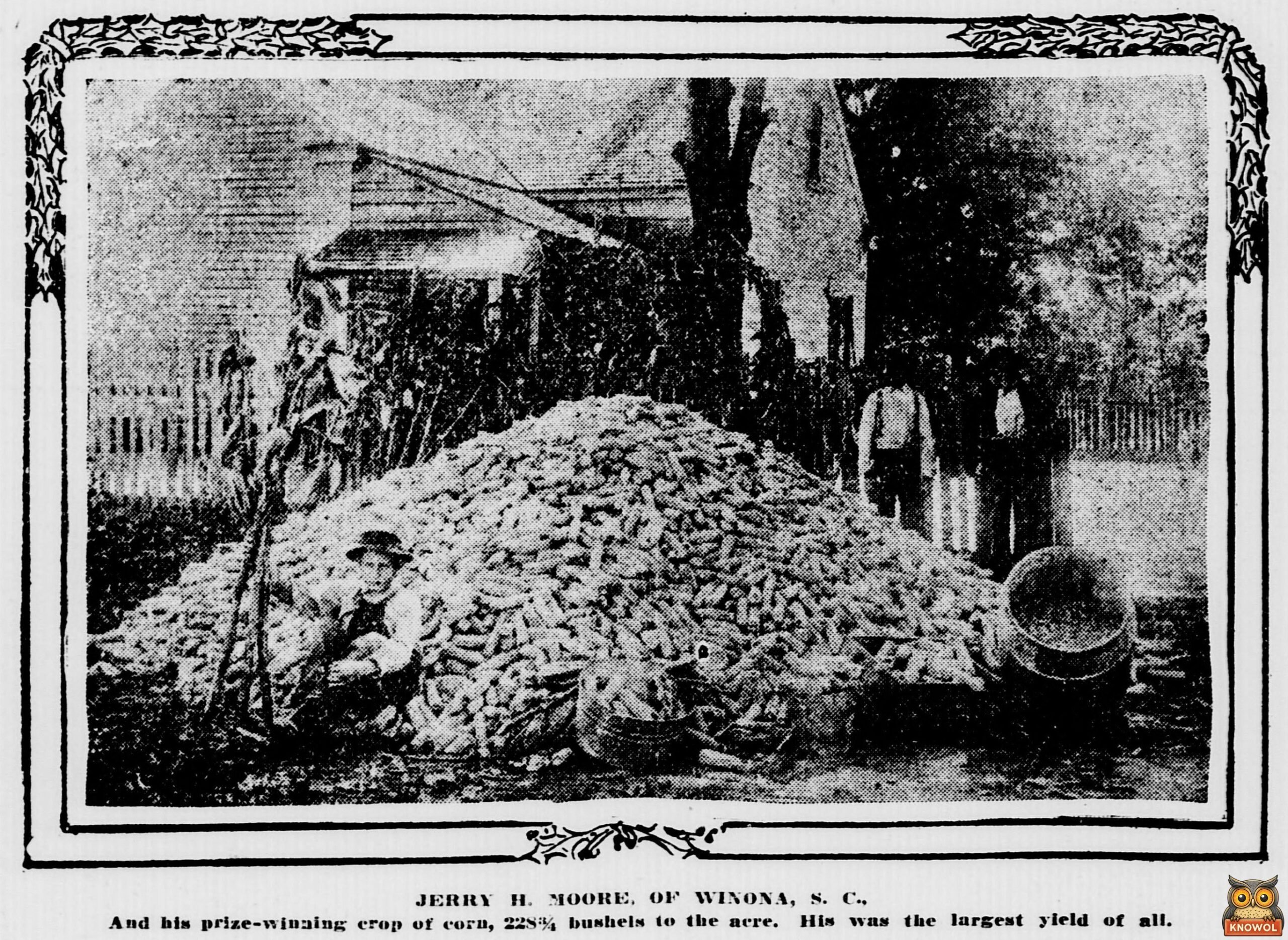
“Jerry H. Moore, of Winona, S. C., and his prize-winning crop of corn, 228¾ bushels to the acre. His was the largest yield of all.” Evening Star, Washington, D.C., December 18, 1910, page 54. Library of Congress, Chronicling America. Click the clipping to read it full size.
One acre of sandy ground
Jerry was the son of a Methodist minister and a member of the Florence County Boys’ Corn Club, one of the clubs the U.S. Department of Agriculture was starting across the South to teach boys new ways of farming. Each boy worked one acre and kept an account of it. Jerry’s was light gray, sandy upland with three or four inches of topsoil, and a Washington paper said he was working pine stump land. So at the start of March 1910 he spread 300 one-horse wagonloads of rich dirt over it, then 50 more loads of stable manure.
Weighed, not guessed
By July almost every stalk had an ear, and many had two or three. Five men measured the land and weighed the crop, and the yield was backed by sworn statements. On Wednesday, November 9, Ira W. Williams, the state agent for the federal farm demonstration work, announced that Jerry was the champion boy corn grower of South Carolina and of the world. A Marlboro County boy had been reported at 258 bushels, but Williams found a mistake in the measuring. That boy had grown 179.
The Department of Agriculture sent three of its most reliable men down to weigh, measure and shell some of the crop, just to be sure. Jerry closed his own account modestly. “What I have done has been more of an experiment than doing what I knew to be wise,” he wrote.
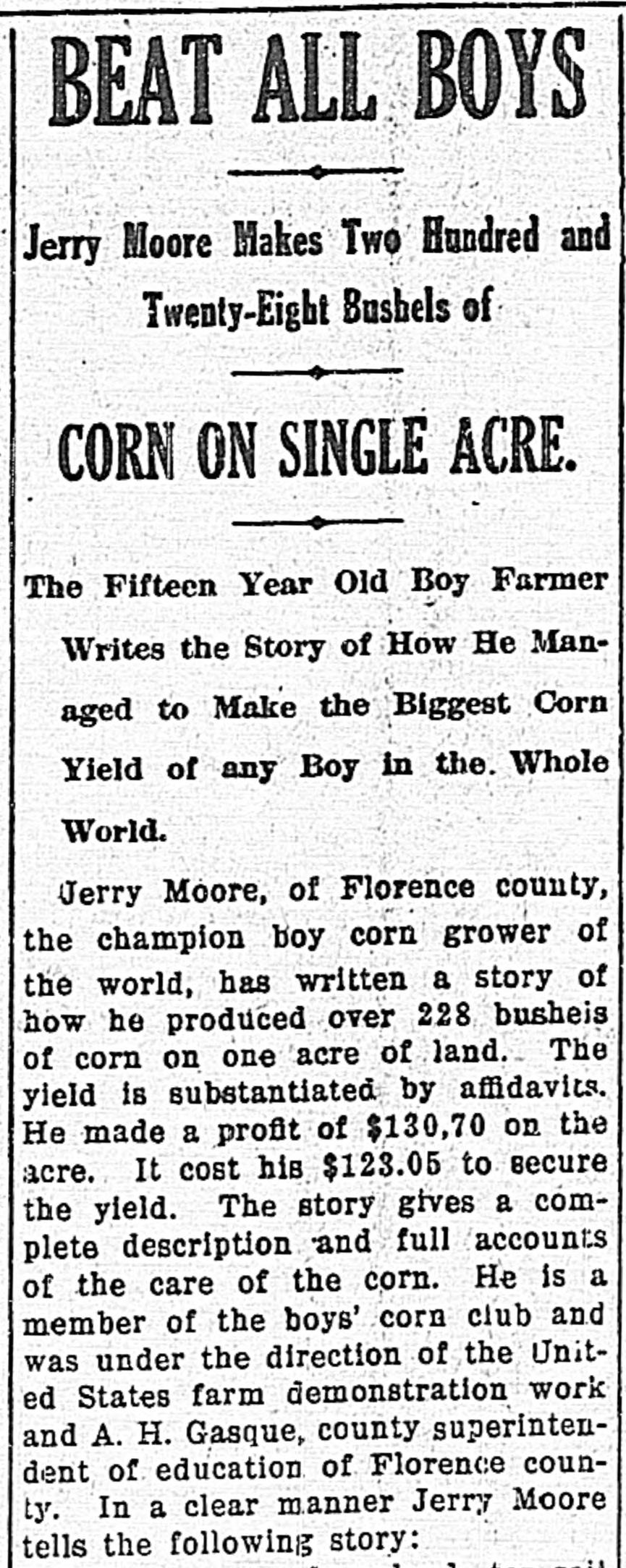
“Beat All Boys,” the start of Jerry Moore’s own account of his acre, the Times and Democrat, Orangeburg, South Carolina, November 12, 1910, page 1. Library of Congress, Chronicling America. Click the clipping to read it full size.
What an acre cost
Jerry’s account listed every dollar. Rent on the acre was $5, manure $25 and store-bought fertilizer $66.55, and with plowing, planting, cultivating and harvesting, the bill came to $128.05. At the going price of $1 a bushel, plus $30 for the fodder, the crop was worth $258.75, which left him $130.70. He didn’t count the 300 loads of dirt, he explained, because dirt had no commercial value. By December he’d found a market for his corn at $3 a bushel, and a Washington paper figured he’d clear about $1,000 on his year’s work.
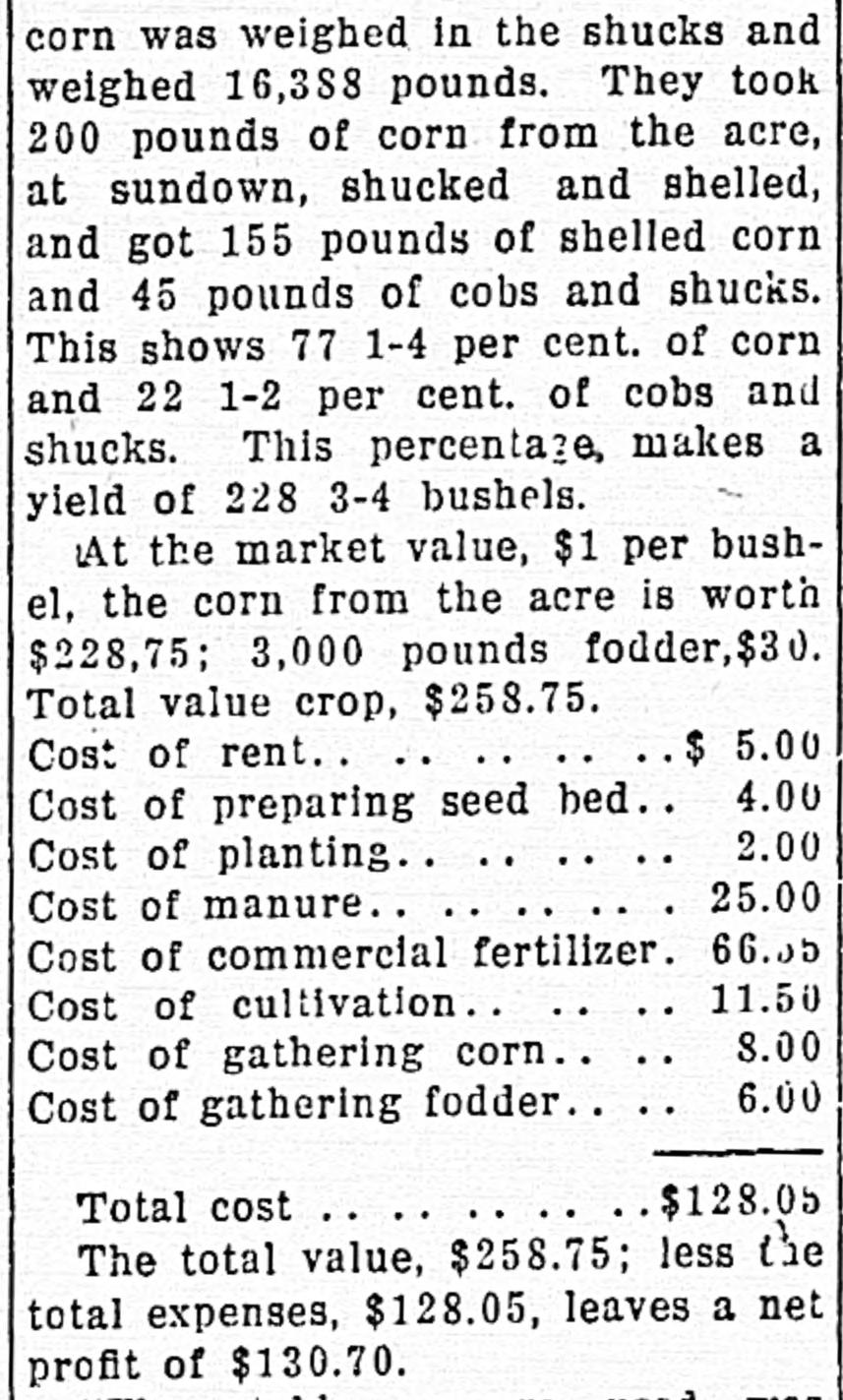
Jerry Moore’s weights and costs for his acre, down to a net profit of $130.70, the Times and Democrat, Orangeburg, South Carolina, November 12, 1910, page 1. Library of Congress, Chronicling America. Click the clipping to read it full size.
A modest young fellow
In December the South Atlantic States Corn Exposition opened in Columbia, and a Sumter paper reported that Jerry was the visitor drawing the most attention. “He is a very modest young fellow and knows corn,” it said. He won a two-horse cultivator from the John Deere Plow Company and a ton of fertilizer for his best ten ears. A 15-year-old girl, Hannah Plowden of Clarendon County, took a prize there too, for growing 120 bushels on her own acre.
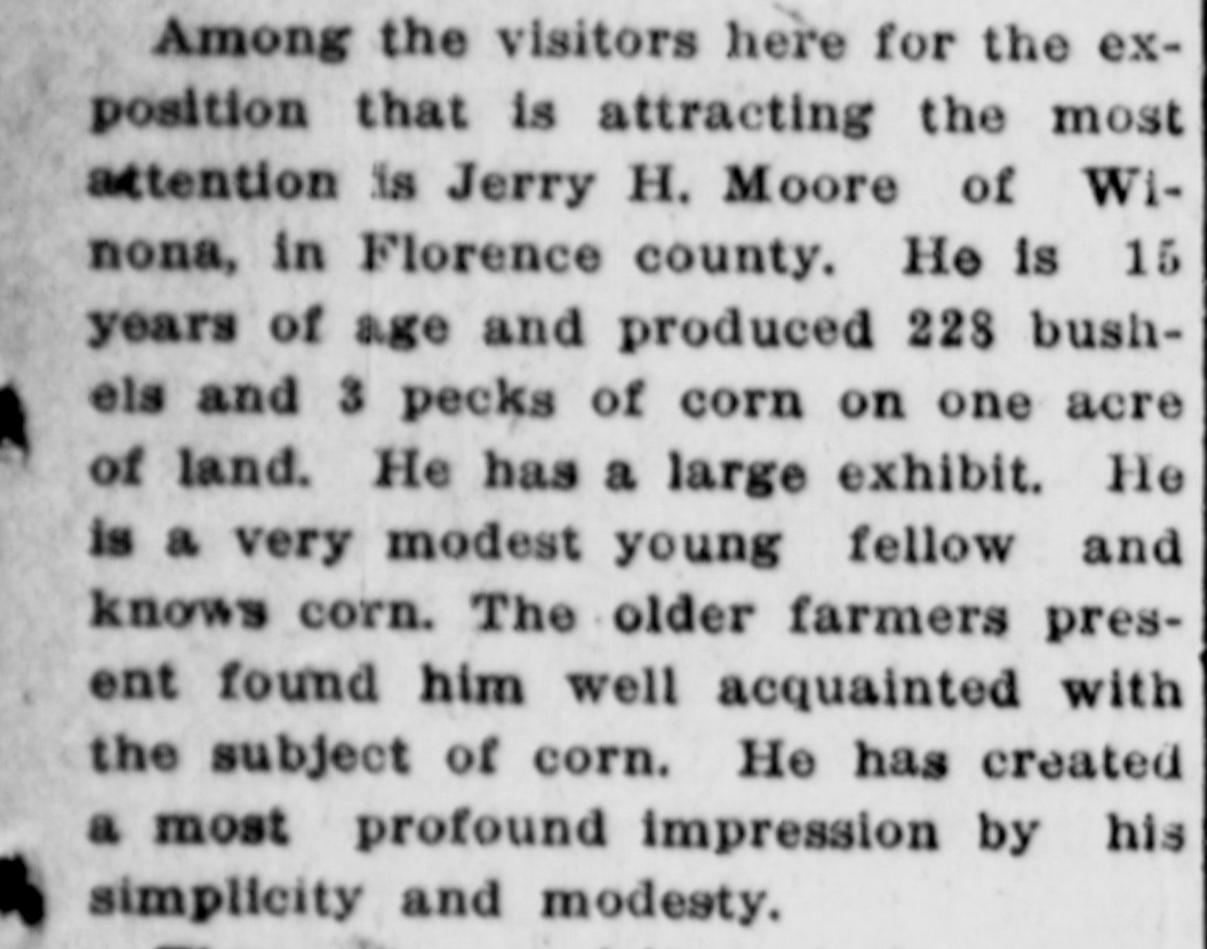
Jerry Moore at the corn exposition in Columbia, the Watchman and Southron, Sumter, South Carolina, December 10, 1910, page 1. Library of Congress, Chronicling America. Click the clipping to read it full size.
No hotels and no Sunday trains
That same month Jerry went to Washington with the other state prize winners, boys from eleven to sixteen years old, as guests of Secretary of Agriculture James Wilson. A department report says they were received at the White House by President William Howard Taft and spent nearly two hours answering questions from the House Committee on Agriculture. Jerry’s father had rules, though. The family didn’t travel on Sunday, so Jerry had to leave in time to be home by Saturday evening. He could go at all only if a private family would put him up, because his father didn’t want him in a hotel, where, the Evening Star reported, “he might acquire the cigarette habit or get into bad company.” The Star’s story about the trip began with the boys heading home, as “eleven tired but happy boys shook the snow of Washington from their feet.”
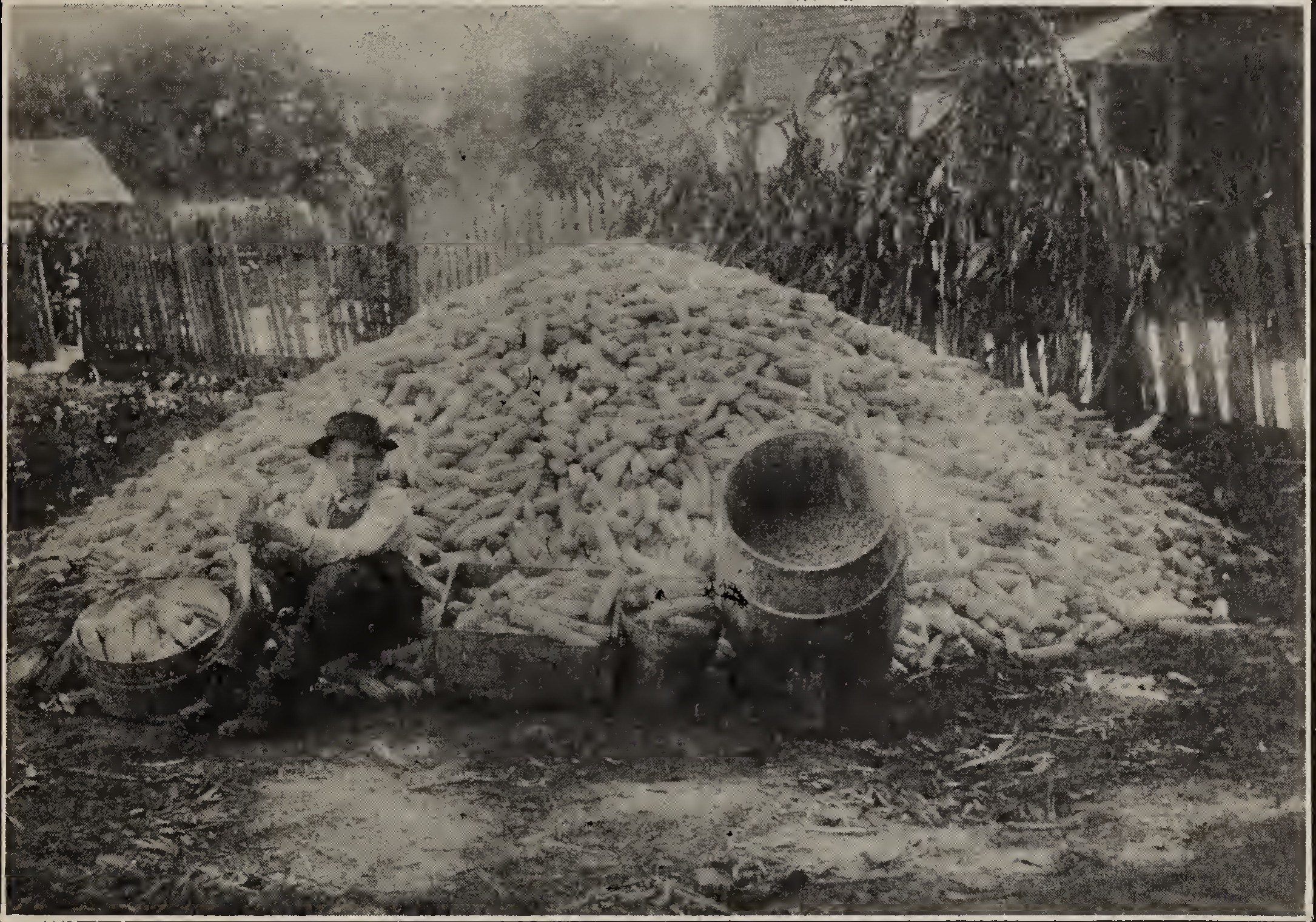
Jerry Moore beside part of his 228¾ bushels, in the Department of Agriculture’s report “Results of Boys’ Demonstration Work in Corn Clubs in 1910,” issued April 5, 1911. U.S. Department of Agriculture, via the National Agricultural Library and Internet Archive. Click the picture to see it full size.
Champion among champions
At the start of 1911 Jerry went to the National Corn Exposition in Columbus, Ohio, with the champion boys’ corn. “Jerry was the champion among champions,” the Star said. The average American acre in 1910 made 27.4 bushels, less than an eighth of his. In 1911, in poor weather, he grew more than 164 bushels, the best of the twelve men and boys in the state who entered that contest. Late in 1912 he spent five days at a land show in Chicago, where a financier named Oren B. Taft said the Middle West “needed about 100,000 boys like him.”
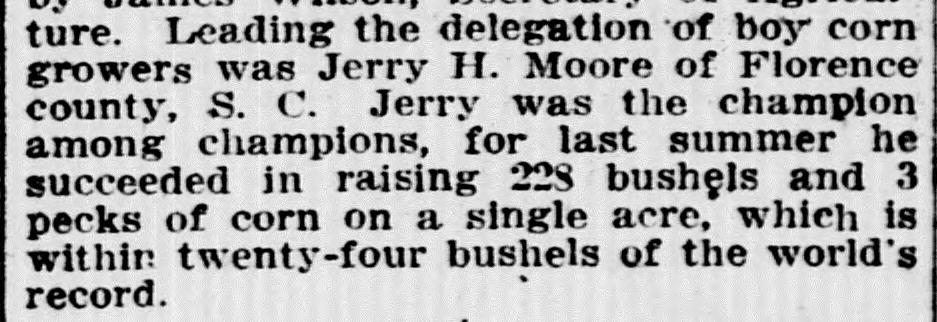
“Jerry was the champion among champions,” Evening Star, Washington, D.C., January 30, 1911, page 9. Library of Congress, Chronicling America. Click the clipping to read it full size.
Sources
- The Times and Democrat (Orangeburg, S.C.), November 12, 1910, page 1 (“Beat All Boys,” with Jerry Moore’s own account, and “Goes Up Head”).
- The Watchman and Southron (Sumter, S.C.), November 12, 1910, page 5 and December 10, 1910, page 1 (the Columbia corn exposition and its prizes).
- The Manning Times (Manning, S.C.), November 16, 1910, page 1.
- Evening Star (Washington, D.C.), December 18, 1910, page 54 (“Boy Corn Clubs Doing Great Work Under Department of Agriculture”) and January 30, 1911, page 9.
- The County Record (Kingstree, S.C.), December 26, 1912, page 1 (“More About Jerry Moore”), South Carolina Digital Newspaper Program, University of South Carolina Libraries.
- S. A. Knapp and O. B. Martin, “Results of Boys’ Demonstration Work in Corn Clubs in 1910,” U.S. Department of Agriculture, Bureau of Plant Industry, B.P.I. 647, issued April 5, 1911, via Wikimedia Commons.pdf) and the Internet Archive.
- All newspaper images: Library of Congress, Chronicling America. No known copyright restrictions.
- Photograph of Jerry Moore and his corn: U.S. Department of Agriculture, 1911, a U.S. government work in the public domain.
- Cover: Jerry Moore beside his corn, from the Department of Agriculture’s report “Results of Boys’ Demonstration Work in Corn Clubs in 1910,” 1911. U.S. government work, public domain.