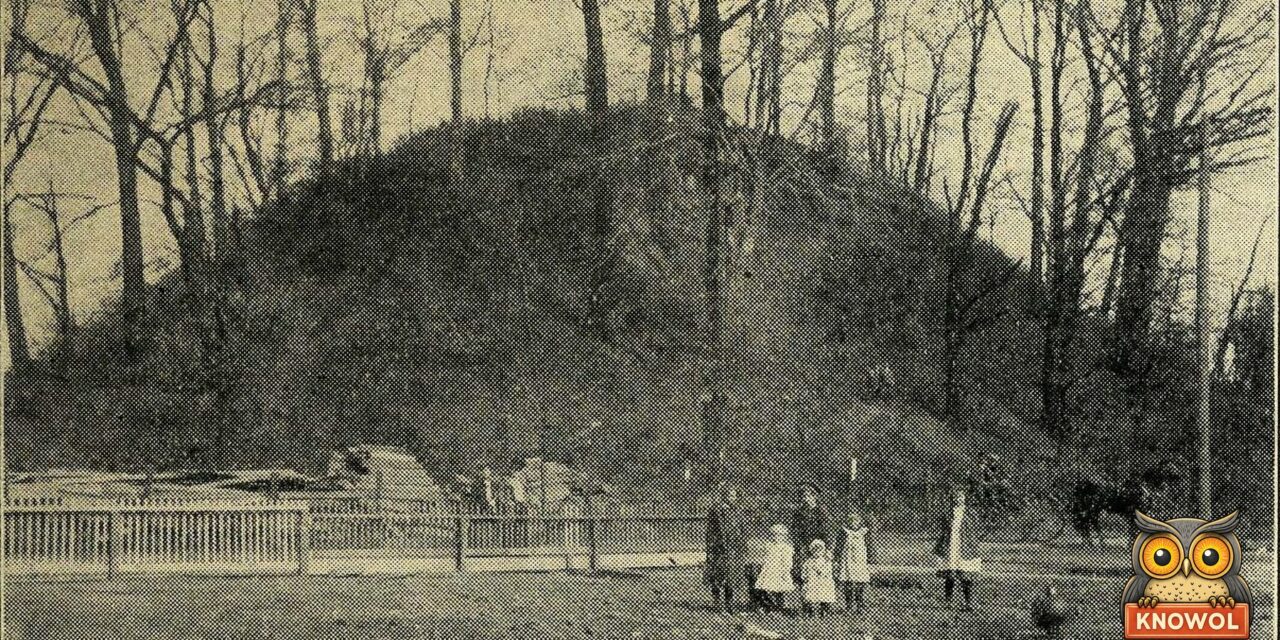
On the afternoon of Thursday, November 5, 1908, schoolchildren all over West Virginia put their lessons aside for something brand new called Mound Day. At the New Haven school, in the Arden district of Berkeley County, the teacher, Miss Valley C. Gain, took up a collection. Her list came to eleven nickels, one dime and one quarter, and a week later the Martinsburg Herald printed every name beside every coin. The money was headed for the other end of the state, to a giant hill of earth in the middle of Moundsville.
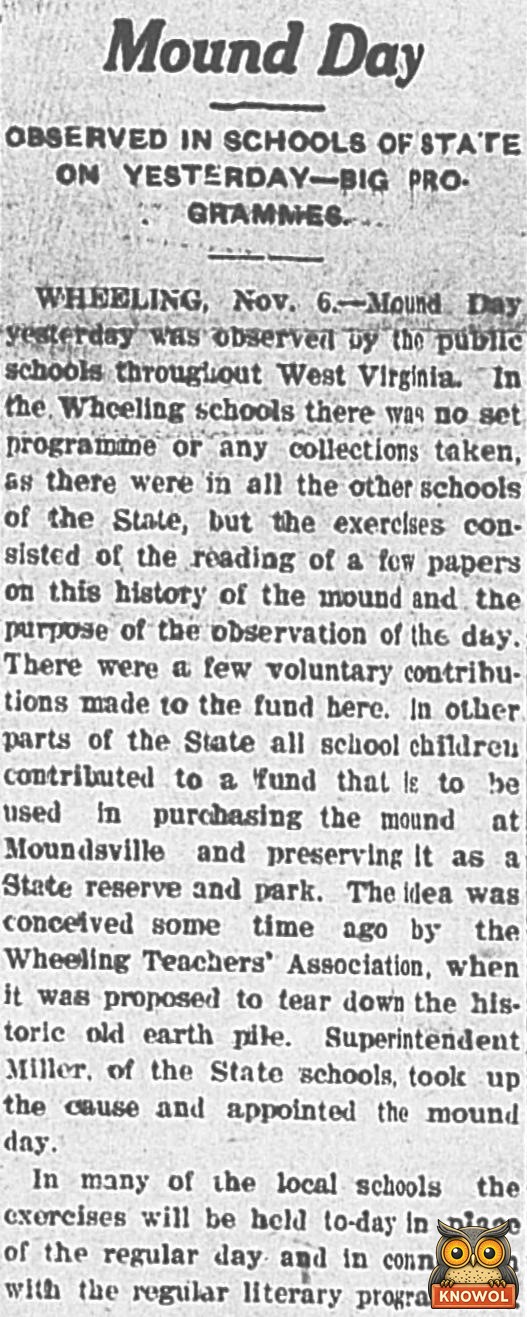
“Mound Day: Observed in Schools of State on Yesterday,” the Fairmont West Virginian, Fairmont, West Virginia, November 6, 1908, page 1. Library of Congress, Chronicling America. Click the clipping to read it full size.
A mound in the way
The Grave Creek Mound is a cone of earth about 62 feet high and 240 feet across, built by American Indian people of the Adena culture beginning around the third century B.C. In 1908 it was private property, filling about a block in the center of town. The man who had owned it, G. S. McFadden, bought it years earlier to keep a saloon off it. “When I went to Moundsville 17 years ago I found a German trying to buy the Mound for a popular resort and he intended to start a saloon there,” he told the Pittsburg Press. “Now, I didn’t want a saloon anywhere around there, and I bought the Mound myself.”
By 1908 the mound cost his heirs taxes and fence repairs and earned them nothing, and they wanted to use the land. The state’s own Mound Day circular admitted that they had already signed a contract to have the mound removed, and had agreed to wait a little while to see what the schools could do. Real estate men figured the cleared ground would sell for $28,000. The family offered the mound to the state for $25,000 and promised $5,000 back as a memorial to McFadden, which left $20,000 to find.
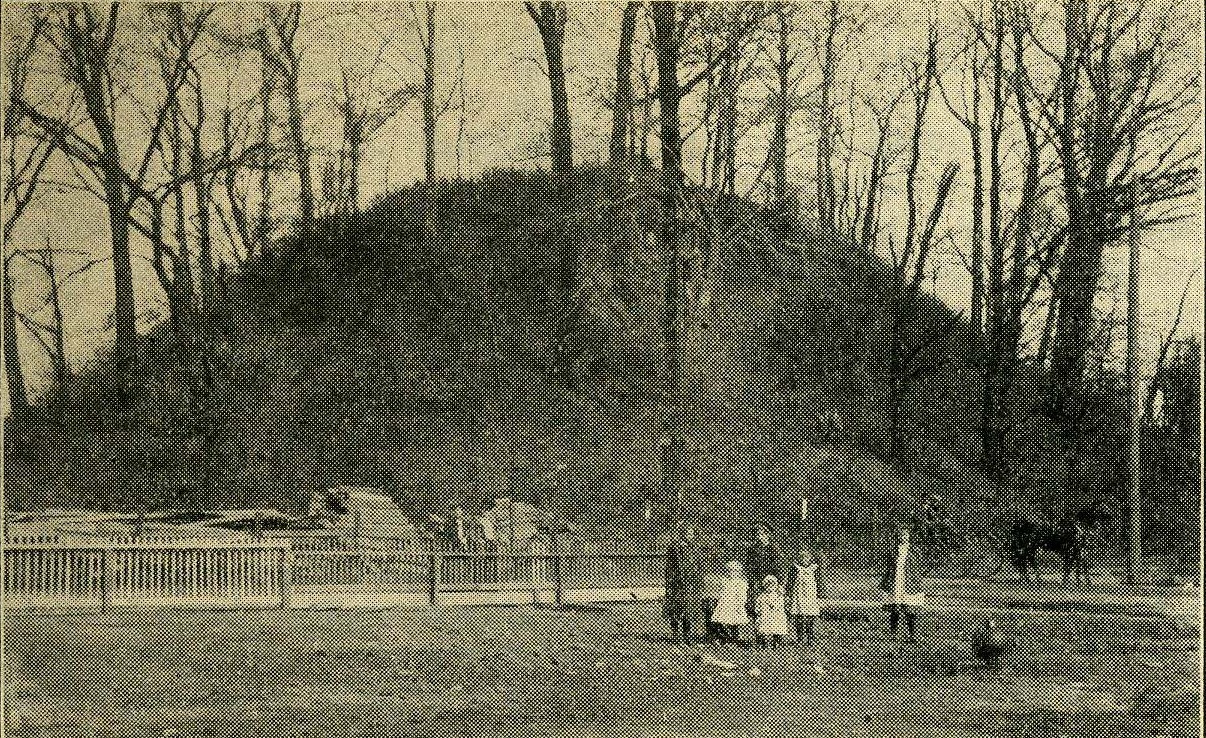
The mound behind its picket fence, with a few children standing in front, on the cover of the state’s 1908 Mound Day pamphlet, “Shall Not the Mound Be Preserved?” West Virginia and Regional History Center, WVU Libraries. Click the picture to see it full size.
Nickels, dimes and a program
The idea came from the Wheeling Teachers’ Association, a Wheeling report said, back “when it was proposed to tear down the historic old earth pile.” State Superintendent of Free Schools Thomas C. Miller made it official. Schools got a suggested program: the song “America,” a paper by a girl on why we observe Mound Day, a history of the mound by a boy, and the song “West Virginia Hills.” The money went to the nearest bank for State Treasurer Newton Ogdin.
The sums were small, and the papers printed them proudly. Charleston’s schools raised $66.95. The high school gave the most for its size, $7.75 from 217 students, and right behind it came the Island School, one of the city’s segregated schools for Black children, with $1.10 from 35 pupils. In Clarksburg, the fourth grade at the Central school gave $3.33, more than any other single room in town.
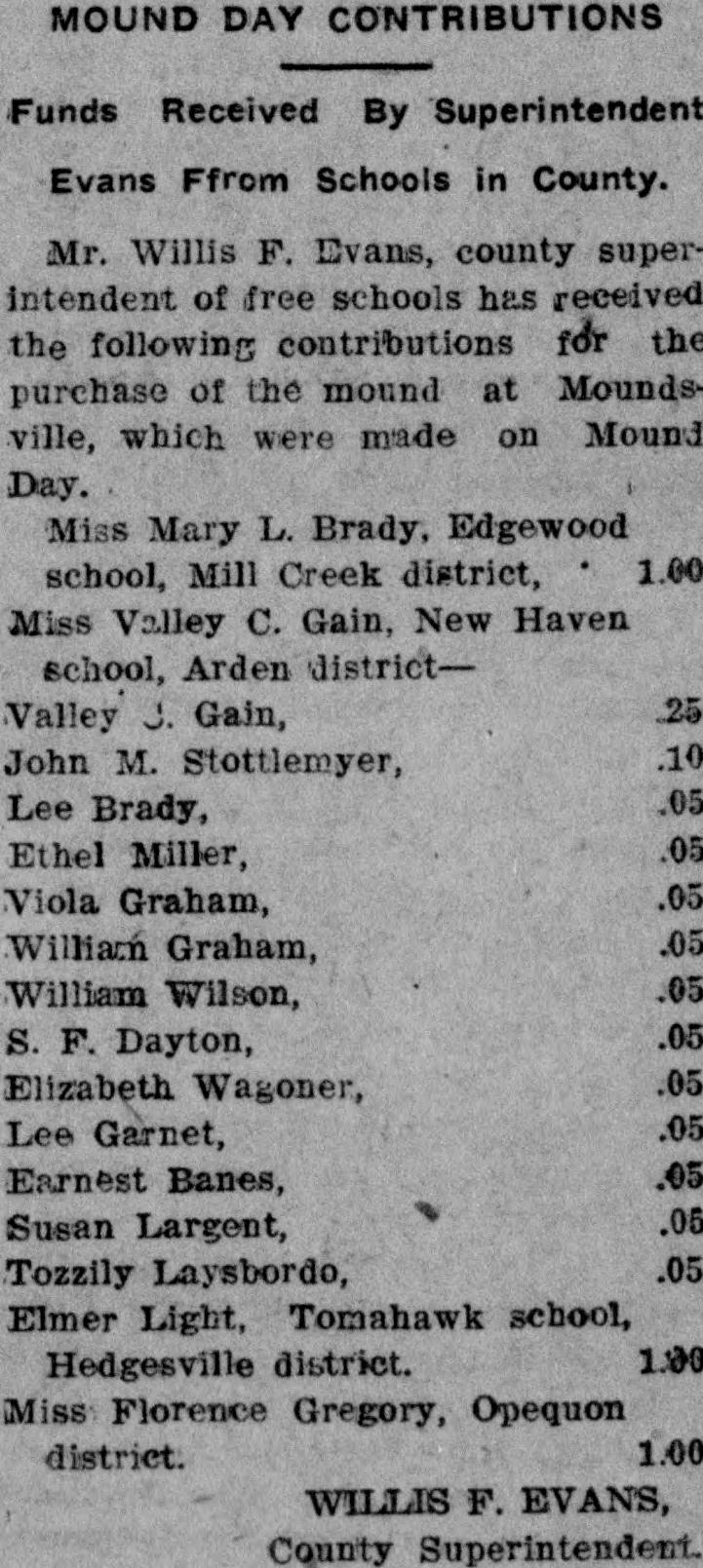
“Mound Day Contributions,” with every nickel from the New Haven school, Martinsburg Herald, Martinsburg, West Virginia, November 14, 1908, page 7. Library of Congress, Chronicling America. Click the clipping to read it full size.
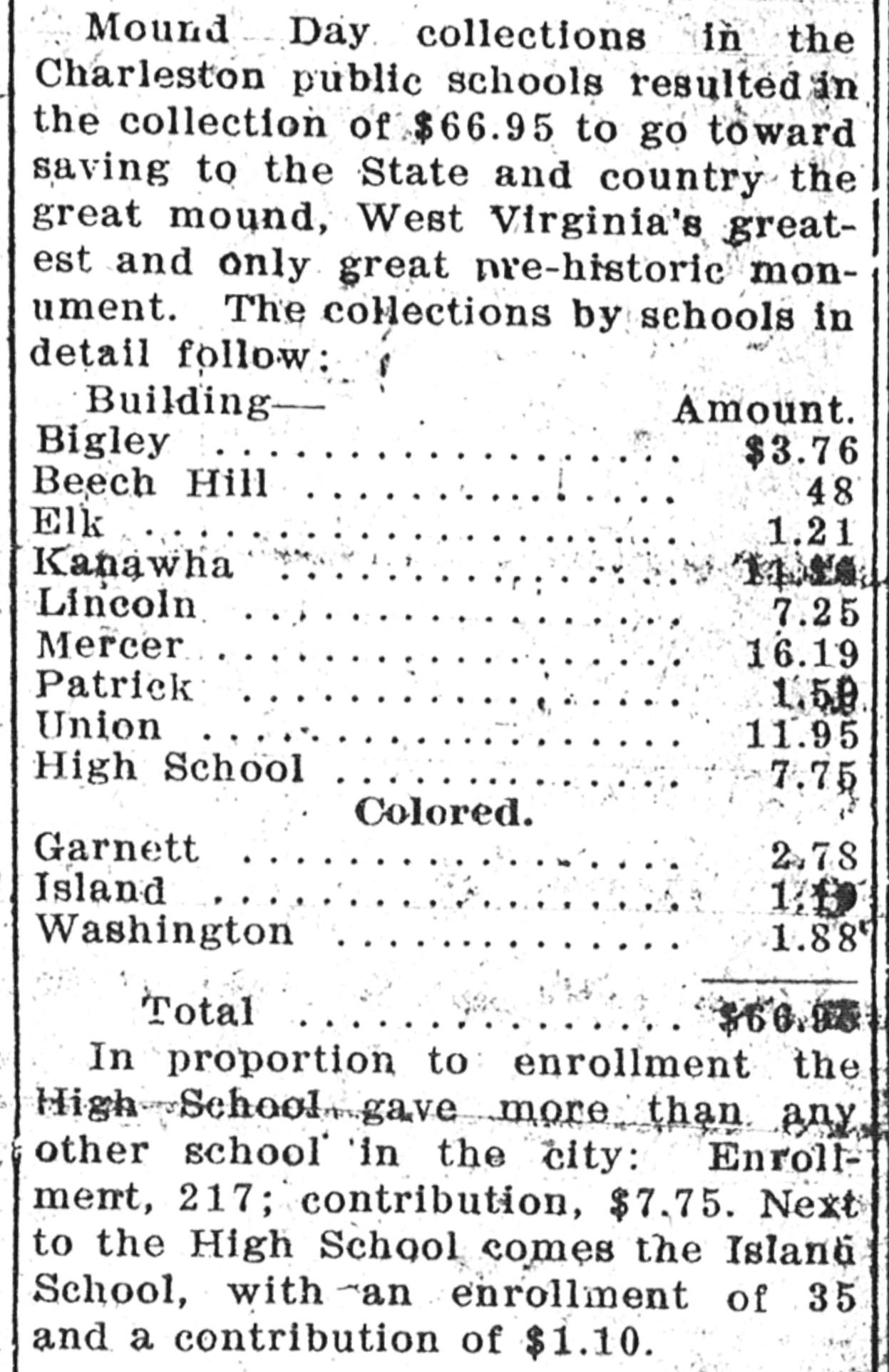
Mound Day collections in the Charleston public schools, the Advocate, Charleston, West Virginia, November 19, 1908, page 3. Library of Congress, Chronicling America. Click the clipping to read it full size.
“Impossible to save it”
Two weeks later the state historian, Virgil A. Lewis, came to Moundsville and spoke to the schoolchildren there. When he was asked about saving the mound, the Fairmont paper reported, “he replied that it would be impossible to save it.” He meant an older fund. Years before, $431.88 had been collected for the mound, and the state historical society had spent it on history books. Lewis said he was all for saving the mound and wanted the state to buy it. A paper in Ronceverte mixed up the two funds and printed a gloomy headline, “Mound May Be Destroyed,” and a hard line: “The owners say they will raze it to make room for building lots.”
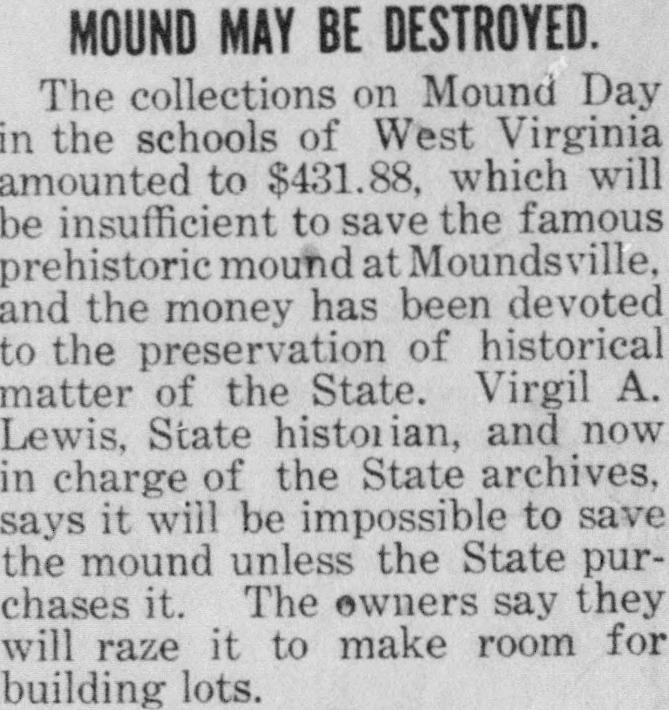
“Mound May Be Destroyed,” the West Virginia News, Ronceverte, West Virginia, December 5, 1908, page 2. Its $431.88 was the old fund, not the Mound Day money. Library of Congress, Chronicling America. Click the clipping to read it full size.
$1,250.49
The money kept coming. On January 13, 1909, the state treasurer reported that the children’s Mound Day collections came to $1,250.49. That wasn’t $20,000, but it was hard to ignore. That winter the Legislature passed House Bill No. 333, which set aside $15,000 “to be used in connection with the fund secured by donations from the schools.” By August 1909 the state owned the mound.
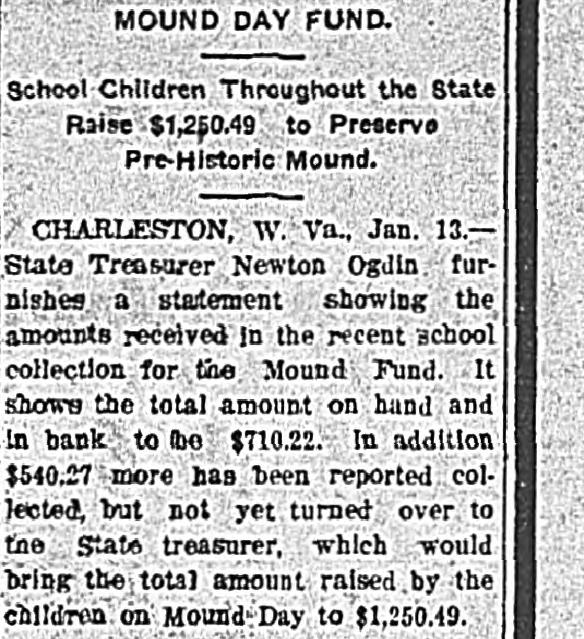
“Mound Day Fund: School Children Throughout the State Raise $1,250.49,” the Fairmont West Virginian, January 13, 1909, page 5. Library of Congress, Chronicling America. Click the clipping to read it full size.
A log cabin and a goldfish pond
The mound had already lived a busy life. An engraving from the 1840s shows a doorway at its base, where diggers had tunneled in during 1838, and a little building on top. McFadden said that in 1862 a Civil War battery under a commander named Mulligan planted a gun up there. The state’s 1909 plans were just as lively. Convicts from the state penitentiary in Moundsville, led by the prison’s florist, cleared out the dead trees. A log cabin was to go on top, with flower beds below and a fountain “filled with gold fish.” There was even talk of a tunnel straight through the mound to look for relics.
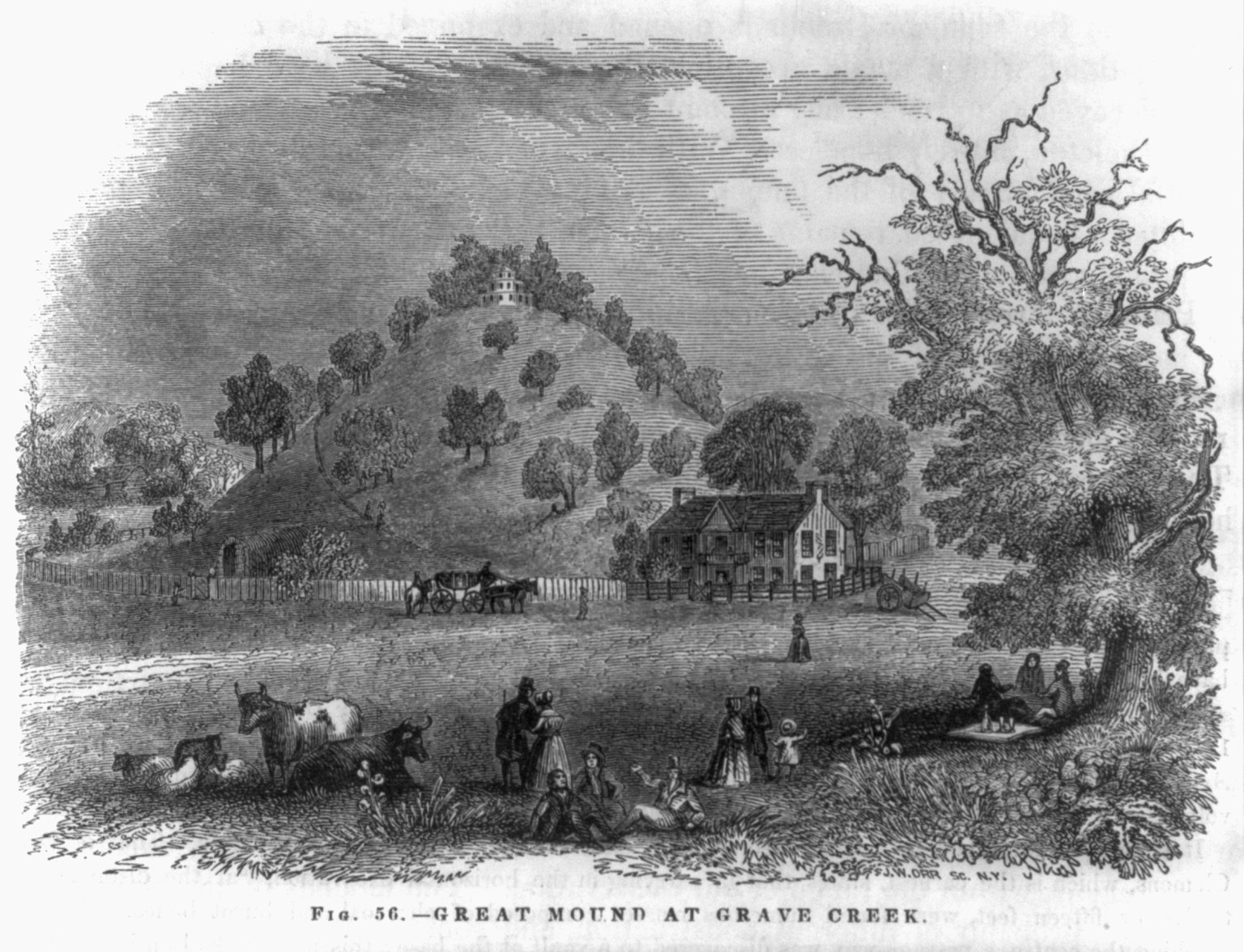
“Great Mound at Grave Creek,” an engraving from the 1840s, with picnickers in front and a door into the mound at its base. Library of Congress, Prints and Photographs Division. Click the picture to see it full size.
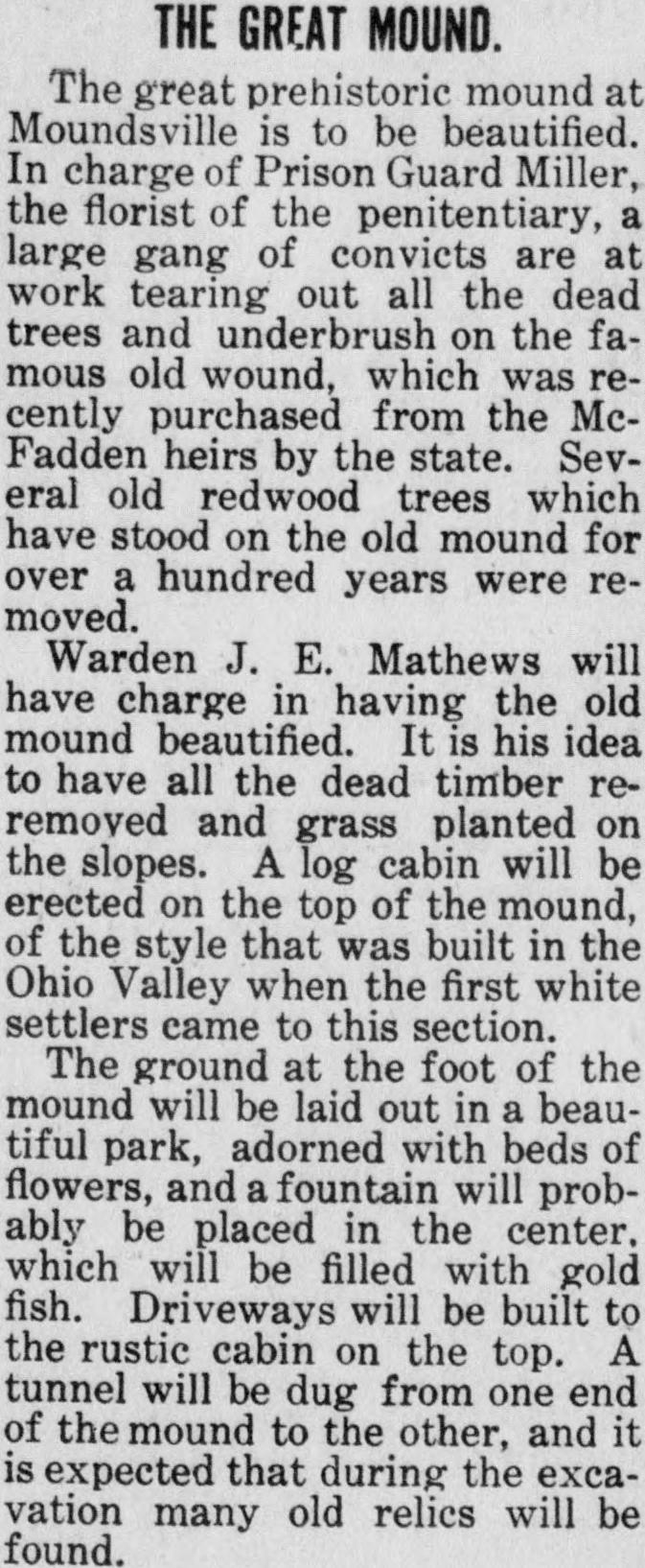
“The Great Mound,” on the state’s plans after the purchase, the West Virginia News, Ronceverte, West Virginia, August 28, 1909, page 2. Library of Congress, Chronicling America. Click the clipping to read it full size.
Still standing
The mound is still in the middle of Moundsville. It became Grave Creek Mound State Park in 1967, and a museum opened beside it in 1978. In 1908 the papers said a vanished prehistoric race had built it. Archaeologists today credit the Adena culture. The eleven nickels from the New Haven school were part of the money that kept it there.
Sources
- The Fairmont West Virginian (Fairmont, W. Va.), November 6, 1908, page 1 (“Mound Day”), November 20, 1908, page 1 (“Save the Mound Says Mr. Lewis”) and January 13, 1909, page 5 (“Mound Day Fund”).
- Martinsburg Herald (Martinsburg, W. Va.), November 14, 1908, page 7 (“Mound Day Contributions”).
- The Advocate (Charleston, W. Va.), November 19, 1908, page 3.
- The Daily Telegram (Clarksburg, W. Va.), November 12, 1908, page 1 (“Mound Funds”).
- The Moorefield Examiner (Moorefield, W. Va.), November 19, 1908, page 1 (“The Fund Will Be Raised”).
- The West Virginia News (Ronceverte, W. Va.), September 5, 1908, page 3 (“Mound Day Postponed”), December 5, 1908, page 2 (“Mound May Be Destroyed”) and August 28, 1909, page 2 (“The Great Mound”).
- The Webster Echo (Addison, W. Va.), September 25, 1908, page 4 (“Historic Mound Day”) and March 12, 1909, page 2 (House Bill No. 333).
- West Virginia Department of Free Schools, “Shall Not the Mound Be Preserved?” (1908 Mound Day pamphlet, with McFadden’s statement), West Virginia and Regional History Center, WVU Libraries, Printed Ephemera Collection P1976.
- Patrick D. Trader, “Grave Creek Mound,” e-WV: The West Virginia Encyclopedia, West Virginia Humanities Council.
- All newspaper images: Library of Congress, Chronicling America. No known copyright restrictions.
- 1908 pamphlet and its photograph: West Virginia and Regional History Center, WVU Libraries (published 1908, public domain in the United States).
- “Great Mound at Grave Creek” engraving: Library of Congress Prints and Photographs Division, LCCN 2004679658, via Wikimedia Commons_Great_Mound_at_Grave_Creek_LCCN2004679658.jpg), public domain.
- Cover: Photograph of the Grave Creek Mound from “Shall Not the Mound Be Preserved?”, West Virginia Department of Free Schools, 1908 (cropped), West Virginia and Regional History Center, WVU Libraries. Public domain.