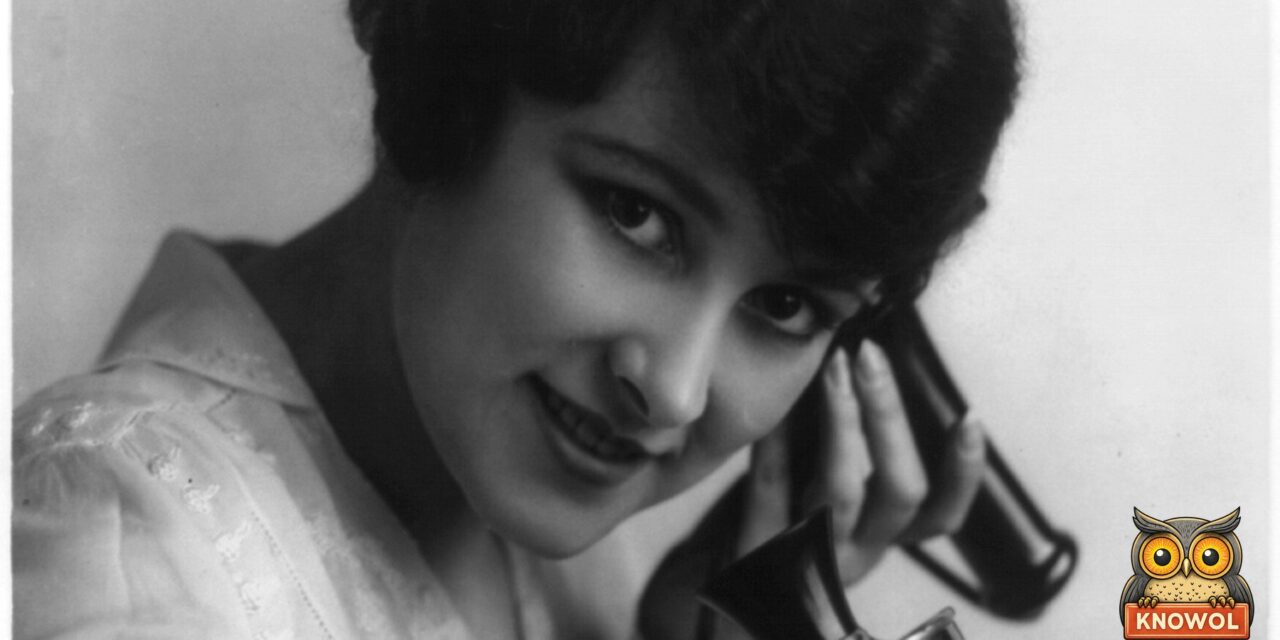
On an afternoon in early March 1916, the telephone rang in the court clerk’s office in Muskogee, Oklahoma. An anxious voice asked if this was the court clerk’s office. A deputy clerk named E. A. Hill said it was. As the Muskogee Phoenix told it the next day, he wasn’t much interested until he heard the next line. “Well, I want to know if you can give me a marriage license over the telephone.”
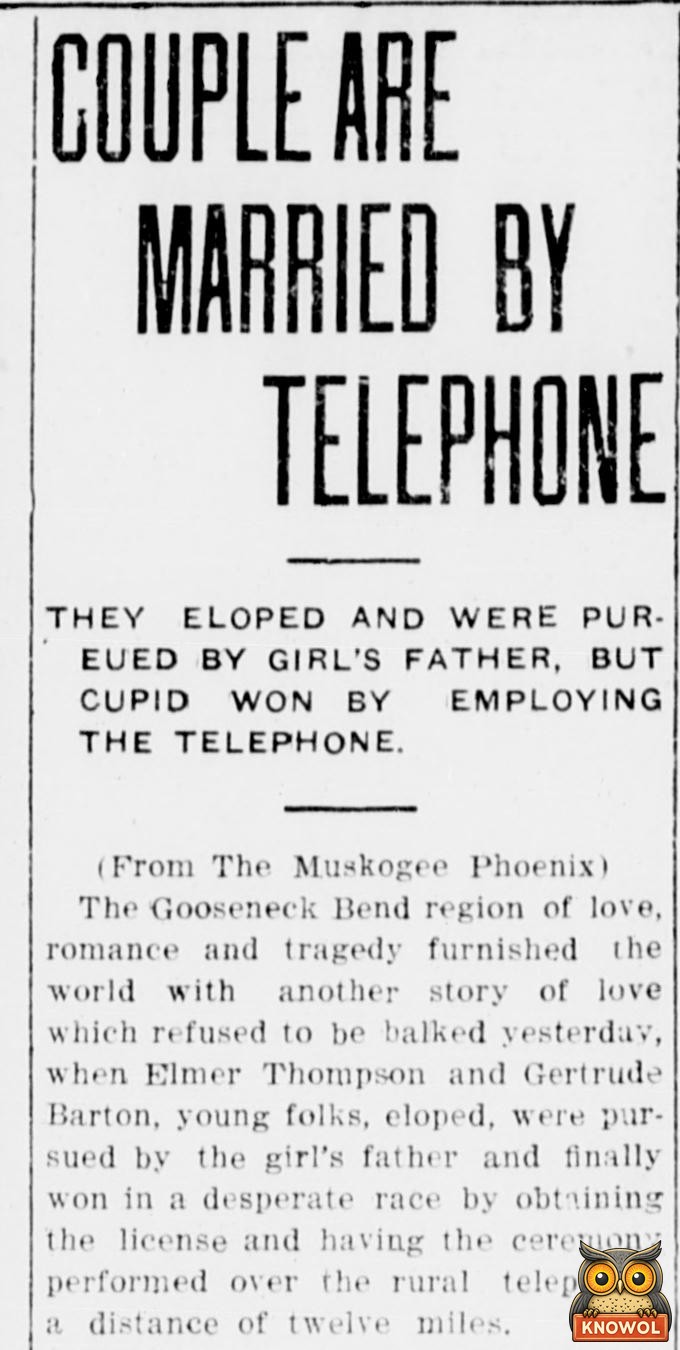
“Couple Are Married by Telephone,” a Muskogee Phoenix story reprinted in the Daily Ardmoreite, Ardmore, Oklahoma, March 8, 1916, page 7. Library of Congress, Chronicling America. Click the clipping to read it full size.
The old man’s faster horse
The caller was Elmer Thompson, 23. With him on a rural telephone line about twelve miles out, in the farm country the paper called the Gooseneck Bend, was Gertrude Barton, 21. They had run off to get married, and her father was on the road behind them. Elmer didn’t waste words. “We started to run away, but the old man’s coming after us and he’s got a faster horse. We can’t make it.”
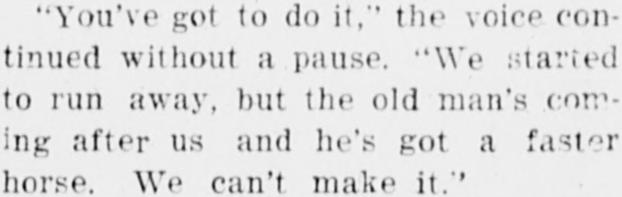
Elmer Thompson’s plea to the deputy clerk, from the Muskogee Phoenix, reprinted in the Daily Ardmoreite, March 8, 1916. Library of Congress, Chronicling America. Click the clipping to read it full size.
Hill agreed, as long as they were both of legal age. He took their names, ages and addresses over the wire as the application and told them they could come in later and swear to the facts. Then he pointed out the catch. A license didn’t make them married, and if her father caught them first, it wouldn’t do them much good. The groom, the paper said, was plainly flustered. So Hill asked who they wanted to marry them. Elmer named Justice Miller but didn’t see how they could reach him in time. Hill told him to call the justice from where he was, and he would hurry down to Miller’s office and explain. Elmer shouted something that sounded like hurrah. Hill didn’t quite catch it, because he was already hanging up and heading out the door.
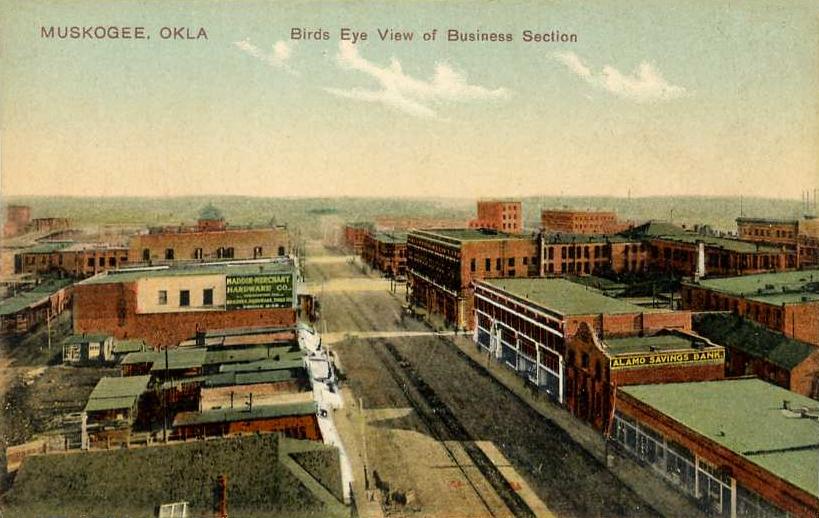
Downtown Muskogee in a postcard from about 1910, a few years before the telephone wedding. Wikimedia Commons, public domain. Click the picture to see it full size.
A wedding twelve miles long
Justice Miller got the drift just as his own telephone rang, and the Phoenix said he was ready to do anything to outwit papa. He began the way weddings always begin, with one small change. “If there is any person at either end of this line,” he said, “who knows any reason why these persons should not be joined in marriage, let him speak now or forever hold his peace.”
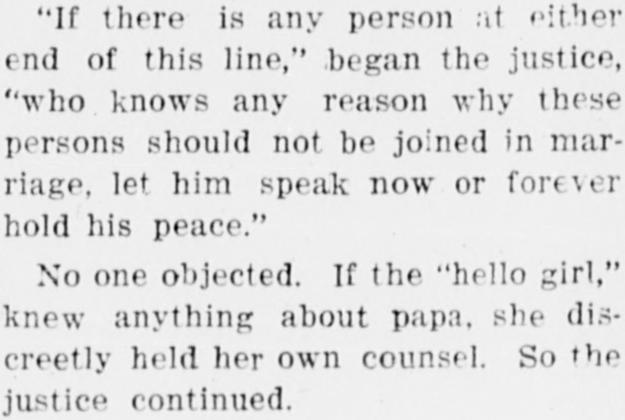
The justice opens the ceremony, and the “hello girl” keeps quiet. The Daily Ardmoreite, March 8, 1916. Library of Congress, Chronicling America. Click the clipping to read it full size.
No one objected, not even the operator. “If the ‘hello girl,’ knew anything about papa, she discreetly held her own counsel,” the paper said. The justice told the couple to join their right hands, and Elmer reported that they had. He said “I do,” handed the receiver to Gertrude, and she said “I do” too. The justice pronounced them man and wife and added a promise: “Now kiss each other and the first time you come to Muskogee I’ll give the bride her carnation.”
Party lines and hello girls
In 1916 a call went through a local operator, the “hello girl,” who connected the lines by hand at a switchboard, and many families shared one line with their neighbors. The same page of the Daily Ardmoreite that reprinted the story carried a big ad from the Pioneer Telephone and Telegraph Company. “Is your telephone line one which two or three or four must use in turn?” it asked. A private Direct Line, the ad promised, cost only a little more.
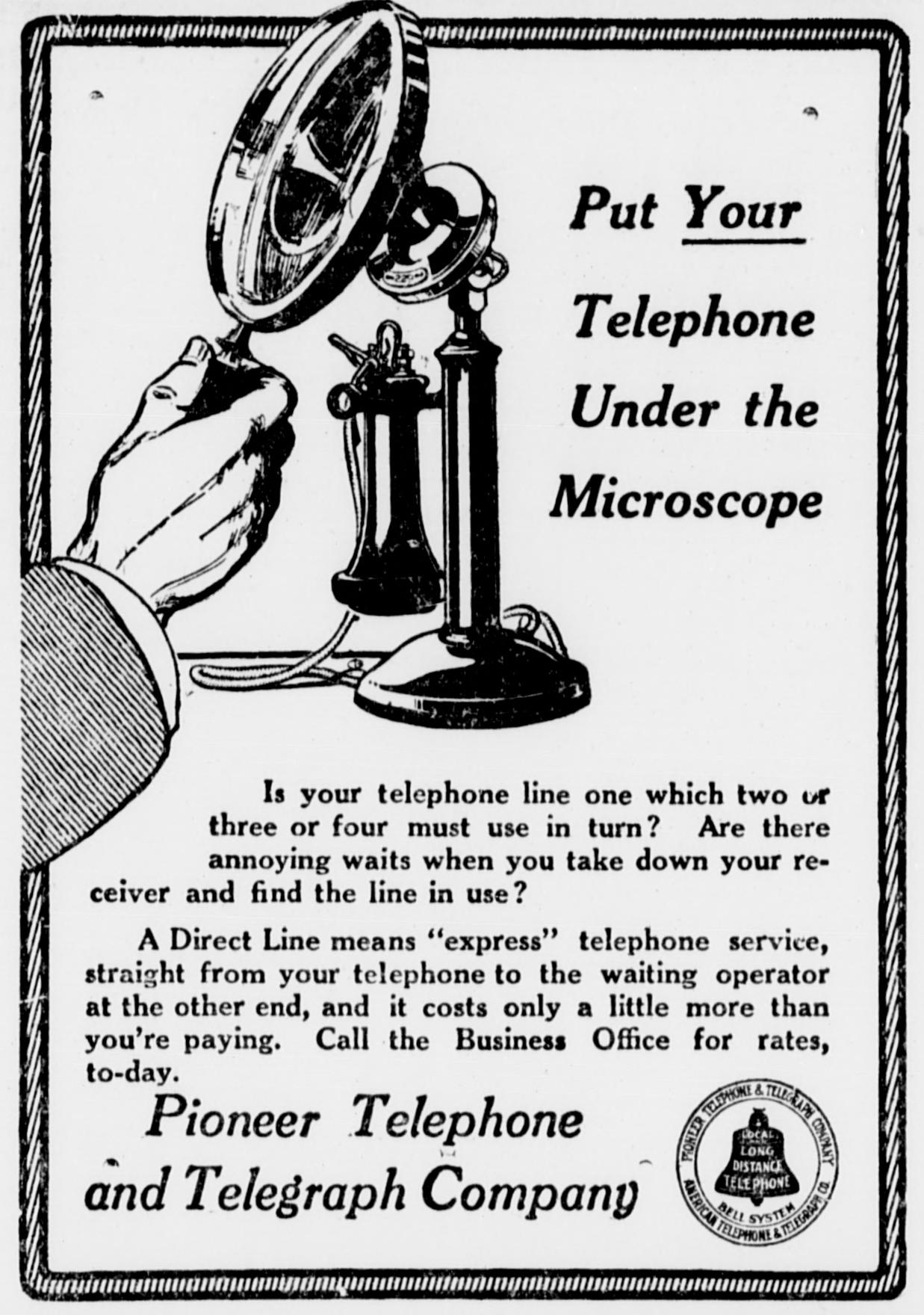
“Put Your Telephone Under the Microscope,” a Pioneer Telephone and Telegraph Company ad on the same page as the wedding story. The Daily Ardmoreite, March 8, 1916. Library of Congress, Chronicling America. Click the clipping to read it full size.
The classified ads on that page show the horse and the automobile side by side. One man offered a horse, buggy and harness for sale, or would trade them for a milk cow. Another wanted to trade a King upright piano and some cash for a slightly used car that seated five or seven.
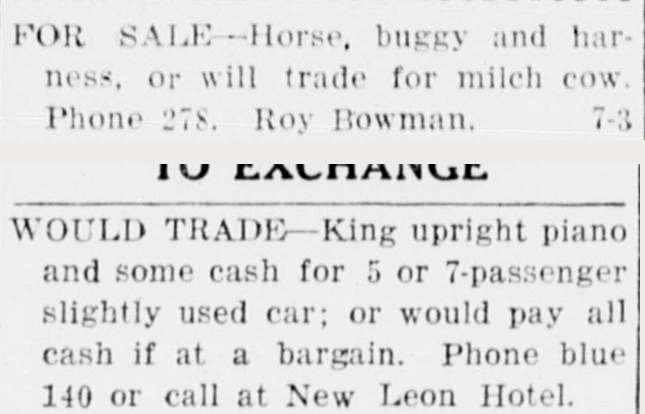
Two want ads from the same page: a horse and buggy to sell or trade for a milk cow, and a piano offered for a used car. The Daily Ardmoreite, March 8, 1916. Library of Congress, Chronicling America. Click the clipping to read it full size.
Legal by long distance
A reporter asked Justice Miller whether a wedding by telephone would hold up. Of course it would, he said. Judge deGraffenried of the district court had just come down hard on a sheriff who refused to obey an order the judge gave by long distance telephone, and what was good enough for the judge was good enough for him. He had a message for the bride’s father, too, if he doubted it: “just let him question that marriage and I’ll fine him for contempt of my court. Yes, sir-e-e.”
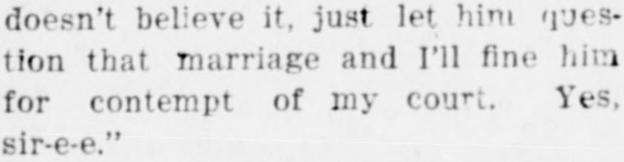
Justice Miller’s warning to the bride’s father, the last lines of the story. The Daily Ardmoreite, March 8, 1916. Library of Congress, Chronicling America. Click the clipping to read it full size.
Oklahomans had married by telephone before. In January 1901, a Chickasha paper reported that when the man who was to perform a wedding at Oxley was held up, the probate judge of Watonga married P. B. Anderson and Anna Shoemaker over the wire. The Muskogee wedding had a race in it. How close Gertrude’s father came, the Phoenix admitted, was a part of the story nobody had told yet. The paper was sure of the ending, though: his daughter was safely married.
Sources
- The Daily Ardmoreite (Ardmore, Okla.), March 8, 1916, page 7 (“Couple Are Married by Telephone,” from the Muskogee Phoenix; the Pioneer Telephone and Telegraph Company ad; the want ads).
- The Chickasha Daily Express (Chickasha, Indian Territory), January 26, 1901, page 2 (the Oxley telephone wedding).
- All newspaper images: Library of Congress, Chronicling America. No known copyright restrictions.
- Muskogee postcard: “Bird’s-eye View of Business Section, Muskogee, Okla.,” about 1910, Wikimedia Commons, public domain.
- Cover: “[Young woman posed with a telephone],” photograph, 1915 (cropped). Library of Congress Prints and Photographs Division, 97510172. Published 1915, public domain.