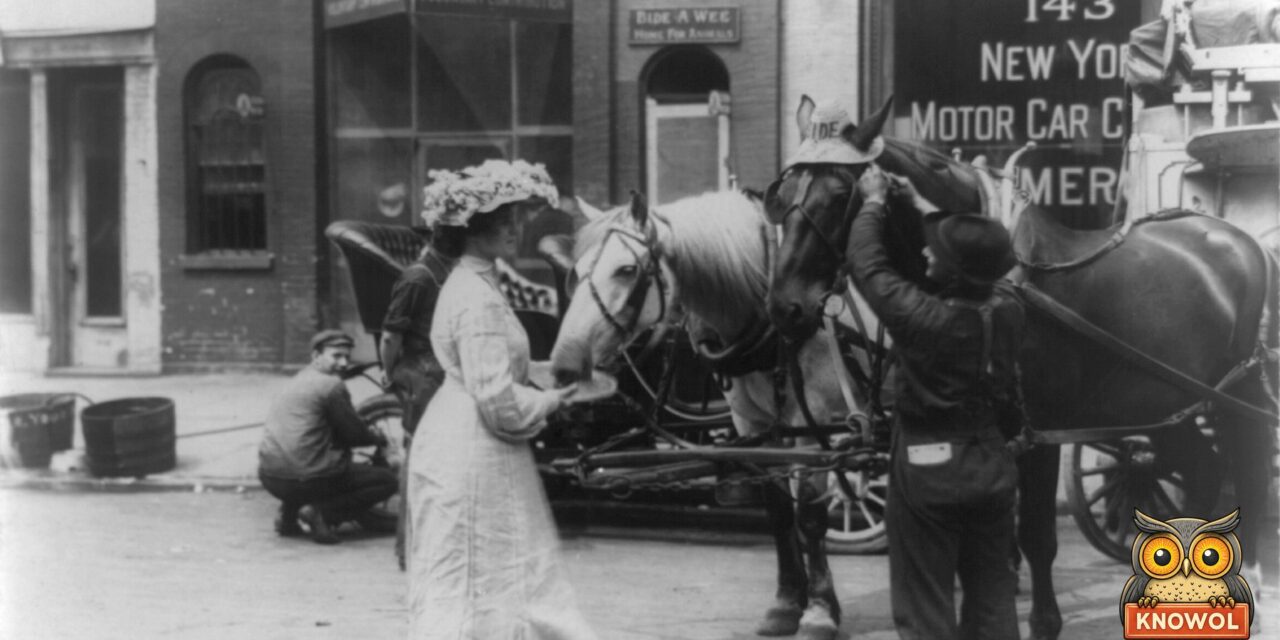
On Tuesday morning, July 25, 1905, the corner of Third avenue and Market street in Louisville, Kentucky, filled up with horses and mules. They weren’t there to shop. They had come for hats. Levy Brothers, a clothing store on that corner, had promised a free straw bonnet to every horse and mule brought to its door.
The week before had been hot, and the city’s work horses had felt it. Horses and mules pulled most of the wagons in town, out in the sun all day, and a straw hat put a little shade over a horse’s head.
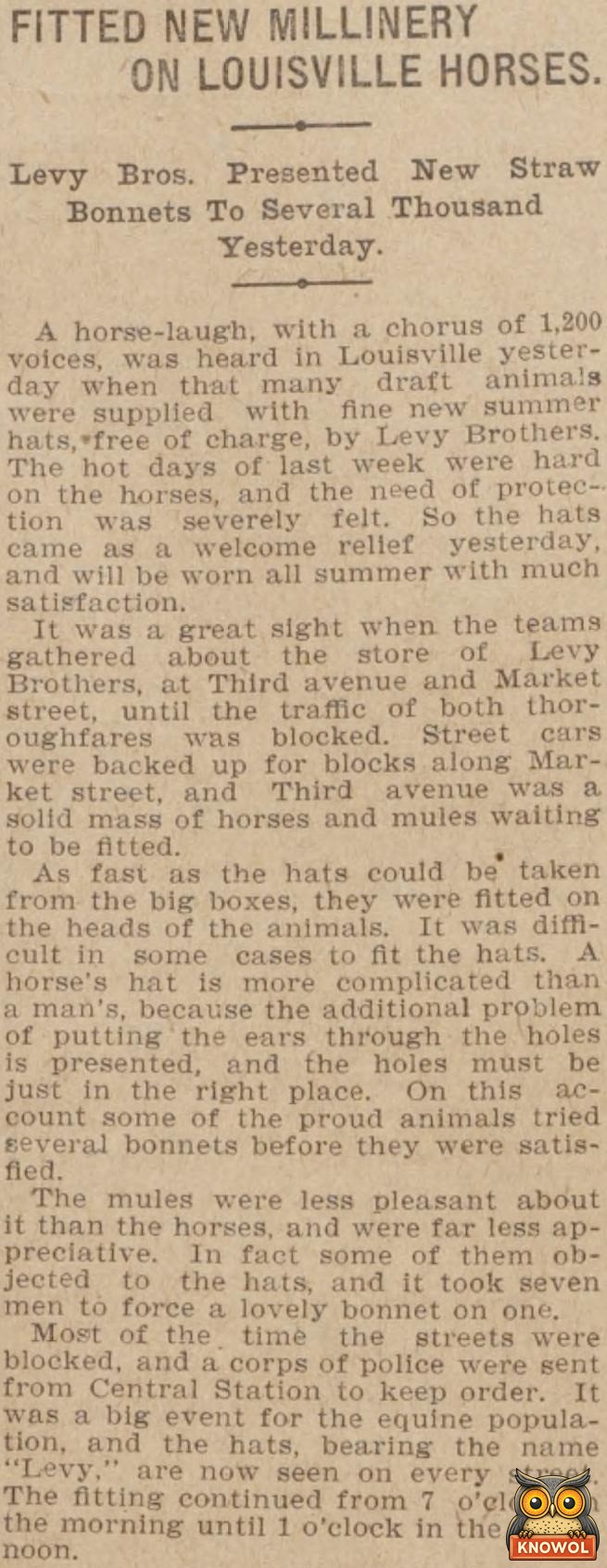
“Fitted New Millinery on Louisville Horses.” The Courier-Journal, Louisville, Kentucky, July 26, 1905, page 5. Library of Congress, Chronicling America. Click the clipping to read it full size.
The Courier-Journal reported it the next morning. “A horse-laugh, with a chorus of 1,200 voices, was heard in Louisville yesterday,” it began, “when that many draft animals were supplied with fine new summer hats, free of charge, by Levy Brothers.” A draft animal is a big, strong horse or mule that pulls heavy loads. Millinery, in the headline, is a fancy word for ladies’ hats.
A traffic jam of horses
So many teams showed up that the two busy streets stopped moving. “Street cars were backed up for blocks along Market street,” the paper said, “and Third avenue was a solid mass of horses and mules waiting to be fitted.” A squad of police came over from Central Station to keep order.
The fitting went on from 7 o’clock in the morning until 1 o’clock in the afternoon. That’s six hours of hats, about 200 animals an hour.
How you fit a hat on a horse
A horse hat looked a lot like a man’s wide straw hat, with two big differences. It had two holes cut in the brim for the ears, and it had strings that tied under the horse’s jaw so it wouldn’t blow off. The Courier-Journal explained the tricky part: “A horse’s hat is more complicated than a man’s, because the additional problem of putting the ears through the holes is presented, and the holes must be just in the right place.” “On this account some of the proud animals tried several bonnets before they were satisfied.”
The mules were another story. They “were far less appreciative,” the paper reported. “In fact some of them objected to the hats, and it took seven men to force a lovely bonnet on one.”
What the store promised
Here is Levy’s ad from that morning’s Courier-Journal, word for word:
FOR YOUR HORSE, Also For Your Mule, If He Kicks For It.
Beginning this morning at 8 o’clock we are going to give away the LATEST STYLE BONNETS for horses and mules as long as big lot we have holds out.
Absolutely free of charge. And the animals MUST BE brought to our store, where we will have an expert to FIT THE BONNETS on and see that each one of our dumb friends gets the right size.
We hope that every owner will co-operate with us in this act of humanity.
Don’t SEND for a bonnet, or call without the horse or mule; for the animal MUST BE HERE in order to get a bonnet.
Levy’s Third and Market.
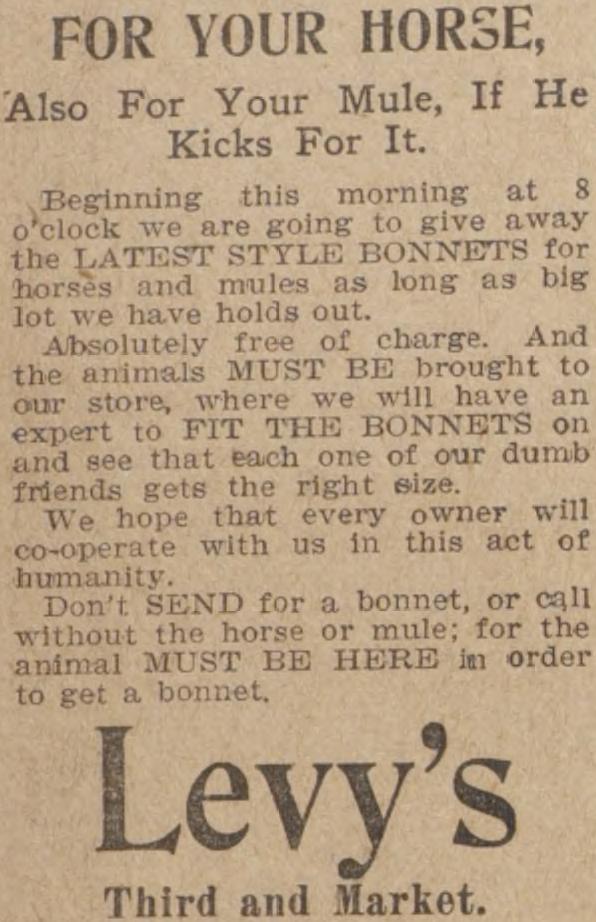
“For Your Horse, Also For Your Mule, If He Kicks For It.” Levy’s ad, The Courier-Journal, Louisville, Kentucky, July 25, 1905, page 10. Library of Congress, Chronicling America. Click the clipping to read it full size.
“If he kicks for it” was a joke. Mules are famous for kicking, and in 1905 to “kick” also meant to complain or make a fuss. “Dumb friends” was an old, kind name for animals. Dumb meant they couldn’t speak, not that they weren’t smart.
The store got something back, too. The paper said the hats bore the name “Levy,” and they “are now seen on every street.” Every hatted horse in town became a little walking ad. On the very same day, the U.S. Patent Office registered a new trademark for Levy Brothers, “Elbee,” for men’s and boys’ coats, vests, trousers and overcoats. Say L. B. out loud and you’ll hear it.
Round two
The hats ran out. On Friday, August 18, Levy’s ran a new ad headed “Horse Bonnets Free At Levy’s Again To-day.” It said the store had bought “several thousand nice straw horse bonnets” the first time, and “The only mistake we made then was in not having enough bonnets to go around.” This time it asked owners “to line up in a way that will not cause a street blockade.”
Under the ad, Levy’s printed two thank-you letters, one from the Animal Rescue League and one from John H. Leathers, president of the Kentucky Humane Society. His society’s job, he wrote, was to “speak for those who cannot speak for themselves.”
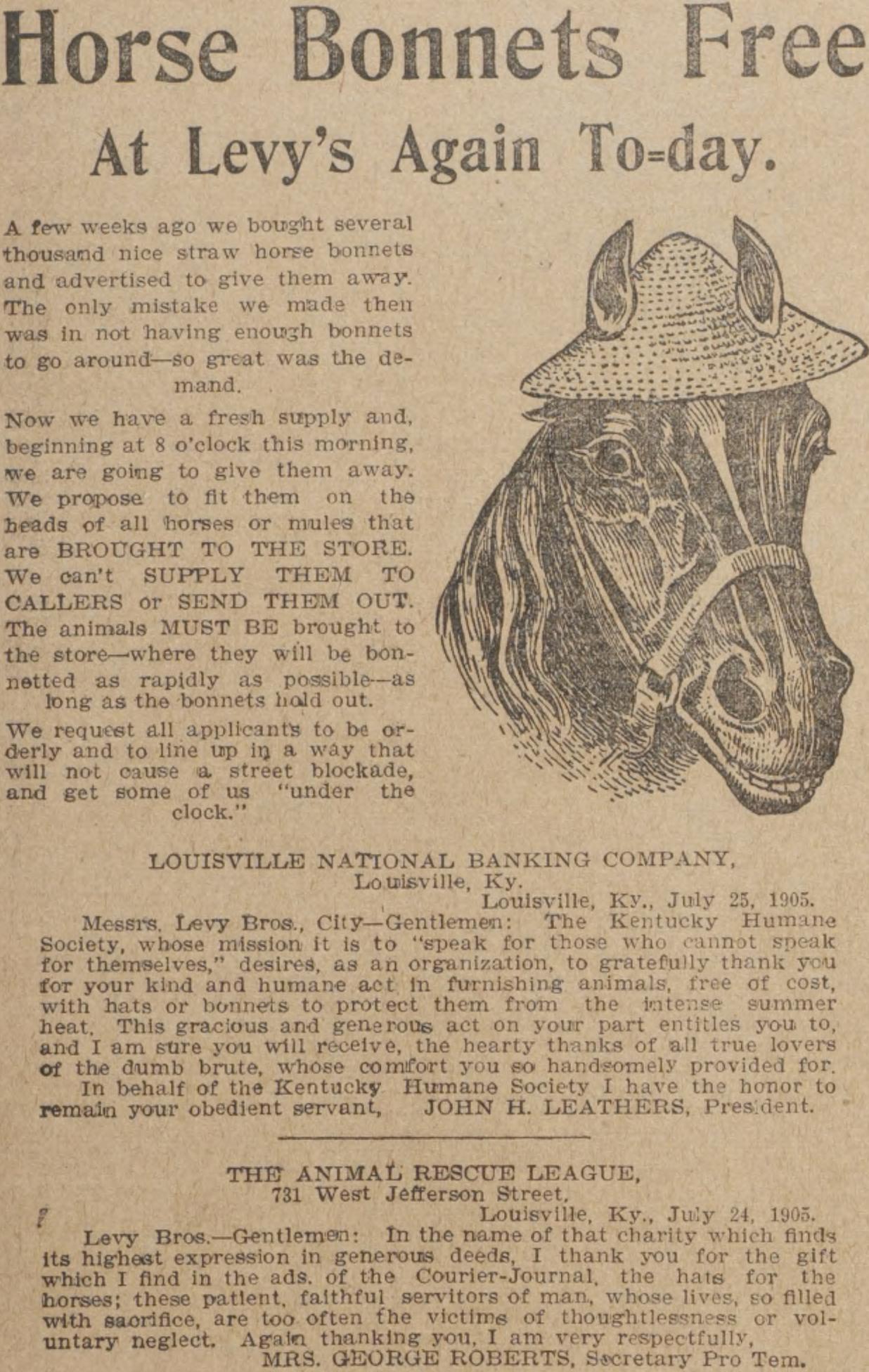
“Horse Bonnets Free At Levy’s Again To-day,” with a drawing of a horse in its straw bonnet and the two thank-you letters. The Courier-Journal, Louisville, Kentucky, August 18, 1905, page 10. Library of Congress, Chronicling America. Click the clipping to read it full size.
Hats in style
Louisville wasn’t the only city putting hats on horses. In 1901 the New-York Tribune reported that John P. Haines, president of the American Society for the Prevention of Cruelty to Animals, had seen horses in straw hats in Paris. He found that the hats “greatly lessened the death rate from heat and sunstroke.” Sunstroke is what happens when too much hot sun makes an animal or a person collapse.
By 1904 each city seemed to have its own look. The Tribune called the “New-York shape” “little more than a straw bag.” The “Boston shape” was “not unlike a college student’s mortar board,” the flat square cap you see at graduations. Philadelphia horses wore a plain Quaker-style straw hat, tied on with blue or red strings. Chicago picked a “rakish” Panama, a dashing hat with the brim turned up on one side. There were even sunbonnets for mares and baby bonnets for ponies. Plain hats were free at the humane societies.
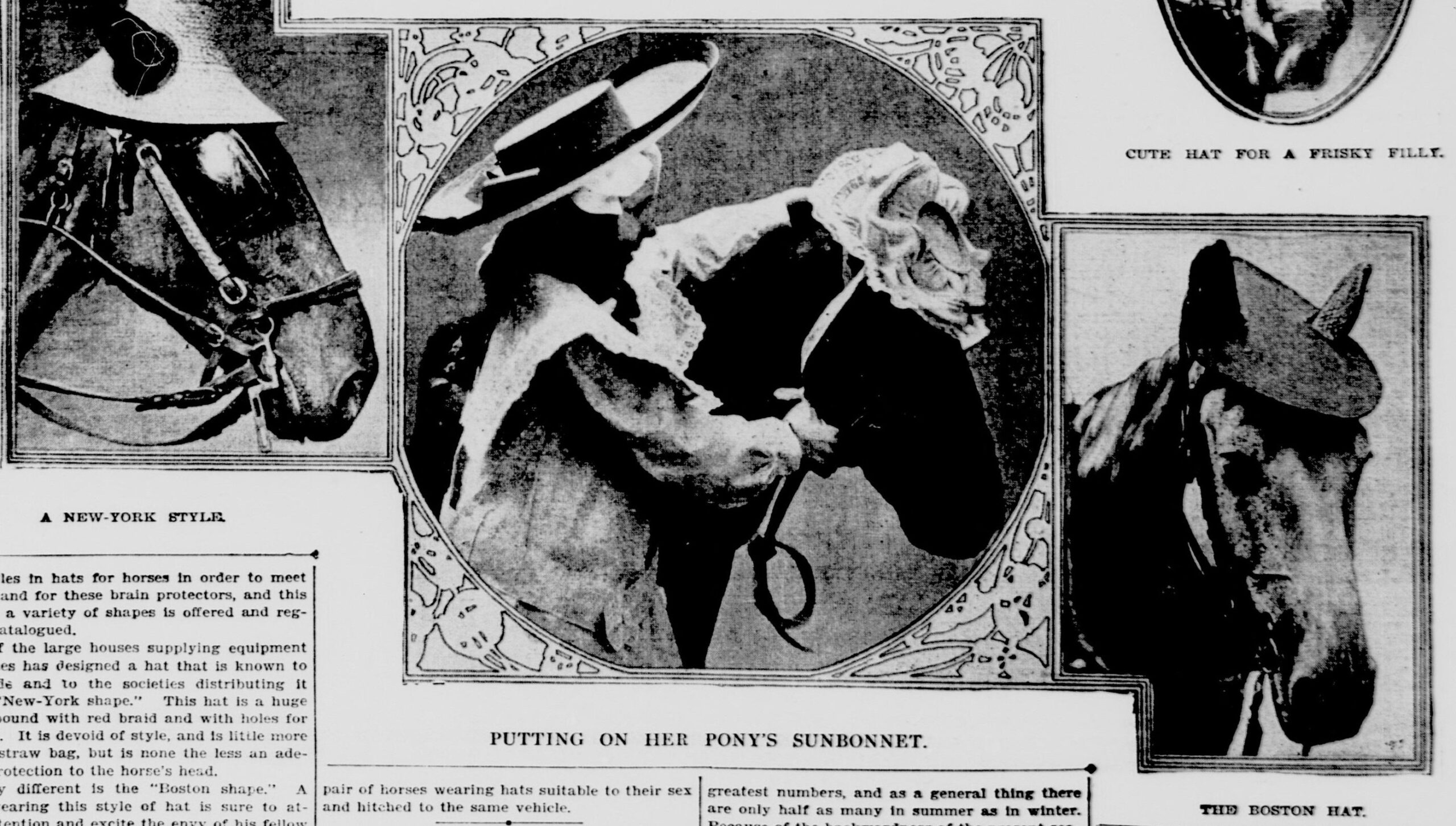
“A New-York Style,” “Putting On Her Pony’s Sunbonnet” and “The Boston Hat,” from “Styles in Horses’ Hats.” New-York Tribune, New York, New York, June 12, 1904, illustrated supplement, page 2. Library of Congress, Chronicling America. Click the picture to see it full size.
In Washington, D.C., during a heat wave in July 1903, the Washington Times noticed more horses “togged out in bonnets,” or dressed up in them. One man, the paper said, “declared with great positiveness that he detected a smile on the animal’s face when the hat was put on.” The next June a donor named John Milton Getterman sent the city’s Humane Society 120 horse hats. He hoped that soon “it may be as rare to see a horse without headgear as a lady without a parasol.”
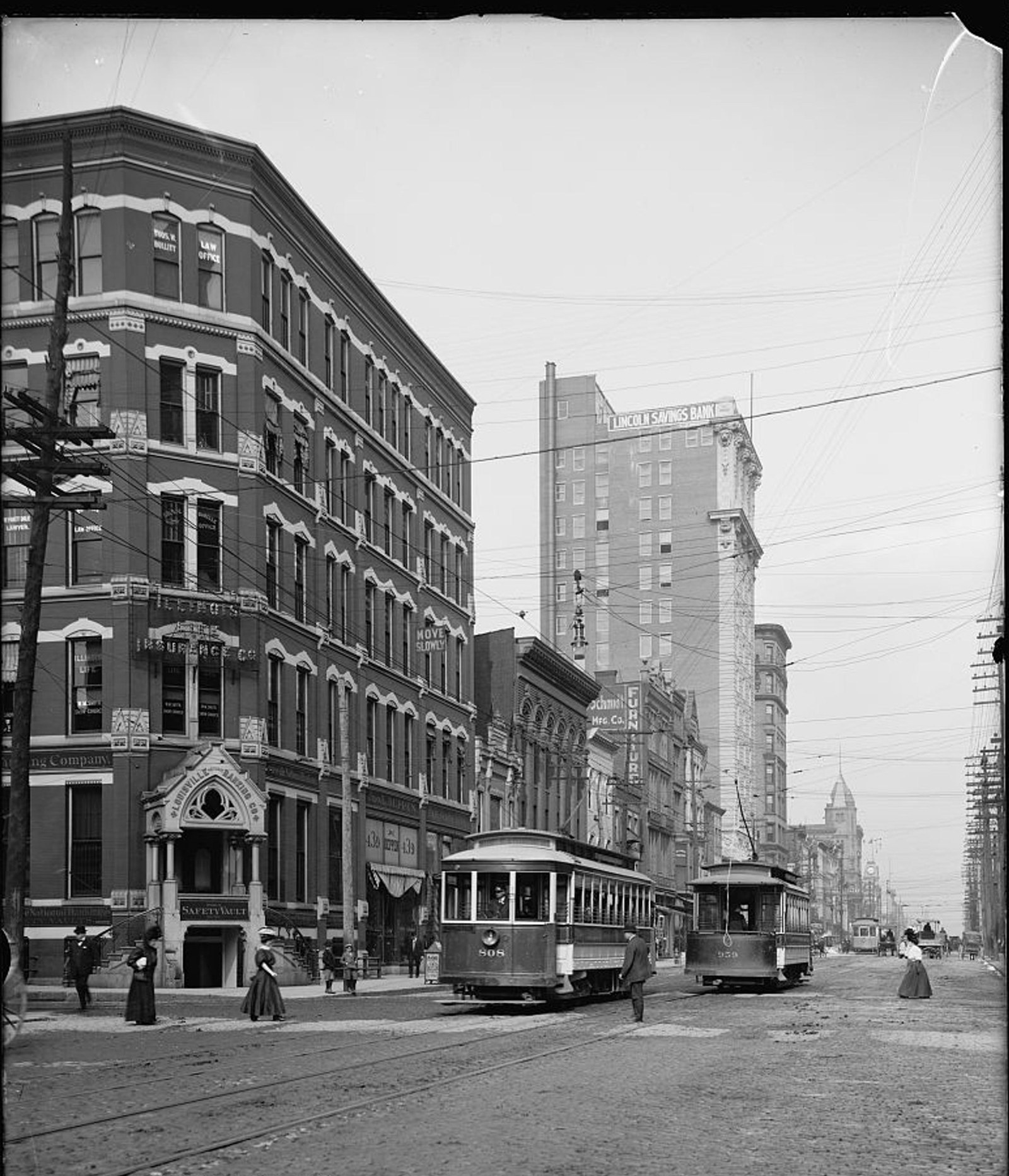
Streetcars on Market Street in Louisville, Kentucky, sometime between 1900 and 1910. Market was one of the two streets the hat crowd blocked in 1905. The bank on the left is the Louisville National Banking Company, the letterhead the Kentucky Humane Society’s thank-you was written on. Detroit Publishing Co., Library of Congress, Prints and Photographs Division. Click the picture to see it full size.
In Louisville, the store’s second giveaway shows how the first one ended: with every hat gone and the town asking for more. For one hot Tuesday in 1905, the busiest corner in the city belonged to 1,200 horses and mules in brand-new straw hats, and at least one mule who wanted nothing to do with it.
Sources
- The Courier-Journal (Louisville, Kentucky): July 25, 1905, page 10 (Levy’s ad, “For Your Horse”), July 26, 1905, page 5 (“Fitted New Millinery on Louisville Horses”) and August 18, 1905, page 10 (“Horse Bonnets Free At Levy’s Again To-day,” with the Kentucky Humane Society and Animal Rescue League letters).
- New-York Tribune (New York, New York): June 30, 1901, page 32 (“Paris Hats for Horses”) and June 12, 1904, page 47 (“Styles in Horses’ Hats,” illustrated supplement).
- The Washington Times (Washington, D.C.): July 11, 1903, page 1 (“Street Temperature High”) and June 15, 1904, page 8 (“Ten Dozen Bonnets for Suffering Horses”).
- All newspaper images: Library of Congress, Chronicling America. Published 1901 to 1905, public domain.
- Trademark: Levy Brothers, “Elbee,” registered July 25, 1905, no. 44,857, Library of Congress, Prints and Photographs Division, no known restrictions.
- Photograph: “Market St., Louisville, Ky.,” Detroit Publishing Co., between 1900 and 1910, Library of Congress, no known restrictions.
- Cover: “Sun hats for horses, Bide-a-Wee Home,” New York, New York, photograph by Byron, 1907, Library of Congress, no known restrictions.