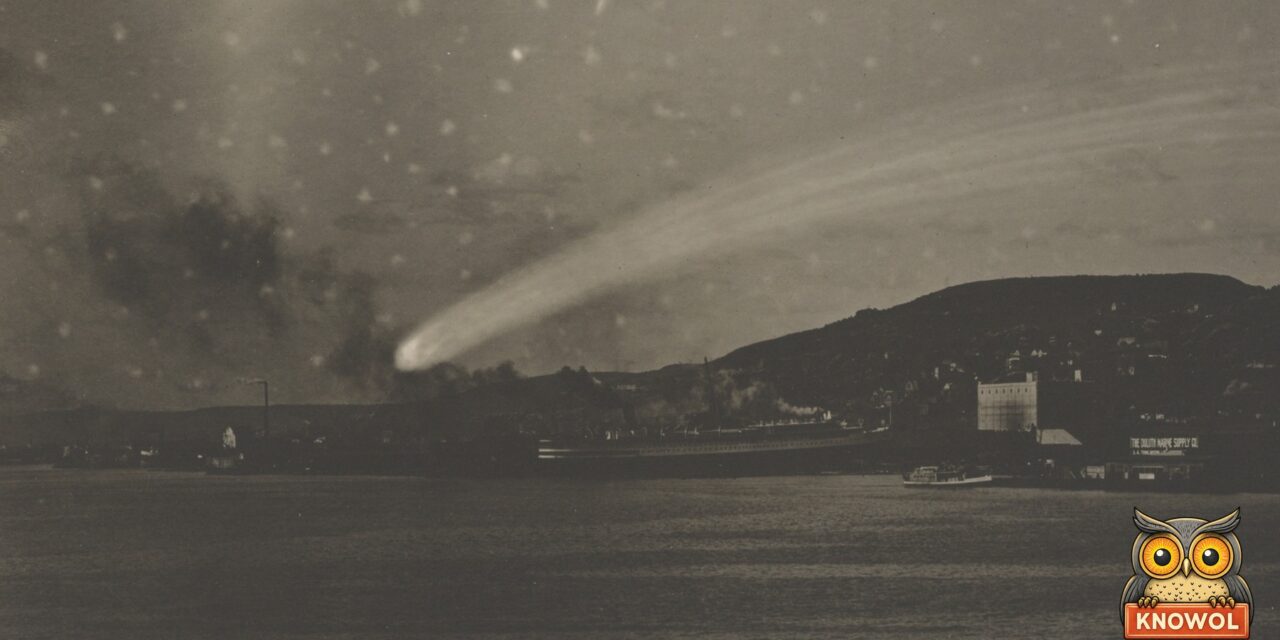
On Wednesday night, May 18, 1910, the young women of the Girls’ Club in Plymouth, Indiana, crowded around the front windows of their club rooms. They were waiting for Halley’s comet. Astronomers had said the Earth would pass through the comet’s tail that very night, and the whole town wanted to see it happen.
A week later, the Plymouth Tribune told the town how it went, under a giant headline: “Were You Stung by the Comet?” In 1910, “stung” meant fooled.
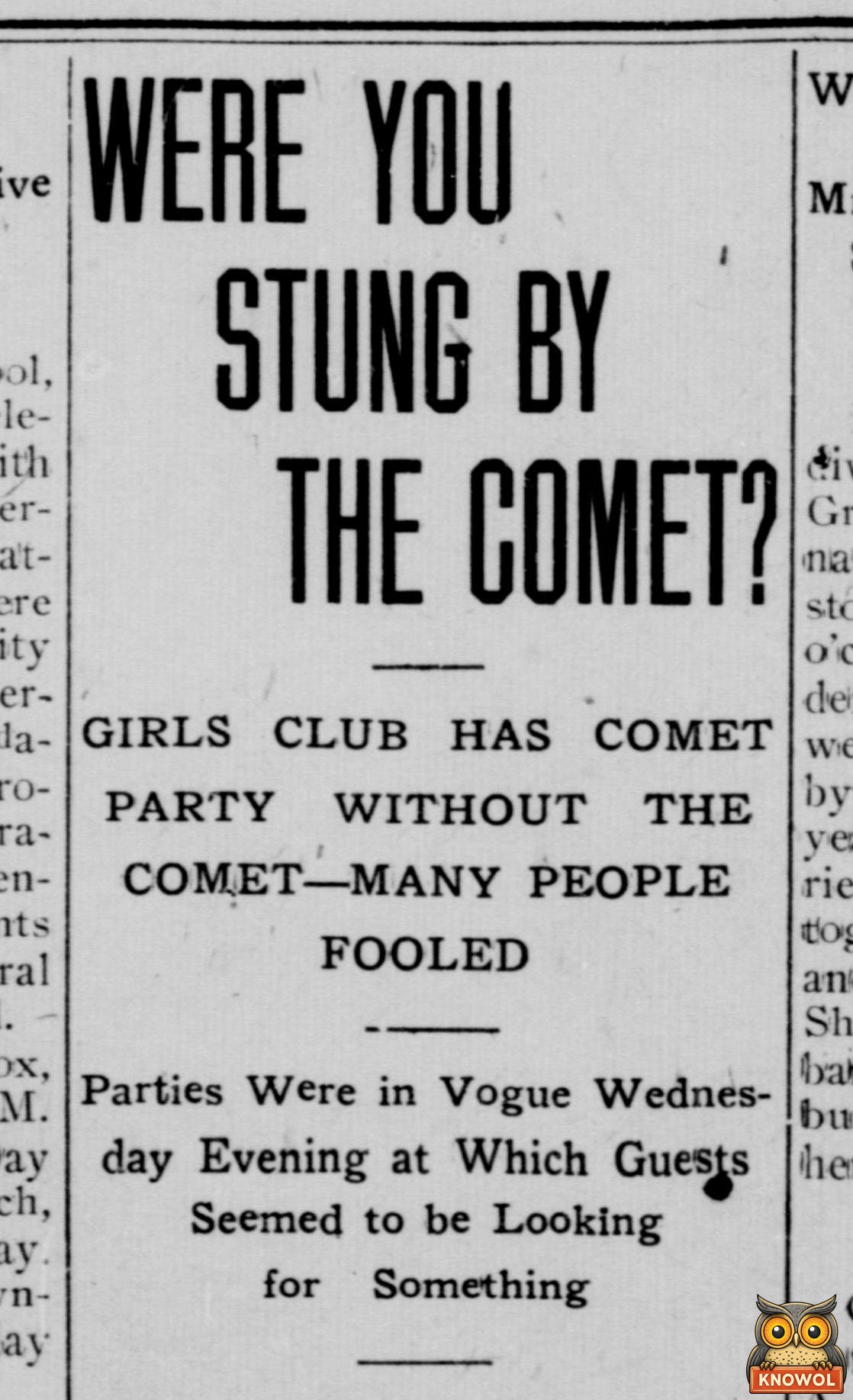
“Were You Stung by the Comet?” The Plymouth Tribune, Plymouth, Indiana, May 26, 1910, page 1. Library of Congress, Chronicling America. Click the clipping to read it full size.
A town with the “rubber neck” habit
Halley’s comet swings past the Earth about once every 76 years. In the spring of 1910 it was back, and people got up at night to look. On May 12 a Tribune headline said Plymouth people were getting the alarm clock and rubber neck habit. A rubberneck was someone who stretched their neck to stare at something.
The best spot in town, people said, was the Michigan street river bridge. A few early risers had already spotted it low in the east before dawn.
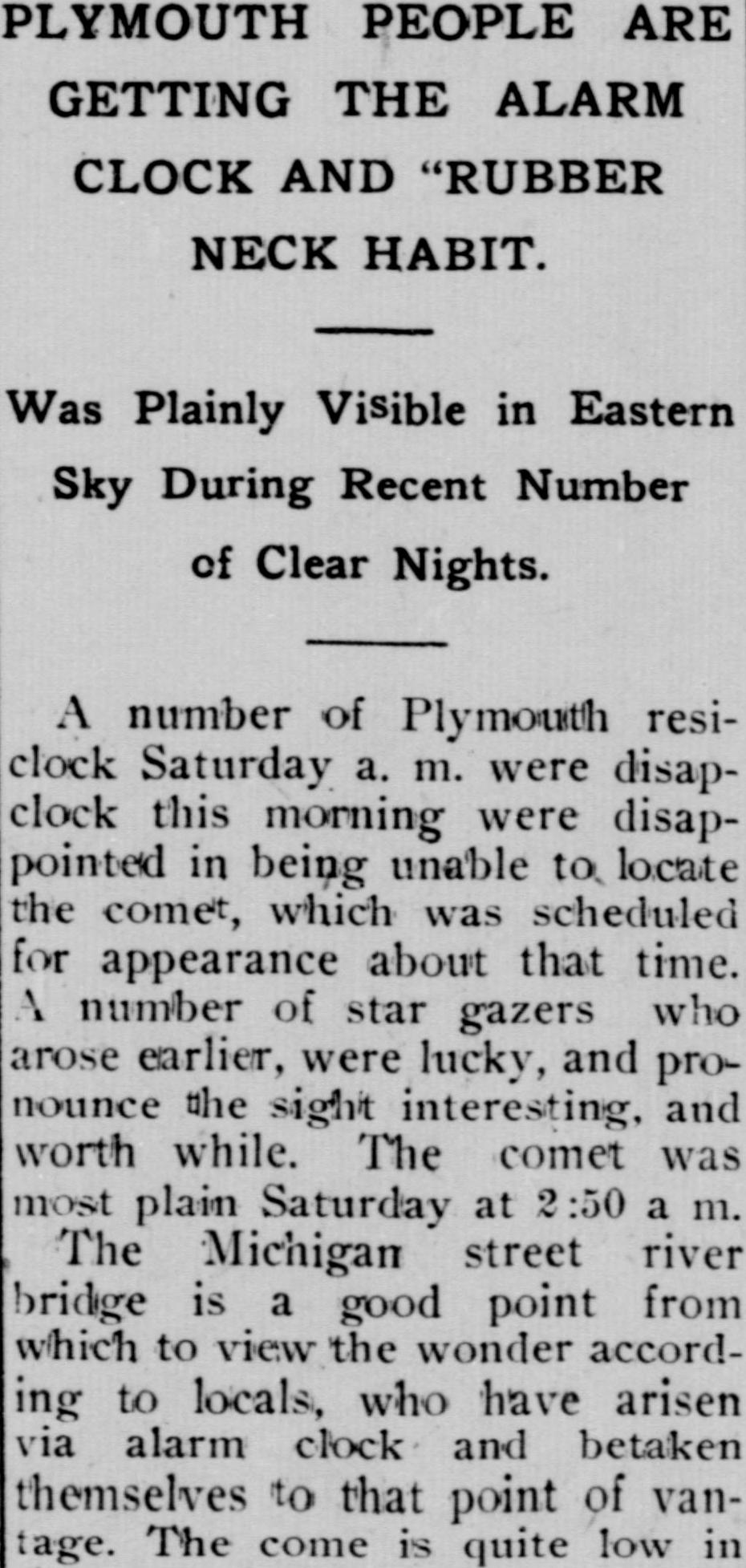
Plymouth gets the alarm clock habit. The Plymouth Tribune, Plymouth, Indiana, May 12, 1910, page 4. Library of Congress, Chronicling America. Click the clipping to read it full size.
The scary part: a poison gas tail
Then came the big night. Scientists had found cyanogen, a poison gas, in the comet’s tail. The tail was millions of miles long, and on May 18 the Earth was supposed to sail right through it. Some people worried the gas would get into the air we breathe.
Most astronomers said there was nothing to fear. The Lake County Times in nearby Hammond, Indiana, joked about all the mixed-up news: “Hold Your Breath, The Comet Comes Tomorrow.” It joked that the comet was “an entirely harmless phenomenon which may destroy the earth.” Then it listed what real astronomers had said. Percival Lowell of Flagstaff, Arizona, said the whole tail “could be paceked in a suit case.” (The paper misspelled “packed.”) S. A. Mitchell of Columbia University put it plainly: “The tail is too rare and diffuse to produce any effect at all.” Rare and diffuse means thin and spread out.
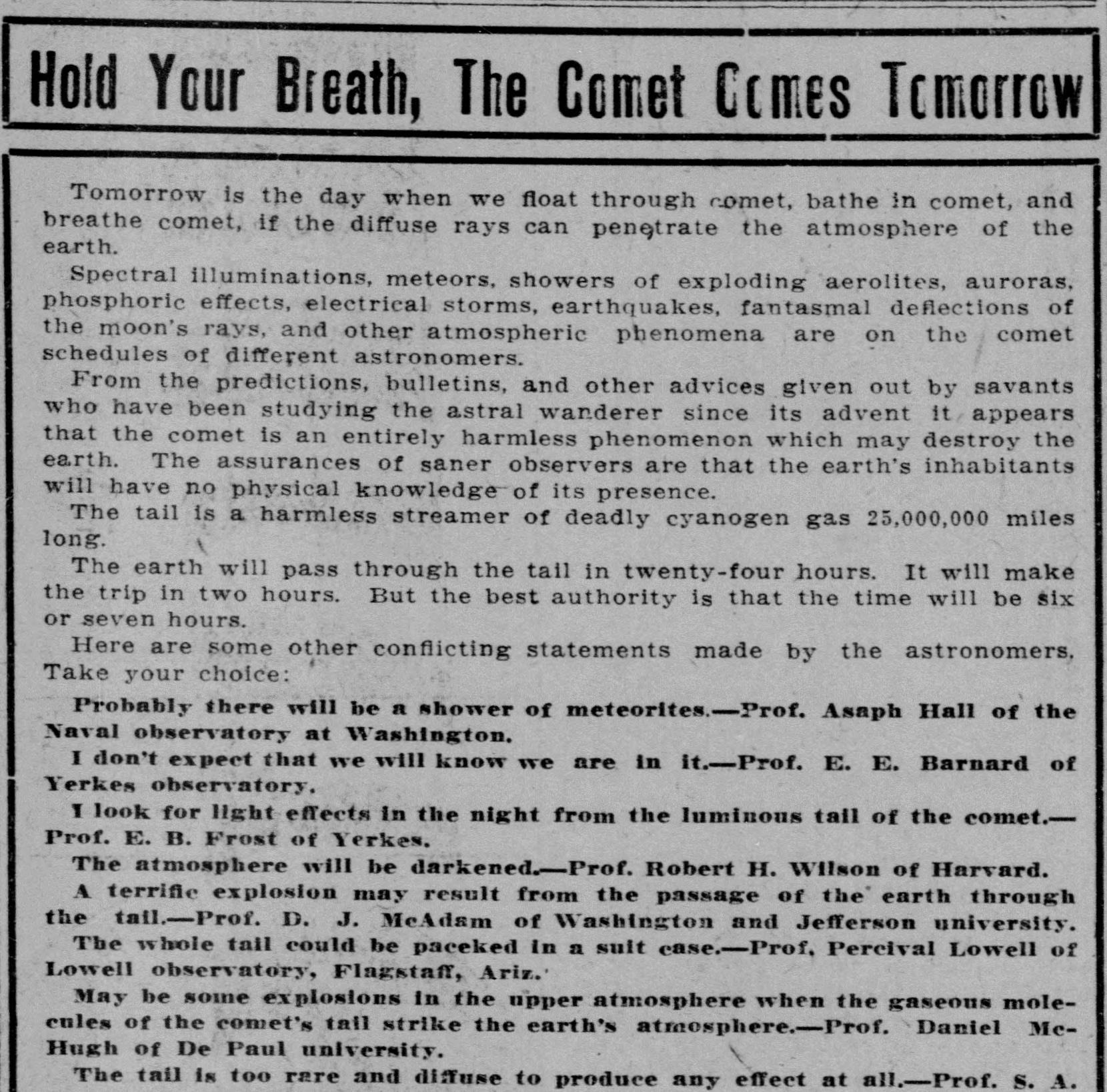
“Hold Your Breath, The Comet Comes Tomorrow.” The Lake County Times, Hammond, Indiana, May 17, 1910, page 1. Library of Congress, Chronicling America. Click the clipping to read it full size.
Not everyone believed them. In Columbus, Georgia, one family “shut themselves in a room,” closed every door and window, and “pasted paper over the keyholes and other places where the gas might enter,” the Ocala Evening Star in Florida reported.
Comet parties all over Plymouth
Plymouth mostly threw parties. “Comet parties were in vogue through the city Wednesday,” the Tribune said, and the biggest one was at the Girls’ Club. The girls had planned a lunch at midnight. Then they decided they couldn’t spare the time when “the sight would be most grand,” so they made a quick snack to eat at the windows instead.
People walking by saw them standing so still that they looked like “classical statuary,” the paper joked. After a few hours, two of the girls went for a walk up Michigan street. A “big burly man” seemed to be chasing them, so they ran to the Capron house and pounded on the door for help. The man caught up and held out a pair of gloves. One of the girls had dropped them. He was a local businessman walking home from work.
Hubert Tanner set his alarm clock for 3 a.m. He wrapped himself in a bathrobe and slipped out the side door to look. He couldn’t find the comet. When he turned to go back in, he found he’d locked himself out. He had to wake up the whole family to get back inside, and he went to bed “vowing, ‘never again.'”
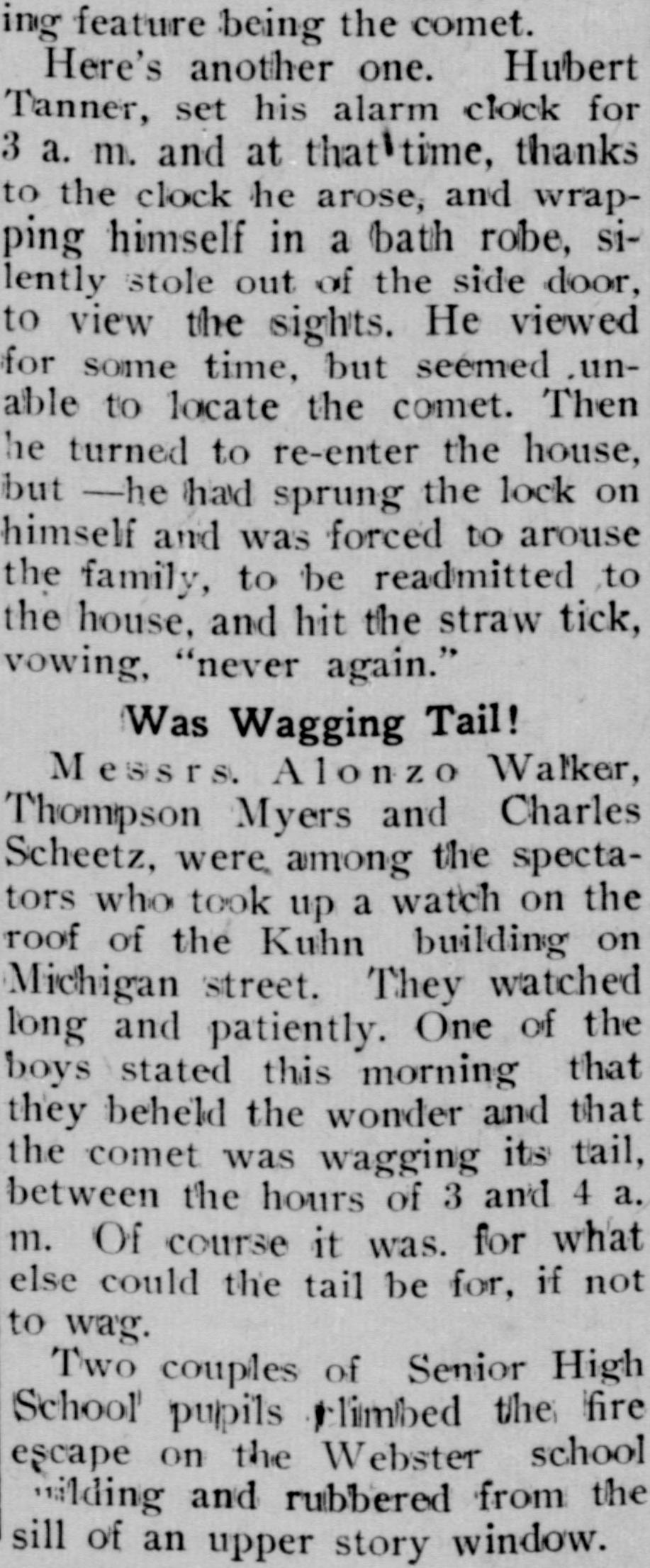
Hubert Tanner gets locked out, and three men watch from a roof. The Plymouth Tribune, Plymouth, Indiana, May 26, 1910, page 1. Library of Congress, Chronicling America. Click the clipping to read it full size.
Three men, Alonzo Walker, Thompson Myers and Charles Scheetz, kept watch on the roof of the Kuhn building on Michigan street. One of them claimed they saw the comet “wagging its tail” between 3 and 4 a.m. The paper played along: “Of course it was. for what else could the tail be for, if not to wag.”
The picture of the comet
The funniest part of the story was a photograph. “Another young lady had a camera,” the Tribune said, and she took “a perfect view of the heavenly wonder” at 1 a.m. The paper printed it, “one-half the actual size.” It was an empty box.
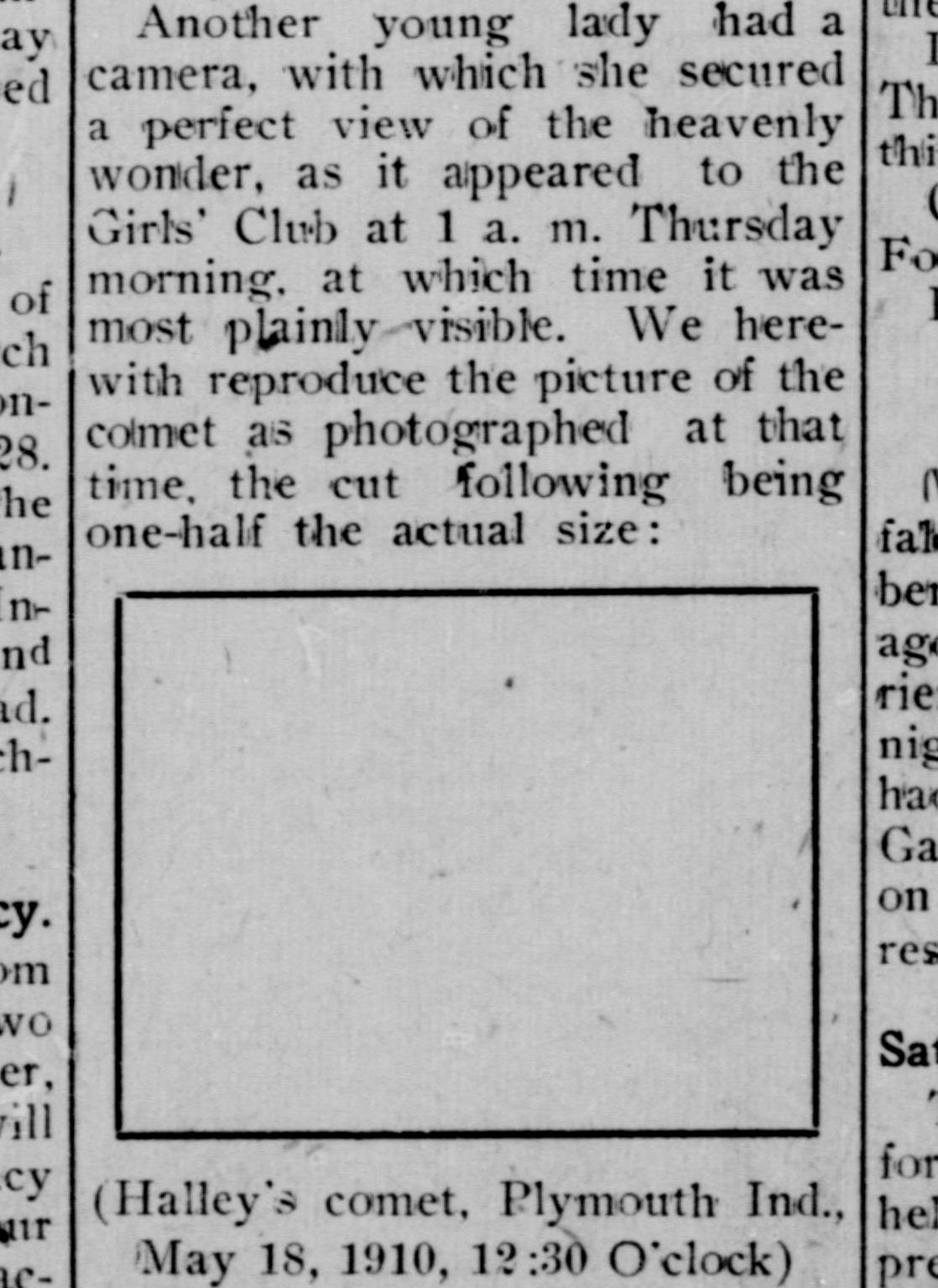
The Tribune’s “picture of the comet,” taken at the Girls’ Club. The Plymouth Tribune, Plymouth, Indiana, May 26, 1910, page 1. Library of Congress, Chronicling America. Click the clipping to read it full size.
What really happened in the sky
The joke worked because nobody in Plymouth could have seen much that night. On May 18 the comet passed between the Earth and the sun. The Tribune had said it would “cross the sun’s disk” that morning. So its bright head was on the daytime side of the sky, lost in the sunshine.
As for the tail, astronomers weren’t even sure the Earth had touched it. A headline in the same Tribune said the comet “Shies at the Earth.” Either way, nothing happened. No one choked and nothing exploded. The gas in a comet’s tail is spread so thin that it can’t hurt anyone. In Hammond, the morning after, the Lake County Times reported people waking up “to find the sun still shining.” A Hammond doctor, Elmore Salisbury, joked that he had set out “six wash tubs for the purpose of catching a supply of laughing gas” and found them empty.
The real show came later
A few nights after the scare, the comet moved into the evening sky, and it was worth the wait. Out west in Pullman, Washington, about 75 people came to a comet party at the home of C. H. Talmage on Monday, May 23. There were Chinese lanterns in the yard and a total eclipse of the moon at the same time. As the Earth’s shadow slid over the moon, one woman said the last bright sliver looked like a banana. Then the comet’s “immense tail” stretched “nearly half way across the sky.”
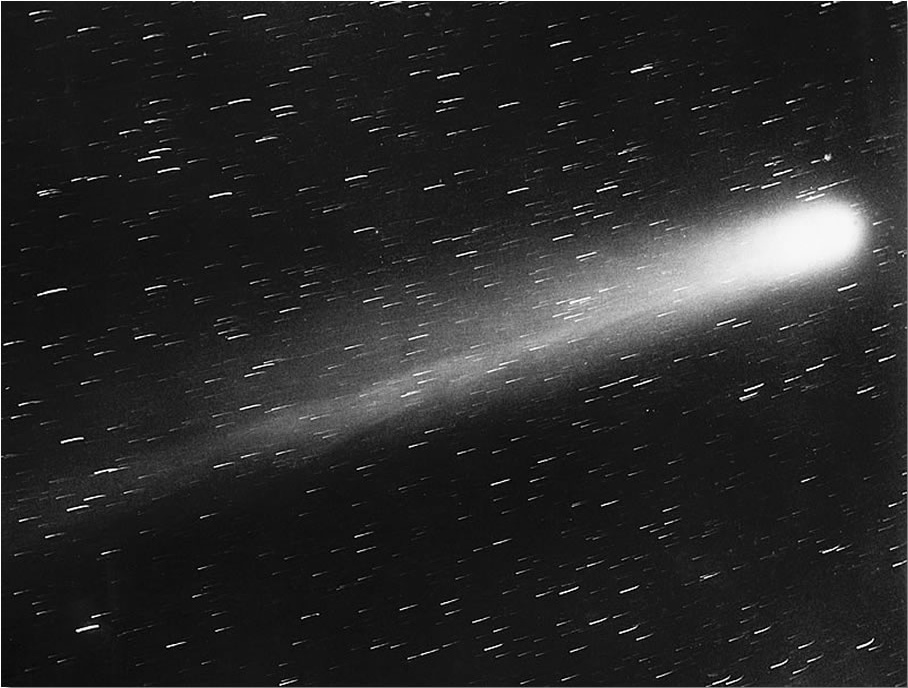
Halley’s comet on May 29, 1910. The stars look like dashes because the camera followed the comet during a long exposure. Credited to E. E. Barnard, Yerkes Observatory, Williams Bay, Wisconsin. Wikimedia Commons, public domain. Click the picture to see it full size.
Talk like it’s 1910
The Plymouth Tribune’s comet stories are full of words nobody uses anymore. Here are a few, with what they meant.
- Rubbered: stared. Two couples of high school seniors climbed the Webster school’s fire escape and “rubbered from the sill of an upper story window.”
- Straw tick: a mattress stuffed with straw. Hubert Tanner “hit the straw tick,” meaning he went to bed.
- Collation: a light snack. The Girls’ Club had “a small collation” at the windows.
Halley’s comet came back in 1986, and NASA says it will return in 2061. Some of the kids reading this will get their own chance to stay up for it.
Sources
- The Plymouth Tribune (Plymouth, Indiana): May 26, 1910, page 1 (“Were You Stung by the Comet?”), May 26, 1910, page 2 (“Halley’s Sky Tramp Shies at the Earth”) and May 12, 1910, page 4 (the alarm clock habit; the comet to “cross the sun’s disk”).
- The Lake County Times (Hammond, Indiana): May 17, 1910, page 1 (“Hold Your Breath, The Comet Comes Tomorrow”) and May 19, 1910, page 1 (Dr. Elmore Salisbury’s wash tubs).
- The Ocala Evening Star (Ocala, Florida): May 21, 1910, page 1 (“Columbus People Made Ready for the Comet,” Columbus, Georgia, May 19).
- Pullman Herald (Pullman, Washington): May 27, 1910, page 1 (“A Delightful Comet Party”).
- All newspaper images: Library of Congress, Chronicling America. Published 1910, public domain.
- NASA Science, 1P/Halley (the 76-year trip, last seen in 1986, returns in 2061).
- Photograph: Halley’s comet, May 29, 1910, credited to E. E. Barnard, Yerkes Observatory, Wikimedia Commons, public domain (published 1910).
- Cover: “Halley’s Comet. Seen at Duluth, Minn.,” photo postcard by McKenzie, 1910, Library of Congress, published 1910, public domain.