One day in July 1899, while the circus was in town, two men stood in front of the Hotel Windsor in Wheeling, West Virginia, shouting at each other. Each held a small bottle with a bug inside, and each swore his bug was the real “kissing bug.” The first man said the other did “not know a kissing bug from a beer wagon.” The second fired back that his rival “could not tell an osculatory beetle from a wheelbarrow.” (Osculatory is a fancy word for kissing.)
The Wheeling Register said the two were about to start a fight when a man the paper called only “the professor” walked up. He peered into the bottles. The first bug was a cockroach. The second was a June bug. Neither one had ever kissed anybody.
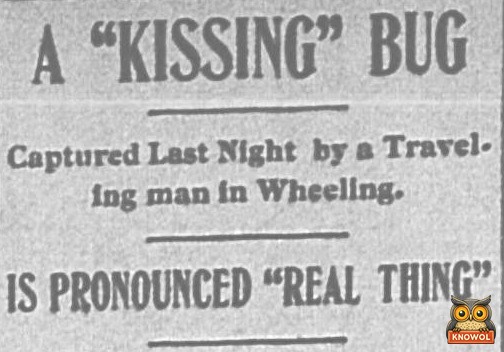
A “Kissing” Bug, captured in Wheeling and “pronounced ‘real thing.'” The Wheeling Daily Intelligencer, Wheeling, West Virginia, July 17, 1899, page 8. Library of Congress, Chronicling America. Click the clipping to read it full size.
How a slow news week started a panic
The kissing bug scare began in Washington, D.C. James F. McElhone was a police reporter for the Washington Post. In June 1899 he noticed that the Emergency Hospital’s patient book listed a lot of “bug-bite” cases. The doctors told him patients came in every day with “very red and extensive swellings, usually on the lips.”
L. O. Howard, the government’s chief bug scientist, later explained why the story took off. “There was a dearth of news,” he wrote. A dearth means a shortage. “These swollen faces offered an opportunity for a good story.”
On June 20, 1899, the Post ran McElhone’s story, “Bite of a Strange Bug.” It began, “Lookout for the new bug.” The bite, it said, made the skin swell “to ten times its normal size.” Since the bug seemed to go for people’s lips, it soon had a nickname: the kissing bug. Other papers copied it. Within weeks, people from Boston to California were blaming every swollen lip on the kissing bug.
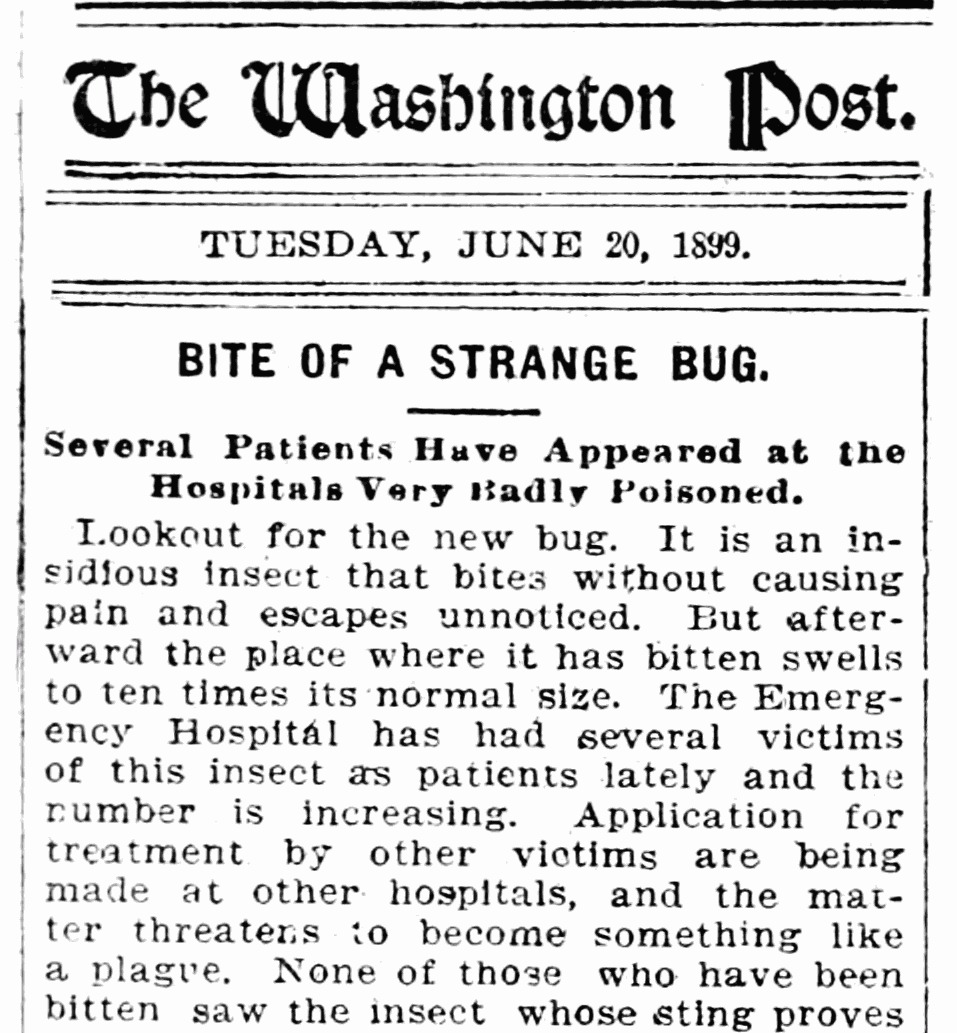
The story that started it all: “Bite of a Strange Bug,” The Washington Post, June 20, 1899 (top of the article). Reprinted in Popular Science Monthly, November 1899. Wikimedia Commons, public domain. Click the picture to see it full size.
“The ‘kissing bug’ has struck Wheeling”
“The ‘kissing bug’ has struck Wheeling,” the Daily Intelligencer announced on July 8. The paper joked that this bug wasn’t picky. In Wheeling, “he kindly kissed most of his victims on the back of the neck.”
Then the bug hunt began. On July 14 the Register reported that H. E. Hillman had caught a bug on Wheeling Island, the neighborhood on an island in the Ohio River. Hillman said it was the “real thing.” It was brown, about an inch and a quarter long, and had “wings and eight legs.” Anyone could see it “at any time at his store.”
Two nights later, a traveling salesman from Toledo named A. D. Terhune was walking down the alley by the Stamm House hotel. Around 10:30 p.m., a big insect smacked into his hat. Terhune was sure he was under attack, so he “impaled the bug with a knife blade” and carried it to the Intelligencer office. A visitor from Cadiz, Ohio, declared it a real kisser from the Philippines, where American soldiers were stationed. The proof, he said, was its “spear-like prolongation,” a long pointed beak.
A few days after that, some men were playing whist, a card game, in a house on the Island. A humming insect circled the room and landed on the hand of W. W. Cloon, manager of the Wheeling Spice and Coffee Mills. It bit him hard at the base of his thumb. Cloon helped catch it, then went to a drug store for medicine. The Register was careful: the bug “may or may not be the celebrated ‘kissing bug.'”
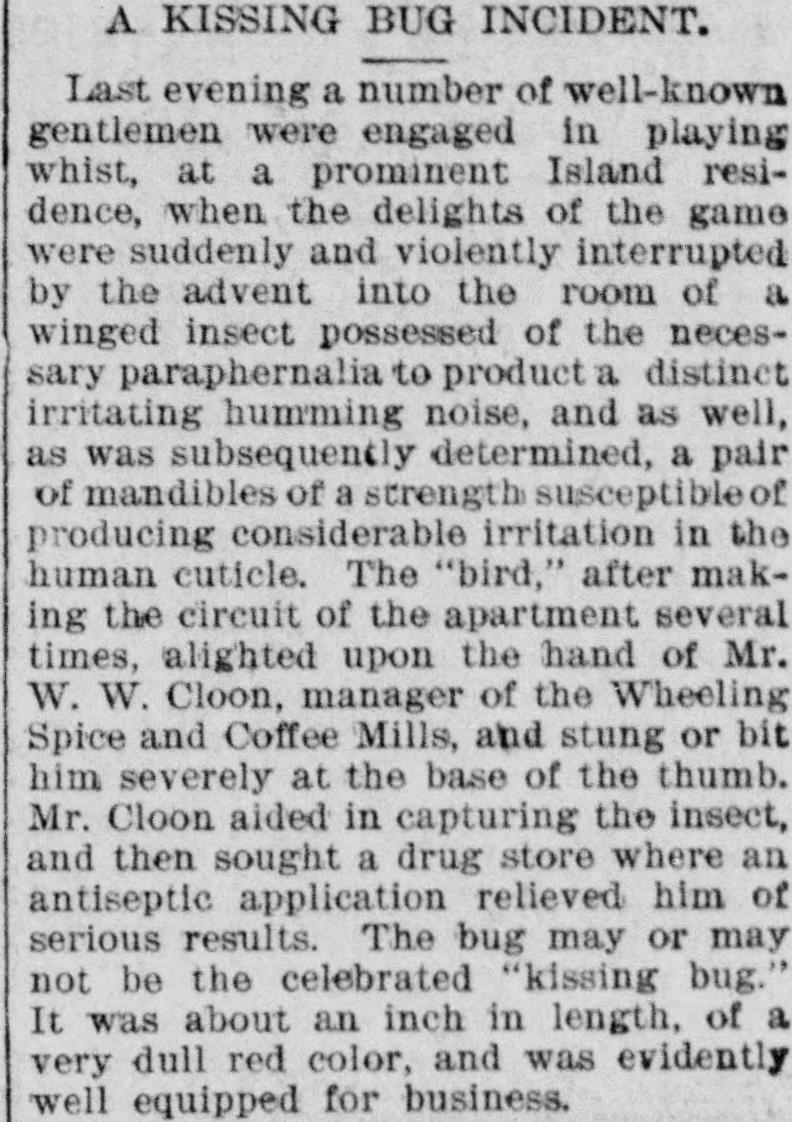
“A Kissing Bug Incident.” The Wheeling Register, Wheeling, West Virginia, July 20, 1899, page 5. Library of Congress, Chronicling America. Click the clipping to read it full size.
The professor counts the legs
The professor in front of the Hotel Windsor pulled a packet of newspaper clippings from his pocket and read them out loud. In Philadelphia, the kissing bug was “a black, shiny bug with red eyes.” In Pittsburgh, it was “a freakish looking blue bug with long mosquito like bill.” In Wheeling, it was brown with “eight legs.”
That last one made him laugh. Beetles come in many thousands of kinds, he said, and “this is the first instance of an eight legged one being found.” Insects have six legs. Spiders have eight, and they aren’t insects. So Hillman’s prize was a spider or a bug nobody had counted carefully.
The professor’s verdict was that the kissing bug lived mostly “in the imagination and in current newspaper reports,” and that it “is but a species of the hum bug.” A humbug is a hoax.
The real kissing bug
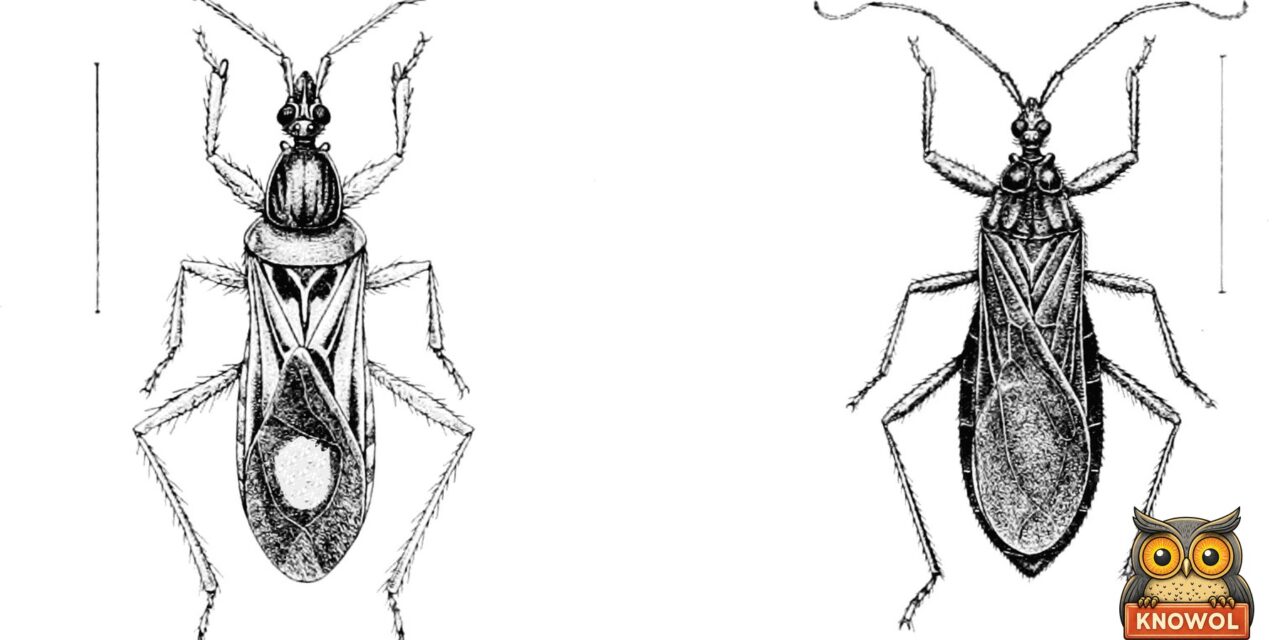
Some of it was real. Howard, who ran the bug division of the U.S. Department of Agriculture, wrote up the cases in Popular Science Monthly in November 1899. Some bites were real, he said. Around Washington, two kinds of insects from the family now called assassin bugs had been “more numerous than usual this year.” These bugs hunt other insects by stabbing them with a sharp beak, and the beak can stab people too. People had caught them in the act of biting and brought them to his office. Out West, people blamed a cousin called the blood-sucking cone-nose.
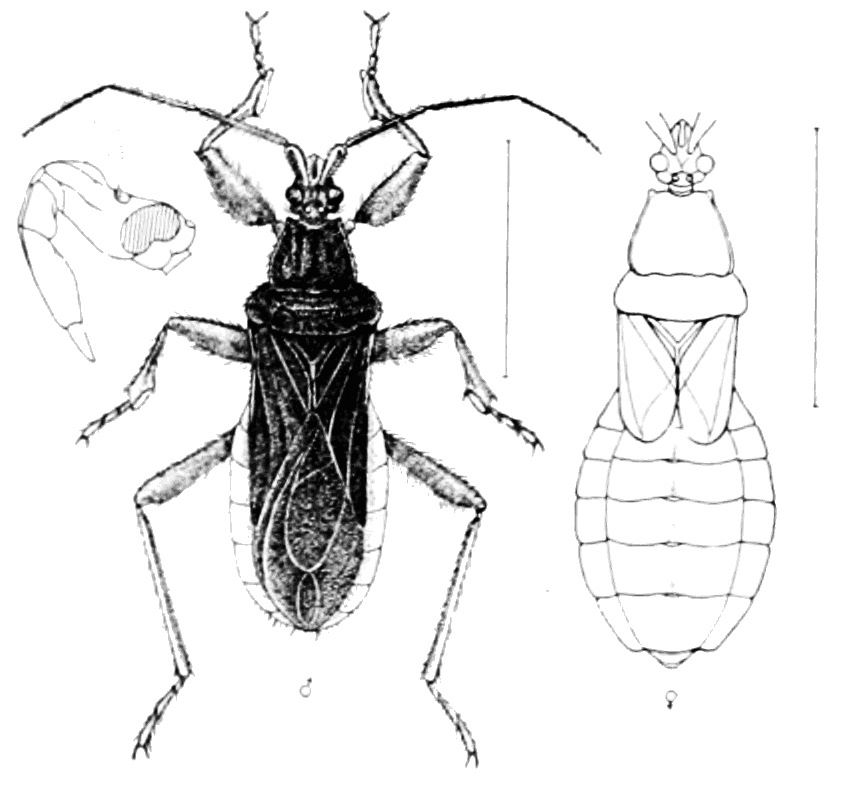
Melanolestes abdominalis, a close cousin of one of the real biting bugs of 1899, drawn twice its natural size: male at left, female at right. Popular Science Monthly, November 1899. Wikimedia Commons, public domain. Click the picture to see it full size.
But most cases, Howard said, were ordinary bites that scared people. He had seen a mosquito bite make a sleeping child’s lip swell up badly. So he argued “that many of these reported cases may have been nothing more than mosquito bites.” His summary: “while there has been a great cry there has been very little wool.” That old saying means a lot of noise over almost nothing. In Washington, he added, beggars even “went around from door to door with bandaged faces and hands,” claiming the bug had cost them their jobs. By late summer, “the newspapers have had their fun.”
The kissing bug by the numbers
- 8: legs on Hillman’s famous bug. Real insects have 6.
- 19 cents: the cheapest bottle of Ferris’ Insect Exterminator at Geo. M. Snook & Co. in Wheeling. Its ad admitted, “The Mysterious Kissing Bug may not succumb to Ferris’ Insect Exterminator,” but it promised to finish off moths, roaches and bedbugs.
- 26: set pieces, or big fireworks pictures, planned for Wheeling’s Merchants’ Day fireworks on September 6. Next to portraits of Navy heroes, the list included “the Kissing Bug.”

“The Mysterious Kissing Bug may not succumb to Ferris’ Insect Exterminator.” Ad for Geo. M. Snook & Co., The Wheeling Daily Intelligencer, Wheeling, West Virginia, July 24, 1899, page 8. Library of Congress, Chronicling America. Click the clipping to read it full size.
Today, scientists use the name “kissing bug” for the cone-nosed bugs, the same group Howard called Conorhinus. The Centers for Disease Control and Prevention calls them triatomine bugs, “sometimes called kissing bugs.” In parts of Mexico and Central and South America, they can spread a parasite that causes Chagas disease. So the name stuck around. Wheeling’s bottled cockroach did not.
Sources
- The Wheeling Register (Wheeling, West Virginia): July 18, 1899, page 3 (“What Is a Kissing Bug?”), July 14, 1899, page 8 (H. E. Hillman’s bug) and July 20, 1899, page 5 (“A Kissing Bug Incident”).
- The Wheeling Daily Intelligencer (Wheeling, West Virginia): July 8, 1899, page 2, July 17, 1899, page 8 (“A ‘Kissing’ Bug”), July 24, 1899, page 8 (Snook ad) and August 24, 1899, page 8 (Merchants’ Day fireworks).
- All newspaper images: Library of Congress, Chronicling America. Published 1899, public domain.
- L. O. Howard, “Spider Bites and ‘Kissing Bugs,'” Popular Science Monthly, volume 56, November 1899, pages 31 to 42, read from the Internet Archive scan. It includes James F. McElhone’s letter and a copy of the Washington Post story of June 20, 1899.
- Drawings and Post clipping: Popular Science Monthly, 1899, via Wikimedia Commons, public domain.
- Centers for Disease Control and Prevention, About Chagas Disease (triatomine bugs, “sometimes called kissing bugs”).
- Cover: two-spotted corsair (left) and Reduvius personatus (right), drawn twice natural size, Popular Science Monthly, November 1899, Wikimedia Commons, public domain.