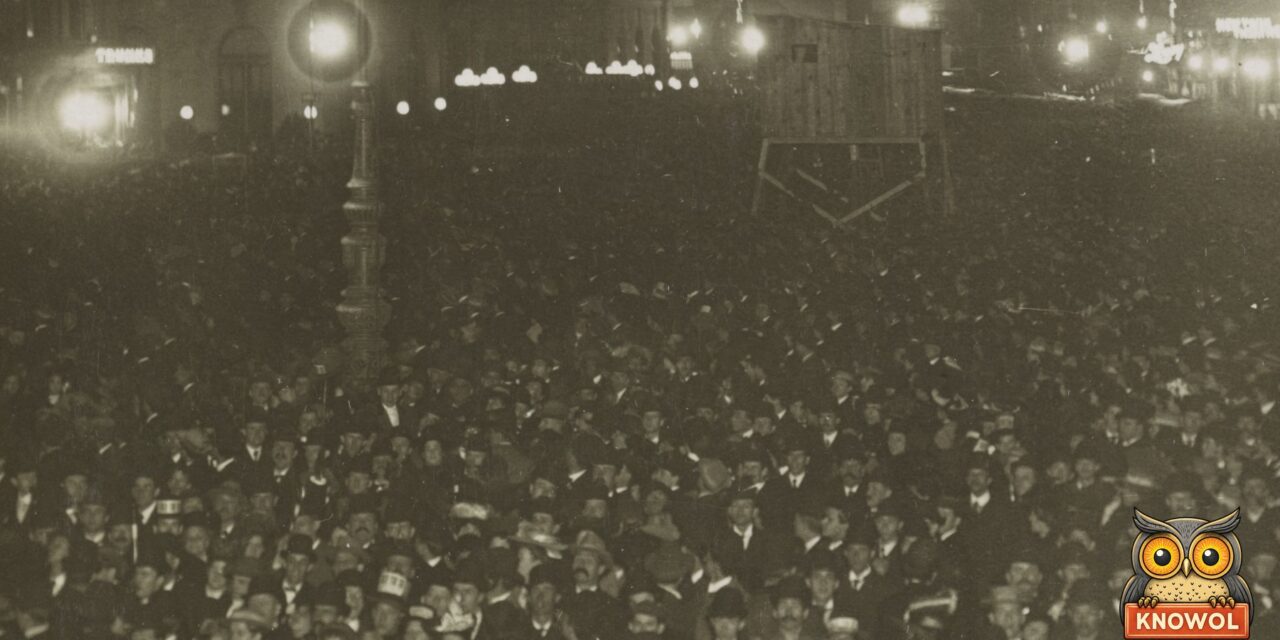
On Tuesday, November 7, 1916, Americans picked a president. It was President Woodrow Wilson against Charles E. Hughes. There was no radio news yet and no television. So in Tacoma, Washington, the evening paper came up with a very loud plan. The Tacoma Times promised to report the winner “to every person inside the city limits, at least to every person who is not deaf.”
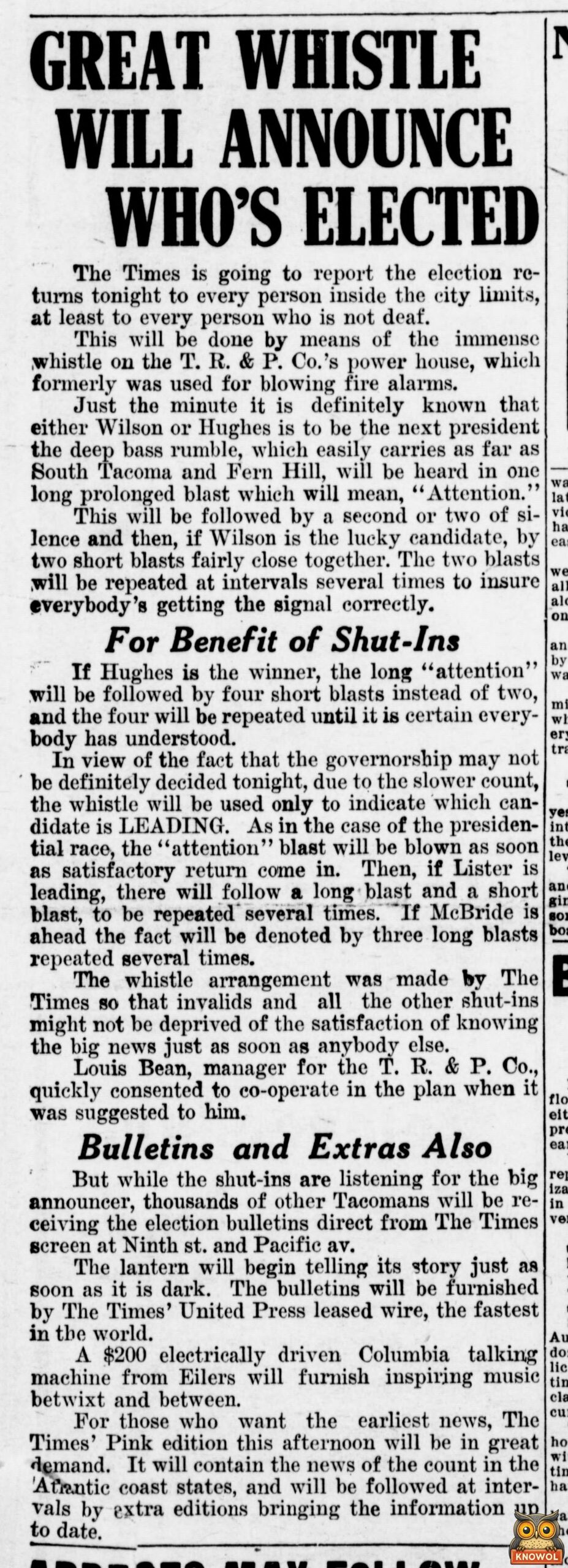
“Great Whistle Will Announce Who’s Elected.” The Tacoma Times, Tacoma, Washington, November 7, 1916, page 1. Library of Congress, Chronicling America. Click the clipping to read it full size.
How the whistle code worked
In 1916 election results came in by telegraph, one town and one state at a time. Newspapers posted them as fast as they could. The Times borrowed “the immense whistle” on the power house of the T. R. & P. Co., the company that ran Tacoma’s streetcars. That whistle used to blow the city’s fire alarms. The paper said its “deep bass rumble” could be heard as far away as South Tacoma and Fern Hill, at the edges of town.
The code was simple. First came one long blast that meant “Attention.” Then a second or two of quiet. Two short blasts meant Wilson had won. Four short blasts meant Hughes. Each signal would be blown again and again “to insure everybody’s getting the signal correctly.”
Why go to all that trouble? The Times said the whistle was for “invalids and all the other shut-ins.” Those were people too sick or too old to leave the house. They deserved to know “the big news just as soon as anybody else.”
A screen on the street
Everyone else could come downtown. The Times showed the news on a big screen at Ninth Street and Pacific Avenue. It used a “lantern,” short for magic lantern, an early kind of projector. A worker wrote the newest numbers on a small square of glass called a lantern slide. The lantern’s bright lamp shone through the glass and threw the writing onto the screen, big enough for a whole street to read. Big cities did the same thing on a giant scale. In New York, election night crowds packed the street in front of the Times building so tight you couldn’t see the pavement.
Between bulletins, a “$200 electrically driven Columbia talking machine,” a fancy record player, played music for the crowd.
A newsboy’s big night
One of the people in the Times window that night was 12 years old. Herbert Stratton sold the Times on the street. He lived at 919 E Street, and he had just won a prize for drawing at Central School. Bill Jones, a circulation manager at the paper, had caught him drawing cartoons while he waited for his papers. On election night Jones brought him up to the office.
They gave Herbert “a grease pencil and a lantern-slide” and told him to “go to it.” He did, “breathing hard and perspiring.” Then, in a quiet moment between returns, Herbert stood in the window and saw his own cartoon glowing on the screen. It showed Everett True, a hot-tempered comic-strip character of the day, “expressing disgust at the early Hughes lead.”
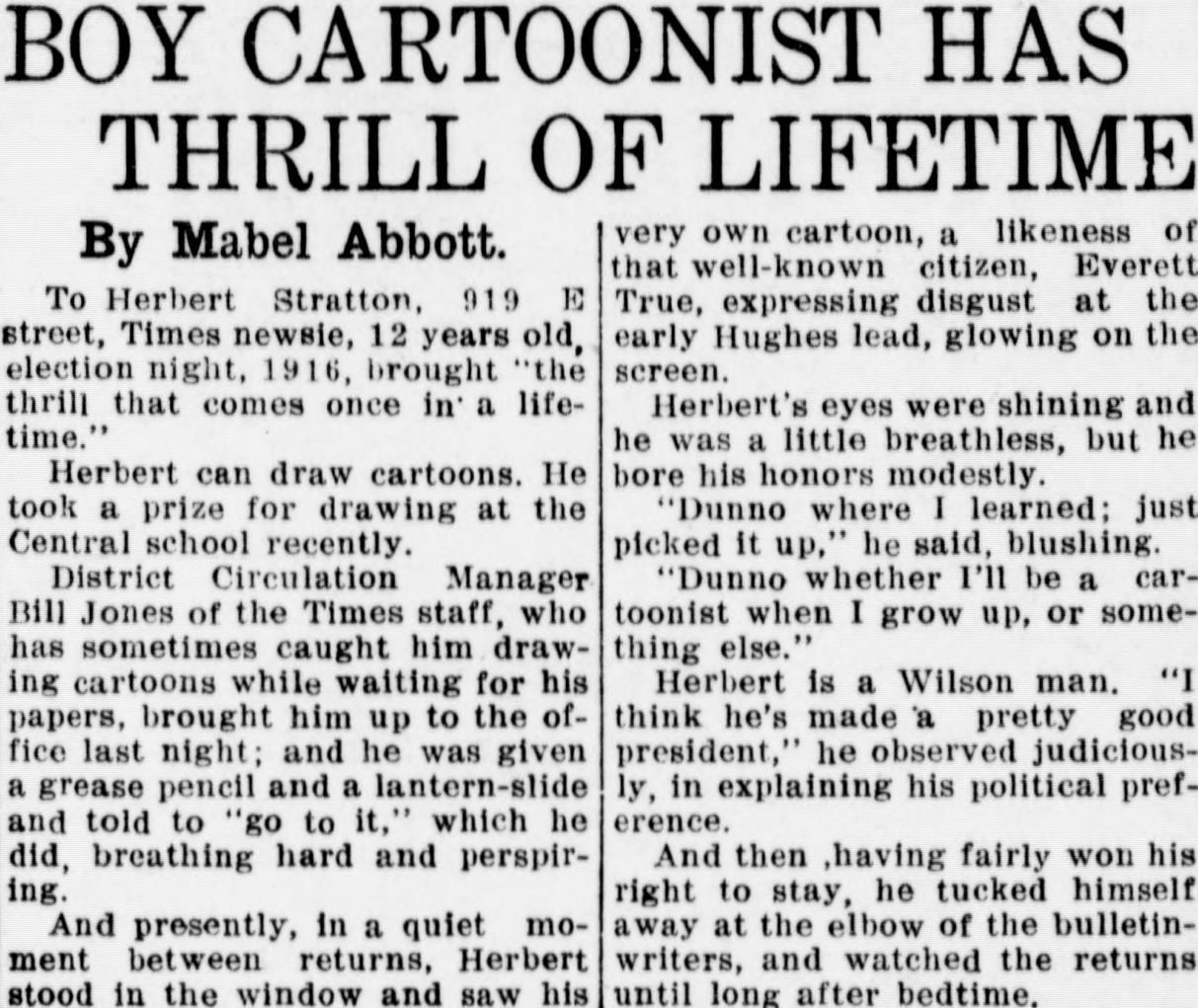
“Boy Cartoonist Has Thrill of Lifetime,” by Mabel Abbott. The Tacoma Times, Tacoma, Washington, November 8, 1916, page 3. Library of Congress, Chronicling America. Click the clipping to read it full size.
“Dunno where I learned; just picked it up,” Herbert said, blushing. He wasn’t sure about his future, either: “Dunno whether I’ll be a cartoonist when I grow up, or something else.” He was a Wilson fan. “I think he’s made a pretty good president,” he said. Then he sat down beside the bulletin writers and watched the returns “until long after bedtime.”
Waiting for the whistle
The whistle was supposed to blow “just the minute it is definitely known” who had won. That minute never came on election night. The early returns from the East put Hughes ahead, and the West was still counting.
By Thursday, November 9, it came down to California. The United Press count there gave Wilson 458,769 votes and Hughes 454,210. “This is a lead for Wilson of 4,559,” the Times reported, with 175 precincts (voting neighborhoods) still to report. That’s about one vote in every 200.
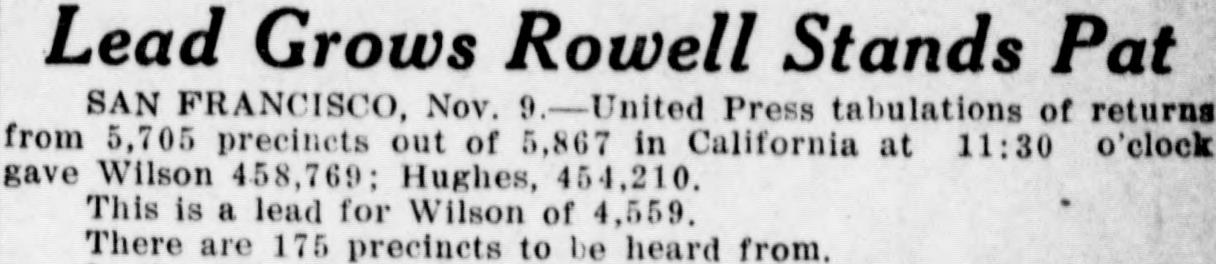
The California count on Thursday. The Tacoma Times, Tacoma, Washington, November 9, 1916, page 1. Library of Congress, Chronicling America. Click the clipping to read it full size.
That night Tacoma finally knew. “All the suspense piled up during the two days of watchful waiting broke loose on the streets of Tacoma,” the Times wrote. More than 1,000 people paraded “to the blare of a brass band and the glow of red fire,” which means red flares. The marchers even stopped at Ninth and Pacific to serenade the Times “in its new building.” The papers we read don’t say whether the big whistle ever blew.
The Times also had a joke ready for the losing side: “Cheer up, if you’re eating crow today, it’s only a short while to turkey.” Eating crow means admitting you were wrong. Thanksgiving was three weeks away.
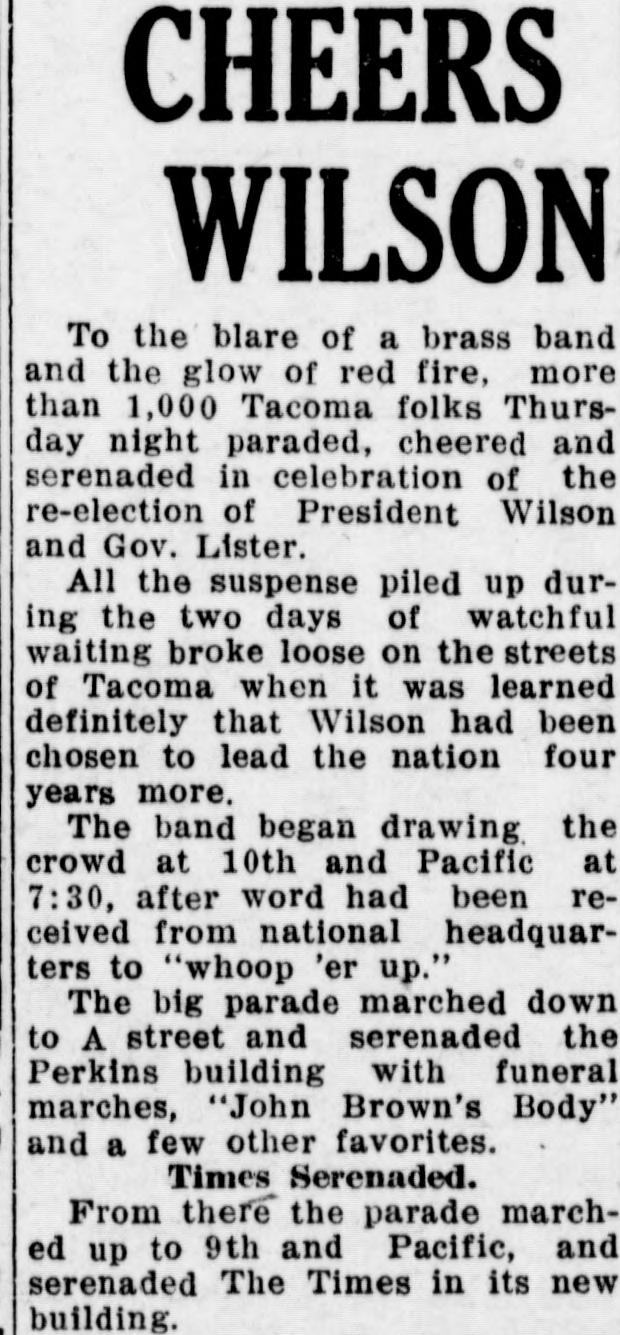
Thursday night’s parade. The Tacoma Times, Tacoma, Washington, November 10, 1916, page 3. Library of Congress, Chronicling America. Click the clipping to read it full size.
Other towns, other codes
Tacoma wasn’t the only town that turned election night into a secret code. In 1908 the Willmar Tribune of Willmar, Minnesota, put a searchlight on top of the new Carlson Bros. building. The beam worked like a giant pointer in the sky. Tipped “at an angle of 45 degrees north,” it meant Taft was ahead for president. South meant Bryan. West and east stood for the two men running for governor, Johnson and Jacobson. When someone actually won, the light would be “turned horizontally,” flat toward his direction.
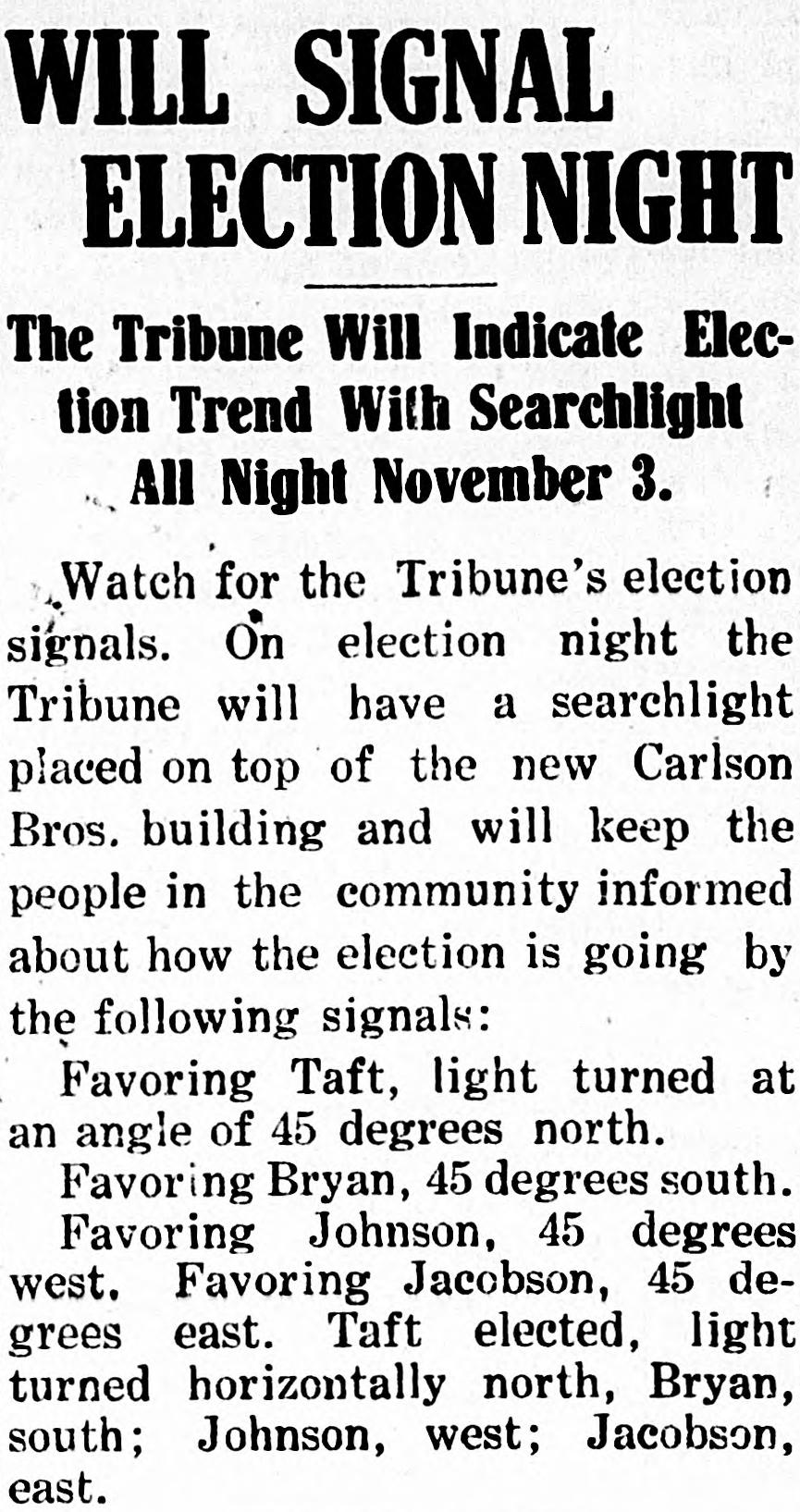
The searchlight code. Willmar Tribune, Willmar, Minnesota, October 28, 1908, page 1. Library of Congress, Chronicling America. Click the clipping to read it full size.
On the same night as Tacoma’s whistle, the Daily Ardmoreite in Ardmore, Oklahoma, set up a midnight whistle with the Chickasaw Compress Company, a plant that squeezed cotton into tight bales. “One long whistle is a warning to wake up and listen for the signal,” the paper said. Three blasts meant Wilson and four meant Hughes. Ardmore had one more choice that Tacoma didn’t: two blasts meant “results doubtful.” In 1916 that was the honest answer at midnight.
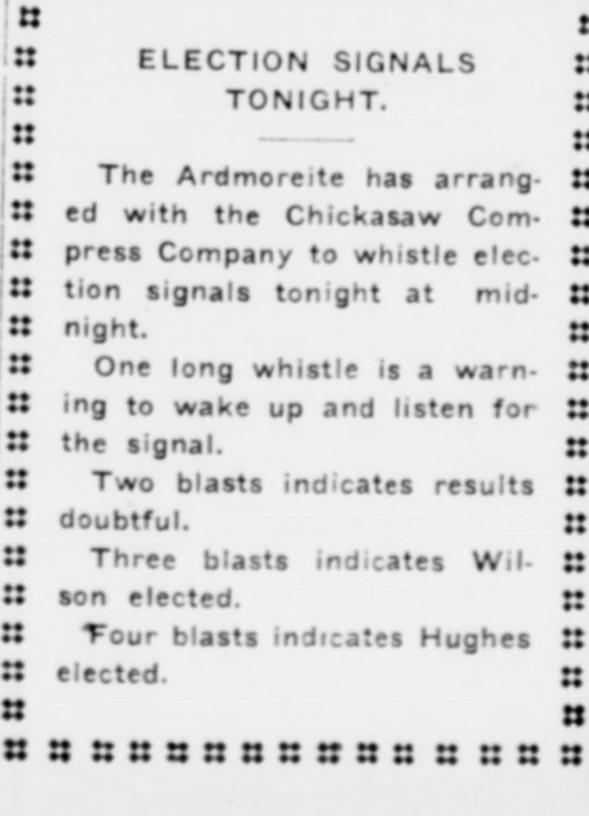
Daily Ardmoreite, Ardmore, Oklahoma, November 7, 1916, page 1. Library of Congress, Chronicling America. Click the clipping to read it full size.
The joke version
All these codes were common enough that a humor magazine made fun of them. In 1904 Puck, a New York magazine, printed its own “system of election signals.” One skyrocket from the roof would mean Theodore Roosevelt had won, and two would mean Alton Parker. If Thomas Watson won, a long-shot candidate, Puck said it would “discharge all his employes and jump off the roof.” If Silas Swallow of the Prohibition Party won, Puck would “drive the water wagon” up Broadway. Being “on the water wagon” was slang for giving up alcohol.
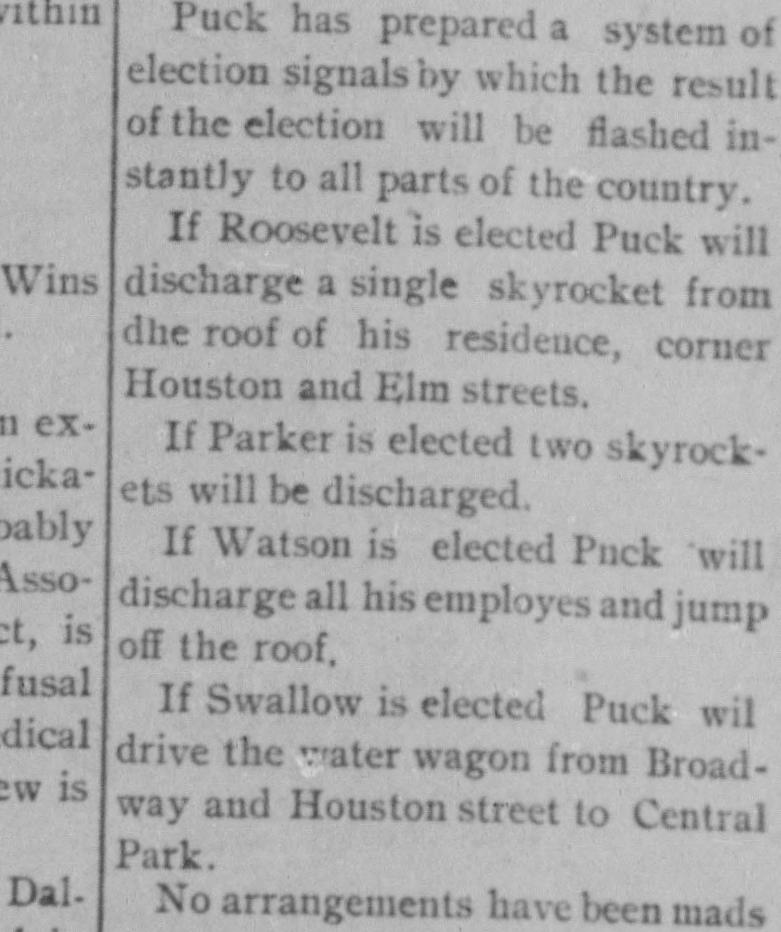
Puck’s joke signals, reprinted in the Chickasha Daily Express, Chickasha, Indian Territory (now Oklahoma), November 10, 1904, page 8. Library of Congress, Chronicling America. Click the clipping to read it full size.
In 1916 the fastest news in Tacoma still traveled by telegraph wire, glass slide and steam whistle. On election night, the people had to wait for the count, just like the whistle did.
Sources
- The Tacoma Times (Tacoma, Washington): November 7, 1916, page 1 (“Great Whistle Will Announce Who’s Elected”), November 8, 1916, page 3 (“Boy Cartoonist Has Thrill of Lifetime,” by Mabel Abbott), November 9, 1916, page 1 (the California count), November 10, 1916, page 1 (“Talk o’ the Times”) and November 10, 1916, page 3 (“Tacoma Cheers Wilson”).
- Willmar Tribune (Willmar, Minnesota): October 28, 1908, page 1 (“Will Signal Election Night”).
- The Daily Ardmoreite (Ardmore, Oklahoma): November 7, 1916, page 1 (“Election Signals Tonight”).
- The Chickasha Daily Express (Chickasha, Indian Territory): November 10, 1904, page 8 (“Puck’s Signals”).
- All newspaper images: Library of Congress, Chronicling America. Published 1904 to 1916, public domain.
- Cover: “Watching the election returns, great crowds before the Times B’ld’g. and Astor Hotel, New York,” stereograph, H. C. White Co., copyright 1907, Library of Congress, no known restrictions on publication.