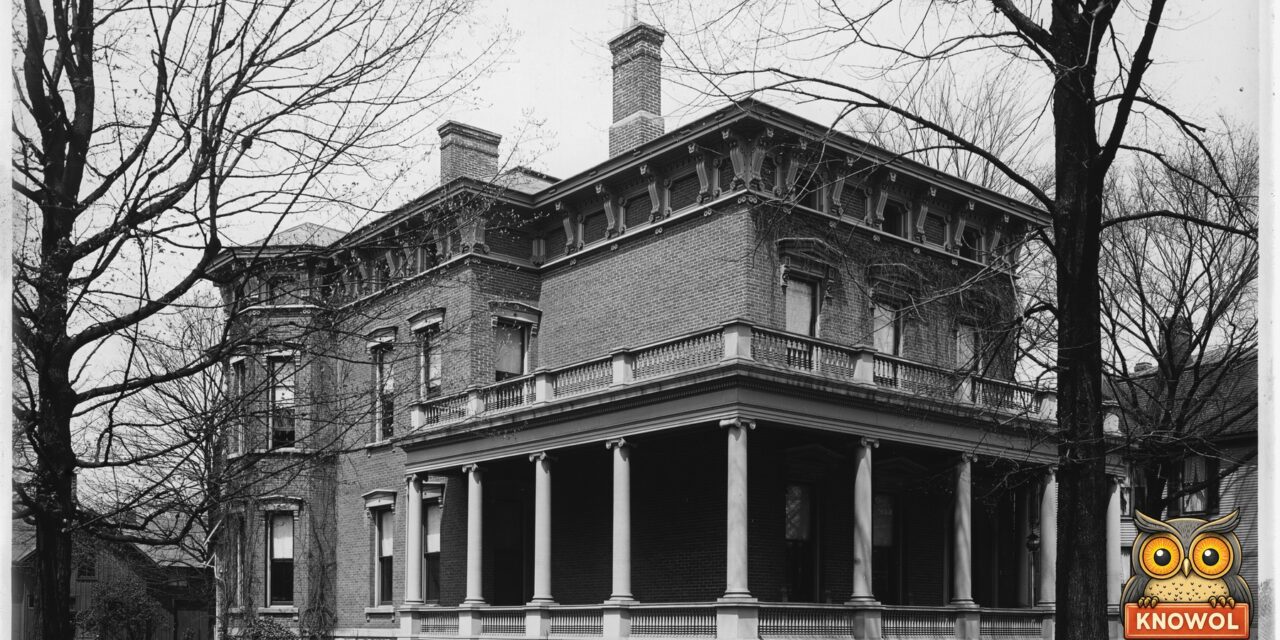
On Thursday, November 8, 1888, it rained all day in Indianapolis, Indiana. The streets were torn up for repairs and deep in mud. Nobody cared. Two days earlier, a man who lived right there in town, Benjamin Harrison, had been elected President of the United States. Now the whole city was out celebrating, and a lot of it was turning red.
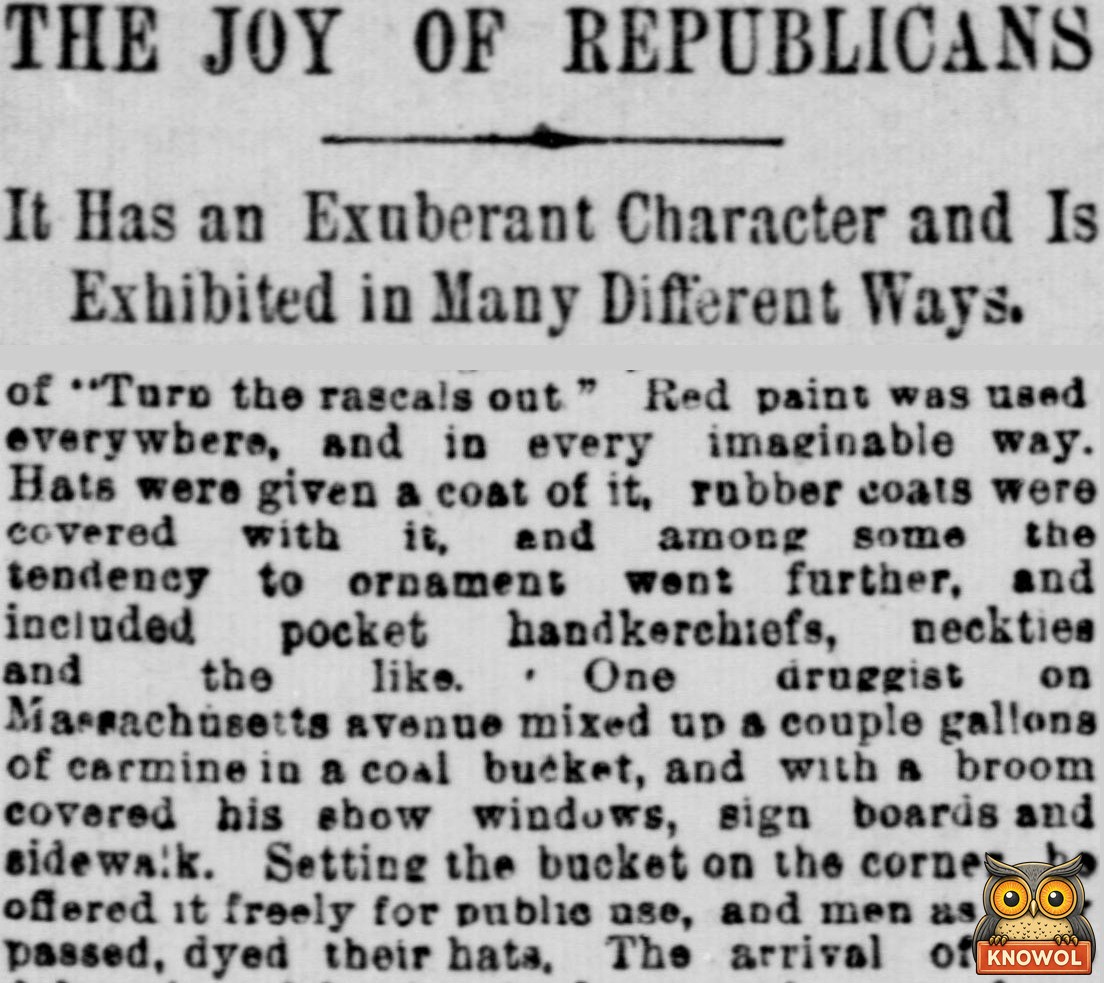
“The Joy of Republicans.” The Indianapolis Journal, Indianapolis, Indiana, November 9, 1888, page 8 (the headline and a paragraph from further down the same story). Library of Congress, Chronicling America. Click the clipping to read it full size.
The hometown candidate
Harrison was a lawyer who had been a general in the Civil War, so everyone called him General Harrison. He ran as a Republican against President Grover Cleveland, a Democrat. In 1888, votes were counted by hand and the results came in by telegraph, a little at a time. It took until Thursday for Indianapolis to feel sure its neighbor had won.
Then the city “broke loose,” as The Sun of New York put it. “Pennsylvania avenue was crowded for squares, with thousands of horns blowing, and the din was abominable. One could not hear nor speak.” Din means a loud, messy noise. A crowd of 3,000 or 4,000 people packed the street outside the New Denison Hotel, where the Republicans ran their campaign.
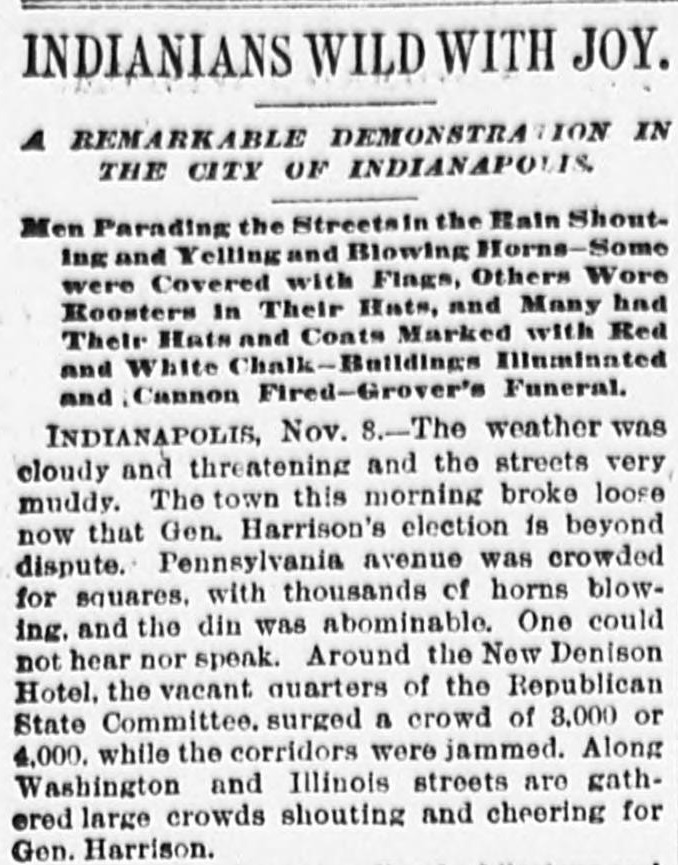
“Indianians Wild With Joy.” The Sun, New York, New York, November 9, 1888, page 2. Library of Congress, Chronicling America. Click the clipping to read it full size.
The Indianapolis Journal, Harrison’s hometown paper, said the party went “all day and far into the night.” Some people carried umbrellas. Some wore gossamers, which were thin raincoats. Hundreds more “walked through the rain as unconcerned as if it were a sunshiny day in June.”
A bucket of red on the corner
Today, “painting the town red” means going out and having a wild time. In Indianapolis that week, people did it for real. “Red paint was used everywhere, and in every imaginable way,” the Journal reported. “Hats were given a coat of it.” So were rubber raincoats, neckties and handkerchiefs.
The best painter of all was a druggist on Massachusetts Avenue. Drugstores back then sold dyes and colors as well as medicine. This one “mixed up a couple gallons of carmine in a coal bucket.” Carmine is a bright red color made from tiny dried bugs. He grabbed a broom and painted his own store windows, his signs and his sidewalk.
Then he did something even better. “Setting the bucket on the corner, he offered it freely for public use,” the Journal said, “and men as they passed, dyed their hats.” Picture a line of men in the rain, dipping their hats in a coal bucket of bug-red paint.
By nightfall, the paper said, it seemed every Republican was trying “to invent a more unique decoration for his hat and clothing than had been met with on the streets.” Bands of men marched up and down the sidewalks, “keeping step to some imaginary tune played on a hundred discordant horns.” Discordant means badly out of tune. Anything that could make noise was used: “Cow bells, sleigh bells, tin pans.”

The Indianapolis Journal, November 9, 1888, page 8. Library of Congress, Chronicling America. Click the clipping to read it full size.
Poor rooster
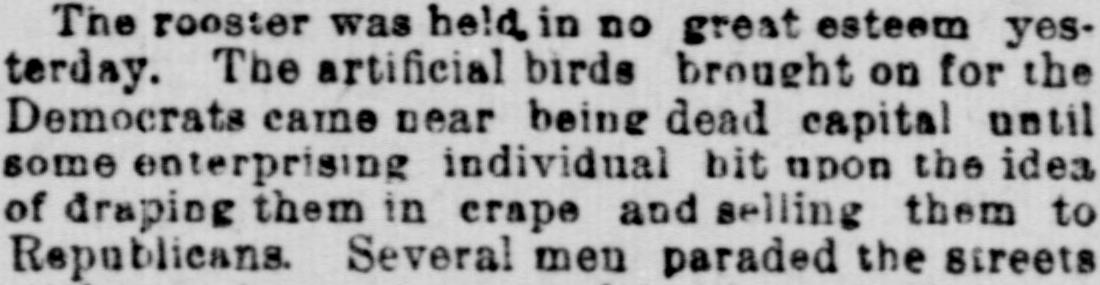
Every party had its symbols. The Republicans had the eagle. Back then the Democrats used a rooster, and their red bandanna, a big handkerchief, was a campaign sign too. On this day, both got teased.
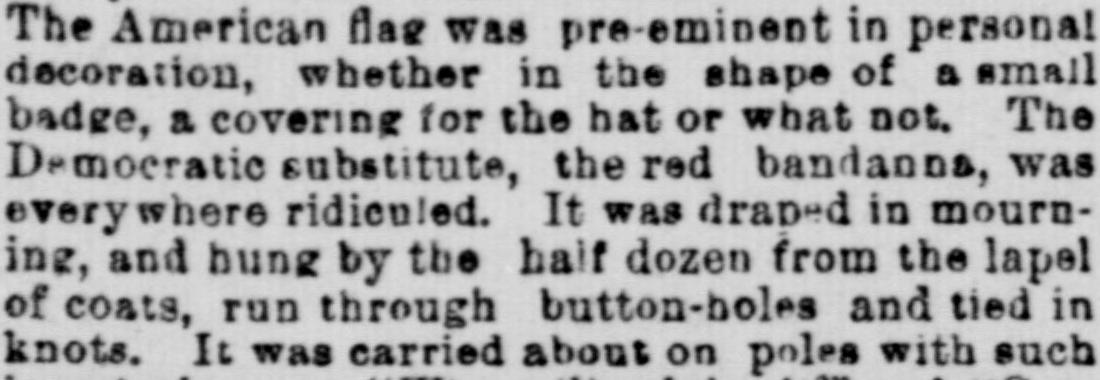
The Indianapolis Journal, November 9, 1888, page 8. Library of Congress, Chronicling America. Click the clipping to read it full size.
Bandannas were “draped in mourning,” wrapped in black like at a funeral, and hung “by the half dozen from the lapel of coats.” Republicans wore “small toys in the shape of a rooster, wearing around its neck a band of crape.” Crape is the black cloth people wore when someone died. The joke was that the Democrats’ rooster had died.
Stores had stocked those toy roosters for the Democrats. After the election, nobody wanted them. Then “some enterprising individual hit upon the idea of draping them in crape and selling them to Republicans.” Enterprising means quick to spot a way to make money.
The Indianapolis Journal, November 9, 1888, page 8. Library of Congress, Chronicling America. Click the clipping to read it full size.
One Democrat, Ferdinand Dietz, had a real rooster story. “Four days before the election my Shanghai rooster was sick,” he told a friend, “and I told my wife if it died Cleveland would be defeated.” On the morning after the election, he went out to the barn. “The rooster was as dead as a door nail.”
Good sports
The Democrats took it fairly well. “Their one word was, ‘We can stand it,'” the Journal said. Even the police, many of them Democrats, said the crowd behaved. Everyone was too busy shouting for the winner to start a fight.
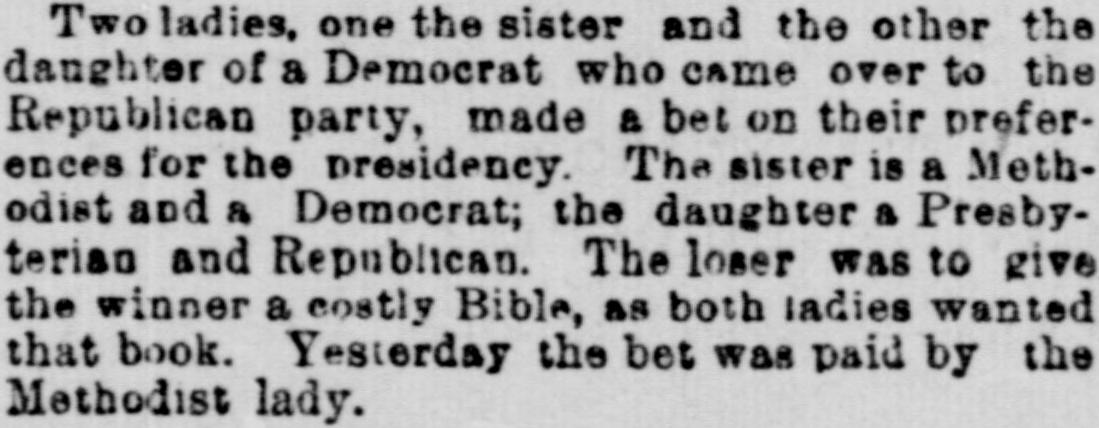
Two women, an aunt and her niece, had made a bet on the race. One was a Democrat, the other a Republican. “The loser was to give the winner a costly Bible, as both ladies wanted that book.” On Thursday, the Democrat paid up.
The Indianapolis Journal, November 9, 1888, page 8. Library of Congress, Chronicling America. Click the clipping to read it full size.
That afternoon, five hundred men and women came in from Danville, Indiana, about 20 miles west. They marched through the mud to General Harrison’s house on North Delaware Street and were “lustily cheered on all sides,” which means cheered loudly. The picture at the top of this story is that house, photographed in about 1904.
What the stores were selling
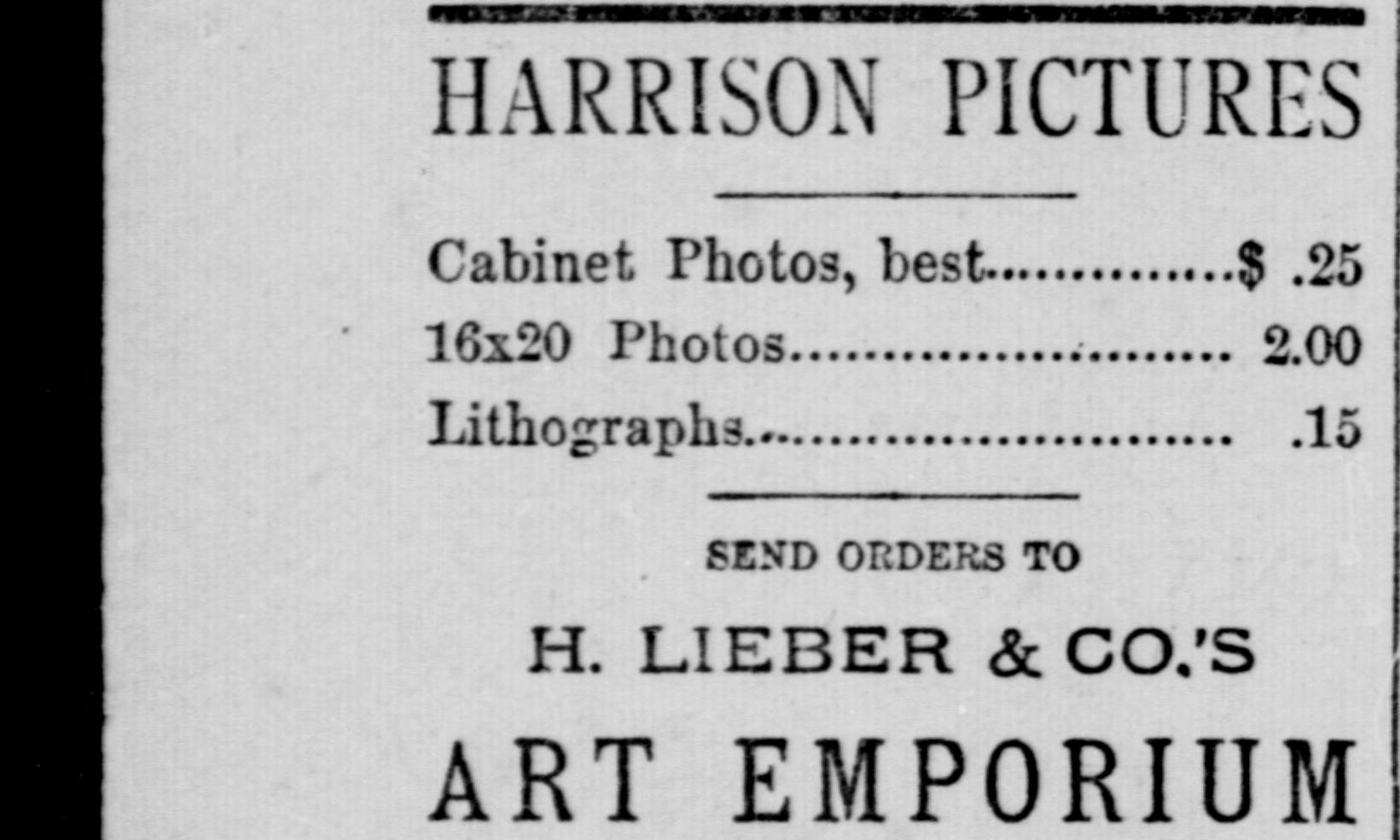
The same newspaper page was full of ads for the party. Kipp Brothers, on South Meridian Street, offered “One half million Illuminating Lanterns” and “One million Horns, of all sizes,” with fireworks and flags. An art shop sold Harrison pictures. A cabinet photo, a small photo glued on stiff card, cost 25 cents. A big 16-by-20-inch photo cost $2.

Kipp Brothers ad. The Indianapolis Journal, November 9, 1888, page 8. Library of Congress, Chronicling America. Click the clipping to read it full size.
H. Lieber & Co. ad. The Indianapolis Journal, November 9, 1888, page 8. Library of Congress, Chronicling America. Click the clipping to read it full size.
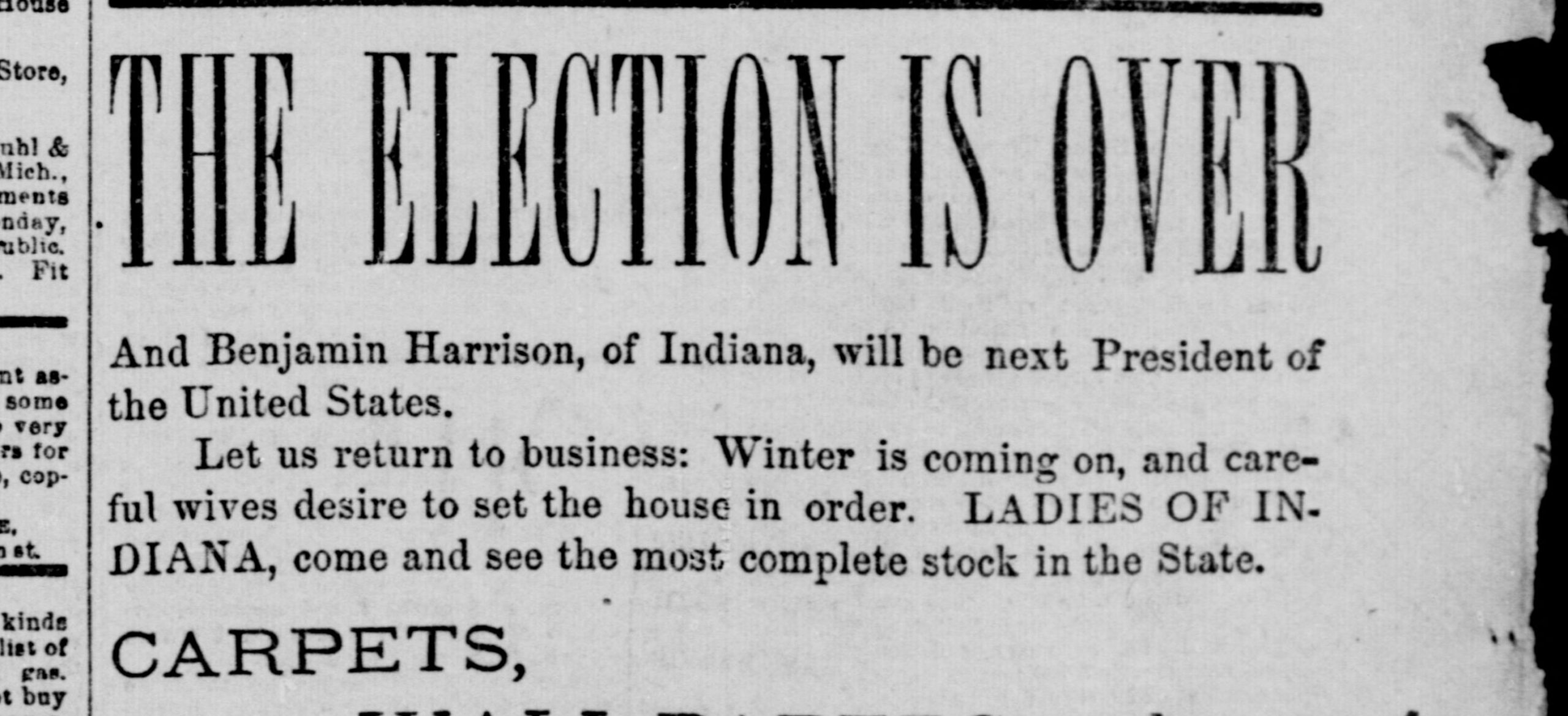
One carpet store was already done with politics. Its giant ad said, “THE ELECTION IS OVER,” then got right down to business: “Winter is coming on.”
Albert Gall carpet store ad. The Indianapolis Journal, November 9, 1888, page 8. Library of Congress, Chronicling America. Click the clipping to read it full size.
The whole state joined in
Other Indiana towns celebrated too. Two days later, the Journal reported that Brazil, Indiana, had its “biggest jollification in her history,” with bonfires, tin horns, cornet bands and “fire-works painting the sky red.” On one corner, a man played the bagpipes.
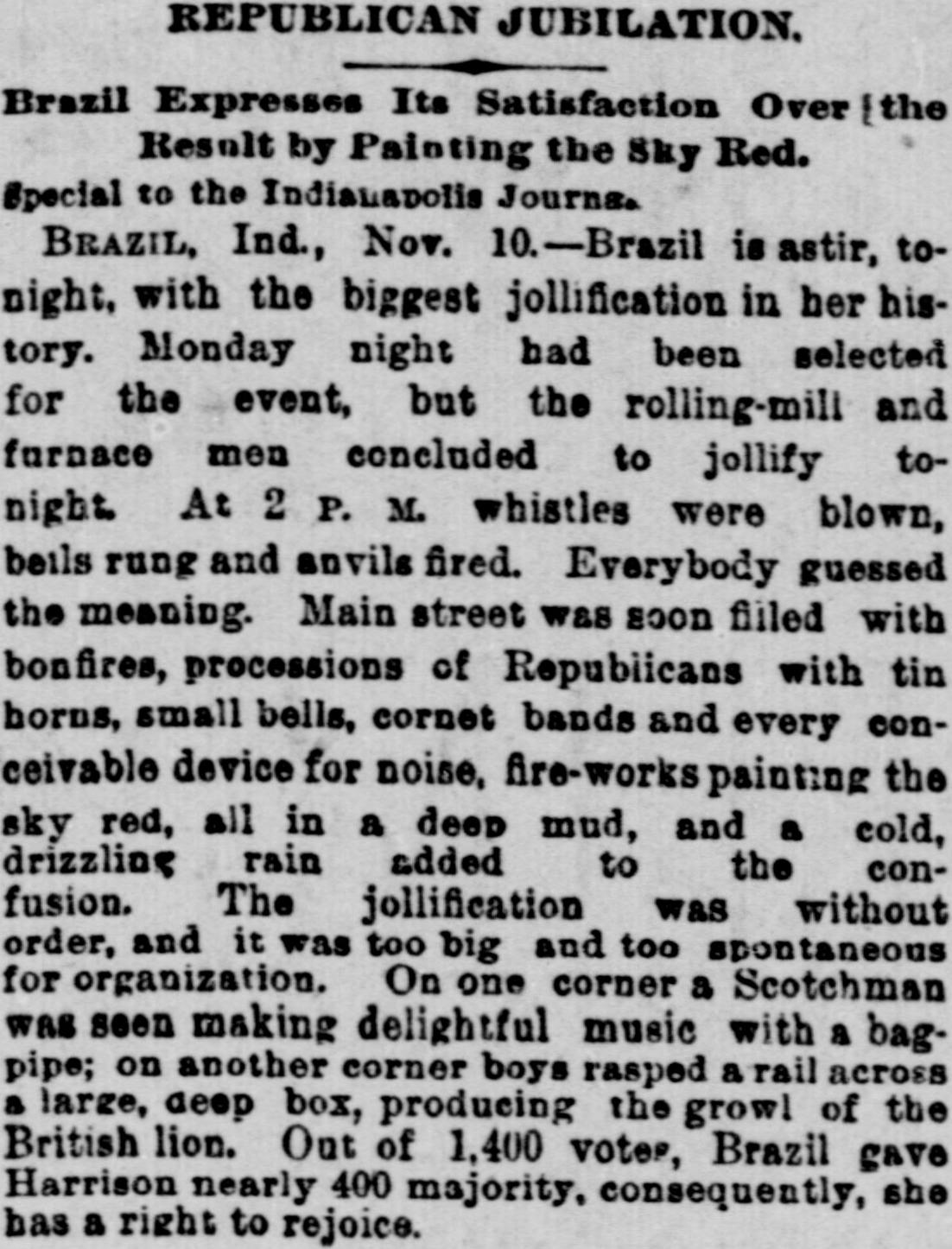
“Republican Jubilation.” The Indianapolis Journal, November 11, 1888, page 2. Library of Congress, Chronicling America. Click the clipping to read it full size.
Back in Indianapolis, a local Democratic marching club called the Taggart Guards had planned a trip to Washington for the new president’s swearing-in on March 4. They had even picked out a uniform: a “high silk hat, blue suit and light spring overcoat.” After the election, the Journal reported, “They will not wear the uniform.” Four months later, Benjamin Harrison of Indianapolis took the oath of office as the 23rd President of the United States, and the red paint on his hometown’s hats had long since washed out in the rain.
Sources
- The Indianapolis Journal (Indianapolis, Indiana): November 9, 1888, page 8 (“The Joy of Republicans,” the notes beside it, and the ads) and November 11, 1888, page 2 (“Republican Jubilation,” Brazil).
- The Sun (New York, New York): November 9, 1888, page 2 (“Indianians Wild With Joy”).
- All newspaper images: Library of Congress, Chronicling America. Published 1888, public domain.
- Cover: Detroit Publishing Co., “Pres[ident] Harrison House, North Delaware Street, Indianapolis, Ind.,” about 1904, Library of Congress, no known restrictions on publication.