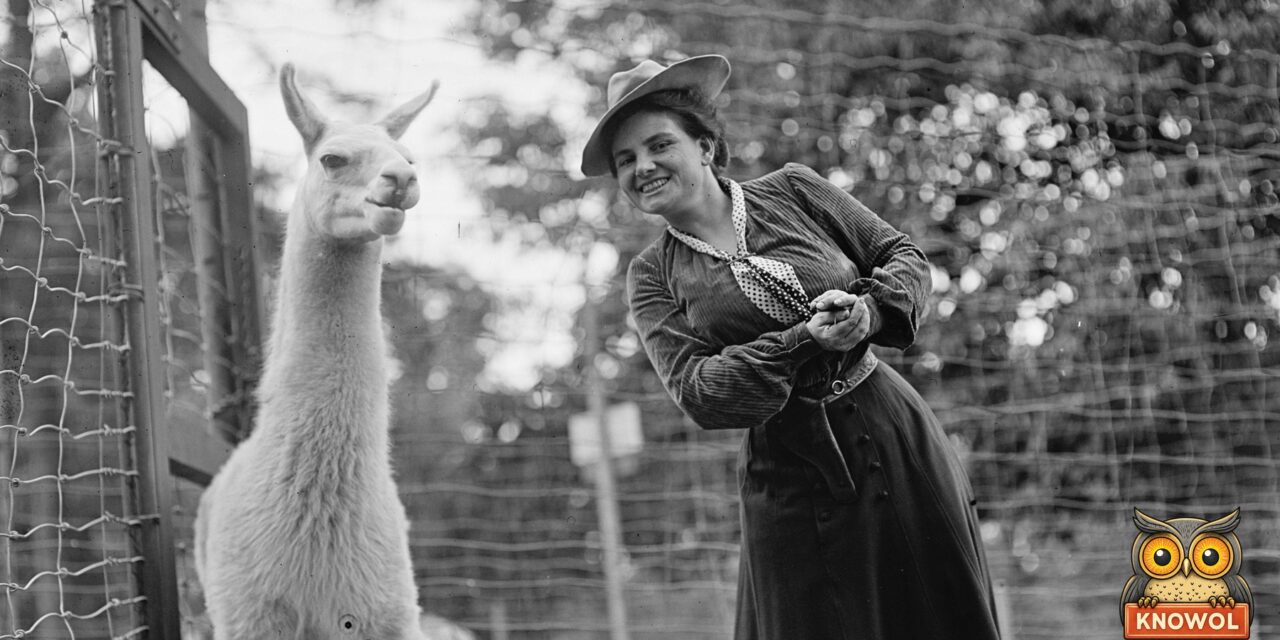
On a Tuesday evening in June 1913, a good-sized crowd in Honolulu, Hawaii, came to the Royal Hawaiian Opera House to hear a woman tell about South America. Her name was Harriet Chalmers Adams. A few weeks earlier the Honolulu Star-Bulletin had counted up her trips in one big line: “Forty thousand miles of journeying through South America!” That is more than one and a half trips around the whole Earth.
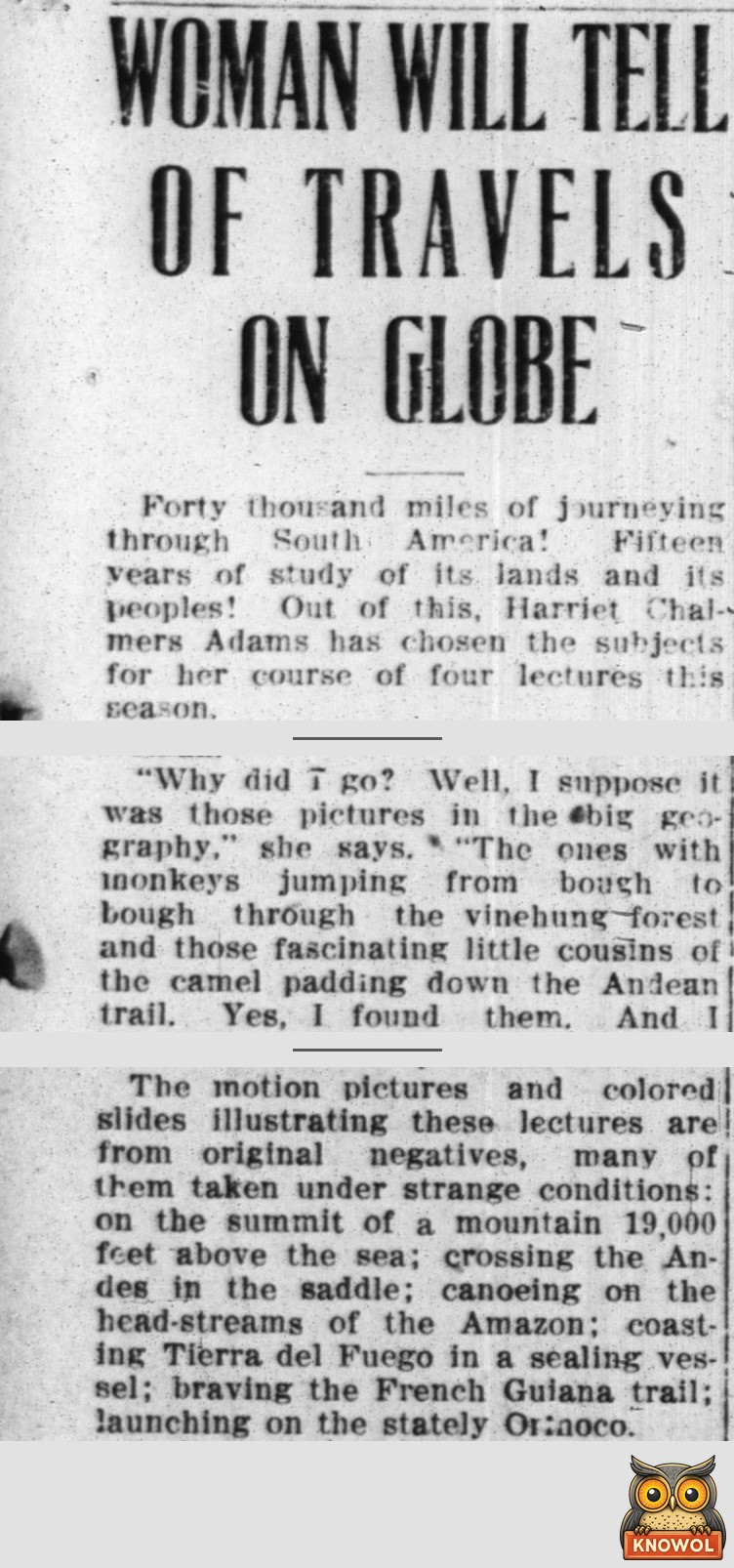
“Woman Will Tell of Travels on Globe.” Honolulu Star-Bulletin, Honolulu, Hawaii, May 5, 1913, page 5 (three parts of the story, joined). Library of Congress, Chronicling America. Click the clipping to read it full size.
The pictures that started it all
People wanted to know what made a woman in 1913 ride mules over mountains and paddle canoes on jungle rivers. The paper printed her answer, and it is a sweet one.
“Why did I go? Well, I suppose it was those pictures in the ‘big geography,'” she said. “The ones with monkeys jumping from bough to bough … and those fascinating little cousins of the camel padding down the Andean trail. Yes, I found them.”
A “big geography” was a geography book, the large kind full of maps and pictures of faraway places. The “little cousins of the camel” were llamas. Llamas really are in the camel family. In the Andes Mountains of South America, people use them to carry loads up and down the steep trails.
So a book with pictures of monkeys and llamas sent her across a whole continent. And when she got there, the animals were real. “Yes, I found them.” That’s a whole travel story in four words.
Where her pictures came from
Adams didn’t just tell stories. She brought pictures, and she took them herself. The paper listed some of the places she carried her camera:
- “on the summit of a mountain 19,000 feet above the sea”
- “crossing the Andes in the saddle”
- “canoeing on the head-streams of the Amazon”
- “coasting Tierra del Fuego in a sealing vessel”
Those are big numbers and big places. A mountain 19,000 feet high is taller than any mountain in the lower 48 states. The head-streams of the Amazon are the little rivers high up where the world’s mightiest river begins. Tierra del Fuego is the group of islands at the very bottom tip of South America, and a sealing vessel was a ship that hunted seals in those cold, rough waters.
A Washington, D.C., paper said she had made a “3,000-mile muleback trip across the Andes.” That’s about as far as from New York to California, on the back of a mule.
Watching the Panama Canal get built
One more fact in the Honolulu paper stands out: “Five times Mrs. Adams has traveled to the Isthmus of Panama to watch the canal in the making.” In 1913 the Panama Canal was one of the biggest digging jobs the world had ever seen. Workers were cutting a path for ships across the narrow neck of land between North and South America.
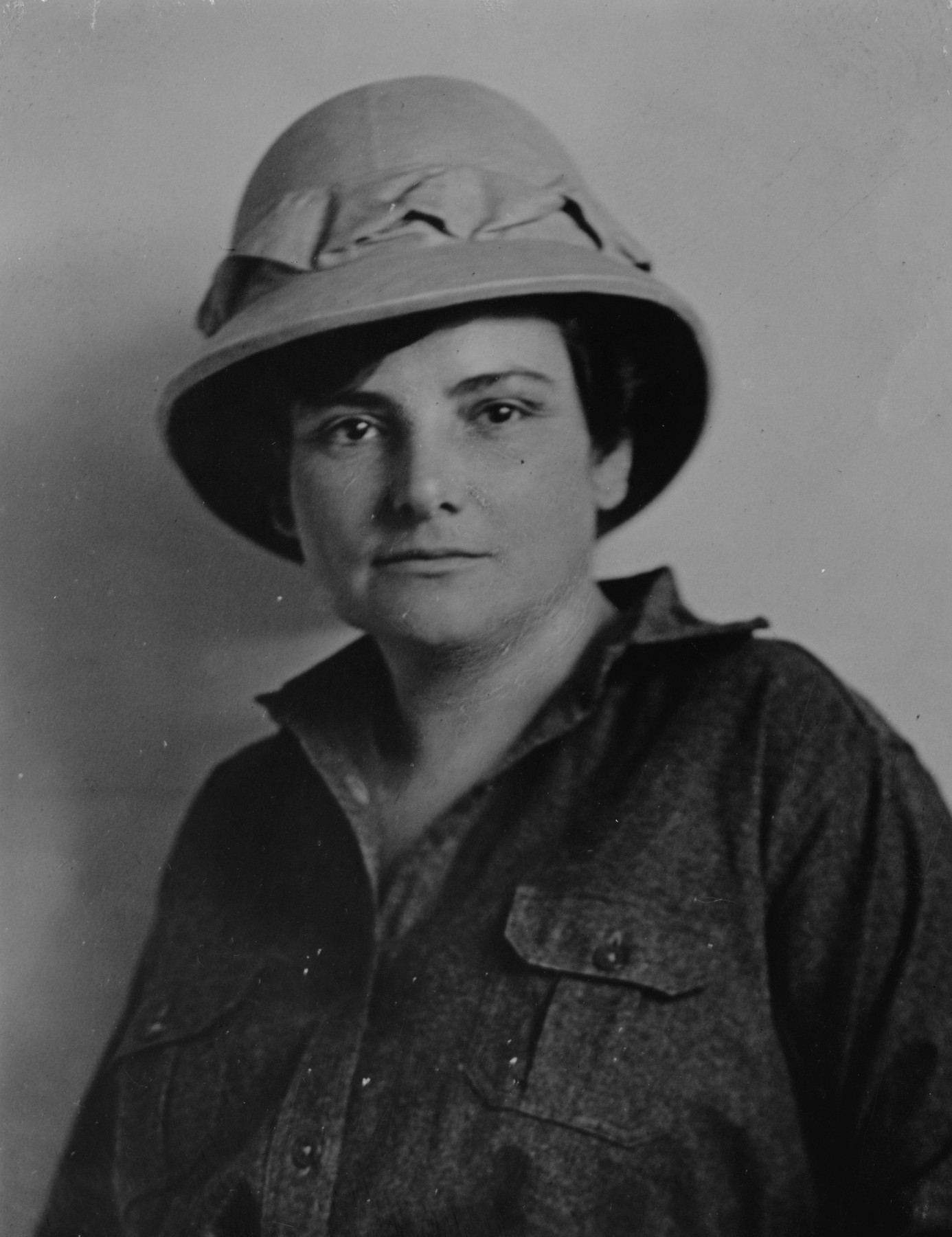
Harriet Chalmers Adams in a sun helmet and work shirt, between 1908 and 1919. National Photo Company Collection, Library of Congress. Click the picture to see it full size.
What a dollar bought in Honolulu
Before the big night, the Star-Bulletin ran an ad for it. A reserved seat cost “$1.00.” For that dollar, the ad promised “One Hundred Color Pictures and Two Thousand Feet of Motion Film” made just for this talk. Two thousand feet of film would stretch more than six football fields, end to end. At the speed movies ran then, that’s roughly half an hour of moving pictures.
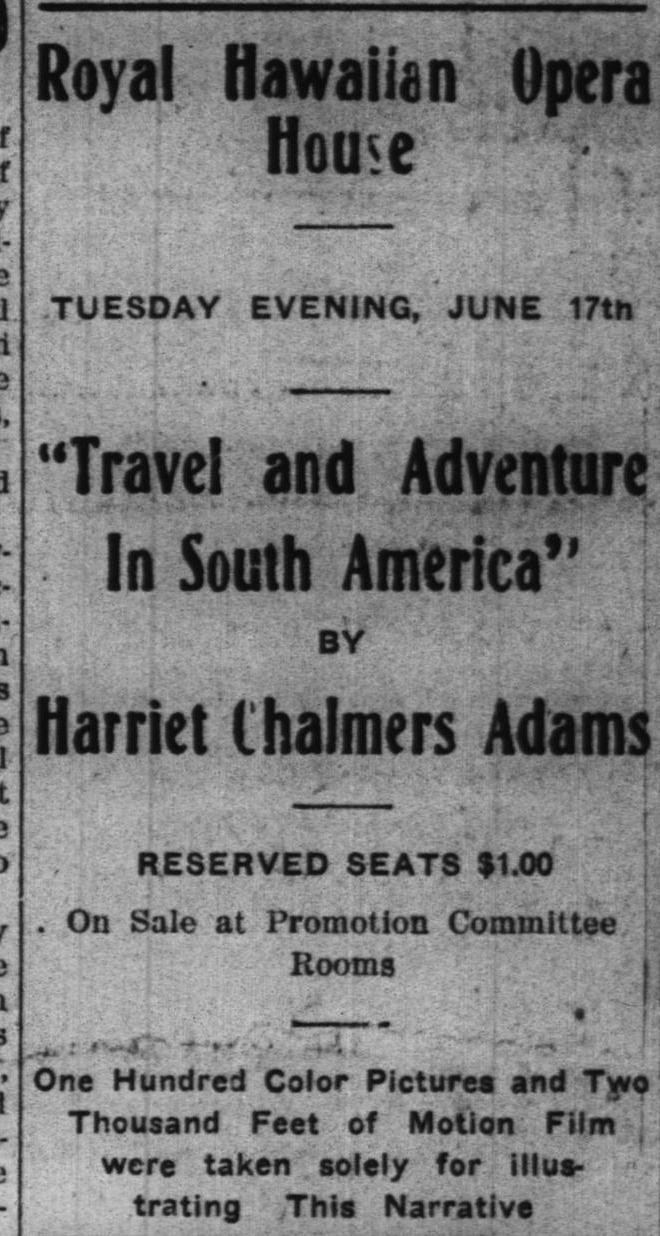
The ad for her talk at the Royal Hawaiian Opera House, Tuesday evening, June 17. Honolulu Star-Bulletin, June 12, 1913, page 5. Library of Congress, Chronicling America. Click the clipping to read it full size.
While she was in Honolulu, she told a reporter she couldn’t understand why Americans kept going to Europe. “I can not see why American’s go year after year to Europe when there is so much of interest to see in the new world,” she said. The new world meant North and South America. She also said the people of Honolulu “are real travelers,” and that was a compliment.
Good news found her in Honolulu, too. She learned that she had been “elected a Fellow of the Royal Geographical Society of London.” That was one of the most famous explorers’ clubs in the world.
The night at the opera house
On Tuesday, June 17, 1913, she gave her talk. The next day the Star-Bulletin said she “carried a good sized audience at the opera house on a trip through South America.” She kept “the attention of her auditors for two solid hours.” Auditors meant listeners.
With her colored slides and films, she took the crowd down the west coast of South America, “around the horn in a sailing vessel,” and up the other side. The Horn is Cape Horn, the stormy southern tip of the continent. Then she gave Honolulu some advice about the Panama Canal. She told people to “see the canal now and not to delay until the water has been turned in.” Once the water filled it, all that amazing digging would be hidden under the ships. The canal opened the next summer, in August 1914.
The paper called her “one of the hardiest mountaineers in the world.” It also had a small scolding for a few people in the seats. “Had a number of members of the audience refrained from conversation during the travelogue, Mrs. Adams’ appearance would have been the better enjoyed by the entire attendance.” Some folks kept chatting during the show, and the paper let them know it.
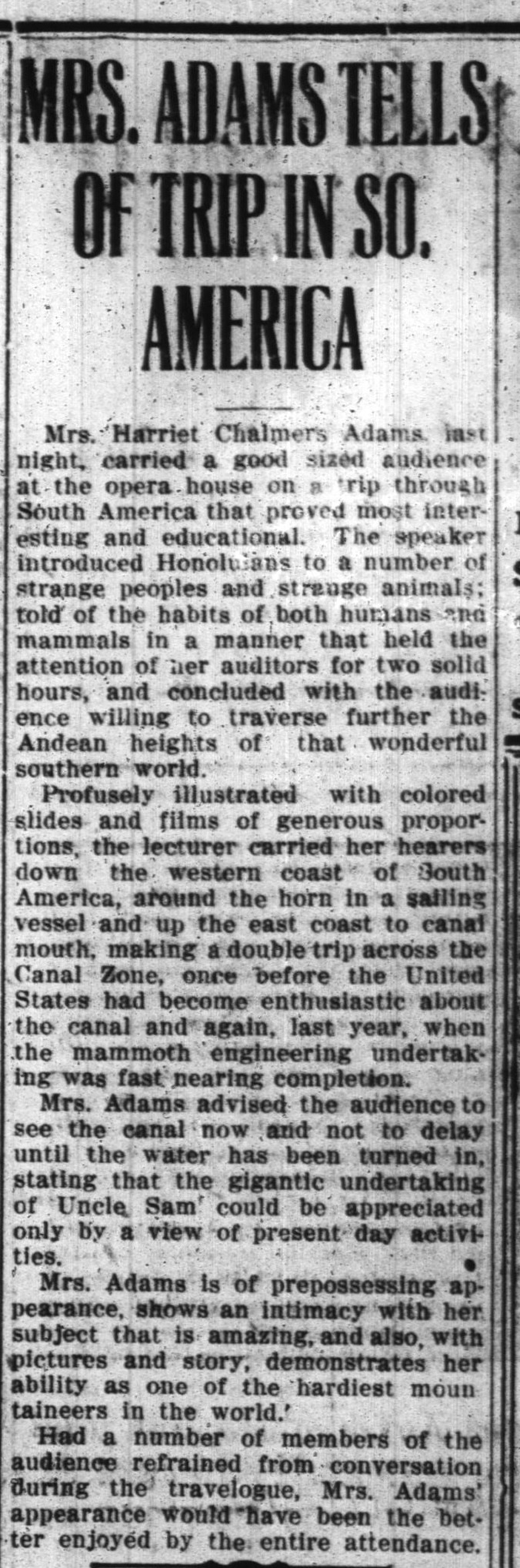
“Mrs. Adams Tells of Trip in So. America.” Honolulu Star-Bulletin, June 18, 1913, page 5. Library of Congress, Chronicling America. Click the clipping to read it full size.
She found them
The picture at the top of this story is Harriet Chalmers Adams in 1912, the year before her Honolulu talk, grinning beside a llama at a zoo. It’s a little cousin of the camel, just like the ones in that big geography book. Somewhere a reader once turned a page, saw a llama on a mountain trail, and wanted to go see it. She went. Then she came home and showed everybody else.
Sources
- Honolulu Star-Bulletin (Honolulu, Hawaii): May 5, 1913, page 5 (“Woman Will Tell of Travels on Globe”); June 12, 1913, page 5 (“‘See America First’ Is Advice of Mrs. Adams,” and the Royal Hawaiian Opera House ad); June 18, 1913, page 5 (“Mrs. Adams Tells of Trip in So. America”).
- The Washington Herald (Washington, D.C.): April 5, 1913, page 4 (“Trip Through Andes”).
- All newspaper images: Library of Congress, Chronicling America. Published 1913.
- Harris & Ewing, “Adams, Mrs. Franklin, nee Harriet Chalmers. At zoo with llama,” 1912, Library of Congress, Harris & Ewing Collection, no known restrictions on publication.
- National Photo Company, “Harriet Chalmers Adams,” between 1908 and 1919, Library of Congress, no known restrictions on publication.