On Monday morning, November 9, 1908, the people of Phoenix, Arizona, kept one eye on the sky. The big territorial fair opened that day, and for two months the fair had promised them an airship. Not a balloon. A real flying machine, with a motor and a propeller, that a man could steer. Plenty of people did not believe it. The Arizona Republican said many visitors figured the airship was “merely an advertised special, to be viewed in a tent, possibly filled with air instead of gas.”
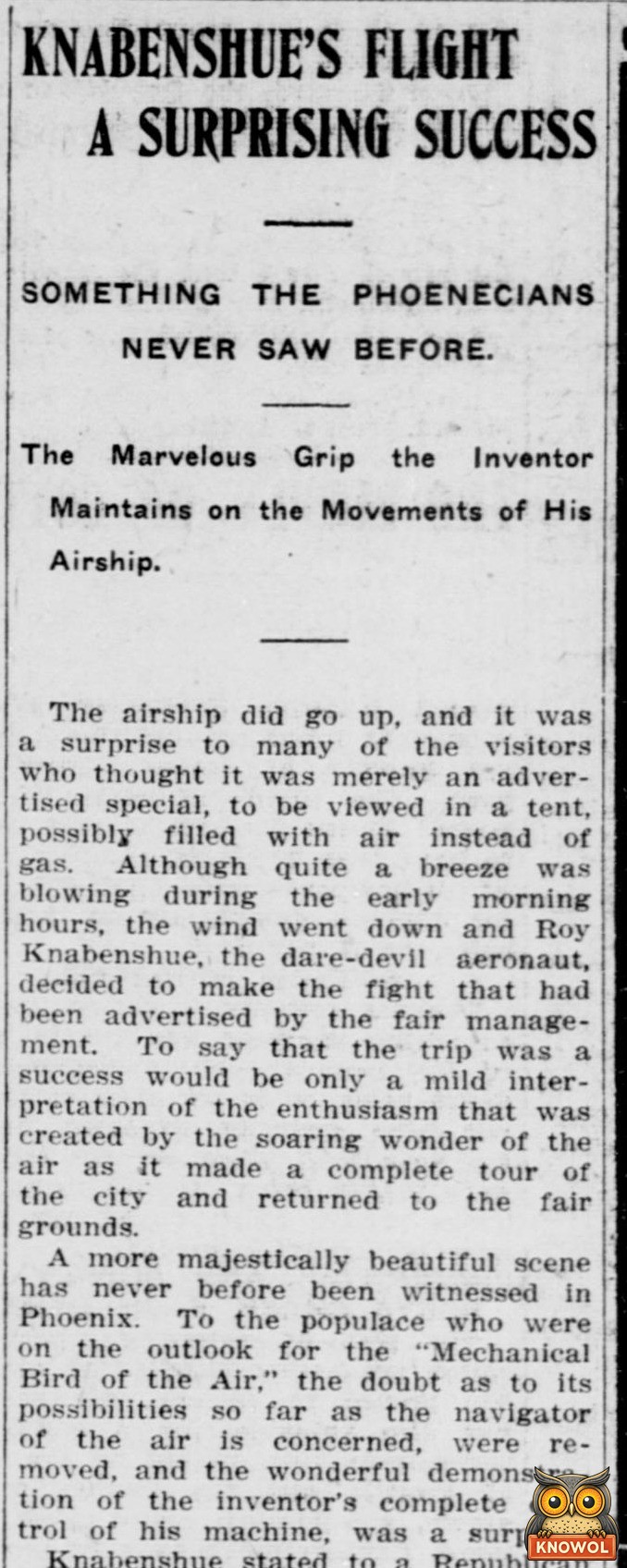
“Knabenshue’s Flight a Surprising Success. Something the Phoenecians Never Saw Before.” The Arizona Republican, Phoenix, Arizona, November 10, 1908, page 15. Library of Congress, Chronicling America. Click the clipping to read it full size.
Then, late in the morning, somebody downtown looked up. The Tombstone Epitaph told what happened next. “The first word that Knabenshue was on his way to the city came when the shout was taken up from throat to throat, ‘There’s the airship!'” People ran for the doors. “From every building poured out a stream of excited humanity, many of whom were to witness for the first time in their lives the successful navigation of the air.”
A real airship, not a balloon
Arizona was not a state yet in 1908. It was a territory, and Phoenix was its capital, a town of dirt streets, brick storefronts and streetcar tracks. Every November the territory held a fair there, with horse races, cattle, fruit and a grandstand. For the fourth fair, the commissioners wanted something nobody in the Southwest had seen. In September, The Oasis of Nogales printed their promise in capital letters: “And it will be a REAL AIR SHIP; not a balloon, but a flying machine which will accommodate several passengers.”
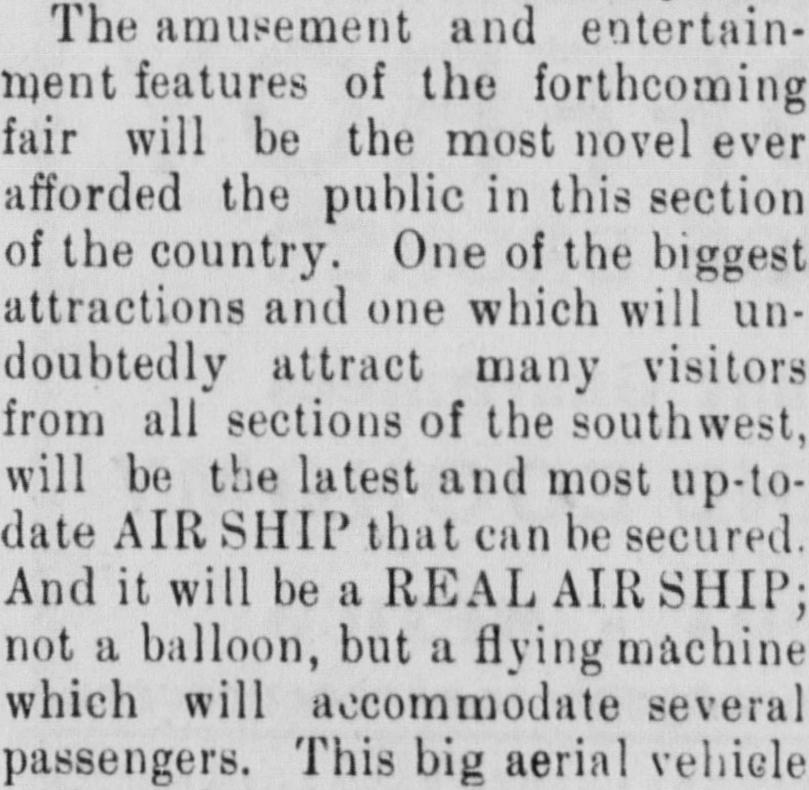
“Arizona Territorial Fair.” The Oasis, Nogales, Arizona, September 12, 1908, page 12. Library of Congress, Chronicling America. Click the clipping to read it full size.
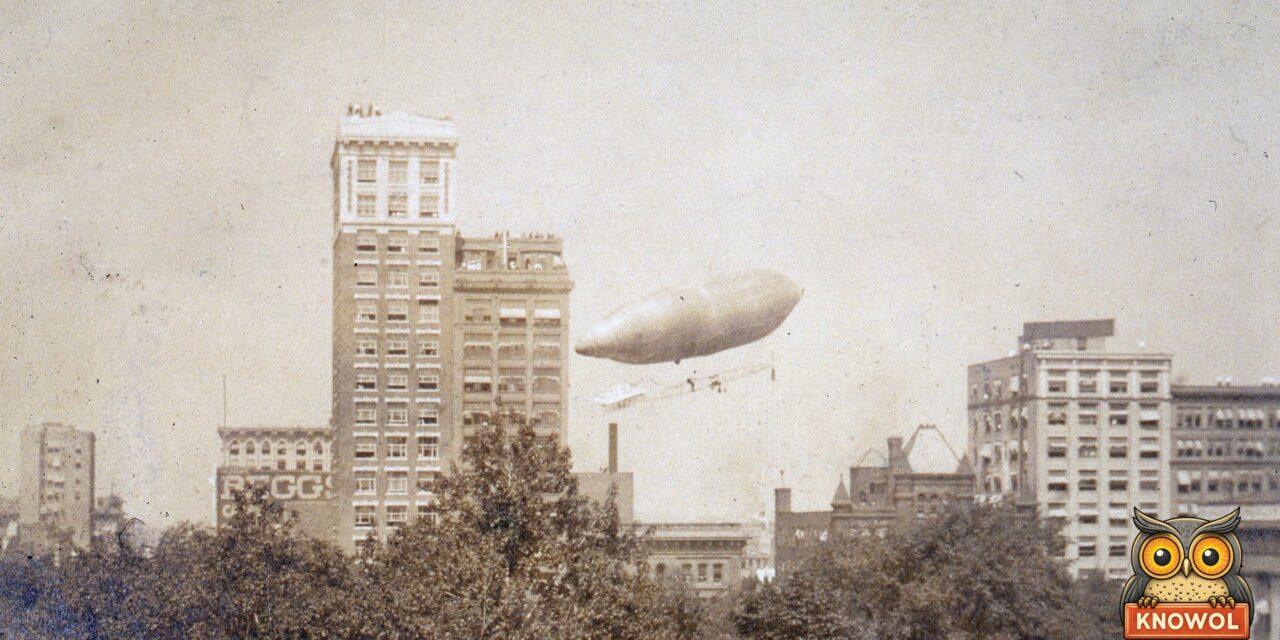
The man they hired was Roy Knabenshue of Toledo, Ohio. He had been flying airships at fairs since the St. Louis World’s Fair of 1904, and the picture at the top of this story shows one of them, his Toledo II, over downtown Columbus, Ohio, in 1906. Arizona’s papers had been talking him up all fall.
His new ship was a big one. The gas bag was 112 feet long, longer than a basketball court, and 17 and a half feet across. It held 20,000 cubic feet of gas and could lift 1,000 pounds. Knabenshue made the gas himself at the fairgrounds, from iron and acid, in his own tanks. Filling the bag cost $360 to $400, and every time the ship moved to a new town the gas had to be let out and made all over again. The Republican said the whole machine had cost him “about $11,000 in actual cash.”
How a man steered a gas bag
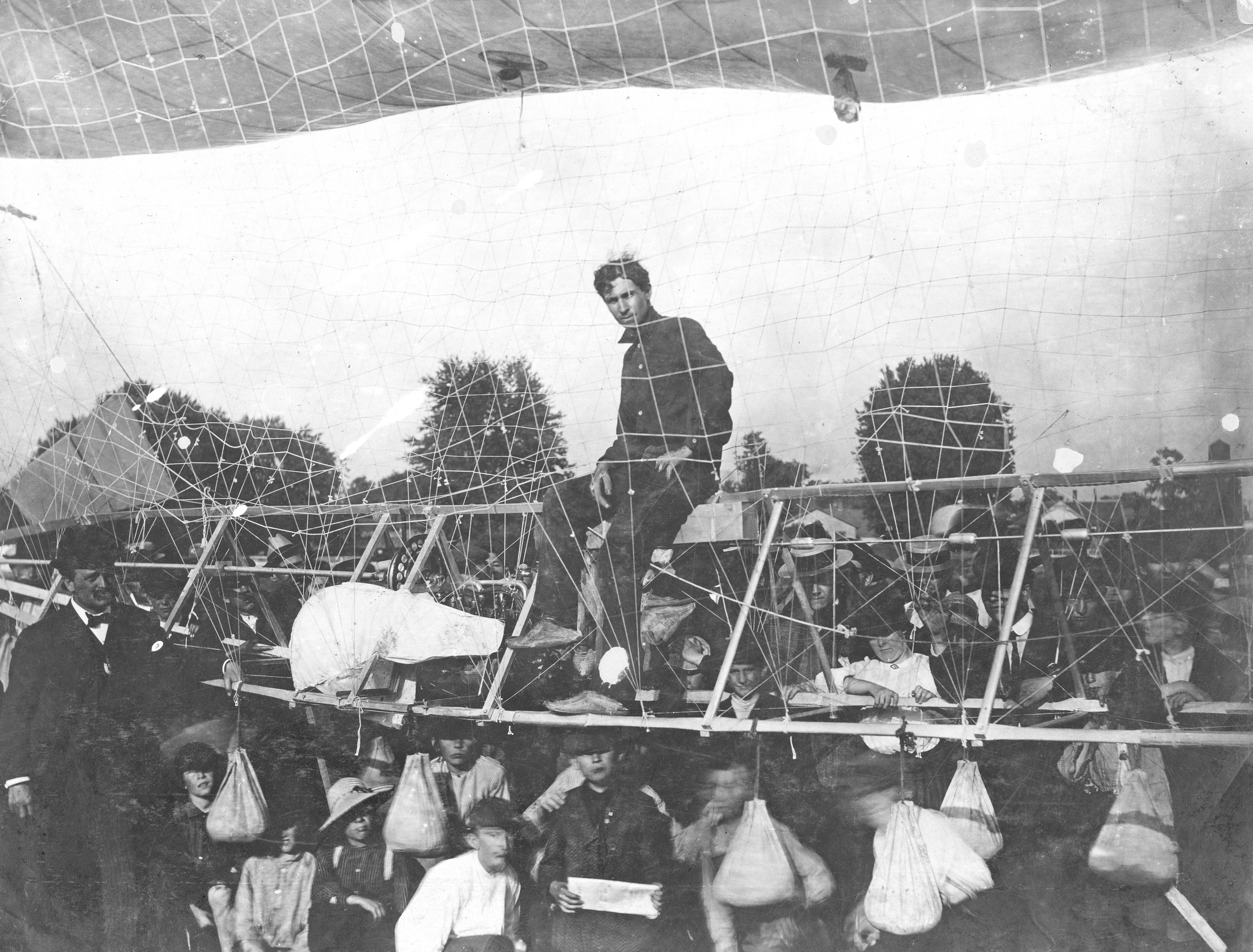
Roy Knabenshue on the frame of his airship, with a crowd around him, about 1910. National Air and Space Museum, Smithsonian Institution, by way of Wikimedia Commons. Click the picture to see it full size.
Here is how it worked. Under the gas bag hung a long, skinny frame of spruce rods, tied up to the bag with a net of cords. The motor and propeller sat on the frame. So did the pilot, with no seat and no floor. To point the nose up or down, Knabenshue walked. The Republican asked its readers to “imagine a man walking backwards and forwards from one end of this frail frame to the other, no platform to walk upon, only the frame work.” If his weight went forward, the nose dipped. If he walked back, the nose rose. The paper added one more thing to picture: “there is no net to catch the unfortunate performer who might miss his hold and fall.”
Knabenshue knew all about that. He told the paper about a flight back home when a gale caught him 1,500 feet up. “You have often seen a kite in the air, when the wind was strong and the tail of the kite too light. Well that’s just how the ship acted. It shot first up and then down and actually turned a complete somersault in one of its evolutions. I don’t know how I managed to hang on but I did and finally made a successful landing.”
He was less sure of himself on the ground. Two weeks before the fair, a Los Angeles judge called him in for speeding in an automobile. He explained that he was still learning to drive. Flying he understood, he said, “but I am all at sea on land.” The Republican ran the story under the headline “KNABENSHUE PINCHED.”
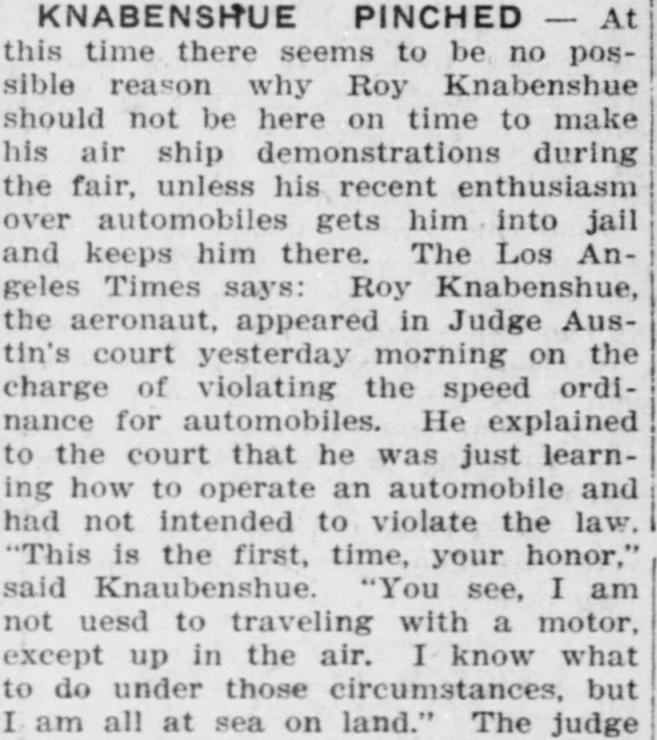
“Knabenshue Pinched.” The Arizona Republican, Phoenix, Arizona, October 25, 1908, page 16. Library of Congress, Chronicling America. Click the clipping to read it full size.
There’s the airship!
The plan for opening day was small: up from the fairgrounds, a turn around the capitol dome, and back. The Republican even warned people not to panic. Whatever came sailing up town through the air, it wrote, “will not be a messenger from Mars nor a supernatural being from the land of Nowhere, but only Roy Knabenshue and his air ship taking a little spin down town.”
A breeze blew early Monday, then died. Knabenshue and his engineer, George Duesler, climbed onto the frame and rose. Up high, Knabenshue found the air smoother than he expected, so he skipped the capitol and headed straight for downtown. The Epitaph said the whole trip, “close to five miles,” took fifteen minutes, and that “it was the first flight ever made by an airship in Arizona.” The downtown streets “were packed with hundreds of shouting and wildly enthusiastic citizens and visitors.” The Republican called it “a sight that is only witnessed once in a lifetime.”
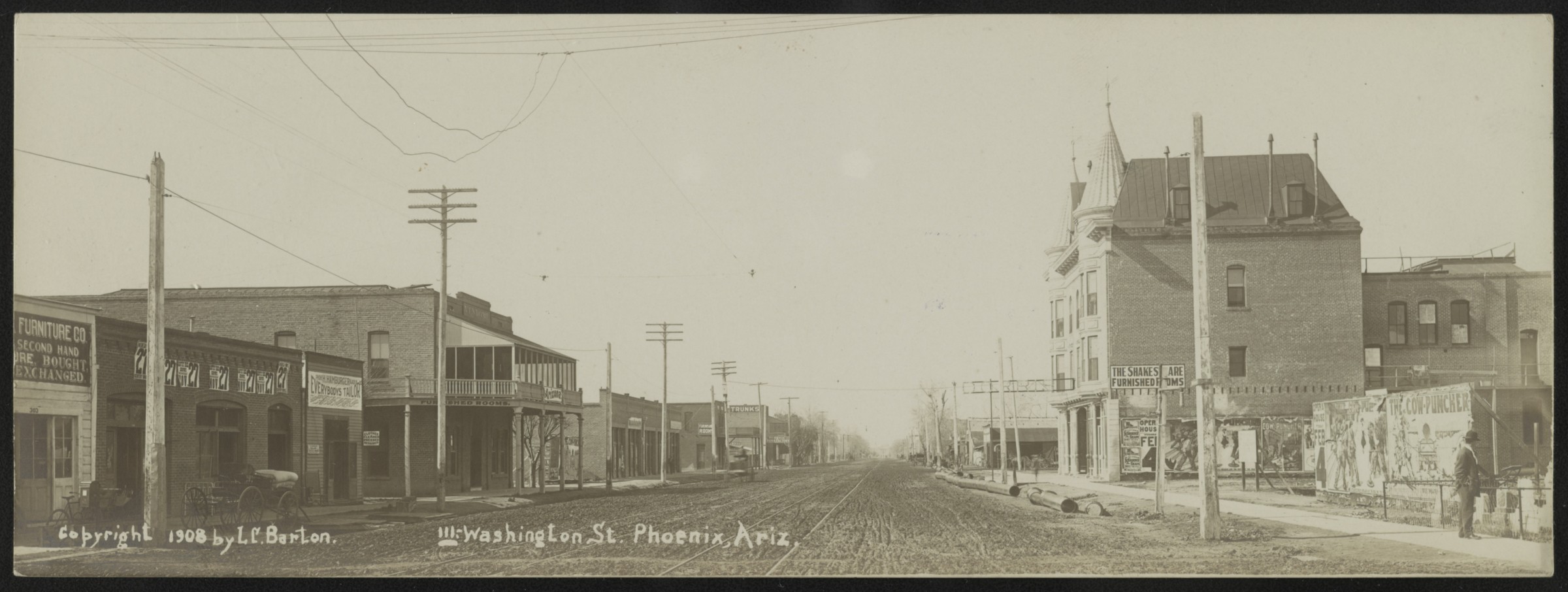
Washington Street in Phoenix, Arizona, in 1908, the year of the flight. Photograph by Lester Clement Barton. Library of Congress, Prints and Photographs Division. Click the picture to see it full size.
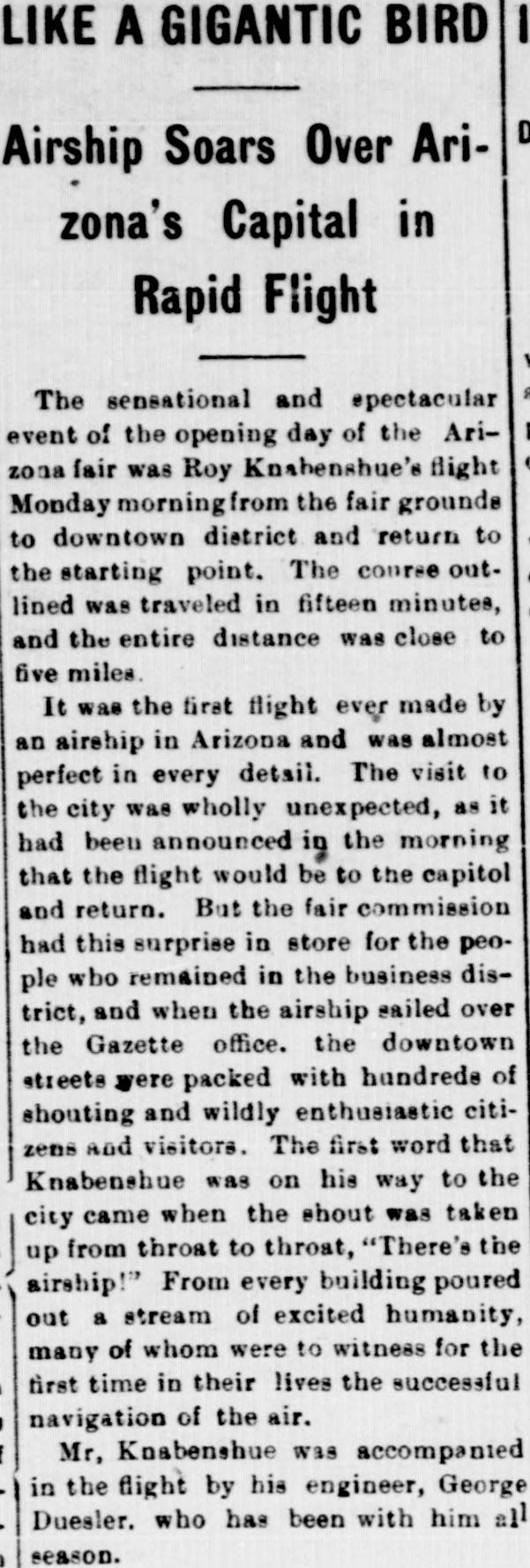
“Like a Gigantic Bird.” Tombstone Epitaph, Tombstone, Arizona, November 15, 1908, page 2. Library of Congress, Chronicling America. Click the clipping to read it full size.
Every day that week
Knabenshue flew nearly every day of the fair. On Tuesday afternoon he rose “fully 2,000 feet above the earth” and sailed over the grounds “as smoothly as a boat cutting the water.” On Wednesday, automobile day, 12,000 people packed the grandstand, and the airship circled over the race cars “till the fair grounds looked like an enormous three ring circus.” Inside the exhibit hall, a Los Angeles company was showing off a new electric car horn that sounded, the paper said, “like a thousand burros with severe colds braying at once.” When the airship came out, the horn stayed quiet, “for fear the noise would cave in the sides of the baloon.”
On Thursday the ship carried its first Phoenix passenger. L. H. Landis, the freight agent for the Maricopa and Phoenix railroad, climbed on with an armload of railroad pamphlets he meant to drop on the crowd. Knabenshue kept the ship low that trip, not much “higher than a box car.” The Republican explained why: “Freight agents can be secured almost anywhere, but successful airship men are quite rare.” Landis never dropped a single pamphlet. He had only two hands, he said, and both were busy holding on. When Knabenshue asked how he felt, he answered, “I’m all up in the air.” Back on the ground he wobbled, and said that was only because he “had my air-legs on.” Asked if he would go up again, he said no. “The earth is good enough for me.”
“Landis Tells of Hair Raising Balloon Trip.” Bisbee Daily Review, Bisbee, Arizona, November 17, 1908, page 3, reprinting the Phoenix Gazette. Library of Congress, Chronicling America. Click the picture to see it full size.
Hopen to own an airship
By the end of the week, all of Arizona was talking about the ship. A theater man in Tucson, Arizona, sent word asking Knabenshue to fly the 130 miles over the mountains to his town, with a local guide named John Beck riding along, a man “who knows this country as well as the birds that fly over it.” No Arizona paper we found ever reported that flight. Out in the farm country near Liberty, people came home from the fair “wishing for a like conveyance to transport hay and alfalfa seed to market.” Up in Flagstaff, the school notes in the Coconino Sun reported that two sisters named Hopen had come back from Phoenix “Hopen” to own an airship. A writer in the Williams News admitted that “the airship which we had expected would be a failure, was not only a success, but a marvel,” and predicted that “the day is not far distant when airships will be as common as automobiles are today.”
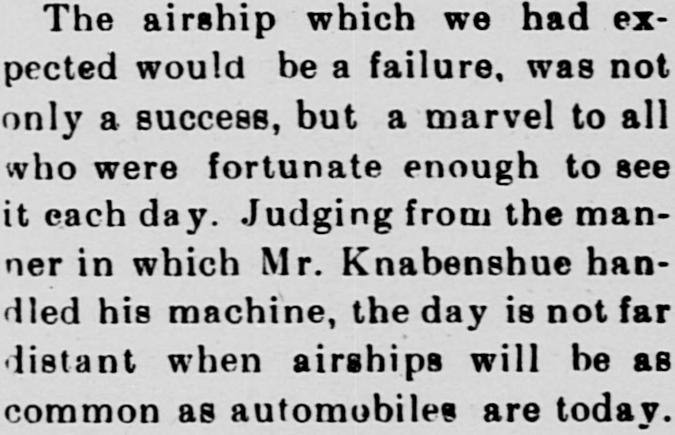
“The Territorial Fair.” The Williams News, Williams, Arizona, November 21, 1908, page 4. Library of Congress, Chronicling America. Click the clipping to read it full size.
It did not work out that way. Airplanes won. But Knabenshue kept his airship a while longer. That Christmas, back in Los Angeles, he flew it over the Y.M.C.A. so hundreds of children at a holiday dinner could watch it pass, with George Duesler riding the frame dressed as Santa Claus. The ship came so close to the roof, the San Francisco Call said, that the two men could see the leftovers of dinner on the tables. For one week in November 1908, though, the sky over Phoenix belonged to one man walking back and forth on a wooden frame, and a whole town that ran outside to watch him.
Sources
- “Knabenshue’s Flight a Surprising Success.” The Arizona Republican, Phoenix, Arizona, November 10, 1908, page 15. Library of Congress, Chronicling America.
- “Like a Gigantic Bird. Airship Soars Over Arizona’s Capital in Rapid Flight.” Tombstone Epitaph, Tombstone, Arizona, November 15, 1908, page 2. Library of Congress, Chronicling America.
- “Arizona Territorial Fair.” The Oasis, Nogales, Arizona, September 12, 1908, page 12. Library of Congress, Chronicling America.
- “A Representative of the Toledo Aviator.” The Arizona Republican, September 30, 1908, page 5. Library of Congress, Chronicling America.
- “Knabenshue Pinched.” The Arizona Republican, October 25, 1908, page 16. Library of Congress, Chronicling America.
- “Knabenshue Has Arrived.” The Arizona Republican, October 29, 1908, page 9. Library of Congress, Chronicling America.
- “Airship Evolutions Big Fair Attraction.” The Arizona Republican, November 7, 1908, page 8. Library of Congress, Chronicling America.
- “The Air Ship.” The Arizona Republican, November 8, 1908, page 1, and November 9, 1908, page 1. Library of Congress, Chronicling America.
- “The Airship” and the Klaxon horn item. The Arizona Republican, November 11, 1908, page 3 and page 1. Library of Congress, Chronicling America.
- “Automobile Day Hits the Grandstand Hard.” The Arizona Republican, November 12, 1908, page 1. Library of Congress, Chronicling America.
- “Landis Up in the Air.” The Arizona Republican, November 13, 1908, page 1. Library of Congress, Chronicling America.
- “Landis Tells of Hair Raising Balloon Trip” (from the Phoenix Gazette). Bisbee Daily Review, Bisbee, Arizona, November 17, 1908, page 3. Library of Congress, Chronicling America.
- “Wants Balloon in Tucson.” Bisbee Daily Review, November 12, 1908, page 8. Library of Congress, Chronicling America.
- Liberty news. The Arizona Republican, November 14, 1908, page 19. Library of Congress, Chronicling America.
- “The Territorial Fair.” The Williams News, Williams, Arizona, November 21, 1908, page 4. Library of Congress, Chronicling America.
- “Normal Notes.” The Coconino Sun, Flagstaff, Arizona, November 27, 1908, page 5. Library of Congress, Chronicling America.
- “Knabenshue Has Santa Claus Ride in Airship.” The San Francisco Call, December 26, 1908, page 5. Library of Congress, Chronicling America.
- Cover: Roy Knabenshue piloting his airship Toledo II over downtown Columbus, Ohio, September 7, 1906. Columbus Metropolitan Library, by way of Wikimedia Commons. Public domain.
- Photograph: Roy Knabenshue on his airship with a crowd on the ground, about 1910. National Air and Space Museum, Smithsonian Institution, by way of Wikimedia Commons. Public domain.
- Photograph: “Washington St., Phoenix, Ariz.,” by Lester Clement Barton, 1908. Library of Congress, Prints and Photographs Division. No known restrictions on publication.
- Newspaper clippings printed in 1908 are in the public domain.