On Saturday, October 8, 1927, the fishing schooner Marjorie Parker was heading home. She was sailing up the South Channel into the harbor at Boston, Massachusetts. One of her fishermen hauled in his trawl line to see what he had caught. One haddock on that line was not like the others. It had three eyes.
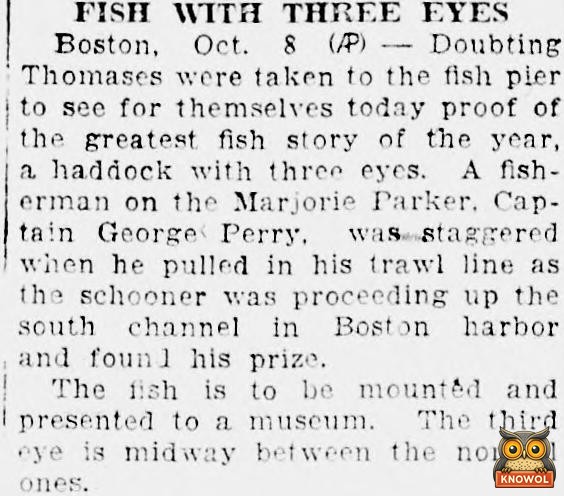
“Fish With Three Eyes.” New Britain Herald, New Britain, Connecticut, October 8, 1927, page 13. Library of Congress, Chronicling America. Click the clipping to read it full size.
One eye too many
The Associated Press sent the story out by wire that same day, and papers all over the country printed it. The fisherman “was staggered when he pulled in his trawl line,” the story said, “and found his prize.” Staggered means he could hardly believe his eyes. The fish could hardly believe its own, either. “The third eye is midway between the normal ones,” the story explained. So the extra eye sat right at the middle of its head, halfway between the usual two.
A trawl line is not a net. It is a long fishing line with hundreds of shorter lines tied along it, and each short line ends in a baited hook. Fishermen set it along the sea floor from small rowboats called dories, let it fish for a while, then haul it back in, hook by hook. Haddock feed near the bottom, so the trawl line was how Boston boats caught them.
The papers named one man, Captain George Perry of the Marjorie Parker. A Kentucky paper said flat out that Captain Perry caught the fish himself. The wire story was less clear about who pulled up the line. Nobody wrote down a first name for the fisherman, so the captain’s name is the one that lasted.
Come and see for yourself
The wire story opened with a joke. “Doubting Thomases were taken to the fish pier to see for themselves today proof of the greatest local fish story of the year, a haddock with three eyes,” it began. A Doubting Thomas is a person who will not believe a thing until they see it with their own eyes. A fish story is a tall tale about fishing, the kind where the fish gets bigger every time it is told. This time the fish was real, and it was lying right there on the pier for anyone to look at.
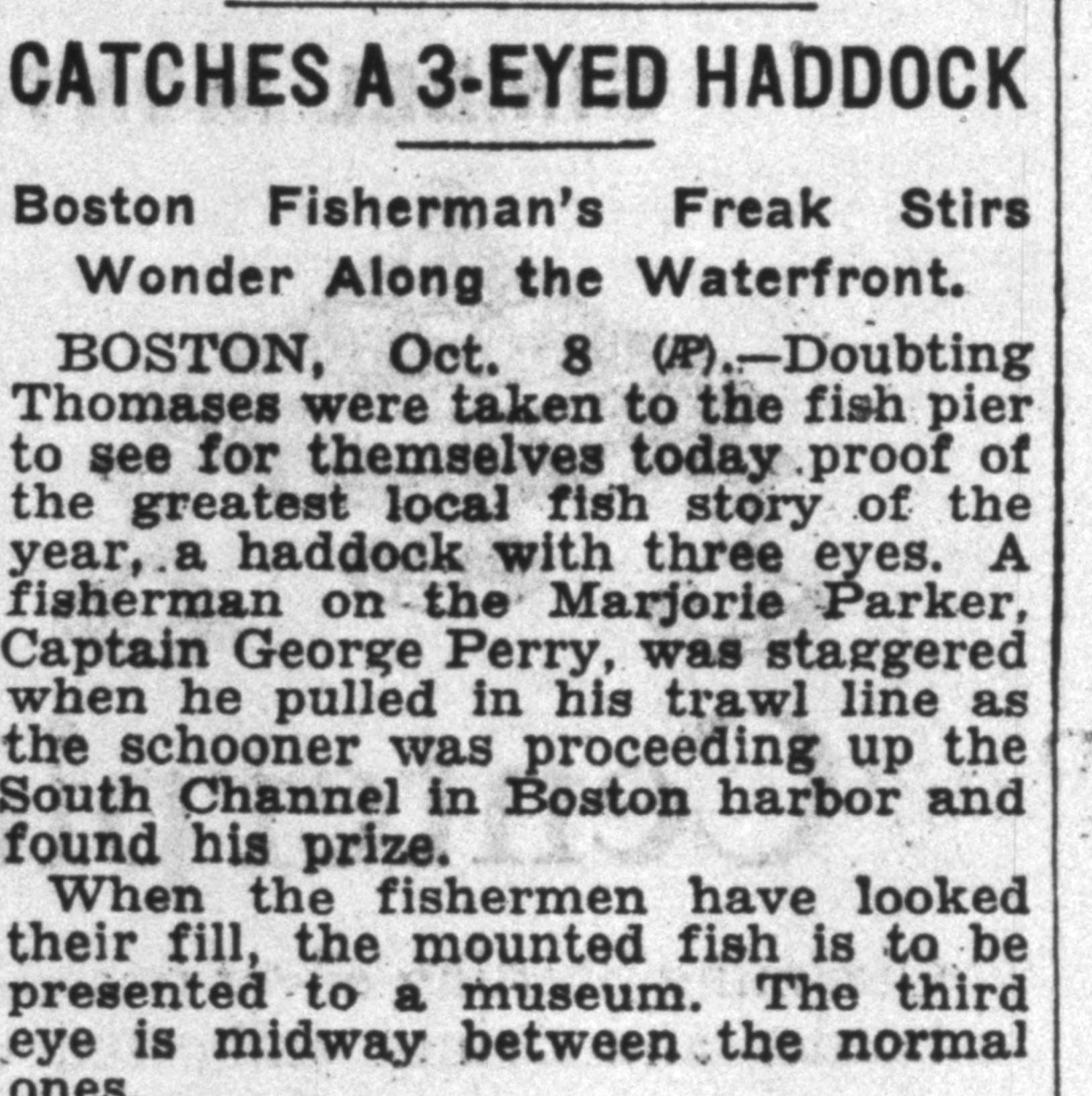
“Catches a 3-Eyed Haddock.” The New York Times, New York, New York, October 9, 1927. Page scan from the Internet Archive. Published 1927, public domain. Click the picture to see it full size.
The fish pier was the Boston Fish Pier, where the city’s fishing fleet tied up and sold its catch. It was a big place. In 1915 the New York Sun said the pier was 1,200 feet long and 300 feet wide, longer than three football fields laid end to end. It was “completed in 1913 at an expense of $1,000,000,” and the fish companies had put up “$2,000,000 worth of buildings” on top of it. The Sun called Boston “the biggest fishing port in this hemisphere.” The catch brought into Boston each year weighed “over 166,000,000 pounds.”
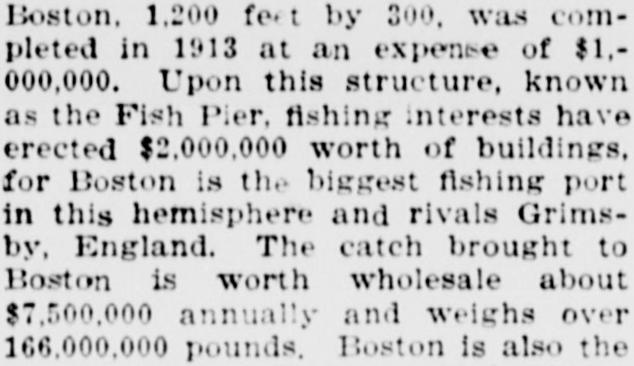
The Fish Pier by the numbers. The Sun, New York, New York, April 18, 1915, page 44. Library of Congress, Chronicling America. Click the clipping to read it full size.
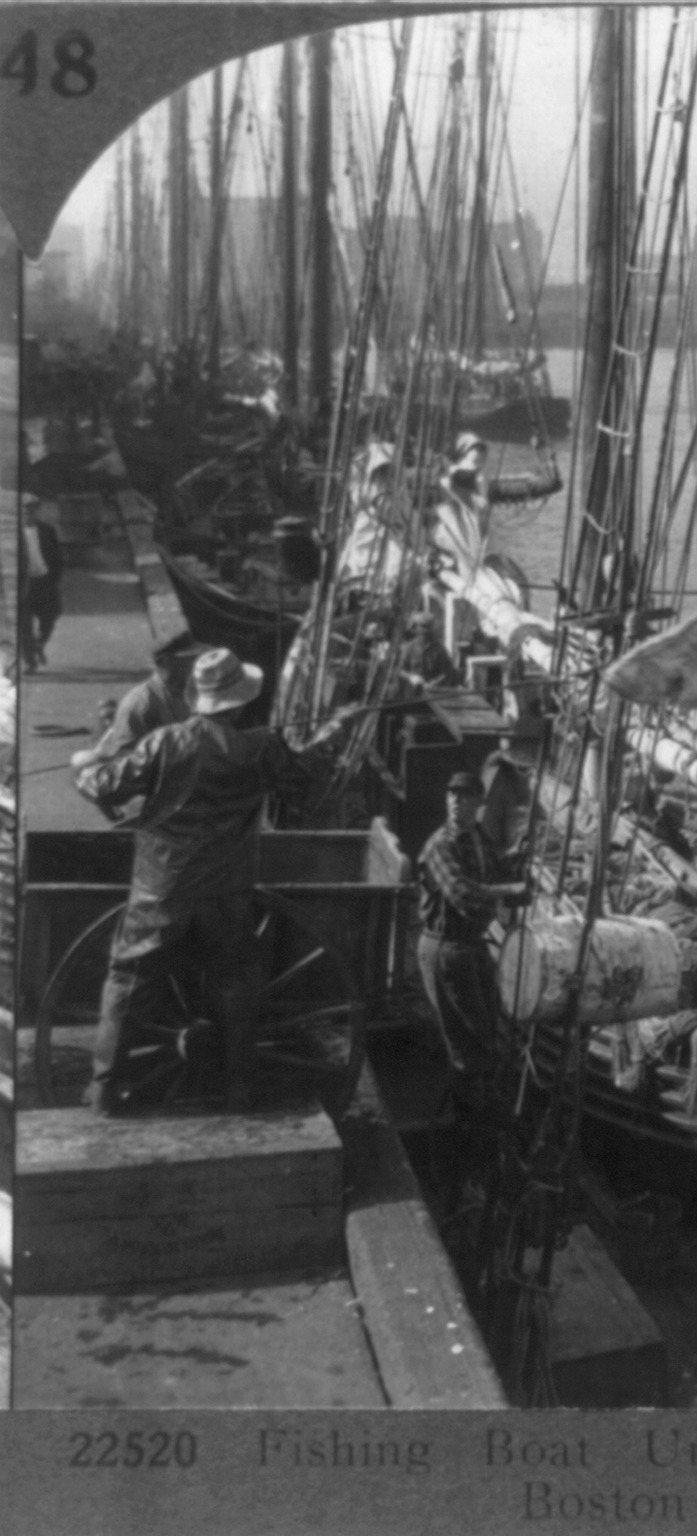
Fishing boats unloading at the Boston Fish Pier in 1928, one year after the three-eyed haddock came in. One half of a Keystone View Co. stereograph card. Library of Congress, Prints and Photographs Division. Click the clipping to read it full size.
Headed for a museum
The fish was not going to be anybody’s dinner. “When the fishermen have looked their fill, the mounted fish is to be presented to a museum,” the wire story said. A mounted fish is one that has been stuffed and fixed to a board, the way some people hang a trophy fish on the wall. The fishermen got the first look. A museum was supposed to get the fish for keeps.
That is where the trail ends. We searched the papers for a follow-up and found none. No paper we could find ever said which museum took the three-eyed haddock, or whether it got there at all. If it still sits in a drawer somewhere in Boston, nobody has written it down.
The fish that traveled
The haddock itself stayed in Boston, but its story kept going. The New Britain Herald in Connecticut printed it the day of the catch. The New York Times ran it the next morning, under the headline “Catches a 3-Eyed Haddock.” On October 20 the Anderson News in Lawrenceburg, Kentucky, told its readers the fishermen were looking “their fill at the queer specimen.” Queer meant odd or strange in 1927, and a specimen is a sample kept for study.
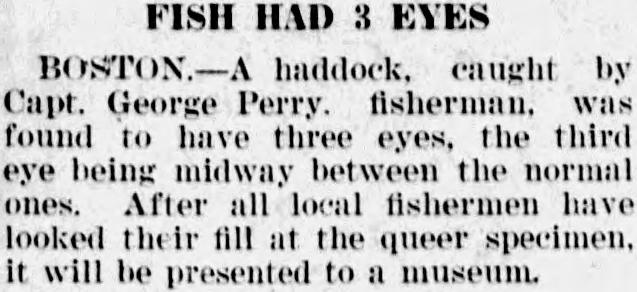
“Fish Had 3 Eyes.” The Anderson News, Lawrenceburg, Kentucky, October 20, 1927, page 3. Library of Congress, Chronicling America. Click the clipping to read it full size.
On October 28, three weeks after the catch, the Mahnomen Pioneer in northern Minnesota ran it with the best headline of all: “Three-Eyed Haddock Amazes Down-Easters.” Down-Easters was the paper’s word for people on the New England coast. Its typesetter also slipped. He turned the fish pier into a “fish pile,” which is a fine place to find a haddock too.
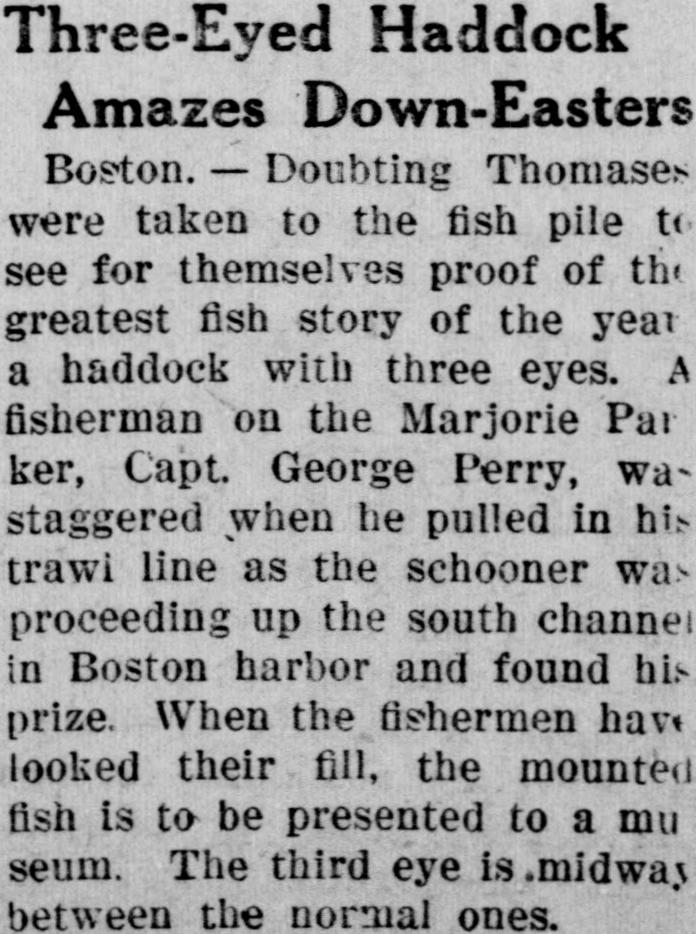
“Three-Eyed Haddock Amazes Down-Easters.” The Mahnomen Pioneer, Mahnomen, Minnesota, October 28, 1927, page 2. Library of Congress, Chronicling America. Click the clipping to read it full size.
What a haddock cost
Haddock was everyday food in New England in 1927, and it was cheap. The same month the three-eyed fish came in, the Putnam Public Market in Putnam, Connecticut, ran this ad: “HADDOCK, Special, lb 6½c For Friday and Saturday.” Six and a half cents bought a whole pound. The one with three eyes, of course, was not for sale at any price.
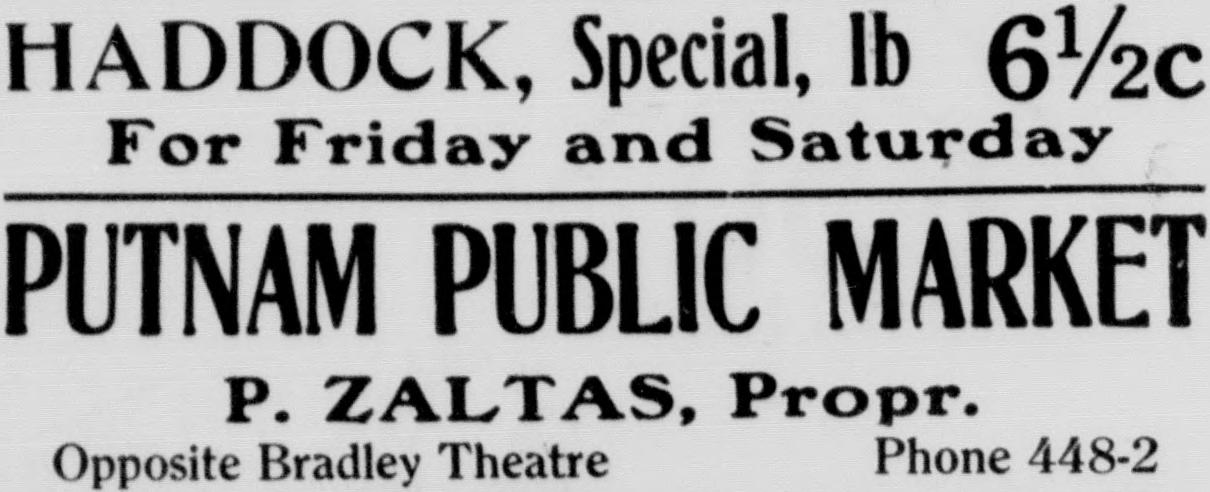
Haddock at 6½ cents a pound. Windham County Observer, Putnam, Connecticut, October 19, 1927, page 4. Library of Congress, Chronicling America. Click the picture to see it full size.
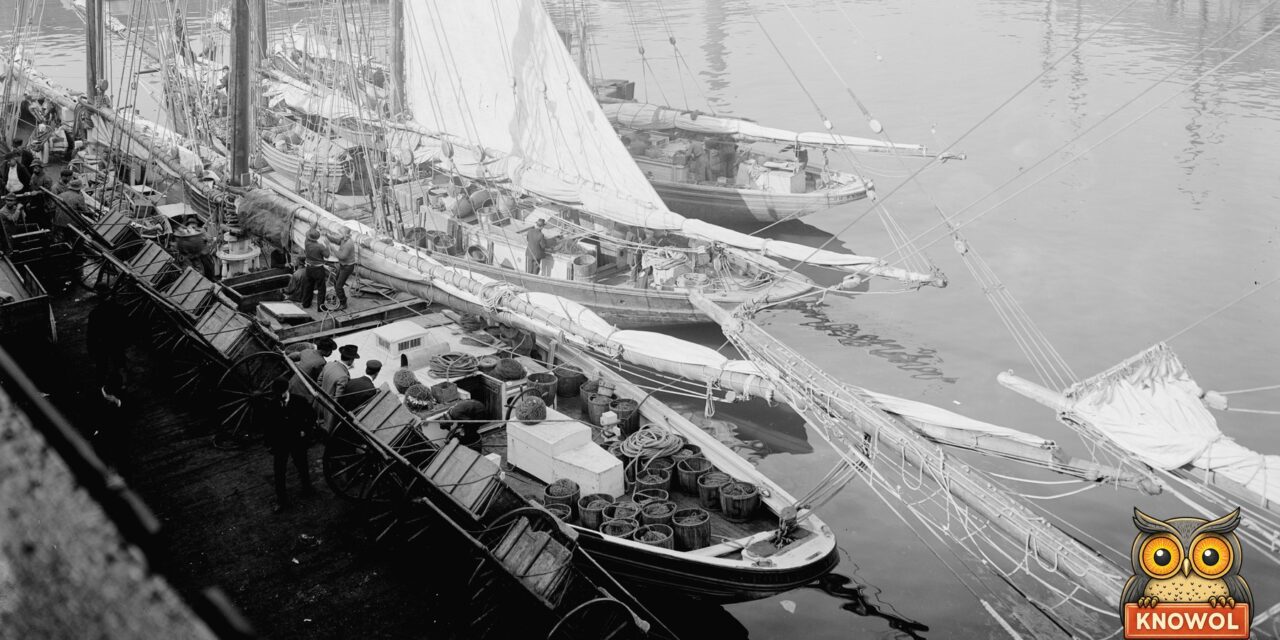
The cover of this story shows fishing schooners unloading at T Wharf in Boston sometime between 1900 and 1910. That was where the fleet tied up before the Fish Pier was finished in 1913. The picture below shows the same wharf around 1904, with the New England Fish Company’s sign over the door.
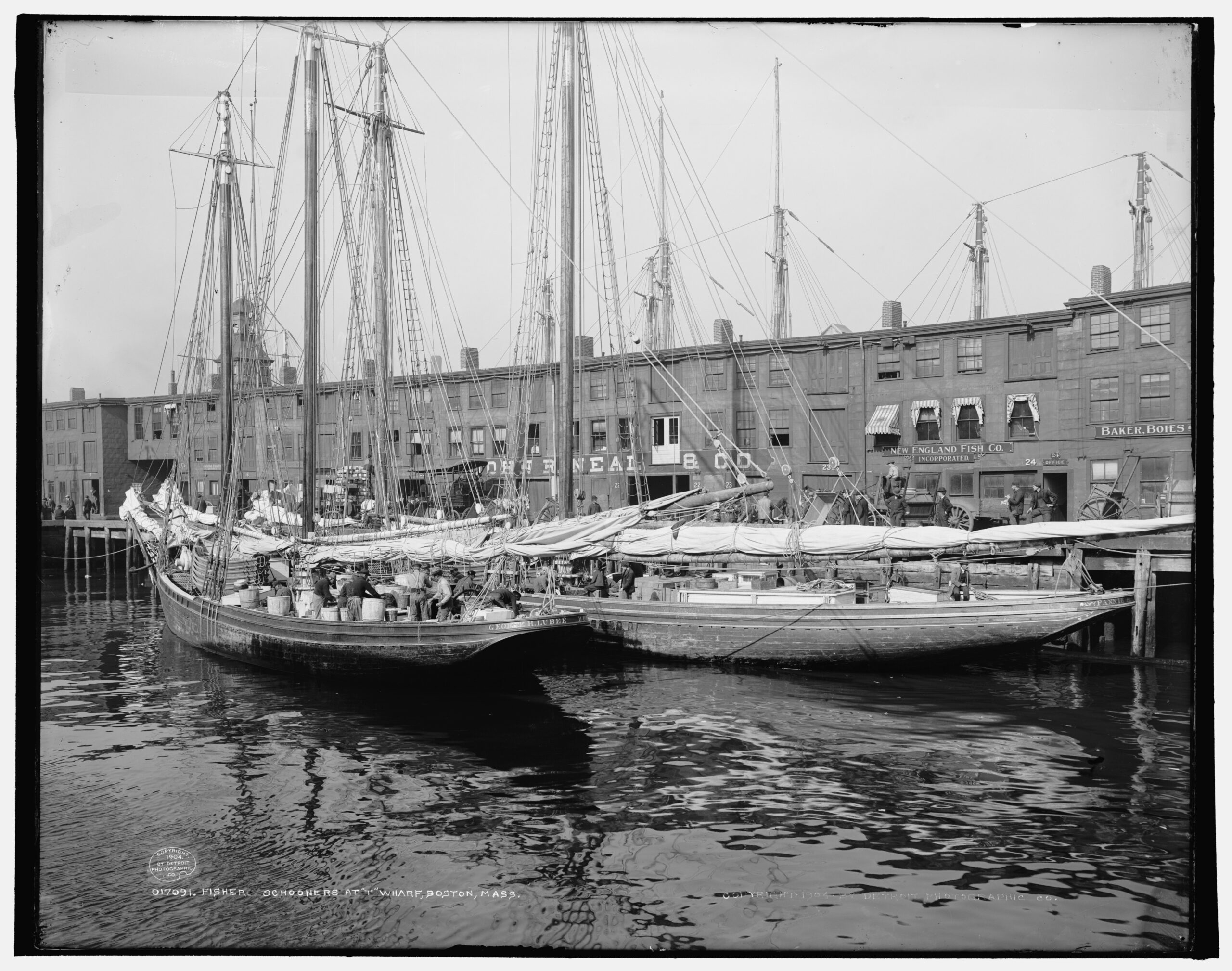
Fisher schooners at “T” Wharf, Boston, Mass., about 1904. Detroit Publishing Co. Library of Congress, Prints and Photographs Division. Click the picture to see it full size.
For one week in October 1927, the most famous fish in Boston was a haddock with one eye too many. It never got the chance to be dinner. It got a crowd on the pier, a headline in New York, and the promise of a museum. Not bad for a fish that was only trying to eat the bait.
Sources
- New Britain Herald (New Britain, Connecticut): October 8, 1927, page 13 (“Fish With Three Eyes,” Associated Press).
- The New York Times (New York, New York): October 9, 1927 (“Catches a 3-Eyed Haddock,” Associated Press), page scan from the Internet Archive.
- The Anderson News (Lawrenceburg, Kentucky): October 20, 1927, page 3 (“Fish Had 3 Eyes”).
- The Mahnomen Pioneer (Mahnomen, Minnesota): October 28, 1927, page 2 (“Three-Eyed Haddock Amazes Down-Easters”).
- The Sun (New York, New York): April 18, 1915, page 44 (the Boston Fish Pier by the numbers).
- Windham County Observer (Putnam, Connecticut): October 19, 1927, page 4 (Putnam Public Market ad).
- Keystone View Co., “Fishing Boat Unloading Halibut at Dock, Boston Fish Pier, Mass.,” stereograph, 1928, Library of Congress. Published 1928, public domain.
- Detroit Publishing Co., “Fisher schooners at ‘T’ wharf, Boston, Mass.,” about 1904, Library of Congress, no known restrictions.
- Cover: Detroit Publishing Co., “Unloading fish at ‘T’ wharf, Boston, Mass.,” between 1900 and 1910, Library of Congress, no known restrictions. It shows T Wharf, not the Fish Pier.
- Newspaper clippings: Library of Congress, Chronicling America, and the Internet Archive. All published before 1931.