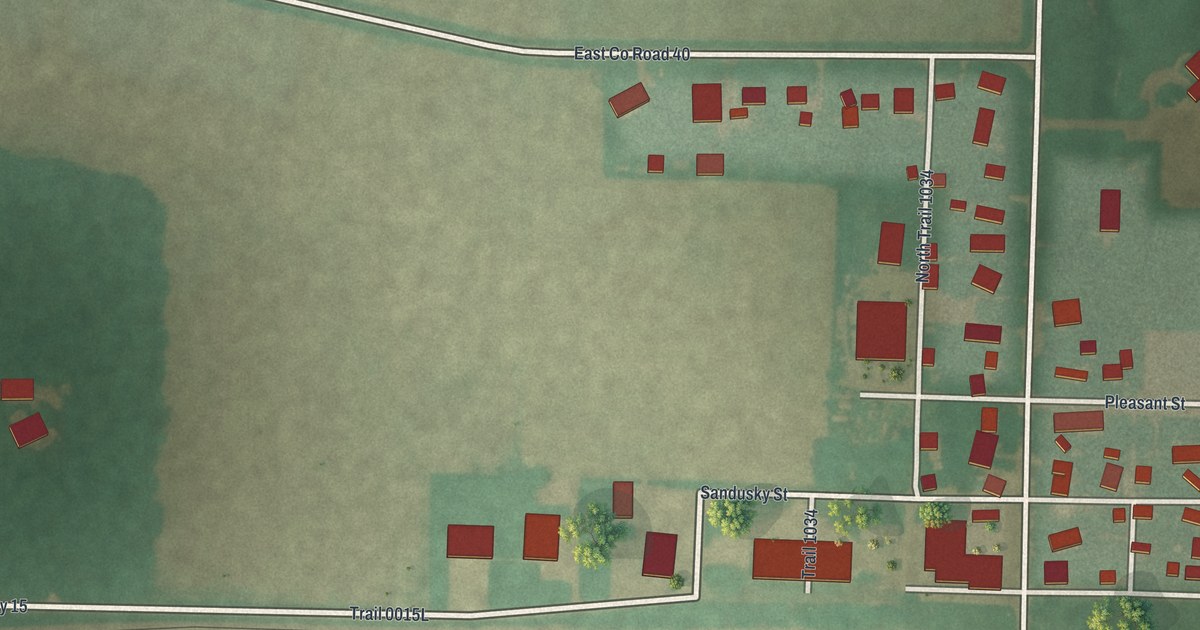
Before daylight on Tuesday, November 19, 1867, a boy let himself into Beery’s Block in Upper Sandusky, Ohio. He was the apprentice at the Wyandot Pioneer, the town’s weekly newspaper, and the office was up on the third floor. His first job every morning was to get the stove going before the men came in. “Early on Tuesday morning, as usual, our apprentice went to the office to make fire,” the paper reported that Thursday. He got as far as the bottom of the stairs.
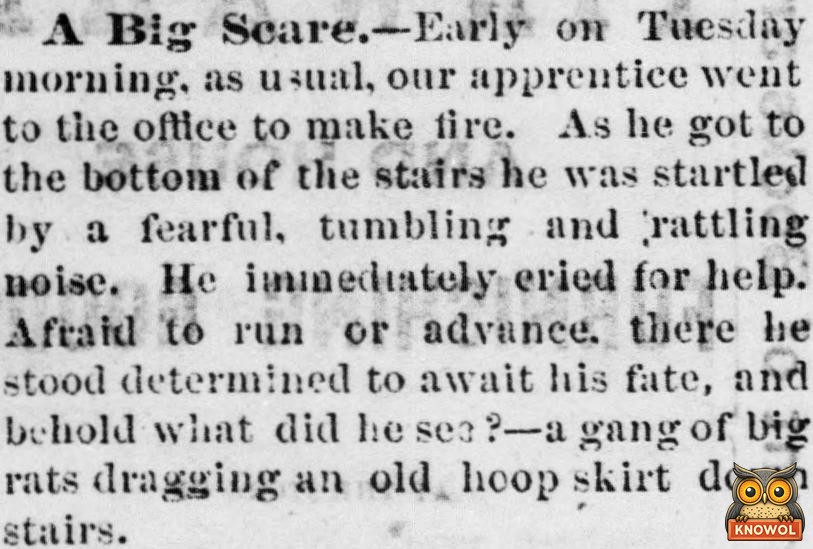
“A Big Scare.” The Wyandot Pioneer, Upper Sandusky, Ohio, November 21, 1867, page 3. Library of Congress, Chronicling America. Click the clipping to read it full size.
Something was coming down
“As he got to the bottom of the stairs he was startled by a fearful, tumbling and rattling noise,” the Pioneer said. Something was bumping down the steps toward him in the dark. “He immediately cried for help.” Then he made his stand. “Afraid to run or advance, there he stood determined to await his fate.” The thing came into view at last. It was “a gang of big rats dragging an old hoop skirt down stairs.”
That is the whole story, as the Pioneer told it. The editor gave it a headline, “A Big Scare,” and moved on to the Sunday school convention. He didn’t say how many rats there were, or what they wanted with the skirt, or whether the boy ever got the fire lit. He didn’t need to explain the noise, though. In 1867 hoop skirts were everywhere, and every reader knew just how one sounded.

The paper’s own office line, from the same page: “Office, In Beery’s Block, Third Story.” The Wyandot Pioneer, Upper Sandusky, Ohio, November 21, 1867, page 3. Library of Congress, Chronicling America. Click the picture to see it full size.
What a hoop skirt was
In 1867 a dress was supposed to stand out wide, like a bell. To hold it out, women and girls wore a hoop skirt underneath. A hoop skirt was a cage of thin steel springs, bent into circles and hung one below the other on cloth tapes. The hoops started small at the waist and grew bigger toward the floor. A store in Washington, D.C., sold them that summer by the number of hoops: “20 springs, 75 cents; 25 springs, 90 cents.”
So picture 20 or 25 loose steel rings bouncing down two flights of wooden stairs in an empty building. That is a fearful, tumbling, rattling noise.
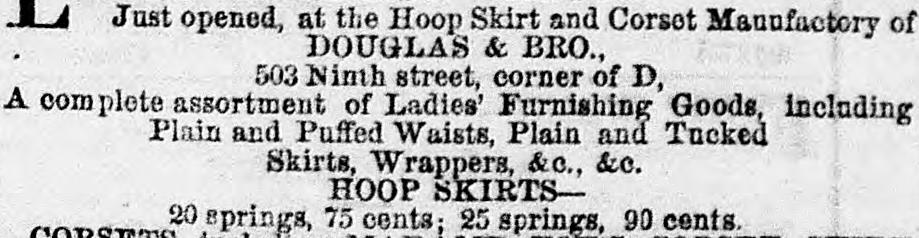
Hoop skirts priced by the number of springs. Daily National Intelligencer, Washington, D.C., June 3, 1867, page 3. Library of Congress, Chronicling America. Click the picture to see it full size.
A London cartoonist, John Leech, poked fun at the size of hoop skirts ten years earlier. His drawing below shows a young lady being fitted for a ball. The hoops were never really that big, but some days it must have felt that way.
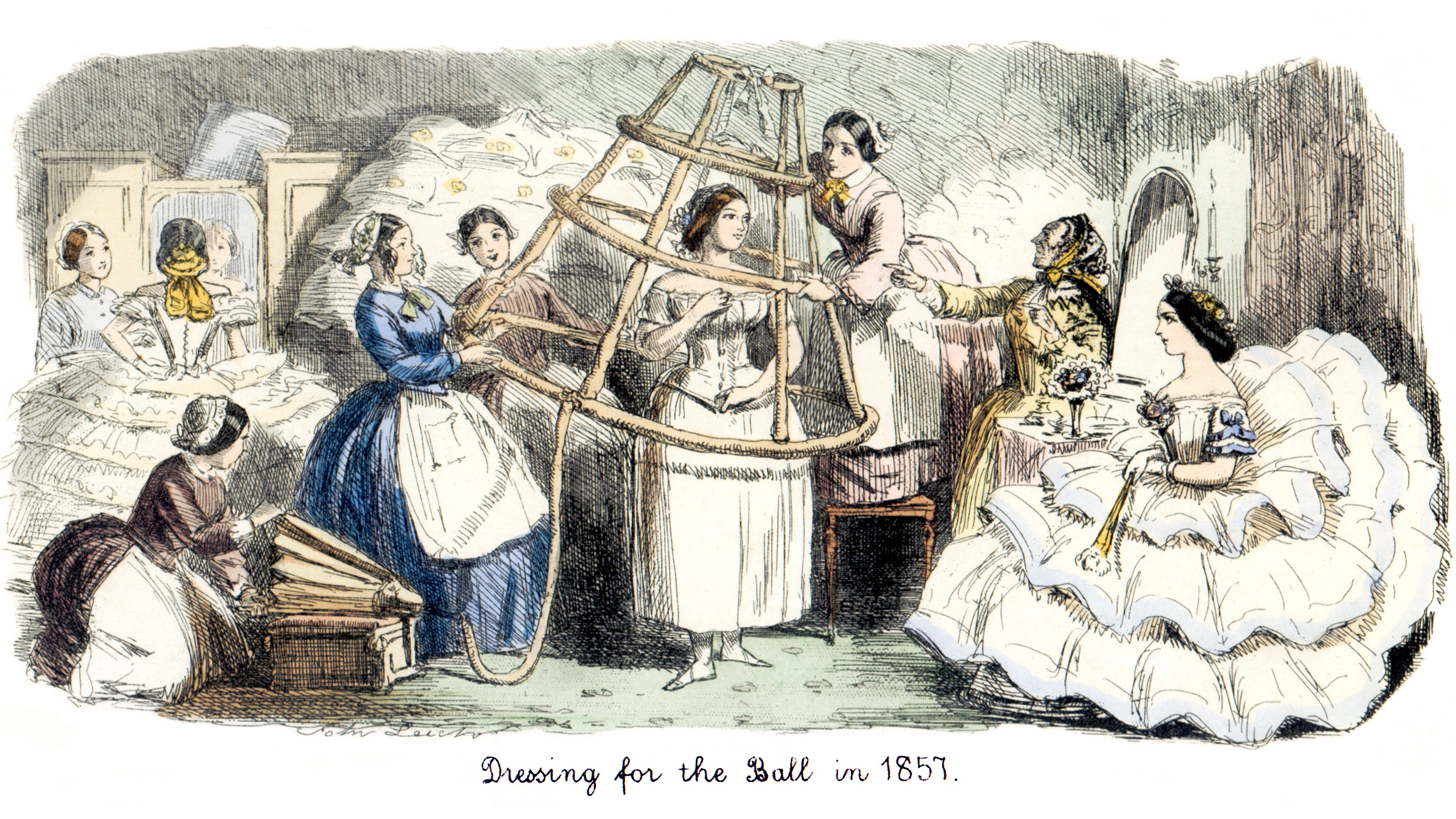
“Dressing for the Ball in 1857,” a cartoon by John Leech from Punch’s Pocket Book, London, 1857. Wikimedia Commons, public domain. Click the picture to see it full size.
Hoop skirts were for sale in Upper Sandusky that very week. On the same page as the rat story, S. M. Worth announced a “NEW STORE and ALL NEW GOODS!” He had “just returned from New York” with a stock that included “Shawls, Balmoral Skirts, Corsets, Hoop Skirts, &c., &c.” His store was “ONE DOOR SOUTH OF THE FIRST NATIONAL BANK.”
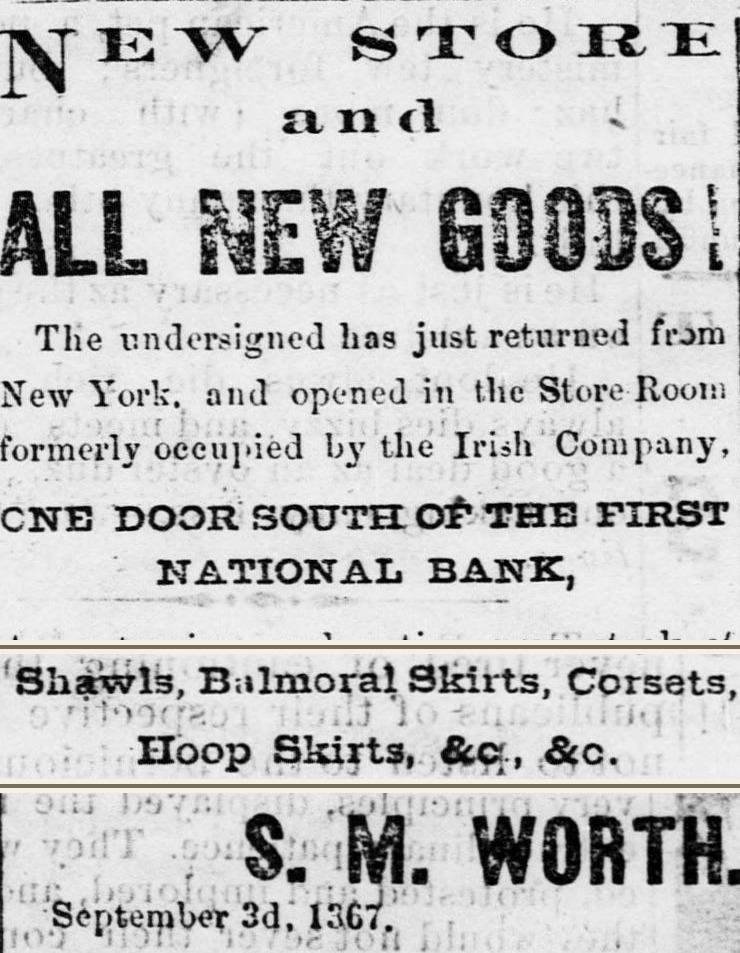
Three pieces of S. M. Worth’s new store ad, with the long list of goods between them left out. The Wyandot Pioneer, Upper Sandusky, Ohio, November 21, 1867, page 3. Library of Congress, Chronicling America. Click the clipping to read it full size.
Why would rats want one?
The paper didn’t say, and nobody asked the rats. Rats do drag cloth, paper and string back to their holes to line their nests. An old skirt with its cloth tapes may have looked like a winter’s worth of bedding. Getting it down the stairs was the hard part. That is why it took a gang.
The boy’s job
The Pioneer never printed the apprentice’s name. An apprentice was a boy learning the printing trade, and the youngest one in a print shop was nicknamed the printer’s devil. He came in first to light the stove, swept up, ran errands and learned to set type one letter at a time.
The job could start young. The county history, written in 1884, tells of an earlier Pioneer apprentice, Robert D. Dumm, who started in the same office in 1845 at the age of ten. His deal with the editor ran four years and included six months of school. Dumm grew up to run newspapers of his own in Upper Sandusky and in Fort Wayne, Indiana.
The man who printed it
The Pioneer’s owner in 1867 was Pietro Cuneo, and he had quite a story himself. He was born in a village near Genoa, Italy, in 1837. In 1849, at age eleven, he landed in New York unable to understand a word of English or write his own name. He worked on farms in New Jersey, trading his labor for board and a chance to go to school. By September 1866 he owned the Wyandot Pioneer. In January 1869 he renamed it the Wyandot County Republican, and the county history says he was the first printer in Upper Sandusky to run his press by steam. President Grant later made him the town’s postmaster.

The nameplate of the issue that carried the rat story. The box at left reads “Published Every Thursday Morning, by Pietro Cuneo, Editor and Proprietor.” The Wyandot Pioneer, Upper Sandusky, Ohio, November 21, 1867, page 1. Library of Congress, Chronicling America. Click the picture to see it full size.
What things cost that week
The Pioneer cost two dollars a year, or five cents a copy. On the day the story ran, the Upper Sandusky grain market paid “2 30@2 40 per bushel” for wheat, which means $2.30 to $2.40. A hoop skirt in Washington that year cost less than a dollar.

The Wyandot Pioneer, Upper Sandusky, Ohio, November 21, 1867, page 3. Library of Congress, Chronicling America. Click the picture to see it full size.
The scare that lasted
The apprentice got no name in the paper and no medal. He got something a boy might like better. The whole county read about the morning he stood his ground at the bottom of the stairs against a gang of rats and a runaway hoop skirt.
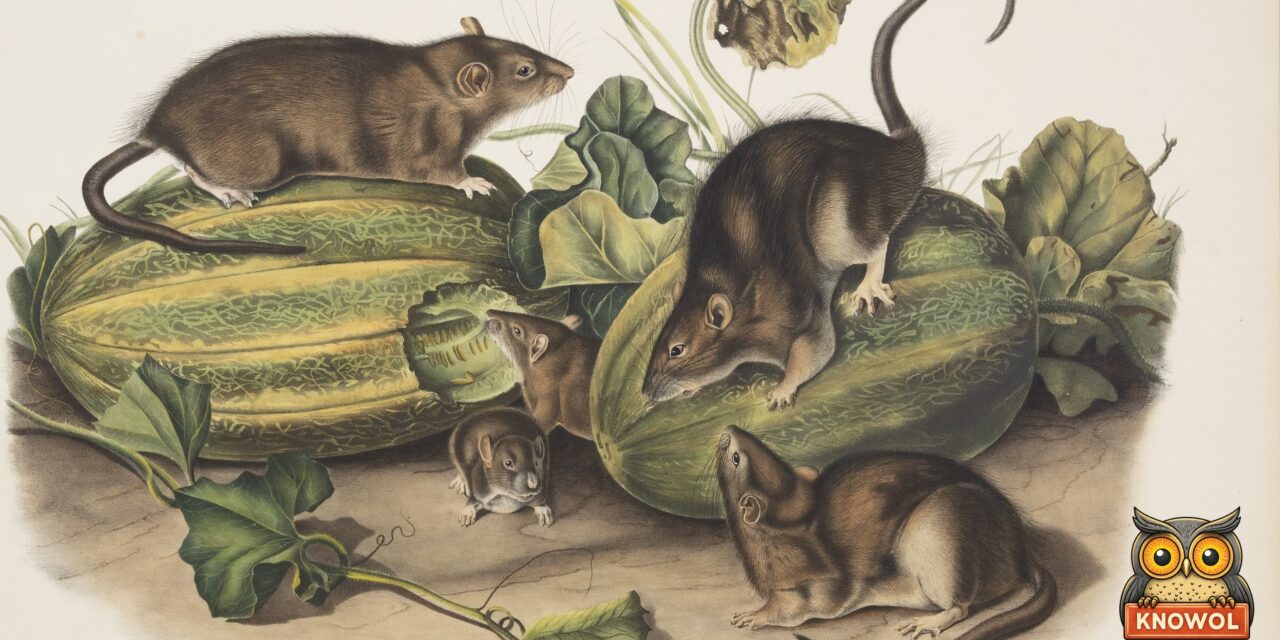
The picture at the top is John James Audubon’s print of brown rats, drawn at life size in 1845, helping themselves to a farmer’s melons. The Pioneer didn’t say what kind of rats carried off the skirt, only that they were big.
Sources
- The Wyandot Pioneer (Upper Sandusky, Ohio): November 21, 1867, page 3 (“A Big Scare,” the office line, S. M. Worth’s ad and the grain market) and page 1 (the nameplate and terms).
- Daily National Intelligencer (Washington, D.C.): June 3, 1867, page 3 (hoop skirts by the number of springs).
- The History of Wyandot County, Ohio (Chicago: Leggett, Conaway and Co., 1884), Chapter IX, “The Press,” and the sketches of Pietro Cuneo and Robert D. Dumm: Internet Archive.
- Library of Congress record for The Wyandot Pioneer, published 1853 to 1868 and continued as the Wyandot County Republican.
- John Leech, “Dressing for the Ball in 1857,” Punch’s Pocket Book, London, 1857: Wikimedia Commons, public domain.
- All newspaper images: Library of Congress, Chronicling America. Published 1867.
- Cover: John James Audubon, “Brown, or Norway Rat,” plate 54 of The Viviparous Quadrupeds of North America, 1845, Missouri Historical Society, via the Digital Public Library of America and Wikimedia Commons, public domain. It shows rats and melons, not Upper Sandusky.