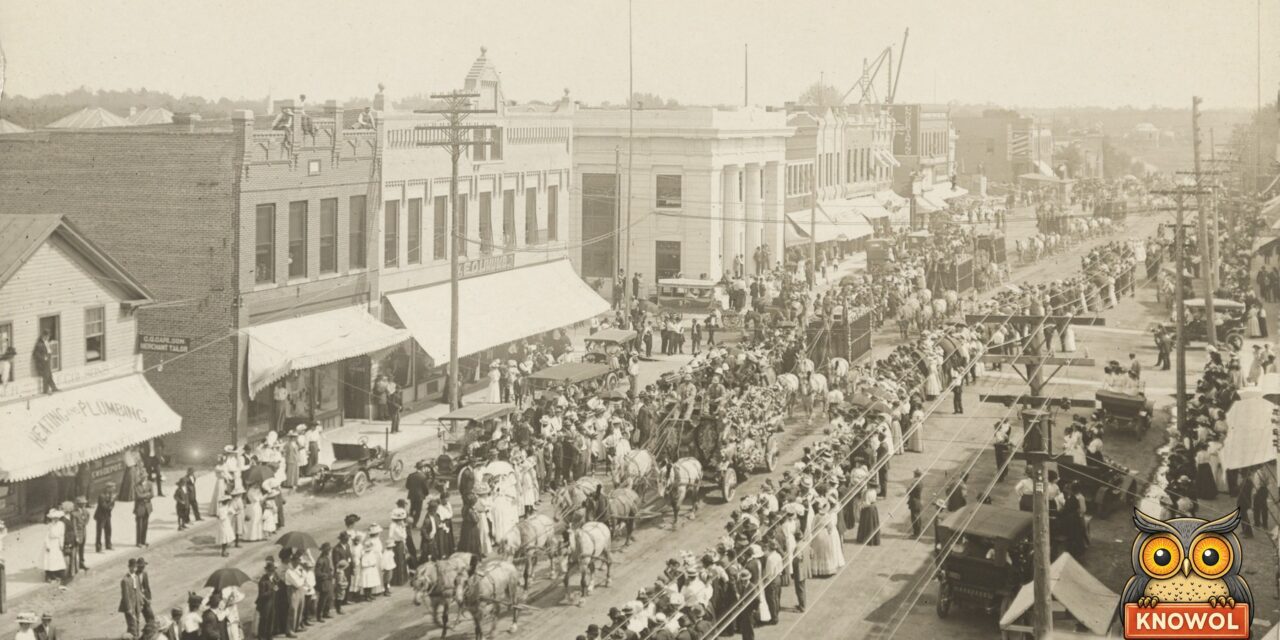
On Sunday, June 4, 1905, the Forepaugh-Sells circus came to Minneapolis, Minnesota, and two grown men made a whole lot of kids very mad. H. L. McCord and C. R. Tubbs belonged to the Minneapolis Chamber of Commerce, the big trading floor where businessmen bought and sold grain. That day the two men rode out to the circus grounds “in an auto, to see the show unload.”
The big war elephant came out of his railroad car, and workers chained him to a stake. He had “flapping ears and great brass-tipped tusks.” The two men stared at him with “wondering eyes.” “Isn’t he a beauty, Hal,” said Tubbs. “I’d like to see him drink.”
“All right, Charlie,” said McCord, “let’s give him a drink.” Each man carried a bucket of water over from the far end of the field. The elephant slurped it up like a girl sipping “a glass of soda thru a straw.” “That’s great,” said Tubbs, “let’s give him another.” By one report, the elephant drank “a barrel and a half of water before he had enough.”
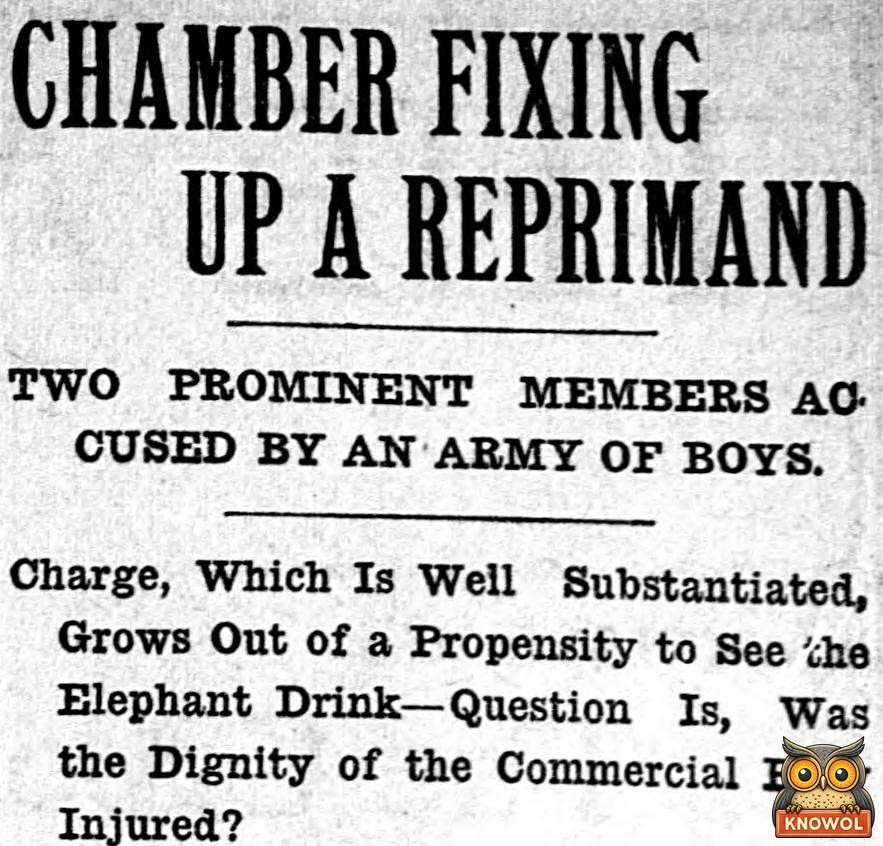
“Chamber Fixing Up a Reprimand.” Minneapolis Journal, Minneapolis, Minnesota, June 7, 1905, page 14. Library of Congress, Chronicling America. Click the clipping to read it full size.
Why the boys were mad
About fifty boys saw the whole thing, “a half hundred small boys,” as the Minneapolis Journal put it. They took it “as infringement upon their rights.” In plain words, the men had grabbed something that belonged to the boys.
Here’s why. In 1905, watering the circus elephants was a kid’s job, and it came with a prize. That August, when the Barnum & Bailey circus pulled into Walla Walla, Washington, the Evening Statesman said “the young boys were there ready to carry water to the elephant or do numerous other small jobs in order to gain admission to the show.” To gain admission means to get in. A boy who hauled enough buckets could earn his way into the big tent. McCord and Tubbs did that job for fun, right in front of the boys who wanted it.
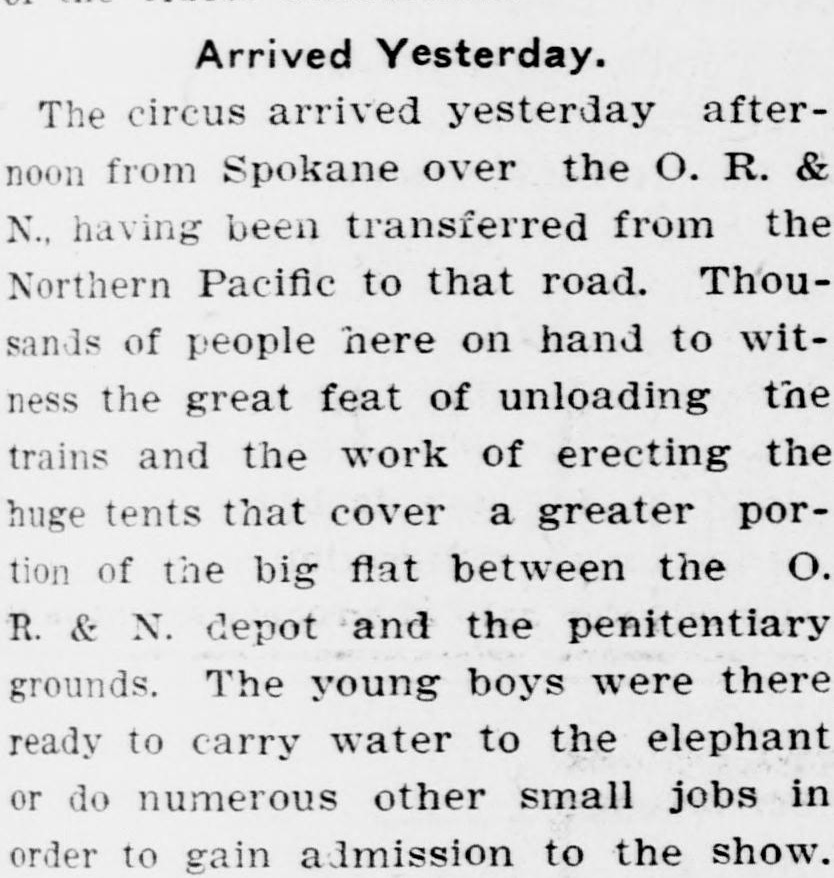
Boys ready to carry water to the elephant. Evening Statesman, Walla Walla, Washington, August 14, 1905, page 5. Library of Congress, Chronicling America. Click the clipping to read it full size.
Up at 4 a.m.
For kids, circus day started in the dark. In Winnemucca, Nevada, the Floto show pulled in at 4 o’clock in the morning on May 22, 1905. About 50 kids were already at the tracks to meet it. “In the home of nearly every family in town the alarm clock was set to go off at 4 o’clock,” the Daily Silver State said, “and the boys and girls turned out to see the circus unload.”
Unloading was a show all by itself. In Walla Walla, “thousands” came out to watch “the great feat of unloading the trains” and the raising of the huge tents. In Minneapolis, thousands more visited the circus lot that Sunday and found it “an exceedingly interesting place.”
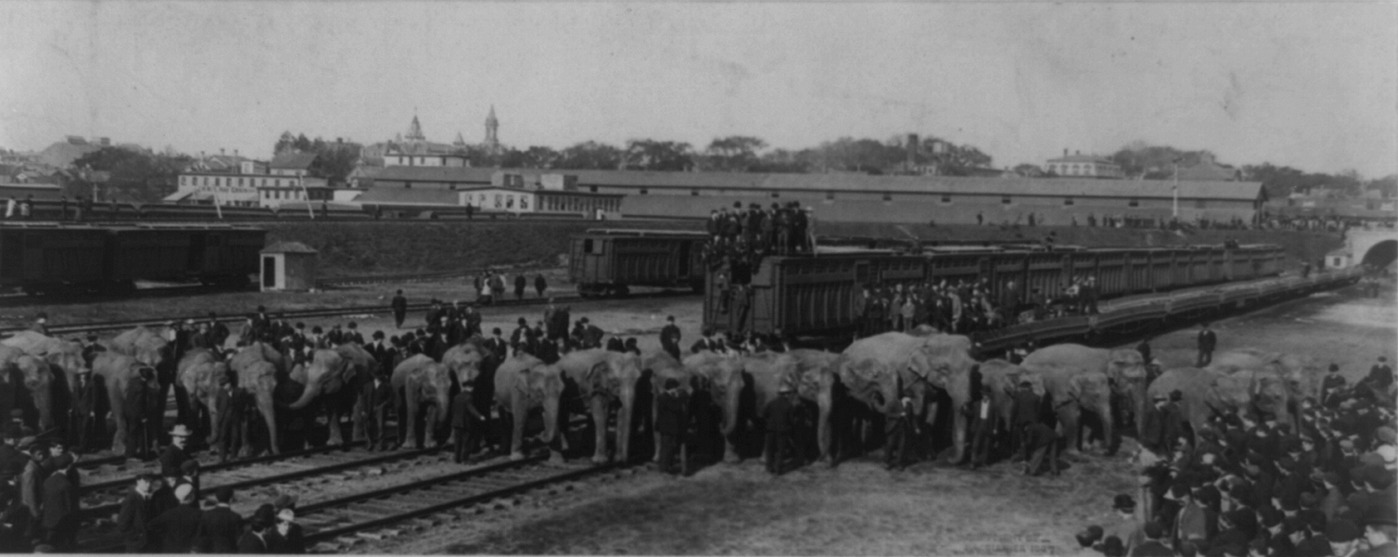
Ringling Brothers elephants line up beside the circus train while a crowd watches, about 1907. Photograph by Glasier, Brockton, Massachusetts. Library of Congress. Click the picture to see it full size.
No school on circus day
Some towns simply gave up and closed the schools. In Bennington, Vermont, the schools shut down all day for circus day in June 1905. The year before, the town had tried holding school on Saturday to make up the lost day. That “did not prove a success,” the Bennington Banner said, because “so many stayed out Saturday also.” So this time, nobody made it up.
In Americus, Georgia, the schools had given a circus holiday “for years.” Every little child would want to see the parade, the Americus Times-Recorder said, so “it will be nothing more than right and humane to give them this one day.” Humane means kind.
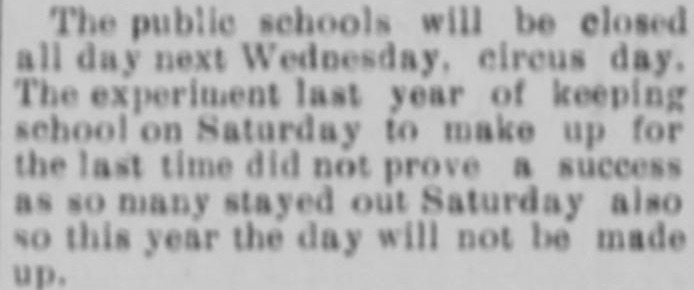
Bennington Banner, Bennington, Vermont, June 10, 1905, page 4. Library of Congress, Chronicling America. Click the clipping to read it full size.
A quiet Sunday
Minneapolis had its own rules. Other years, the Sunday before circus day had turned into a party around the circus grounds. In 1905 that Sunday was “not to be given over to revelry,” which means loud partying. Mayor Jones promised to keep order, and even the lemonade stands couldn’t open until Monday morning.
The circus behaved, too. It set up on “the big lot at Fourth avenue S and Thirty-fourth street.” Workers gave the horses and many of the other animals baths, then turned in to rest. After that, the paper said, the tented city was “as quiet as a tomb.”
Circus day
On Monday, June 5, a “glittering pageant of gold” paraded through downtown. It had a caravan of camels and “three herds of elephants.” Two of them, “Congo” and “Zeffa,” were African war elephants, “said to be the only two of this species in captivity.”
That afternoon, more than 10,000 people packed the big tent. “Twenty odd elephants,” meaning twenty or so, “waltzed, walked upon their hind legs and interlocked trunks.” When the clowns ran in, “a shriek from the host of children” greeted them. As the paper put it, “the laugh of the small boy resounded thru the great arena.”
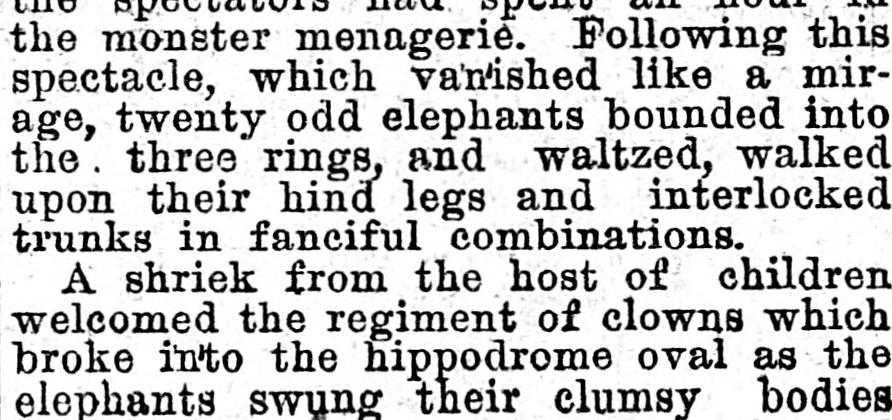
The elephants and clowns at the afternoon show. Minneapolis Journal, June 5, 1905, page 9. Library of Congress, Chronicling America. Click the clipping to read it full size.
By the numbers
- 4 a.m.: when the alarm clocks rang in Winnemucca, Nevada, on circus day.
- About 50: kids at the tracks in Winnemucca, and boys watching McCord and Tubbs in Minneapolis.
- 1 1/2 barrels: the water the war elephant drank before he had enough.
- 20 or so: elephants dancing in the Minneapolis show.
- 10,000: people at the Minneapolis afternoon show.
Two men in section G
The boys got even. They “made haste to spread the story.” On Wednesday, the Journal ran it under the headline “Chamber Fixing Up a Reprimand.” A reprimand is an official scolding. The paper joked that the grain traders were debating whether a member had “a right to work his way into the circus by watering the elephant.” The talk on the trading floor, it said, was that it was “conduct detrimental to the dignity” of the Chamber. In other words, it made the whole club look silly.
At the evening show, the crowd’s attention was “about evenly divided between the elephants and two men who sat in section G vainly trying to hide behind their hats.” Vainly means it didn’t work.
The kids of Winnemucca didn’t let the fun stop when the circus left town. Their paper expected “a series of amateur circuses for the next month, for the boys like to ‘play circus.'”
Sources
- Minneapolis Journal (Minneapolis, Minnesota): June 3, 1905, page 7 (“Must Keep Sunday”), June 5, 1905, page 9 (“Thousands See the Elephants”) and June 7, 1905, page 14 (“Chamber Fixing Up a Reprimand”).
- Evening Statesman (Walla Walla, Washington): August 14, 1905, page 5.
- Daily Silver State (Winnemucca, Nevada): May 22, 1905, page 1 (“The Floto Show”).
- Bennington Banner (Bennington, Vermont): June 10, 1905, page 4.
- Americus Times-Recorder (Americus, Georgia): November 12, 1905, page 4 (“Schools Will Have a Holiday”).
- All newspaper images: Library of Congress, Chronicling America. Published 1905, public domain.
- Photograph: Elephants from Ringling Bros. circus, trains and crowd of people, about 1907, copyright by Glasier, Brockton, Mass. Library of Congress, Prints and Photographs Division. Public domain.
- Cover: Ringling Circus Grand Street Parade, Alexandria, Minn., 1910, photo postcard by Johnson-Olson. Library of Congress, Prints and Photographs Division. Public domain.