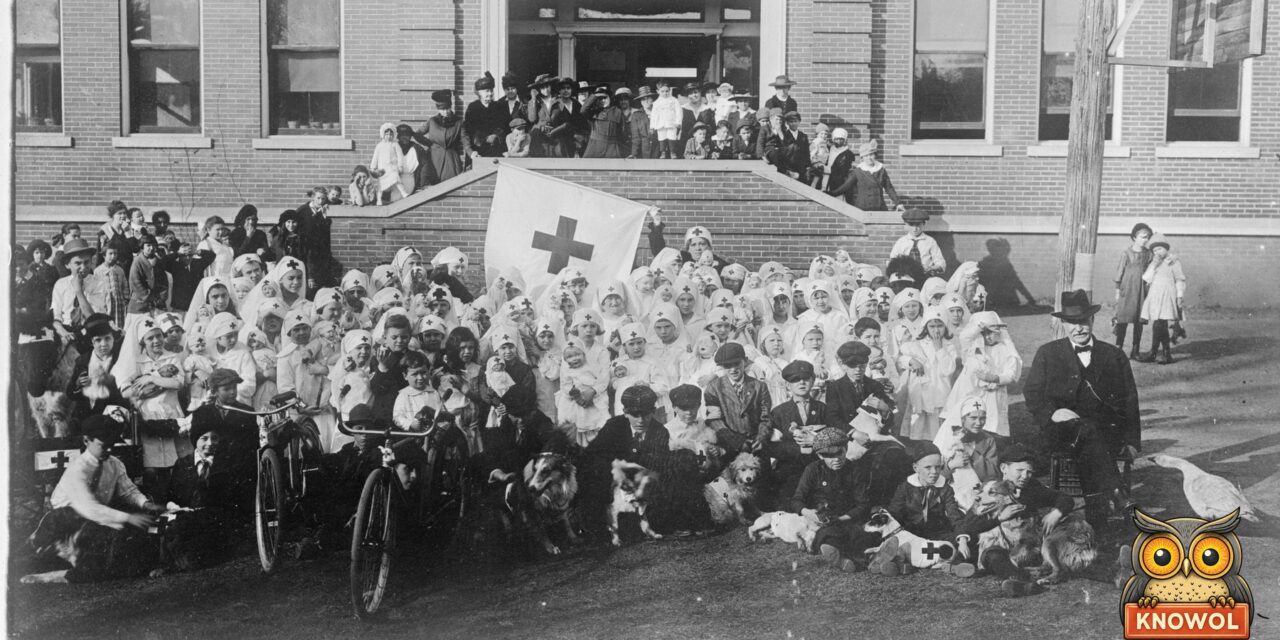
On Tuesday, March 31, 1925, the city auditorium in Montgomery, Alabama, filled up with barking, howling and squawking. It was Montgomery’s first pet show, run by the Boy Scouts and the local Humane Society. More than 400 animals were entered, and “hundreds of people” came to see them. There were dogs of every size, a cat on a pillow, a goat, rabbits, macaws, a war hero and one pig that looked like a porcupine. But the first prize didn’t go to any of them. It went to a honey bee.
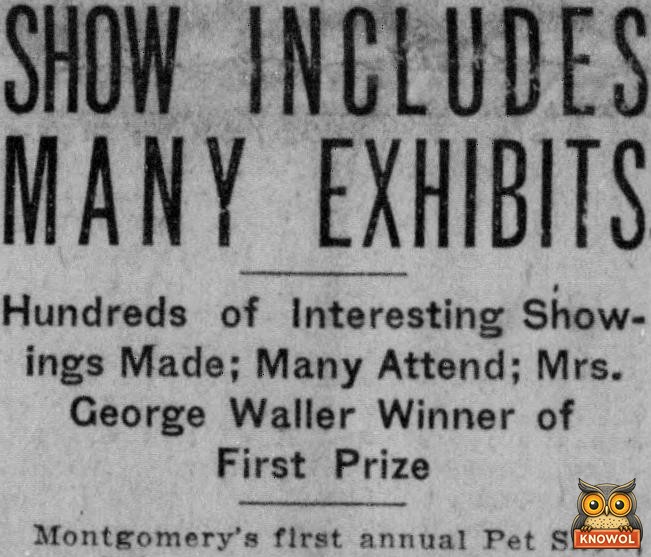
“Show Includes Many Exhibits.” Montgomery Advertiser, Montgomery, Alabama, April 1, 1925, page 1. Library of Congress, Chronicling America. Click the clipping to read it full size.
A hum-hum dinger
The Scouts got the town excited first. Two days before the show, the Montgomery Advertiser ran a silly poem from the “Scout Bugle.” It started like a cheer: “Come on, boys! Let’s go! Let’s go! What’s a hum-hum dinger? It’s a Scout Pet Show.” A humdinger is something terrific.
The poem pictured the pets getting ready. A pug was “Trying to smooth his wrinkled mug.” A chow barked, “I wanter go! I wanter go!” And there was a goat “Who is always butting in.” He “had a lot of cheek,” the poem said, “And his tail seemed to grow Upon his chin.” That’s a joke about a goat’s beard.
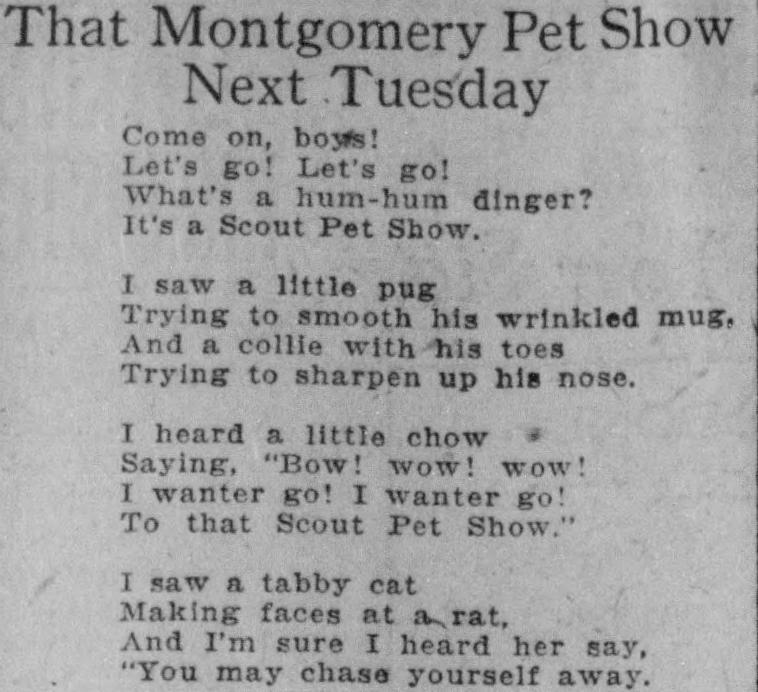
The start of the Scout Bugle poem. Montgomery Advertiser, March 29, 1925, page 4. Library of Congress, Chronicling America. Click the clipping to read it full size.
The rules
The rules were simple: every dog had to wear “a collar and chain,” and the smaller animals would get cages. Every pet had to be in its spot by noon on show day, and a Scout bugle call would open the show.
The prizes were small but real. The “most unique pet” would win $5, and so would the best kept pet. There were $1 prizes for the cutest pet, the most beautiful pet, the best kept goat, cat and pony, and the best kept dog “without a pedigree.” A pedigree is a written family tree proving that a dog is purebred, so that prize was meant for a plain old mutt.
Four hundred pets in one room
The Scouts ran the show, children crowded the auditorium, and some of the best entries were all about getting along. Edgar and Hugh Stuart brought one cage that held “a goat, a collie, three bulldogs and two grey cats, all living amicably together.” Amicably means in a friendly way. Boy Scout signs on those cages showed that animals “can be trained to be kind to each other.”
Fancy pets showed off too. A white Persian cat named “Sonny Boy” lay “on a white pillow” with a pink ribbon. A Russian wolfhound had a kennel “big enough for a child’s play house.” One mother dog, Topsy, had “a litter of ten pups” in her pen, and a sign said her puppies had sold for $3,000 over three years.
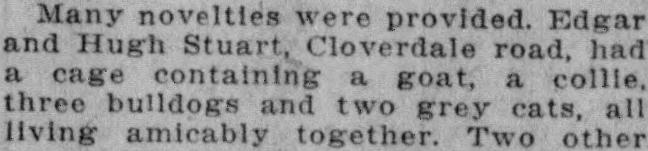
The cage where the animals got along. Montgomery Advertiser, April 1, 1925, page 1. Library of Congress, Chronicling America. Click the clipping to read it full size.
The war dog
The biggest hit with “the young folks” was a pit bull named Bud. In World War I, he had been the mascot of the 325th Machine Gun Company, and the paper called him “the dog hero” of some of the hardest battles. His harness was on display, covered with “American and French citations for bravery,” plus medals. A citation is an official award for bravery. He even had an “identification tag” like the ones soldiers carried, and the kids loved him because he was so friendly.
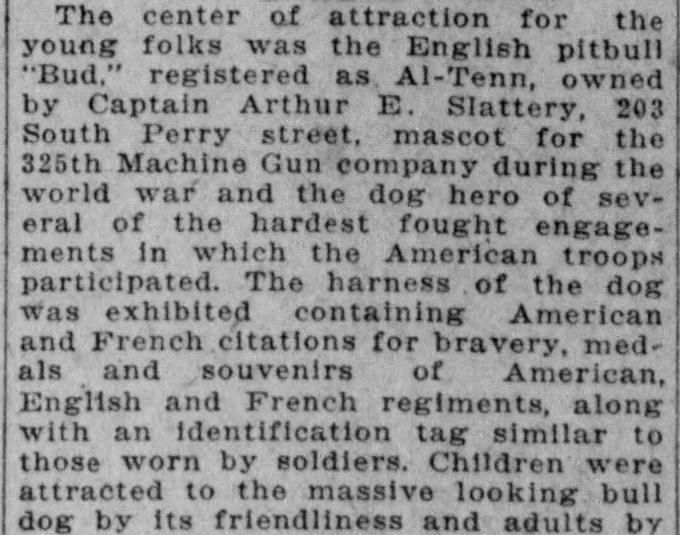
Bud the war dog. Montgomery Advertiser, April 1, 1925, page 1. Library of Congress, Chronicling America. Click the clipping to read it full size.
Sleeping through the band
Several hundred dogs in one room should have been loud, and it was. Starting at the 4 o’clock opening, the Sidney Lanier High School band and the Highland Avenue orchestra played music for two hours. According to W. L. Sprouse, the Scout leader in charge, the dogs “went to sleep during the music.” They “made a tremendous howling before and afterwards,” though.
Sprouse was proud of two things. There “were no dog fights,” and “not one dog was lost.” Meanwhile, young dancers did a rabbit dance for the children, and the Girl Scouts put on a short play about “kindness to animals.”
And the winners were
The best kept goat was Hugh Stuart’s. The prize for the tiniest dog went to Stirling Cooper’s fox terrier. Echo Dynes won a special prize for a black cat, and Jane Van Pelt won one for taking care of a “common dog.” The cutest pet was a “pink poodle” owned by Flora Frances Robison.
The big winner was Mrs. George Waller. She took first prize for the most unique exhibit “with a honey bee from Honduras.” Honduras is a country in Central America, more than 1,000 miles away.
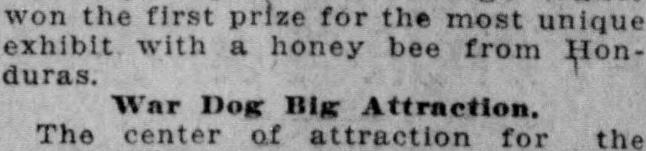
The winner. Montgomery Advertiser, April 1, 1925, page 1. Library of Congress, Chronicling America. Click the clipping to read it full size.
What the prizes paid
- $5: the most unique pet, and $5 again for the best kept pet.
- $3 and $2: second and third best kept pets.
- $1: cutest pet, most beautiful pet, best kept goat, best kept cat, best kept pony and best kept mutt.
- Ribbons: first, second and third place in every class of pets.
Meanwhile, in Nevada
Montgomery wasn’t the only town showing off its pets. A year earlier, on Saturday, April 12, 1924, Fallon, Nevada, held its “first pet show,” run by the Parent-Teacher Association. There were so many pets that “people wondered how they were all rounded up.” A little pig refused to be led, and “a playful young goat” added to the fun.
Fallon judged the kids by grade. William Ascargorta won for the upper grade boys and Maxine Springer for the upper grade girls. Carlon Dodge and Lorraine Saunders won the lower grades. One more prize went to the three children of Mr. and Mrs. D. R. Williams, for “the most original entry in which no pet appeared.” Sometimes the best pet at a pet show is no pet at all.
Sources
- Montgomery Advertiser (Montgomery, Alabama): March 25, 1925, page 9 (“Humane Society Perfects Plans For ‘Pet Show'”), March 29, 1925, page 4 (“That Montgomery Pet Show Next Tuesday,” from the Scout Bugle), April 1, 1925, page 1 (“Show Includes Many Exhibits”) and April 1, 1925, page 7 (the rest of the story and the prize list).
- Fallon Standard (Fallon, Nevada): April 9, 1924, page 4 and April 16, 1924, page 4 (“Pet Show a Success”).
- All newspaper images: Library of Congress, Chronicling America. Published 1924 and 1925, public domain.
- Cover: Animal members of Junior Red Cross and their owners, Junior Red Cross 40, Southern Division, Athens, Ga., about 1917 to 1919. American National Red Cross photograph collection, Library of Congress. No known restrictions on publication.