On Saturday morning, June 19, 1926, a big crowd gathered at Walnut Hill Park in New Britain, Connecticut, to watch the final of the city’s marble tournament. More than a thousand boys had entered. Only two were left. One was Frank Zaleski, 13, from a family so good at marbles that a Zaleski had won the city title the two years before. The other was Dominic Cartelli of Putnam Street. He was 10 years old and “one of the smallest boys” in the whole contest. The betting ran “about 10 to 1 on Zaleski.” The bettors were wrong.
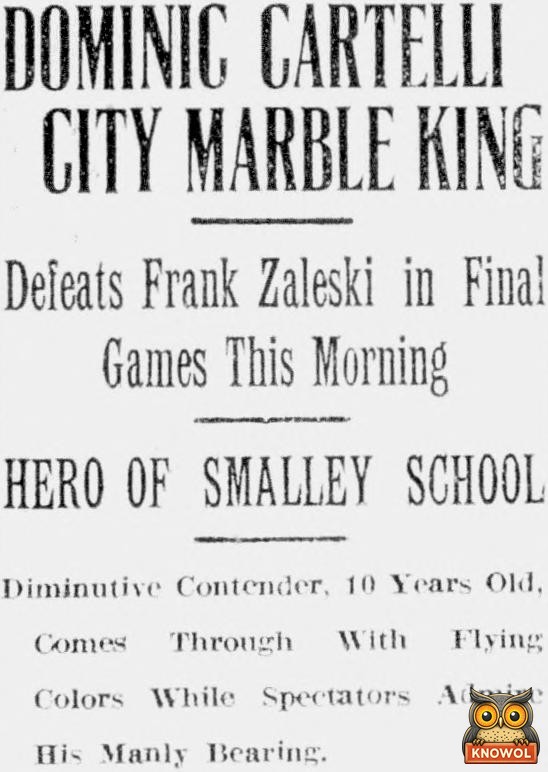
“Dominic Cartelli City Marble King.” New Britain Herald, New Britain, Connecticut, June 19, 1926, page 1. Library of Congress, Chronicling America. Click the clipping to read it full size.
How the game worked
The boys played the ring game. Thirteen marbles sit in the middle of a circle drawn on the ground. Each player kneels at the edge and flicks a bigger marble, called his shooter, to knock the little ones out of the ring. Every marble knocked out is a point, and the player with more points wins the game.
Dominic won the first game 7 to 6, and the paper said the score “was tied right up to the last shot.” Zaleski took the second, 7 to 5. Then Dominic won the last one 7 to 4, “with comparative ease,” meaning it wasn’t even close. That day’s Herald called him the “City Marble King.” Plenty of people in the crowd, the paper said, “could not help feel pleased that the little fellow had” won.
“Gee, it’s great”
The prize was a trip to the national marble tournament in Atlantic City, New Jersey. Dominic went “as the guest of the Herald,” the city’s newspaper, with a grown-up escort. It was his first trip away from home since his family came to America from Italy six years before. The trip started with a night in a sleeping car on the train, and he had never eaten in a restaurant before.
The Herald printed his reports on its front page, signed “By Dominic Cartelli.” His first one began, “Gee, it’s great to be a marble champion and come to Atlantic City.” His hotel was “the swellest place I ever saw.” There were “48 marble champions” there, he wrote, including one boy from Boston and one “all the way from Honolulu.” Most were boys, “but there are some girls.” The day before, a Philadelphia newspaper filled 13 buses and took everyone to Valley Forge, where George Washington’s army had camped. The kids got “whistles, hats and other things to play with.”
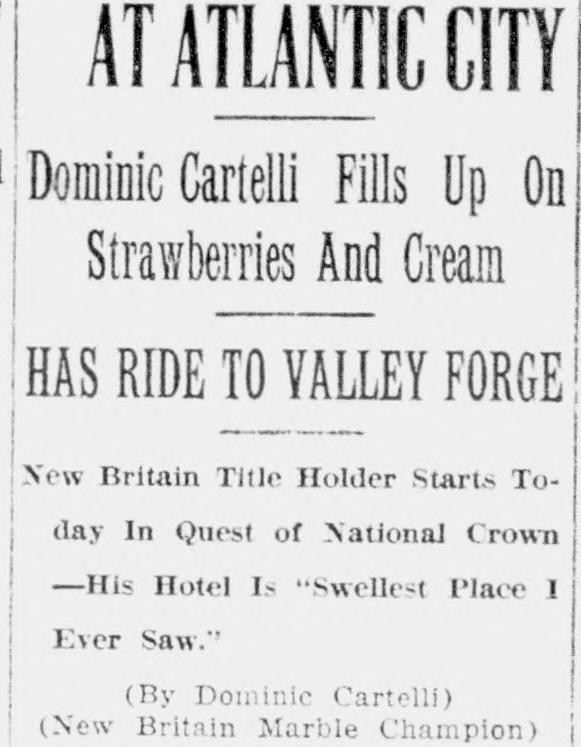
Dominic’s first report from Atlantic City. New Britain Herald, June 28, 1926, page 1. Library of Congress, Chronicling America. Click the clipping to read it full size.
Four desserts for breakfast
The hotel had one rule for the champions: there were no rules. “Anything the boys want they get,” the Herald said. So every morning, Dominic ordered “four desserts and cocoa” for breakfast. One day at lunch he asked for strawberries and cream, stewed rhubarb, sliced pineapple, cocoa, cream pie and hard-boiled eggs. The grown-ups did talk him into eating some fish and roast, but he flatly refused the potatoes.
He was the smallest and the youngest champion in the tournament, and the big-city papers loved him. They called him “Nicky the Peewee Champ.” When a reporter interviewed him, he said that next to marbles, his “chief vices are strawberries and indoor baseball.” A vice is a bad habit, so he was joking.
At a banquet for newspapermen in a big Atlantic City hotel, Dominic and three friends played a game right in the main dining room. A table was cleared, and guests and waitresses crowded around. One man got so interested that he offered “twenty-five cents to each boy every time he made a hit.” The Herald said “several of the quarters” ended up in the pockets of “the boy from the Hardware City.” That was New Britain’s nickname, because of all the tools and hardware made there.
A piece of wood
Dominic played hard and won 12 games while losing 8. Then, in one key game, “a small piece of wood deflected his shooter” and ruined what was probably the winning shot. The next Herald headline said it all: “Cartelli Out of Marbles Contest.”
The national champion was Willis Harper, 11, of Bevier, Kentucky. In the final he beat Danny Gore of Springfield, Massachusetts. The Herald made sure to add that Dominic had played Gore earlier “and gave him a scare.”
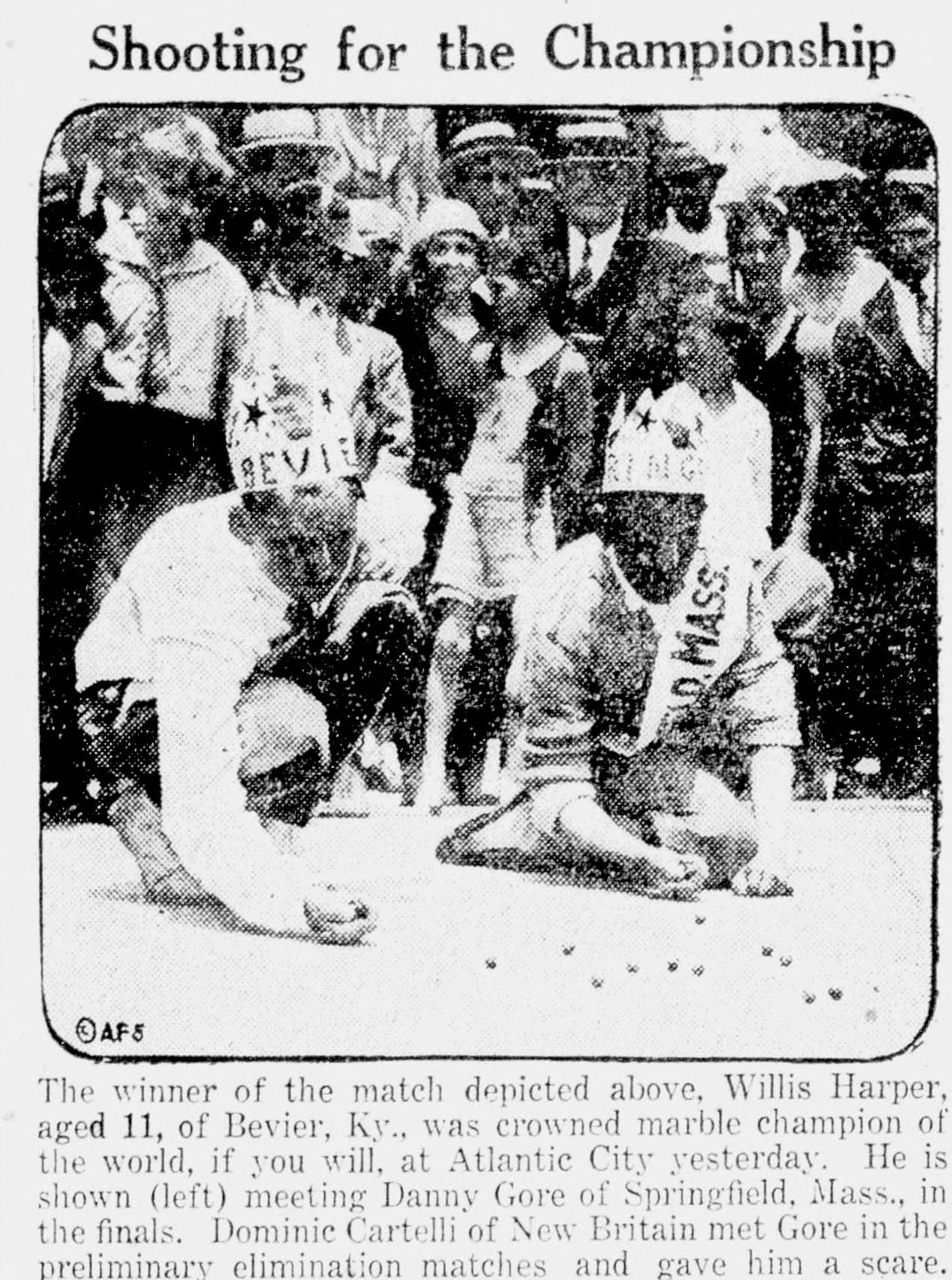
Willis Harper (left) and Danny Gore in the national final, Atlantic City. New Britain Herald, July 3, 1926, page 14. Library of Congress, Chronicling America. Click the clipping to read it full size.
By the numbers
- 1,000+: boys in New Britain’s marble contest.
- 10 to 1: the betting against Dominic in the city final.
- 48: marble champions at the national tournament.
- 4: desserts Dominic ordered for breakfast.
- 12 and 8: his wins and losses in Atlantic City.
- 100+: glass and agate shooters each champion got to take home, plus salt water taffy.
“I’ll lick ’em”
Dominic came home on a Saturday night, and he wasn’t sad for long. “I am going to win next year,” he told his father. “I can shoot as good as those other guys and I’m going to practice all winter and next year I’ll lick ’em.”
He didn’t wait that long. In August, the Herald and a Springfield newspaper set up a match in Springfield, Massachusetts, against the best boys there. Dominic took two out of three games from “Dutch” Robbins, who had been the national champion in 1923. Then he beat Danny Gore in one game, 13 to 0. That’s every single marble in the ring, and Gore didn’t get one.
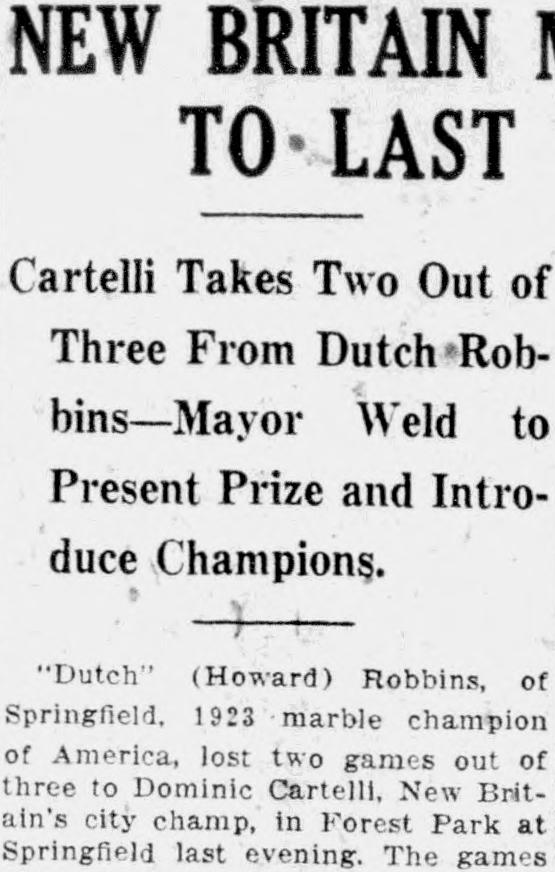
“Cartelli Takes Two Out of Three From Dutch Robbins.” New Britain Herald, August 10, 1926, page 16. Library of Congress, Chronicling America. Click the clipping to read it full size.
Sources
- New Britain Herald (New Britain, Connecticut): June 19, 1926, page 1 (“Dominic Cartelli City Marble King”), June 28, 1926, page 1 (“At Atlantic City,” by Dominic Cartelli), June 30, 1926, page 15 (“Cartelli Out of Marbles Contest”), July 3, 1926, page 14 (“Shooting for the Championship”), July 6, 1926, page 2 (“‘Nicky’ Confident He’ll Be King Yet”) August 10, 1926, page 16 (“Cartelli Takes Two Out of Three From Dutch Robbins”) and August 12, 1926, page 20.
- All newspaper images: Library of Congress, Chronicling America. Published 1926, public domain.
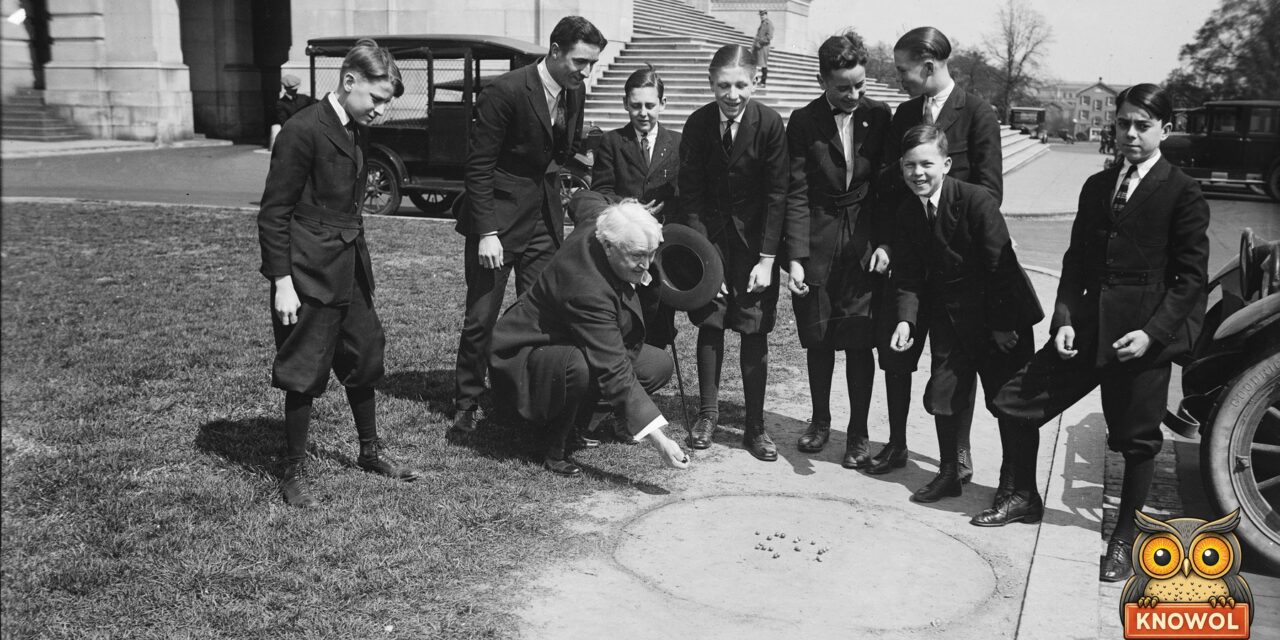
- Cover: Group playing marbles outside U.S. Capitol, Washington, D.C., April 1924. Harris & Ewing collection, Library of Congress. No known restrictions on publication.