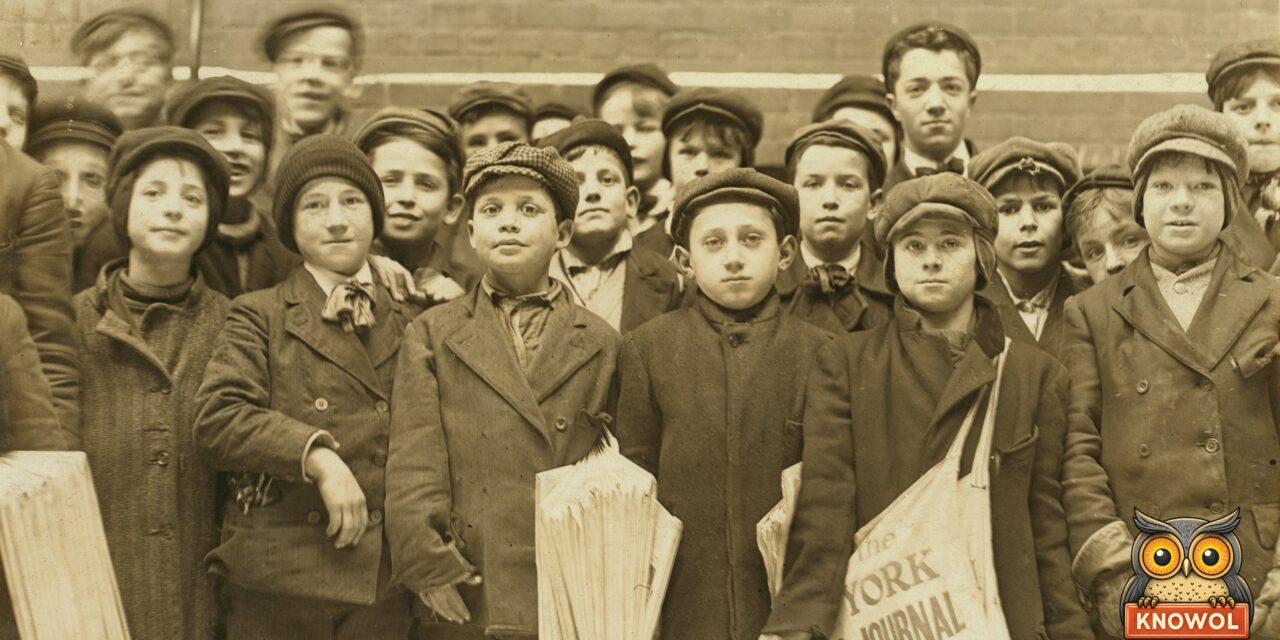
On Christmas Day, 1905, a crowd of newsboys marched up to the Iler Grand hotel in Omaha, Nebraska, and made what the Omaha Daily Bee called “noises peculiar to newsboys.” Peculiar meant special to them, and these were boys who shouted the news on street corners all day, so they knew how to be loud. It worked. Rome Miller, a grown-up friend of theirs, got up from his Christmas dinner, came out and gave them a talk. Later, at their own Christmas dinner, the boys chipped in their pennies for presents, and Miller cried.
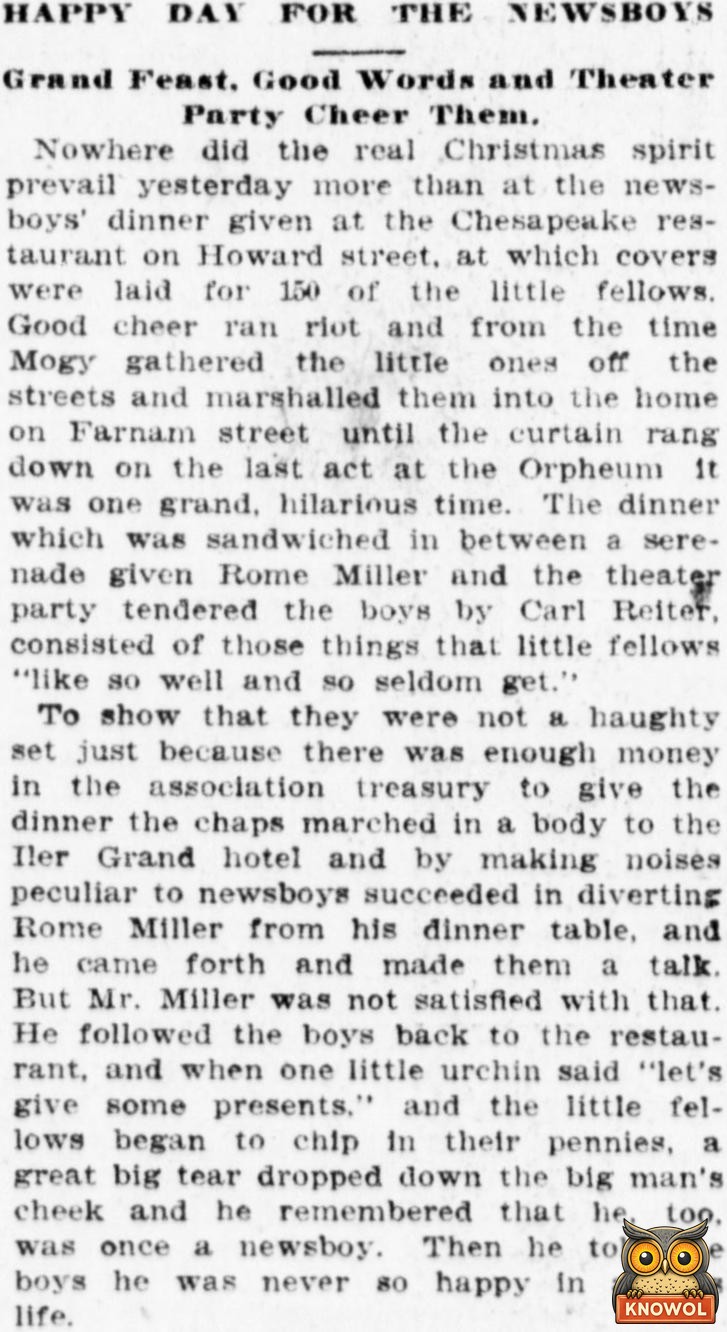
“Happy Day for the Newsboys.” Omaha Daily Bee, Omaha, Nebraska, December 26, 1905, page 10. Library of Congress, Chronicling America. Click the clipping to read it full size.
A club of their own
Newsboys were kids who sold newspapers on the street. They bought a stack of papers, sold each one for a little more than it cost them, and kept the difference. Some had families to go home to, but others had nowhere to sleep, and the Bee wrote that winter was a hard time for “the homeless boys.”
That fall, Omaha’s newsboys got a home base. On November 1, 1905, the newsboys’ headquarters at 1416 Farnam Street added a home for boys. It had cots to sleep on, things to read, a bathroom and a kitchen that sold food at cost, meaning for just what the food cost, with no profit. A bowl of soup with crackers was 3 cents, cake was 1 cent, pie was 2 cents, and a hot roast beef sandwich was 3 cents. The boys would also be taught “the value of saving money.”
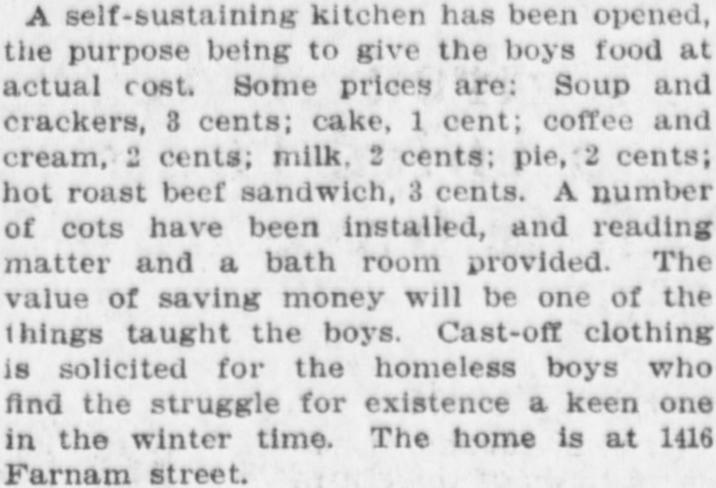
The club kitchen’s prices. Omaha Daily Bee, November 2, 1905, page 5. Library of Congress, Chronicling America. Click the clipping to read it full size.
The person in charge was Mogy Bernstein, and everybody just called him Mogy. Mrs. Draper Smith, one of the women who helped run the home, said Mogy had gotten the boys “to quit tobacco smoking and forego swearing.” Then she added, “The boys cannot be made perfect, of course.”
Thanksgiving in the basement
On Thanksgiving, 110 newsboys crowded into the club for a dinner of chicken, cakes, apples, oranges, nuts, candy, pie, coffee and cranberry sauce. Mogy and Rome Miller helped serve. The club was only a basement room, but one writer said the boys’ faces and eyes lit it up brighter than any lamp could.
For once, that writer said, these “urchins with the strident voices,” meaning kids with loud, sharp voices, were quiet, “for a while, at least.” During the dinner, a woman who wouldn’t give her name made an offer. She would put the first money into a savings account for every boy who didn’t have one at the club yet and wanted to start one.
No badge, no papers
On December 16, about 100 boys came to a club meeting to get something new: badges. Each one was “a metal shield with a star in the center,” and in the middle of the star was the boy’s own number. Soon a boy would need his badge to get his papers. The Bee said there was “much interest, impatience and jostling around the tables” as the numbers were handed out.
Mogy, Tony and Joe, the club’s leaders, got badges one, two and three. Rome Miller got No. 10, and Abe Jacob got No. 13, a number many people thought was unlucky, but Abe didn’t care. “He is past believing in signs,” the paper said.
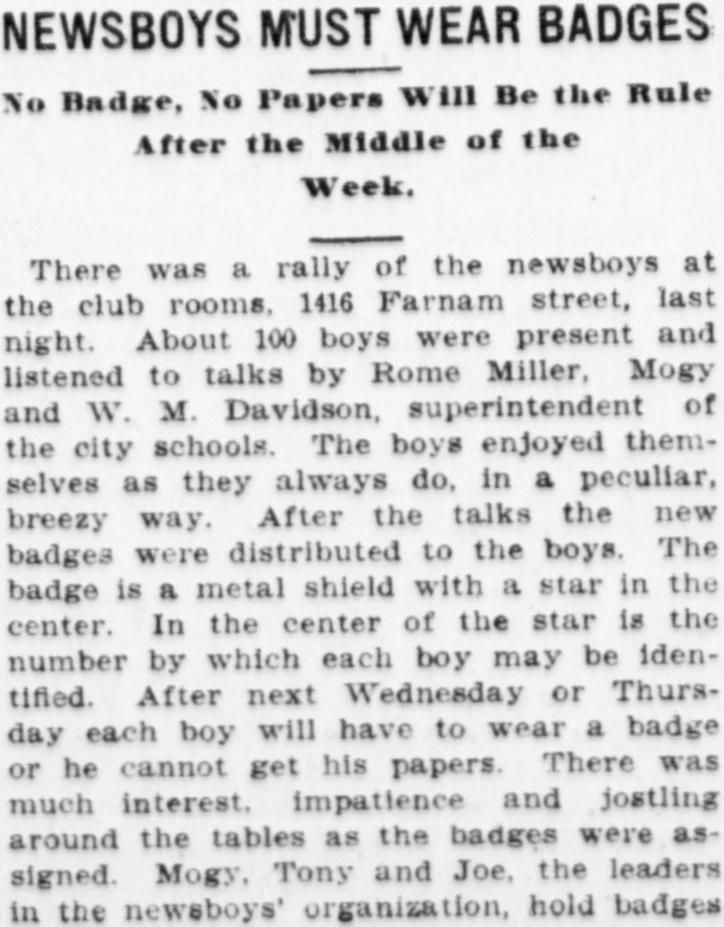
“Newsboys Must Wear Badges.” Omaha Daily Bee, December 17, 1905, page 4. Library of Congress, Chronicling America. Click the clipping to read it full size.
“Let’s give some presents”
On Christmas Eve, the Bee warned that if any Omaha newsboy missed Christmas dinner, “he will have only himself to blame.” On Christmas Day, Mogy gathered the boys off the streets. The Bee said there was enough money in the newsboys’ own treasury to pay for the dinner. The boys wanted everyone to know that hadn’t made them stuck-up. That’s why they marched to the hotel and called out Rome Miller, “to show that they were not a haughty set.”
Then they ate, at the Chesapeake restaurant on Howard Street, which set places for 150, and the food was the kind of thing boys “like so well and so seldom get.” The boy with badge No. 63 cleaned his platter and tried to sneak over to another full plate. Nobody minded, because, as the boys explained, it “was just a way he had when hungry.”
Rome Miller followed the boys back to the restaurant, and then one small boy said, “let’s give some presents.” As the others began to chip in their pennies, “a great big tear dropped down the big man’s cheek.” Miller remembered that he had once been a newsboy too, and he told the boys he was “never so happy in all his life.” The presents were boxes of candy, sent from the boys to three women who helped the club: Mrs. Draper Smith, Mrs. Rome Miller and Mrs. W. J. Broatch.
Badge No. 109
The boys had one more present to give. They made two theater men honorary members of their club. One was W. J. Burgess, who ran the Boyd theater. The other was Carl Reiter, who was taking the boys to a show at the Orpheum. Each got a real badge, which allowed him “to sell papers on the streets.” From then on, Burgess was No. 109 and Reiter was No. 131, the Bee said, “as long as both are in good standing.” A man named W. S. Balduff sent over “enough candy to last them far into the night.” Then it was off to the Orpheum until the last curtain came down.
Burgess soon said thank you for his badge. He invited the newsboys to a play, and he saved the whole balcony just for them. The boys decided to bring along, as their own guests, the grown-ups who had hosted their Christmas dinner.
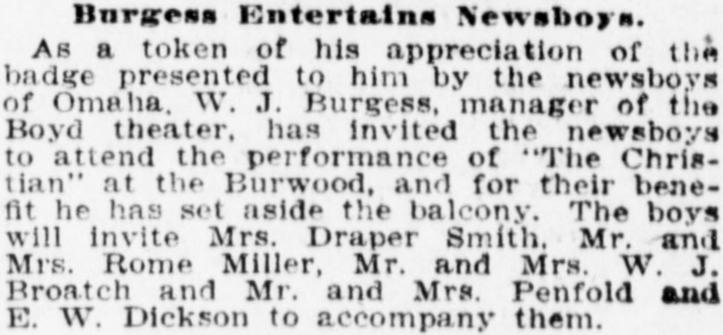
“Burgess Entertains Newsboys.” Omaha Daily Bee, December 27, 1905, page 3. Library of Congress, Chronicling America. Click the clipping to read it full size.
By the numbers
- 2 cents: a piece of pie at the club kitchen.
- 110: newsboys at Thanksgiving dinner.
- 13: Abe Jacob’s badge, and he didn’t mind.
- 150: places set for Christmas dinner.
- 109 and 131: the badges of the two honorary newsboys.
Sources
- Omaha Daily Bee (Omaha, Nebraska): November 2, 1905, page 5 (“Home Opened for All Boys”), December 1, 1905, page 1 and page 7 (“Hordes of Hungry Newsies”), December 17, 1905, page 4 (“Newsboys Must Wear Badges”), December 24, 1905, page 4 (“Dinner for the Newsboys”), December 26, 1905, page 10 (“Happy Day for the Newsboys”) and December 27, 1905, page 3 (“Burgess Entertains Newsboys”).
- All newspaper images: Library of Congress, Chronicling America. Published 1905, public domain.
- Cover: Group of newsboys at the Times Office, Hartford, Conn., photo by Lewis W. Hine, March 1909. National Child Labor Committee collection, Library of Congress. No known restrictions on publication.