“Will pay good cash price for cats.” That was the whole advertisement. Seven words, in the back of a small-town newspaper in Rome, Georgia, in the early 1870s. It was signed with the name of a grocery store. The store had not written it. A young editor named Henry Grady had, and he was about to prove a point.
Grady ran the Daily Commercial, Rome’s first daily paper, with his brother Will. A newspaper lives on advertising, and Grady needed the big stores in town to buy space. One of the biggest was the Rounsaville brothers’ warehouse and grocery. Years later, J. A. Rounsaville told a Rome historian what happened. “Mr. Grady came by and asked us to give him an advertisement,” he said. The brothers turned him down, nicely. They told him “that his old paper couldn’t sell any more goods than we could, and that on general principles we didn’t believe in advertising.”
“He went away without saying any more about it,” Rounsaville remembered. Grady did not argue. He went back to his office and wrote one small want ad. A want ad is a tiny notice in the back pages: help wanted, lost dog, that sort of thing. This one asked for cats, and it was signed “Rounsaville & Bro.”
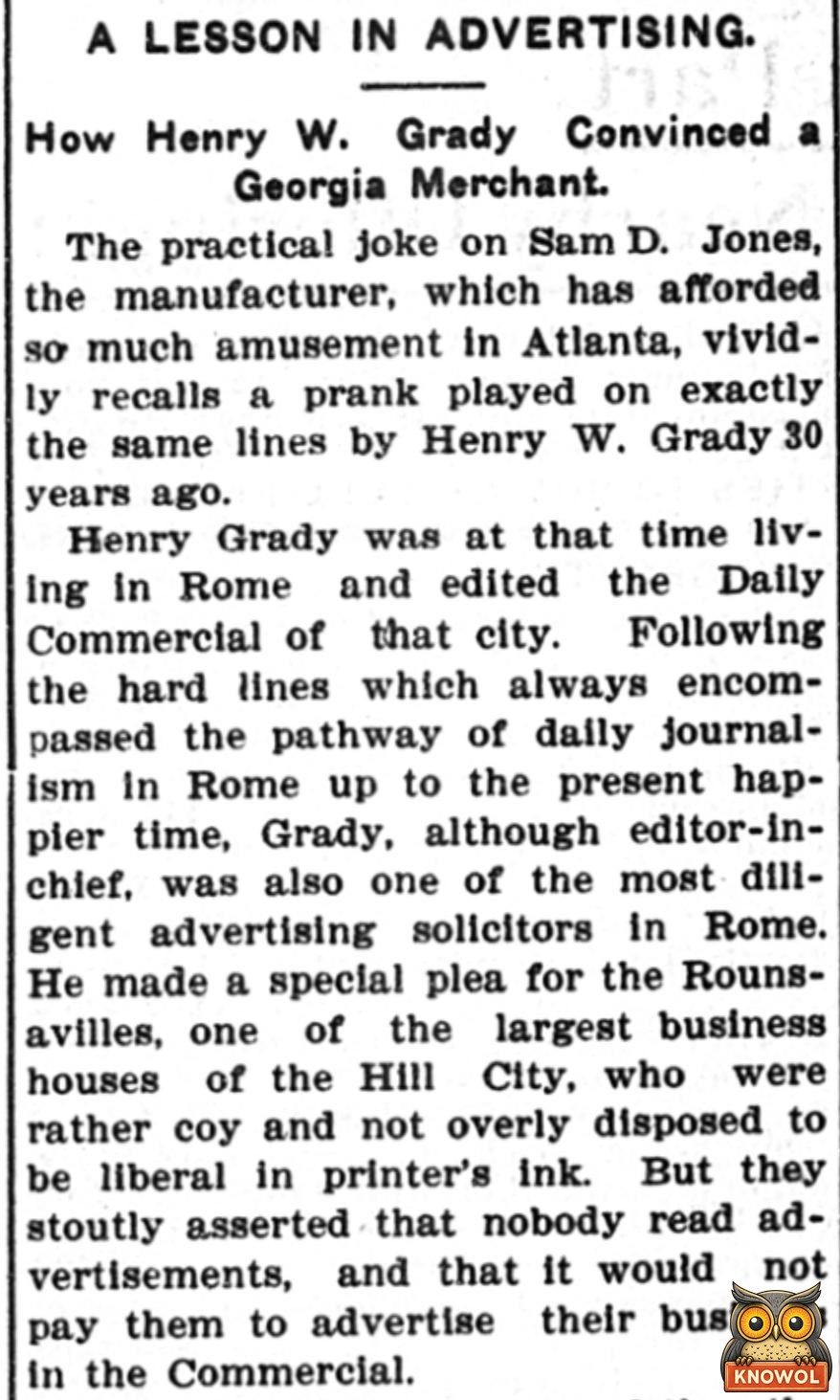
“A Lesson in Advertising.” Yorkville Enquirer, Yorkville, South Carolina, May 12, 1905, page 4. Library of Congress, Chronicling America. Click the clipping to read it full size.
The next morning
“The next day we were treated to a deluge of cats,” Rounsaville said. A deluge is a flood. “Every small boy in town, it seemed, brought from one to six cats, and when we asked them why they came, they said we had advertised in The Commercial.” The brothers bought a paper and found the ad. So people did read the Commercial after all. The boys did, anyway.
The merchant’s own ending is the best part. “We sent for Mr. Grady and told him it was his duty to stop the applications,” he said. The applications were the boys lined up with cats. Grady had his answer ready. “He said he could do that only by inserting a half-page ad.”
The brothers gave in. “We replied, ‘All right, but put in the center of it that we don’t want any more cats!'”
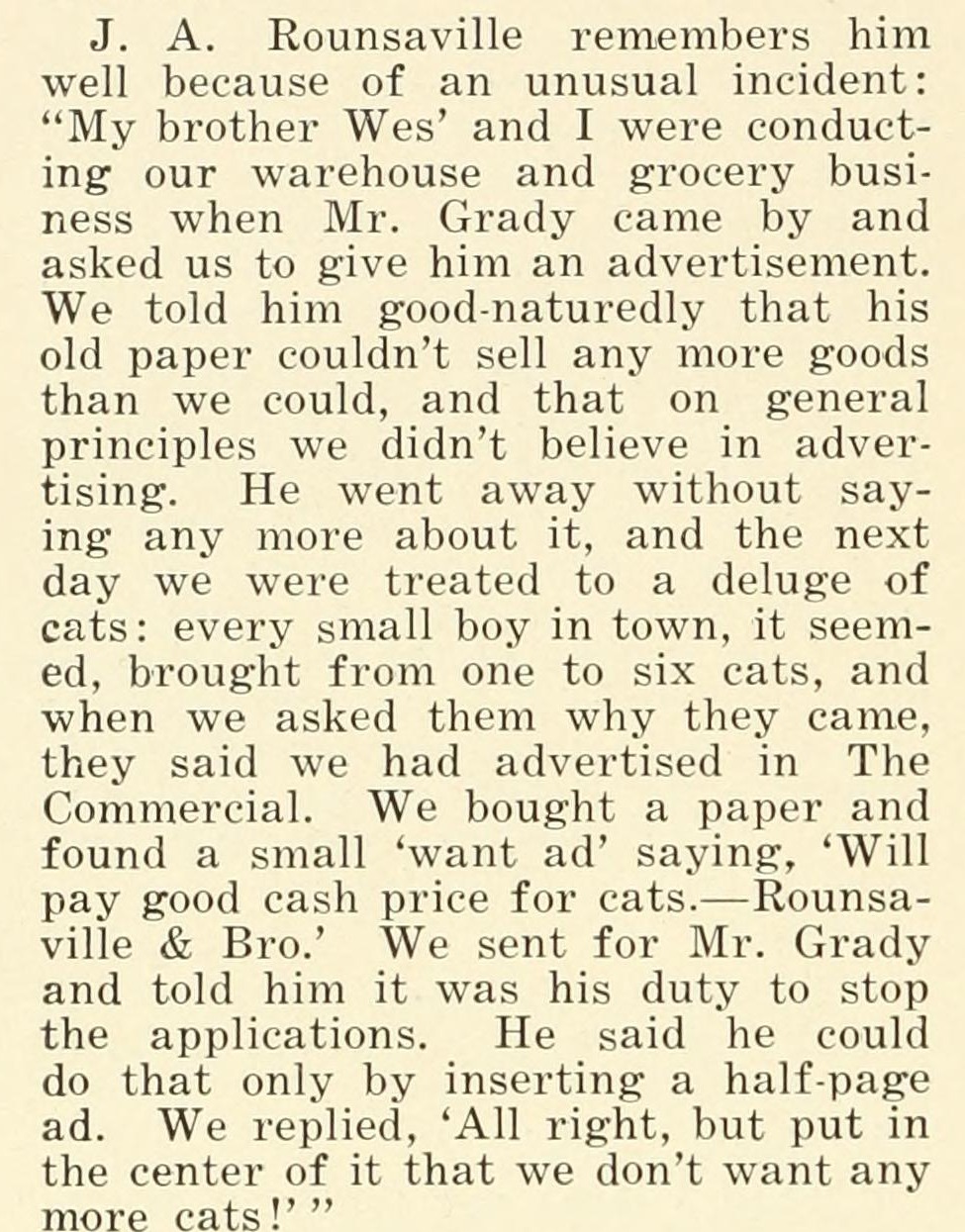
J. A. Rounsaville’s own account, in A History of Rome and Floyd County by George Magruder Battey Jr., Atlanta, 1922, page 252. Internet Archive, public domain. Click the clipping to read it full size.
How the story grew
That is the smallest version of the story, and it came from the man it happened to. Grady went on to become famous. He died in 1889, before he turned 40, and after that the cat story got bigger every time someone told it.
In 1890 the Rome Tribune told it, and papers as far away as California copied it. In that version Wes Rounsaville says, “Why, Grady, nobody reads your paper; it is of no use to advertise in it.” Grady’s ad asks for “Fifty cats; liberal price for the same.” The next morning, boys “from all parts of Floyd county” (the county around Rome) blocked “the sidewalk, doorways and street with bags full of cats.” There were “house cats, yard cats,” “church cats,” “fat cats and lean cats,” and “honest cats and thievish cats.”
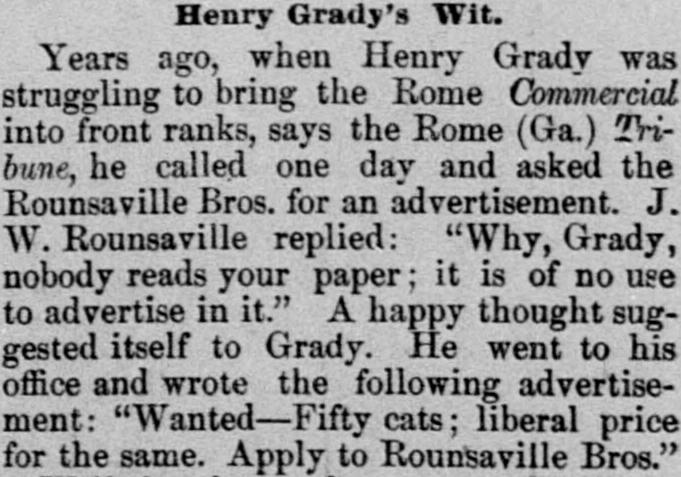
“Henry Grady’s Wit,” from the Rome Tribune. Sacramento Daily Record-Union, Sacramento, California, August 2, 1890, page 1. Library of Congress, Chronicling America. Click the clipping to read it full size.
By 1901 a New York paper had the ad asking for 2,000 cats, “for which we will pay fifty cents each.” Then: “It rained, snowed and hailed cats. Every boy in town stole cats to sell. Farmers hauled them in from the country. The railroads brought them by freight and express. They arrived in sacks, boxes, bags, kegs and barrels.” In this telling Grady “leaned against a telegraph pole splitting with laughter,” shouting, “Nobody reads advertisements, eh? Nobody reads ’em?”
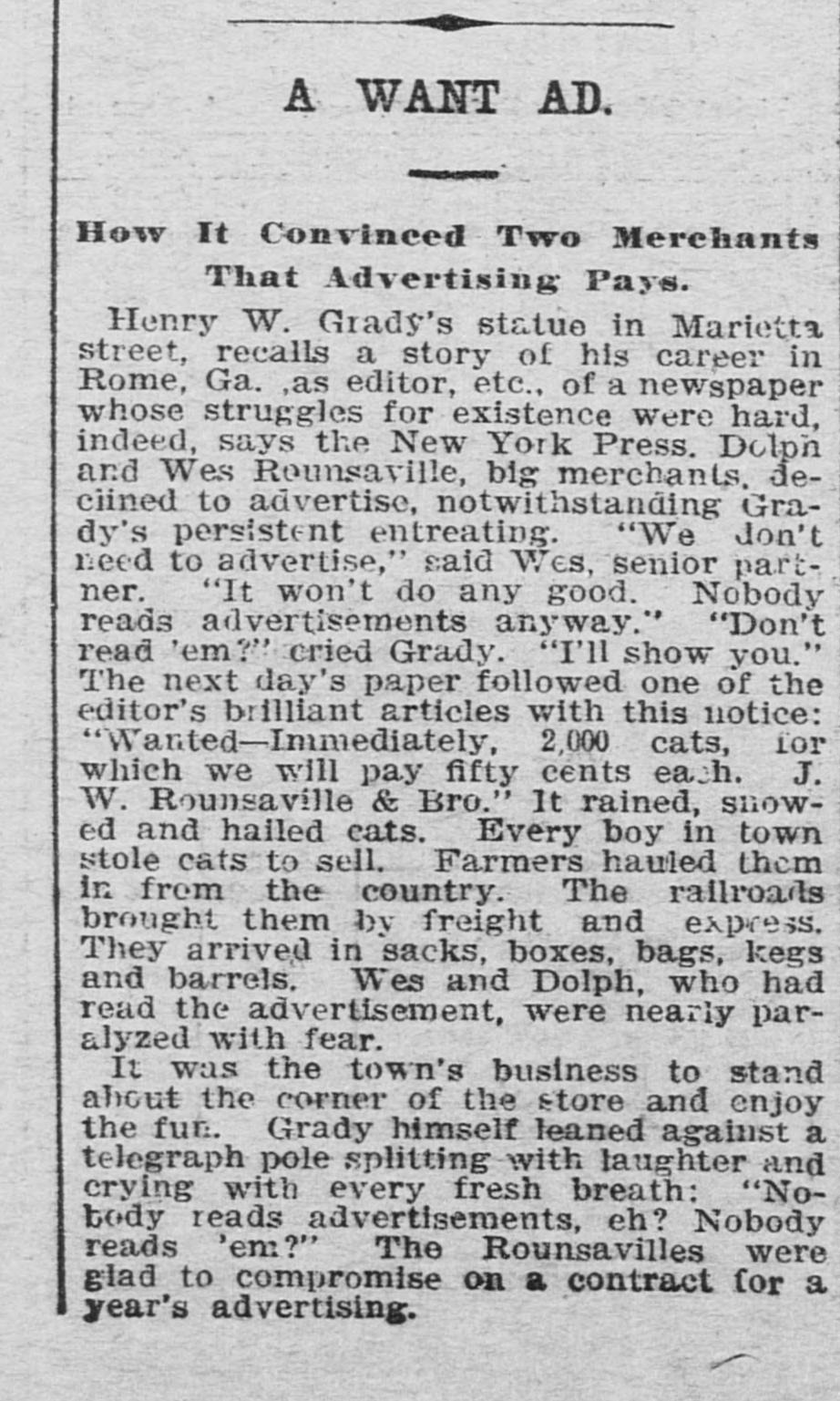
“A Want Ad,” from the New York Press. The Saint Paul Globe, St. Paul, Minnesota, February 10, 1901, page 17. Library of Congress, Chronicling America. Click the clipping to read it full size.
By 1905 the cats were “mounting way past the hundreds and up into the thousands.” Wagons stood “for 40 or 50 yards” outside the store. There were “Gray cats and black cats, tom cats and tabby cats, old cats and young cats, cats in arms, cats in baskets, cats in cages, cats quiet and cats mewing, cats with backs arched and cats softly purring, all there and waiting for the Rounsavilles.” Half the town, the paper said, came to watch.
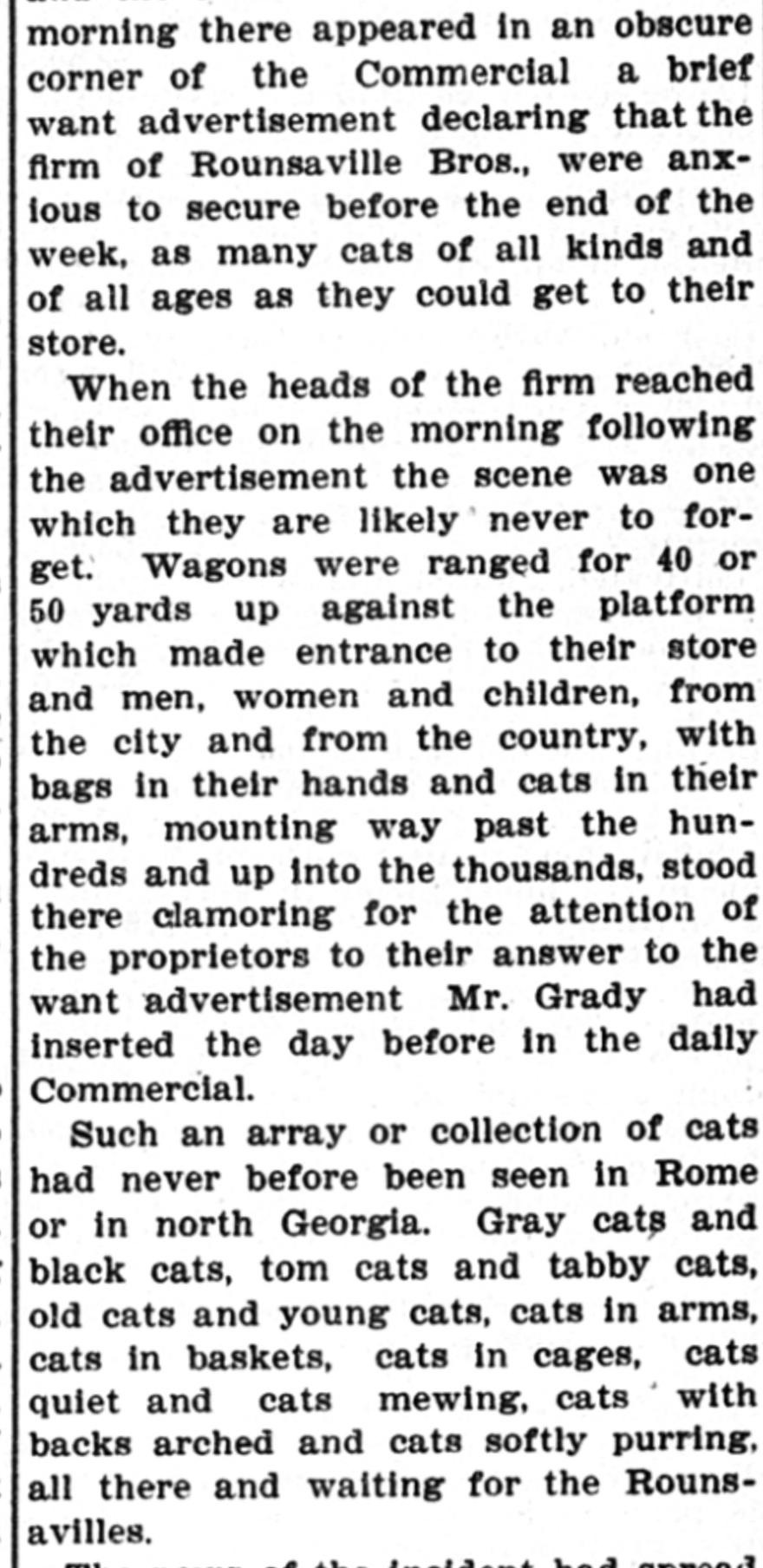
The 1905 version of the cat parade. Yorkville Enquirer, Yorkville, South Carolina, May 12, 1905, page 4. Library of Congress, Chronicling America. Click the clipping to read it full size.
Fifty cats or thousands, nobody really counted. Every version agrees on the ending, though. The 1890 story says the Rounsavilles told Grady “to reserve a column for their advertisement as long as his paper continued.” The 1905 story says their ad never left the Commercial again.
The editor nobody paid
Henry Woodfin Grady was born in Athens, Georgia, on May 24, 1850. He and Will bought the Rome Commercial in July 1870, when Henry was 20, and sold it in November 1872. So the cat ad ran somewhere in those two years. The paper lost money the whole time. Rome old-timers remembered Henry running up candy bills of “$15 at a time” and leaving town with the bill collectors close behind.
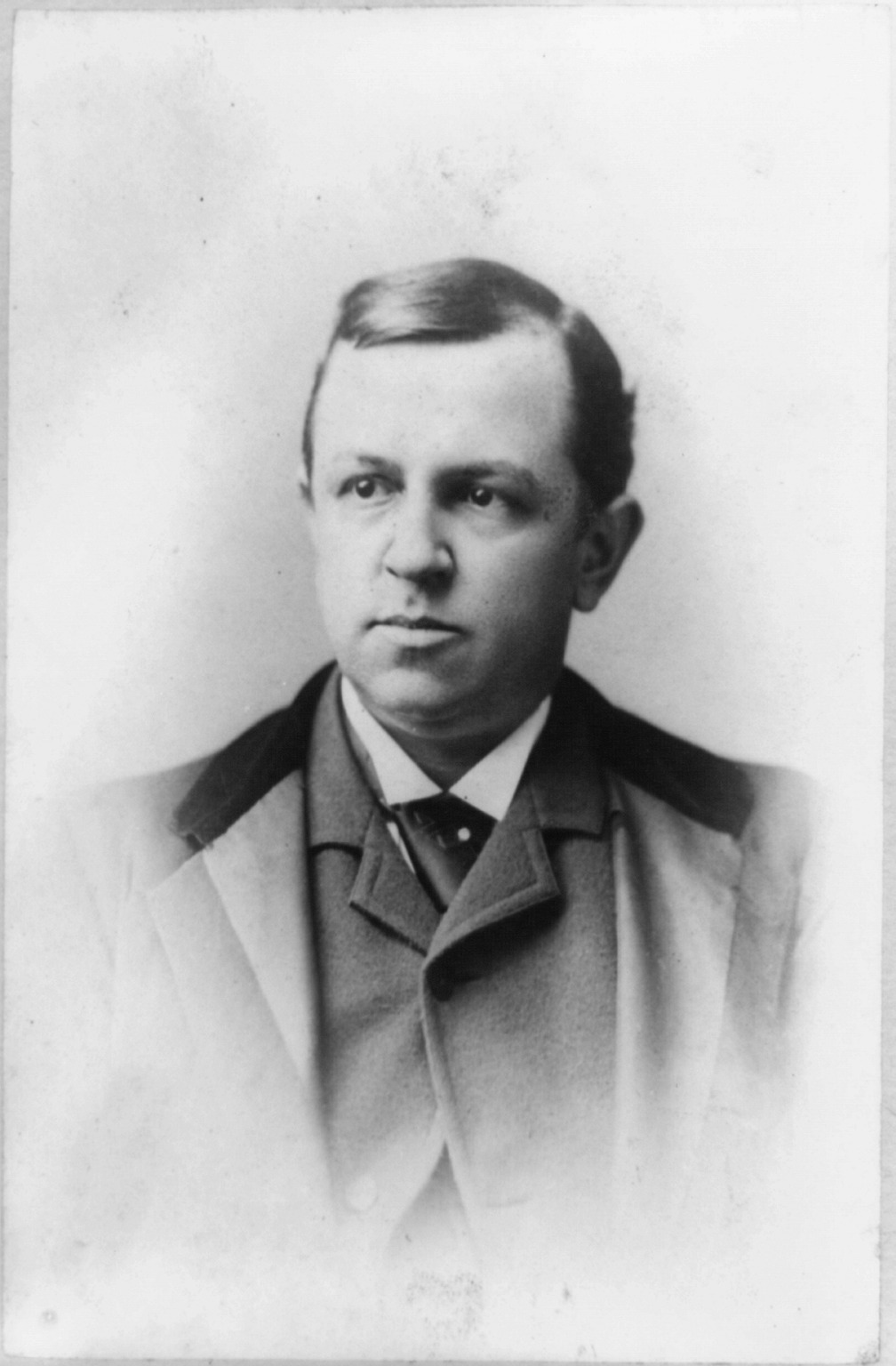
Henry W. Grady, half-length portrait, facing left. Photograph copyrighted in Atlanta, 1889. Library of Congress, Prints and Photographs Division, no known restrictions on publication. Click the clipping to read it full size.
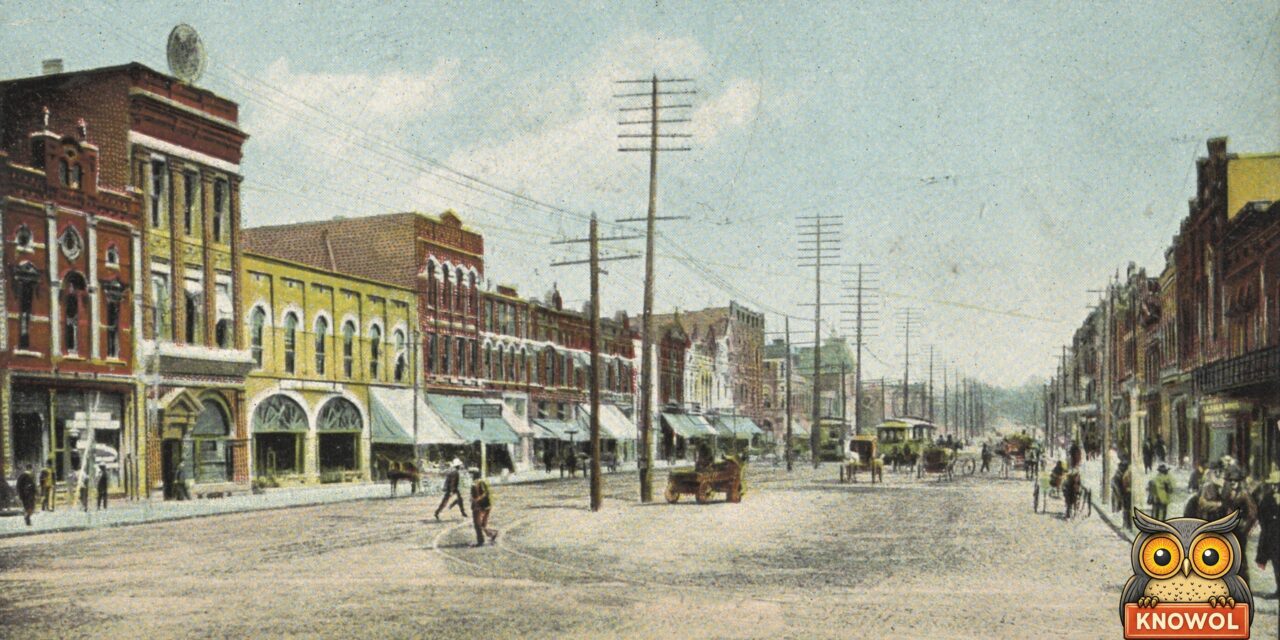
His office was “about the middle of the Hotel Forrest block on Broad,” the main street. The cover of this story shows Broad Street on a postcard printed between 1890 and 1920, a few decades after Grady’s day. One Rome man, A. Rawlins, remembered walking into that office to pay for his subscription. Grady looked at him hard. “Do you really mean that you voluntarily want to pay a subscription to this newspaper?” he asked. Rawlins said yes. Grady called him “the first man I have met in this community who wanted to do that. I have worn out $49 worth of shoe leather calling on the others.”
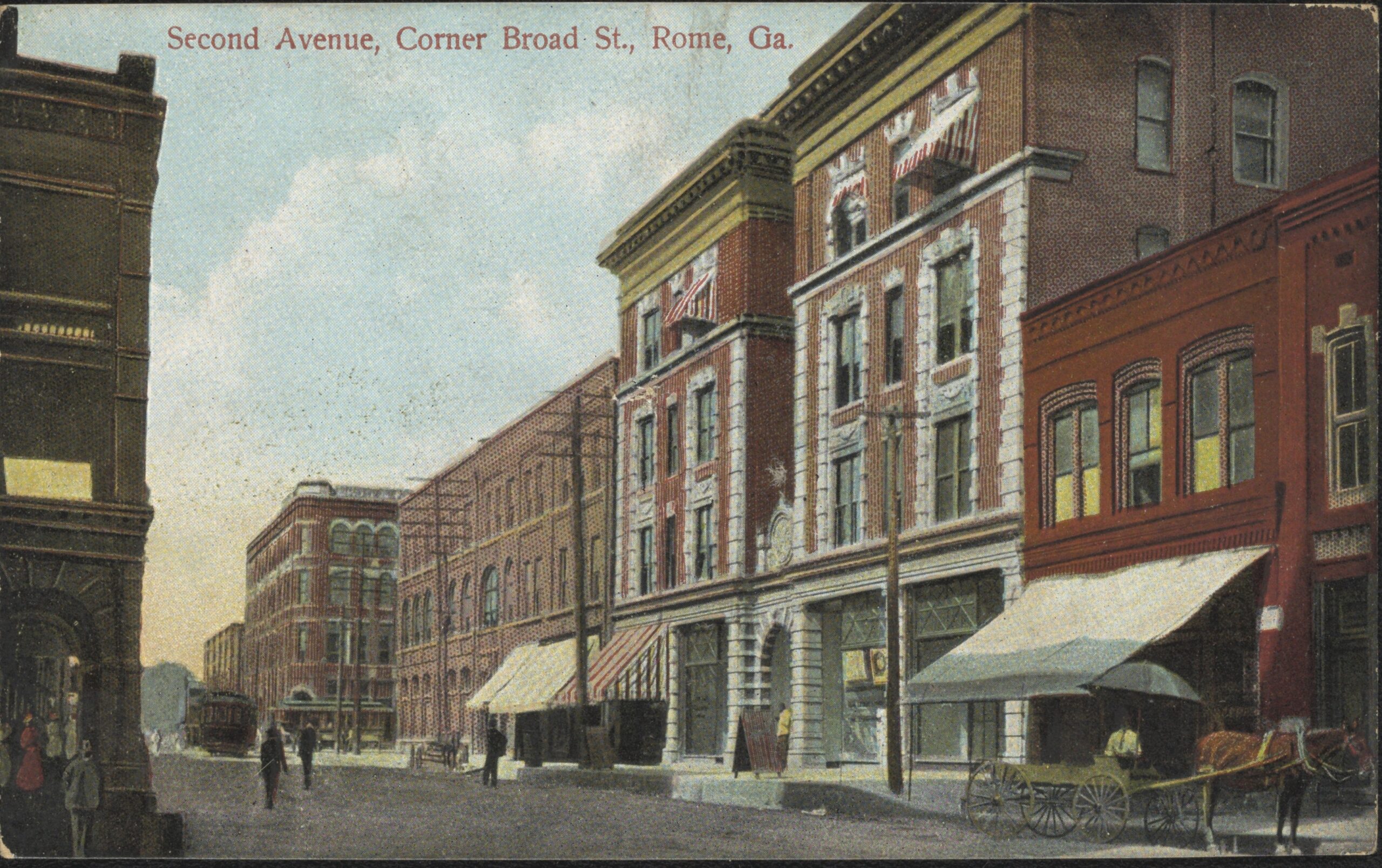
Second Avenue, Corner Broad St., Rome, Ga. Postcard by the International Post Card Co., printed between 1890 and 1920. Library of Congress, Prints and Photographs Division. Click the picture to see it full size.
In Atlanta, Georgia, Grady became editor of the Atlanta Constitution and one of the most famous speakers in the country. He died in Atlanta on December 23, 1889. In the fall of 1891 a bronze statue of him went up on Marietta Street, paid for by gifts from all over the country, and the 1901 version of the cat story opens with that statue.
The same trick, in Atlanta, in 1905
The cat story came back in the papers in May 1905 because somebody in Atlanta had just done it again. A club called the Ten Literary Club had a rule in its constitution: “at each meeting some practical joke be played on one of the members or guests.” The members picked Sam D. Jones, a big Atlanta manufacturer. Then “want ads were put in the newspapers, in which Mr. Jones announced his willingness to purchase all cats brought to his home.”
“The home of the victim was literally deluged with cats,” the Atlanta Constitution reported: “old cats and kittens, large cats and small cats, white cats and black cats, mouser cats and maltese cats, a wild cat and a pole cat.” A pole cat is a skunk. The paper figured about 500 cats came to the door, “outside of those offered over the ‘phone.”
Jones announced “positively and unequivocally that he does not want cats or anything looking like a cat.” He added, “I am going to sit on the next man who brings me a cat for sale.” His wife took it better. “Cat calls are getting monotonous,” said Mrs. Jones, “but wasn’t it a good joke on Sam?”
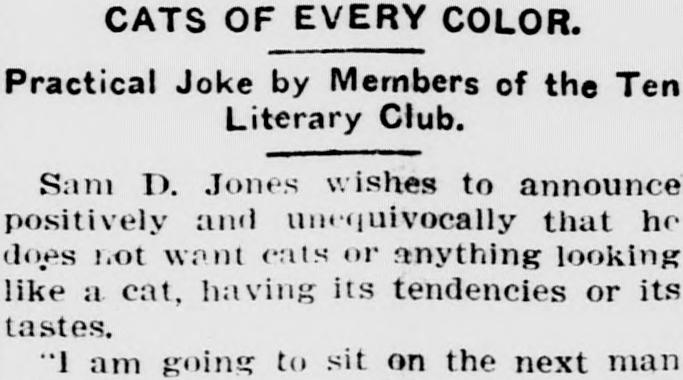
“Cats of Every Color,” from the Atlanta Constitution. Daily Kennebec Journal, Augusta, Maine, August 5, 1905, page 3. Library of Congress, Chronicling America. Click the clipping to read it full size.
Sixteen years after Henry Grady died, his seven-word ad still worked. People read the paper. Especially the boys, and especially when it said cats.
Sources
- Yorkville Enquirer (Yorkville, South Carolina): May 12, 1905, page 4 (“A Lesson in Advertising. How Henry W. Grady Convinced a Georgia Merchant”). The same story ran in The Watchman and Southron (Sumter, South Carolina), May 10, 1905, page 7.
- Sacramento Daily Record-Union (Sacramento, California): August 2, 1890, page 1 (“Henry Grady’s Wit,” credited to the Rome, Georgia, Tribune).
- The Saint Paul Globe (St. Paul, Minnesota): February 10, 1901, page 17 (“A Want Ad,” credited to the New York Press).
- Daily Kennebec Journal (Augusta, Maine): August 5, 1905, page 3 (“Cats of Every Color,” credited to the Atlanta Constitution).
- George Magruder Battey Jr., A History of Rome and Floyd County (Atlanta, 1922): pages 250 to 252 (the Commercial’s dates, Grady’s office on Broad Street, the Rawlins story, and J. A. Rounsaville’s account of the cats). Internet Archive.
- Lucian Lamar Knight, Georgia’s Landmarks, Memorials and Legends (1913): the Grady monument (unveiled in the fall of 1891; the dates of his birth and death are carved on it). Internet Archive.
- Henry W. Grady, half-length portrait, c1889, Library of Congress, no known restrictions on publication.
- Second Avenue, Corner Broad St., Rome, Ga., postcard, Library of Congress, printed between 1890 and 1920.
- All newspaper images: Library of Congress, Chronicling America. Published 1890 to 1905.
- Cover: View on Broad St., Rome, Ga., postcard by the International Post Card Co., printed between 1890 and 1920, Library of Congress. It shows Broad Street a few decades after Grady’s newspaper office stood there.