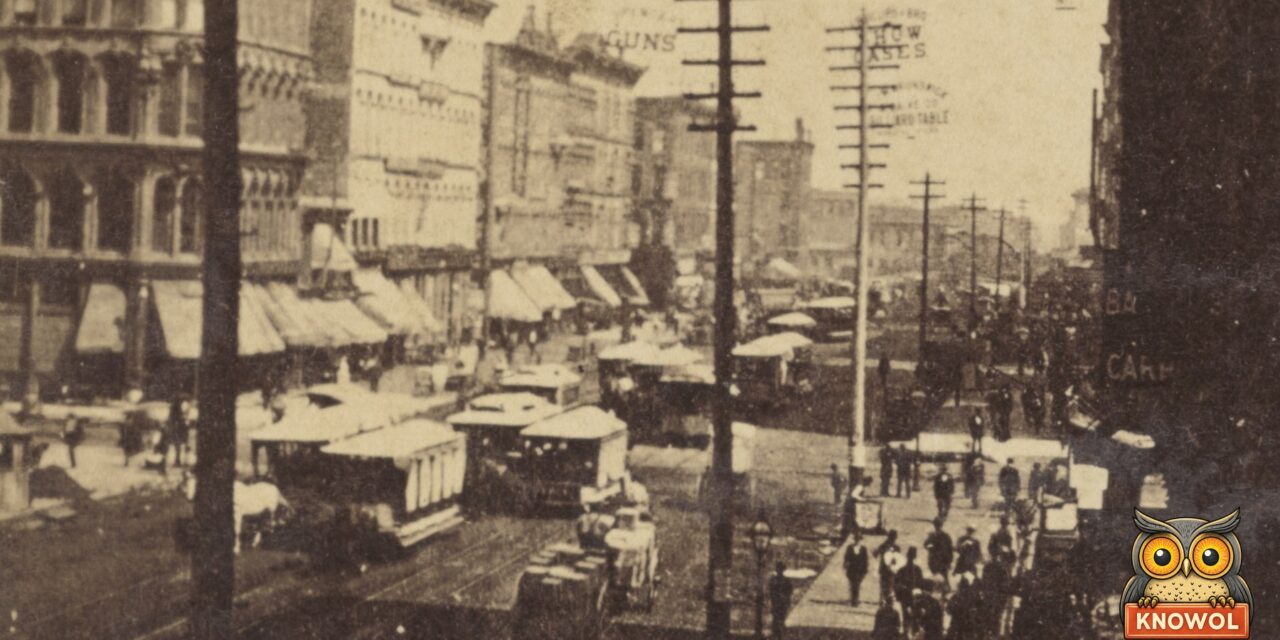
On March 19, 1874, the Chicago Tribune had good news for baseball fans. Four players of the White Stockings, the city’s professional ball club, had arrived in town, and the rest of the team was due by Saturday. Chicago had gone two whole summers without a team of its own. The reason was the Great Fire.
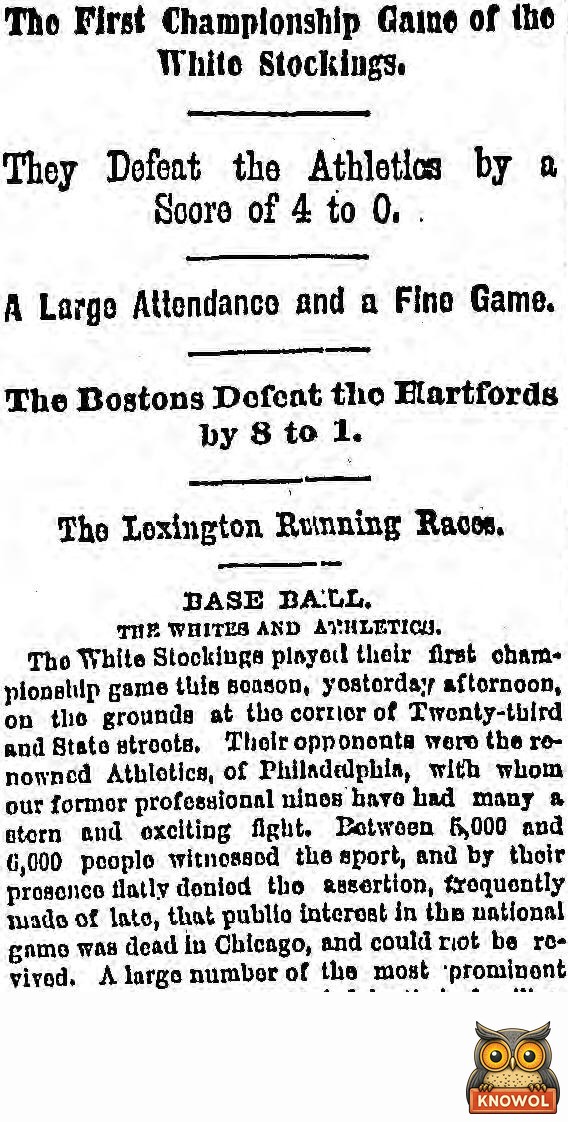
“The First Championship Game of the White Stockings.” Chicago Daily Tribune, Chicago, Illinois, May 14, 1874, page 8. Library of Congress, Chronicling America. Click the clipping to read it full size.
The fire took the ball club, too
In October 1871, fire burned the heart of Chicago, Illinois. Stores, hotels, churches and thousands of homes were lost. The White Stockings were lost too, in their own way. A big history of Chicago printed in 1886 says the club sat out the 1872 and 1873 seasons. The city had more serious work to do than play ball.
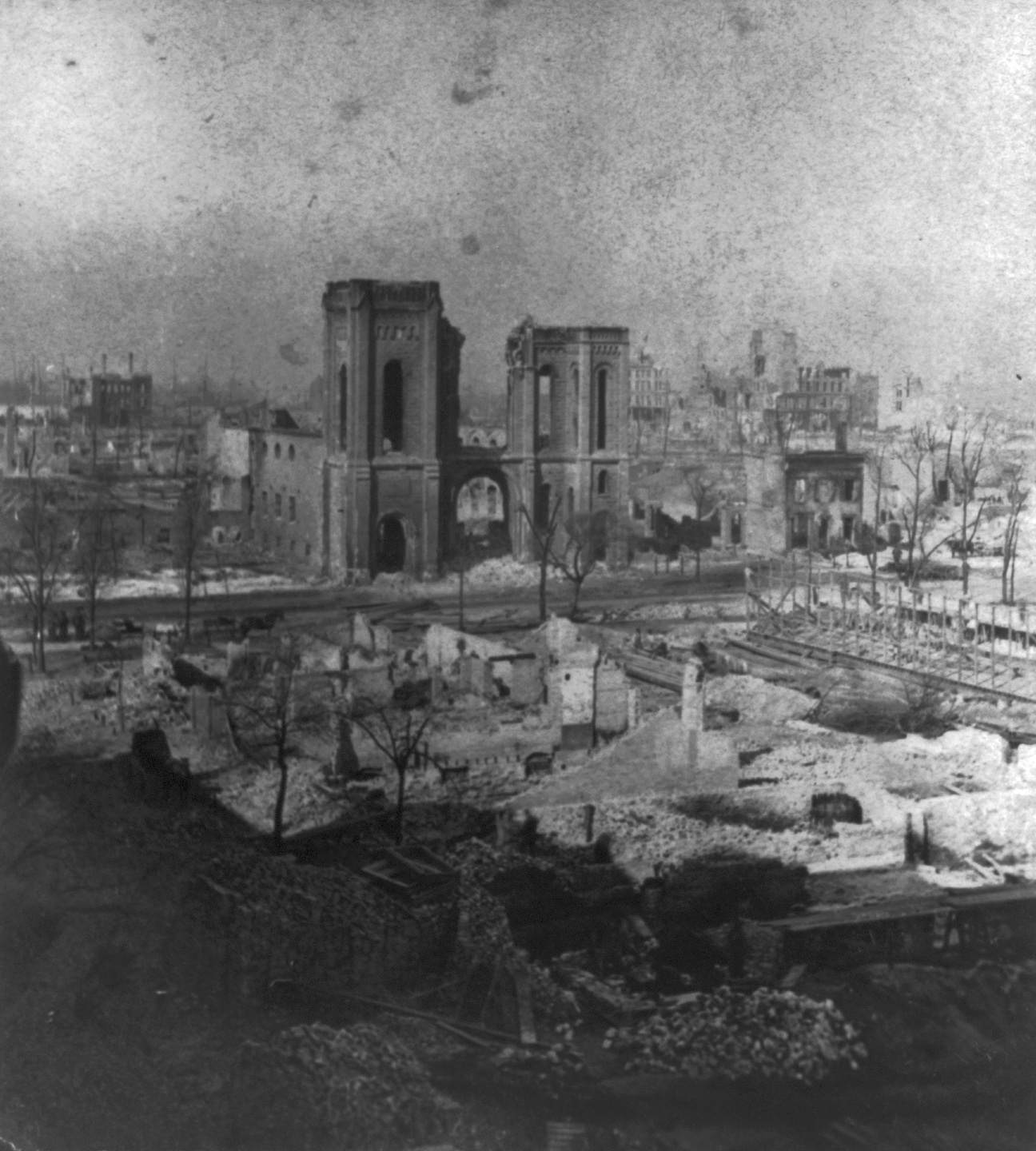
Chicago in ruins after the Great Fire of October 1871, looking northwest from a Michigan Avenue hotel. Stereograph photo by Copelin & Hine, Chicago. Library of Congress Prints and Photographs Division. Click the picture to see it full size.
In March 1872, the people who owned shares in the club met to settle up. They didn’t meet in a fancy office. They met at Brewster’s hat store on State Street. The Tribune called the club “defunct,” an old word for dead and gone. Even its records were gone. The secretary, Mr. Thacher, had lost “his books and papers in the big fire,” and he wouldn’t make up the numbers by guessing. So a committee split what was left of the last season’s money among the players.
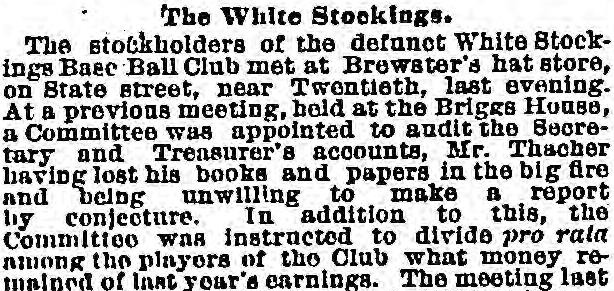
“The White Stockings.” Chicago Tribune, Chicago, Illinois, March 2, 1872, page 2. Library of Congress, Chronicling America. Click the clipping to read it full size.
Spring comes back
By 1874, Chicago had built itself back up, and the ball club was coming back too. A letter from Chicago in the New York Herald, dated March 12, put it this way: “The mild spring breezes and genial sun have vivified the lovers of the national game.” Vivified means brought back to life. The club’s president, Mr. Gassette, told his players to report the next week.
The Herald also said what the team would wear. “The uniform of 1874 will be white, with black shoes and belt; the cap white, with black band and cord.” The home grounds would be at the corner of State and Twenty-third streets, on the city’s South Side.
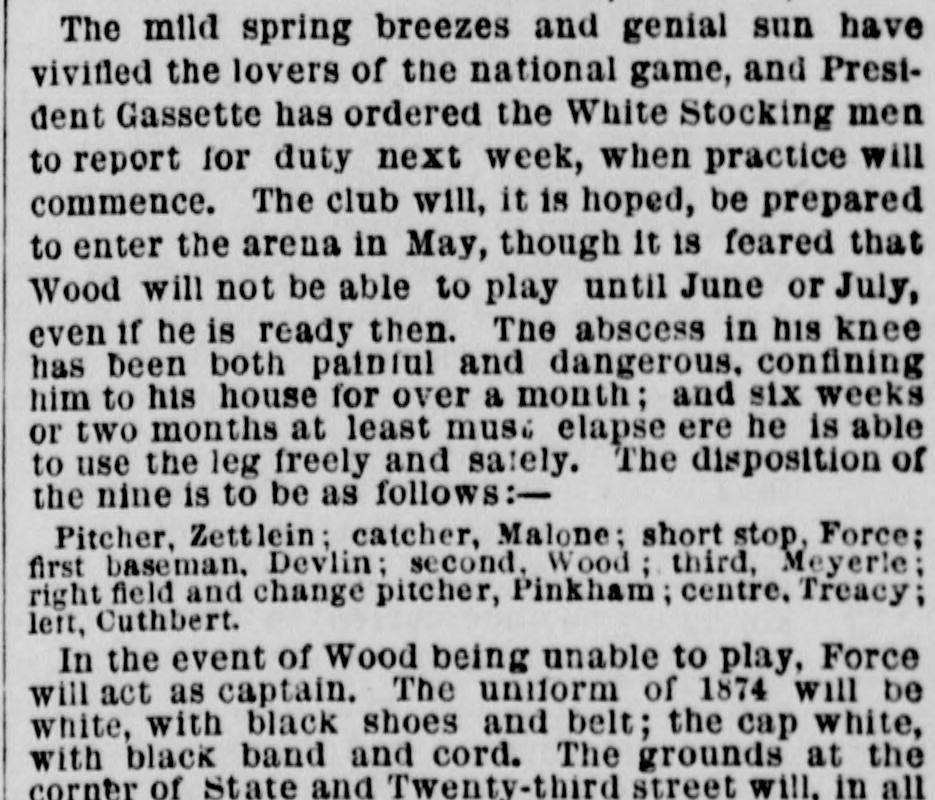
From “Sport in Chicago.” The New York Herald, New York, New York, March 16, 1874, page 3. Library of Congress, Chronicling America. Click the clipping to read it full size.
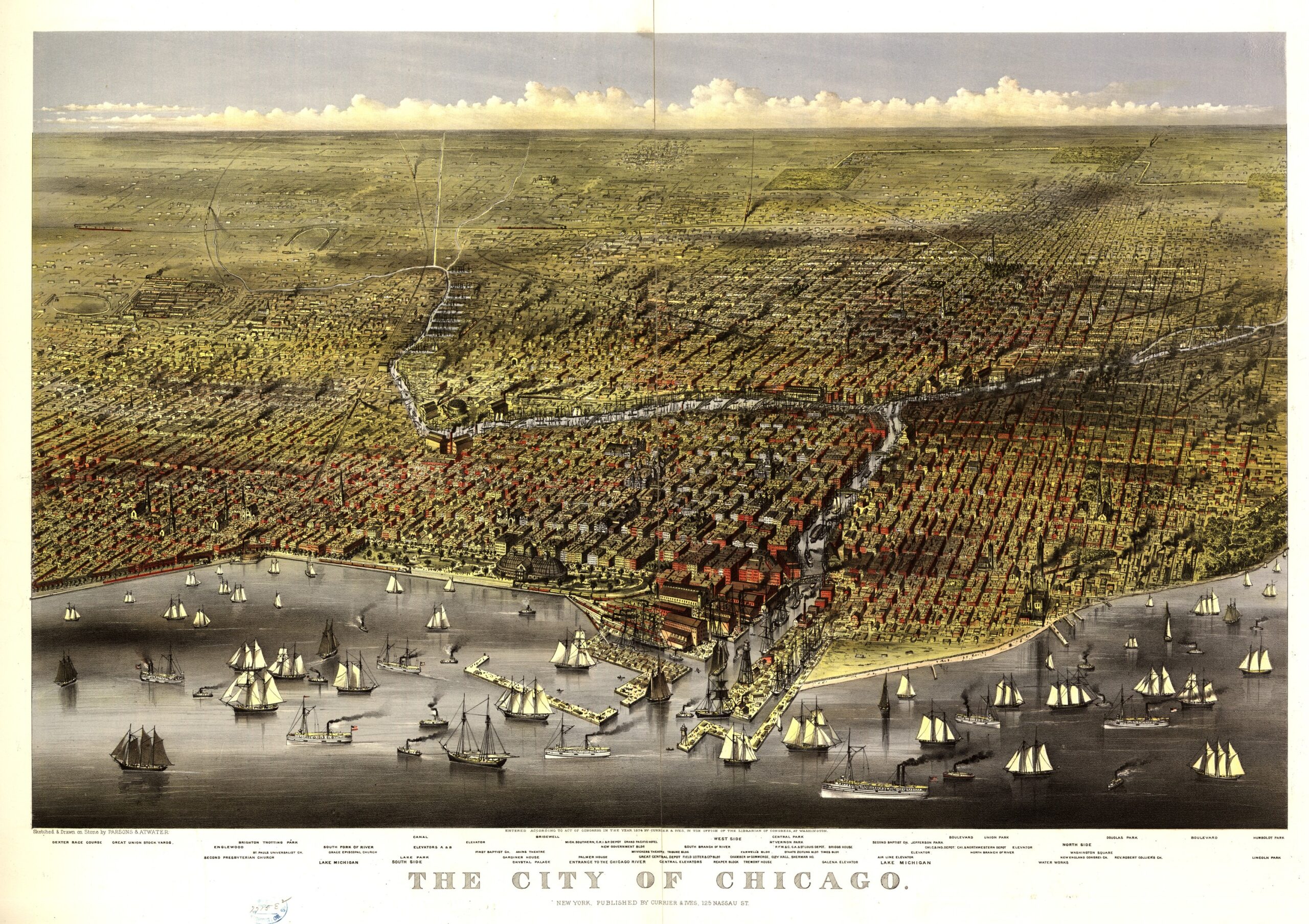
“The City of Chicago,” a bird’s-eye view drawn on stone by Parsons & Atwater and published by Currier & Ives in 1874, the year the White Stockings came home. Library of Congress Geography and Map Division. Click the picture to see it full size.
“You must be gentlemen”
Then came the Tribune’s welcome on March 19. The pitcher, Zettlein, had the nickname “Charmer.” The paper said work on the grounds would start that very day, and practice would begin Monday if the good weather held.
It also had a few words for the new team, friendly but firm. Winning, it said, took more than luck: “it is not luck that wins this trophy now, but hard work, temperance, and batting.” Temperance meant staying away from strong drink. Chicago would give “plenty of praise for good work,” the paper promised, but no excuses for a player who acted like a “bummer,” a lazy loafer. Then came one short line that said it all: “You must be gentlemen if you want our support.”
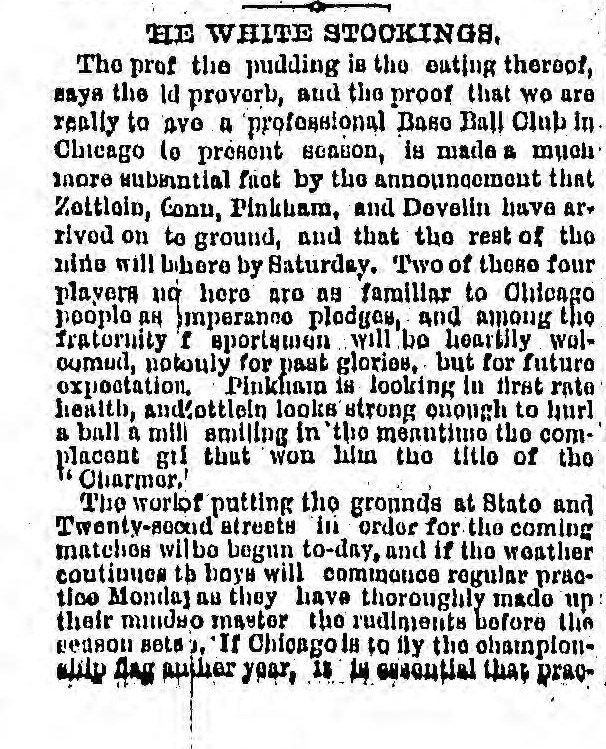
“The White Stockings.” Chicago Daily Tribune, Chicago, Illinois, March 19, 1874, page 3. The left edge of the old page is worn. Library of Congress, Chronicling America. Click the clipping to read it full size.
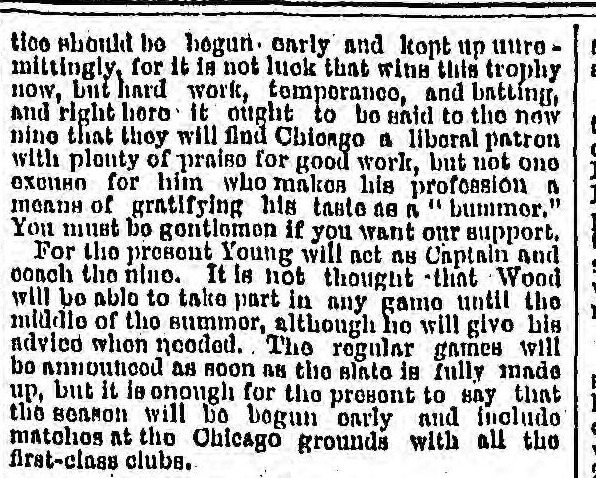
The end of the same story, at the top of the next column. Chicago Daily Tribune, March 19, 1874, page 3. Library of Congress, Chronicling America. Click the clipping to read it full size.
5,000 fans and a 4 to 0 win
The real test came on Wednesday afternoon, May 13, 1874. The White Stockings played their first championship game of the season at home. A championship game was an official game in the National Association, the top pro league of the day, and it counted toward the pennant, the champion’s flag. The other team was the famous Athletics of Philadelphia.
Some people had been saying that Chicago didn’t care about baseball anymore. The crowd answered them. “Between 5,000 and 6,000 people witnessed the sport,” the Tribune wrote, “and by their presence flatly denied the assertion, frequently made of late, that public interest in the national game was dead in Chicago, and could not be revived.”
And Chicago won, 4 to 0. The Tribune was honest about how. The home club “was outbatted and outfielded,” it admitted, and won on “great nerve” at the big moments. Zettlein pitched “a shrewd and faultless game.” The Athletics said they had been “beaten by luck.” The Tribune’s answer started with one word, “Granted,” and then it pointed out that the Athletics had enjoyed some luck of their own.
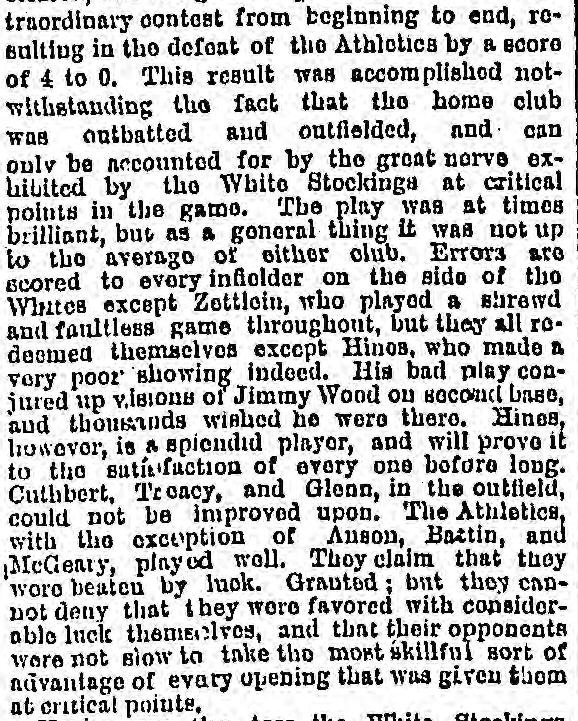
From “The First Championship Game of the White Stockings.” Chicago Daily Tribune, May 14, 1874, page 8. Library of Congress, Chronicling America. Click the clipping to read it full size.
One more name hides in that story. The Tribune said the Athletics all played well “with the exception of Anson, Battin, and McGeary.” Two years later, that same Anson was wearing a Chicago uniform.
A ball game on the fire’s anniversary
On October 9, 1874, Chicago marked three years since the fire. The Tribune called it “the anniversary of the Great Fire, and a sort of general holiday besides.” The White Stockings spent the day the best way they knew. They played a practice game against the Philadelphias, a second pro team from Philadelphia, at State and Twenty-third streets.
Only a few hundred fans came, because hardly anyone had heard about it. The ones who did saw something odd. To make the game more fun, “ten innings were played, with ten men on a side.” A regular game had nine innings and nine players a side.
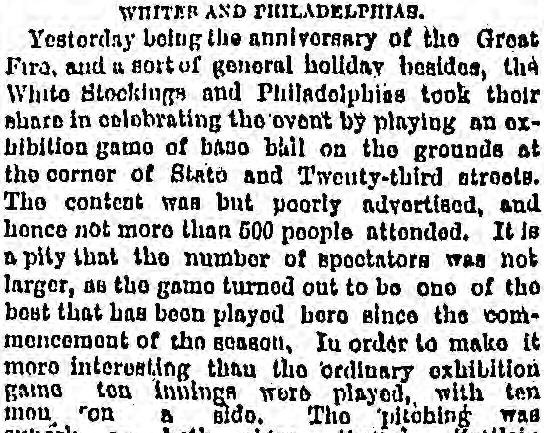
“Whites and Philadelphias.” Chicago Daily Tribune, Chicago, Illinois, October 10, 1874, page 12. Library of Congress, Chronicling America. Click the clipping to read it full size.
By the numbers
- 2: summers Chicago went without its pro ball club, 1872 and 1873.
- 5,000 to 6,000: fans at the first home championship game, May 13, 1874.
- 4 to 0: the score that day.
- 10: innings, and players on each side, in the fire anniversary game.
- 1876: the year Chicago’s club became the champions.
Champions
The comeback didn’t stop there. By 1876, the Chicago club was the champion club of baseball. A print of the 1876 and 1877 team came out in April 1877 under two big words, “Chicago Champions.” Two of the faces, Hines and Glenn, had played in that 4 to 0 game in May 1874. Anson, the young man from the Athletics, is on it too. The same club still plays today. It’s called the Chicago Cubs.
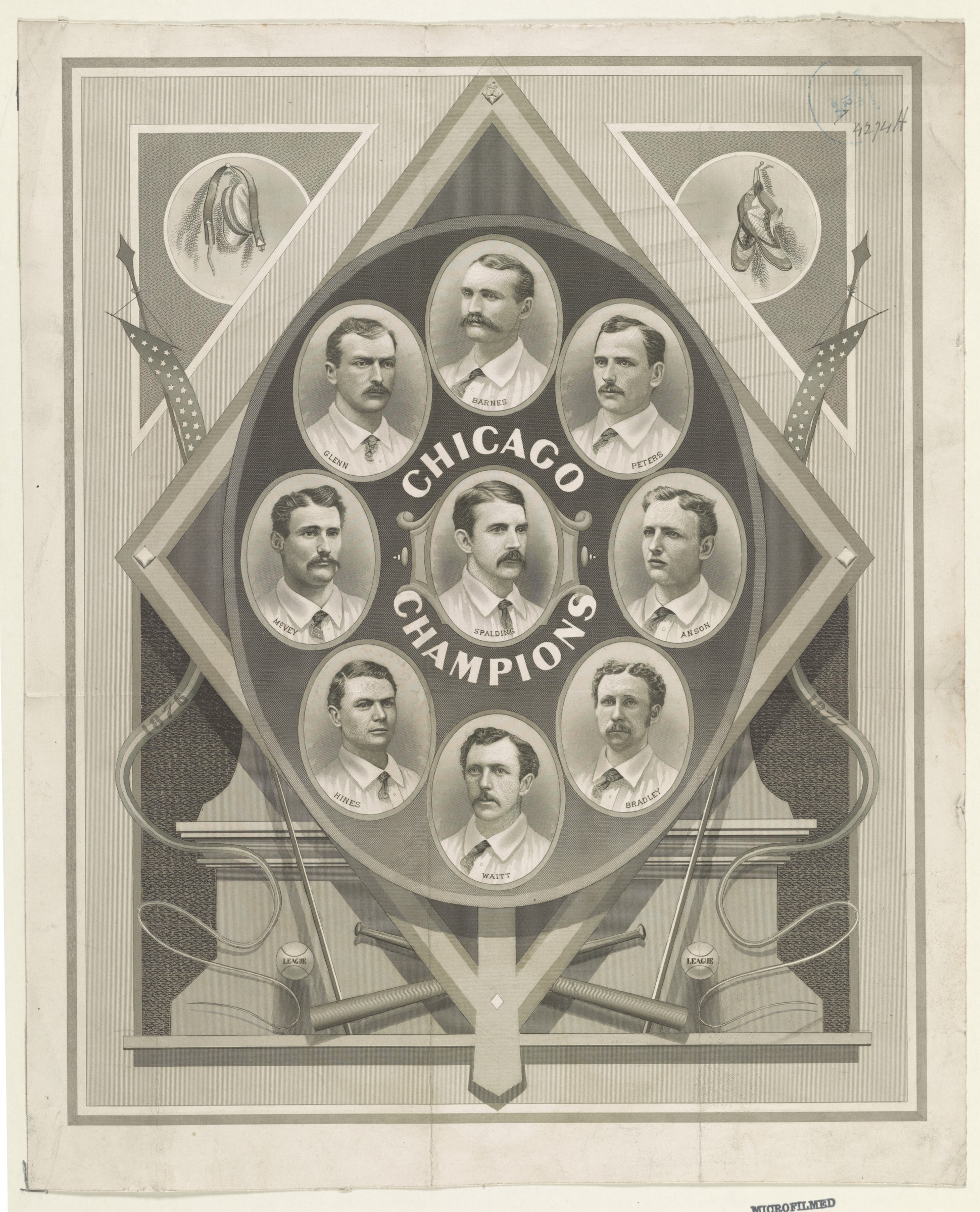
“Chicago Champions,” a print of the 1876 and 1877 White Stockings. Clockwise from the top: Barnes, Peters, Anson, Bradley, Waitt, Hines, McVey and Glenn, with Al Spalding in the center. Barbeck & McRay, 1877. Library of Congress Prints and Photographs Division. Click the picture to see it full size.
The photo at the top of this story shows State Street in Chicago on an old stereograph card, with horse-drawn streetcars rolling down the middle. It’s the same street where the club’s owners once met in a hat store to divide up the money of a team that was gone. A few years later, farther south on that same street, more than 5,000 people came out to cheer it home. Twelve summers after that, the club’s president had a new worry about his players and that word “temperance.” That’s another story: Why Chicago Sent Its Champion Ball Club to Hot Springs, Arkansas, to Dry Out.
Sources
- Chicago Daily Tribune (Chicago, Illinois): “The White Stockings,” March 19, 1874, page 3; “The First Championship Game of the White Stockings,” May 14, 1874, page 8; “Whites and Philadelphias,” October 10, 1874, page 12. Library of Congress, Chronicling America.
- “The White Stockings,” Chicago Tribune (Chicago, Illinois), March 2, 1872, page 2. Library of Congress, Chronicling America.
- “Sport in Chicago,” The New York Herald (New York, New York), March 16, 1874, page 3. Library of Congress, Chronicling America.
- A. T. Andreas, History of Chicago, volume 3 (Chicago, 1886), on the club sitting out 1872 and 1873 after the fire. Internet Archive.
- Chicago, a History and Forecast (Chicago Association of Commerce, 1921), on the grounds at State and Twenty-third streets and the 1876 champions. Internet Archive.
- Pictures: State Street, Chicago (stereograph, the cover); The Chicago Fire, view of the city in ruins (Copelin & Hine stereograph); The City of Chicago (Currier & Ives, 1874); Chicago Champions (Barbeck & McRay, 1877). Library of Congress. No known restrictions on publication.