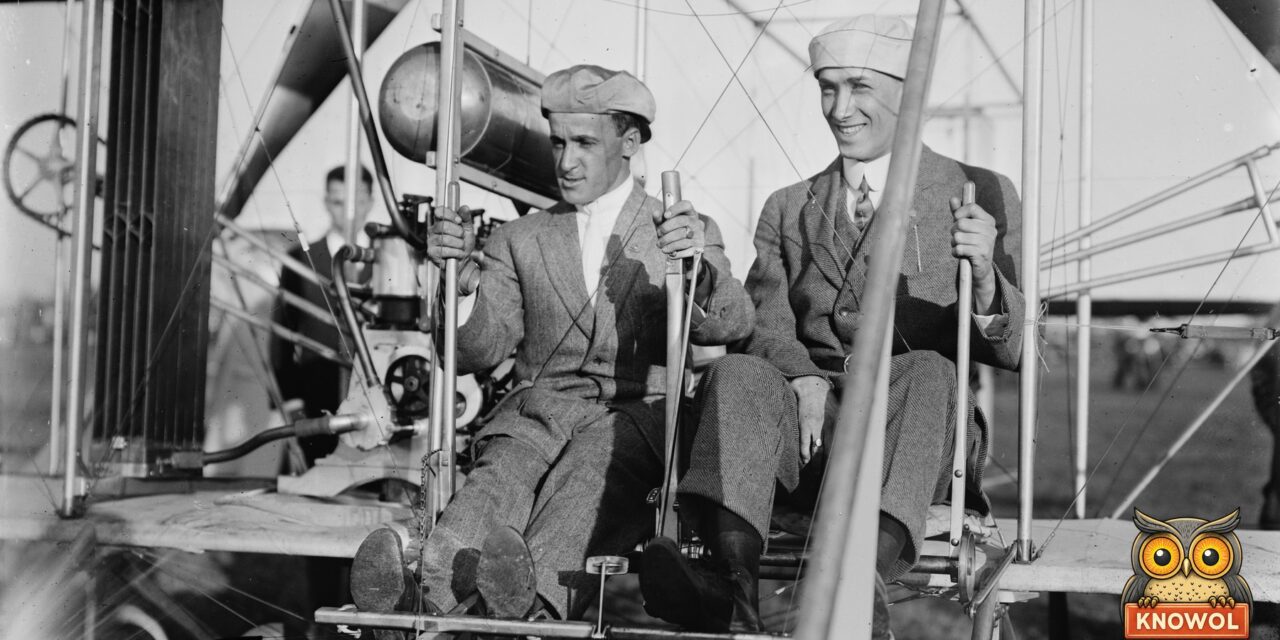
On the afternoon of July 4, 1911, a big man in a business suit walked across a flying field in Corpus Christi, Texas. His name was F. Z. Bishop. He had spent the year before building a whole new town out of brush and cactus, and he had put his own name on it. Now he climbed onto the seat of a Wright biplane, a flying machine made of wood, wire and cloth, and sat down next to the pilot. There were no walls around him and no roof over him. Then the engine roared, and up they went.
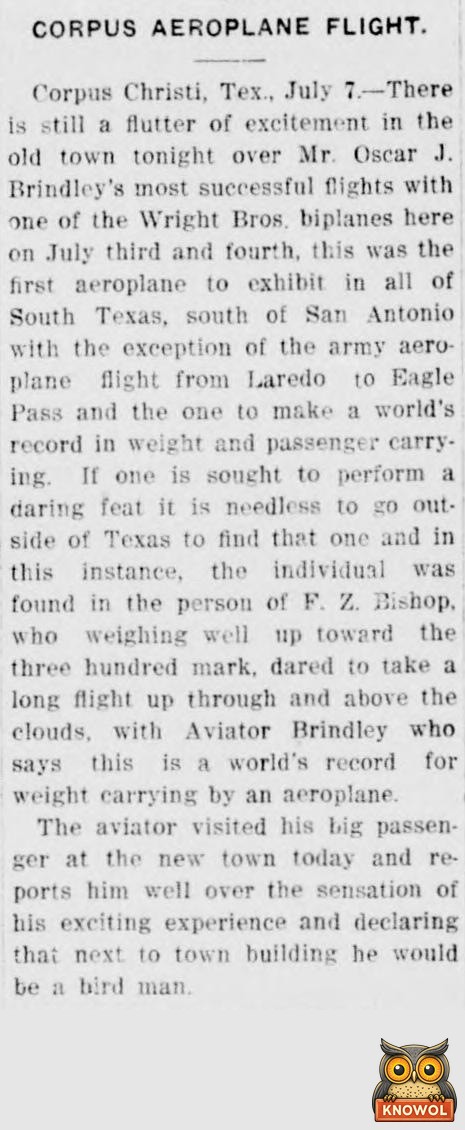
“Corpus Aeroplane Flight.” Laredo Weekly Times, Laredo, Texas, July 9, 1911, page 11. Library of Congress, Chronicling America. Click the clipping to read it full size.
A flying machine comes to South Texas
Corpus Christi threw a big Fourth of July party that year. It lasted two days, Monday, July 3, and Tuesday, July 4. Special trains brought crowds from as far away as Laredo. The hometown paper, the Weekly Corpus Christi Caller, said ten thousand people came. There were sailboat races on the bay and baseball games against Laredo. But the star of the show was the airplane.
The Laredo Weekly Times said it was “the first aeroplane to exhibit in all of South Texas, south of San Antonio.” The only one before it was an Army plane that had flown from Laredo to Eagle Pass. Most people in the crowd had never seen a flying machine at all.
The pilot was Oscar Brindley, a young flyer for the Wright Brothers’ company of Dayton, Ohio. He was new at the job, too. A few weeks later, the Seattle Star said Brindley “only began flying last May, when the Wrights took him into their school at Dayton.” So when he came to Corpus Christi, he had been a pilot for about two months.
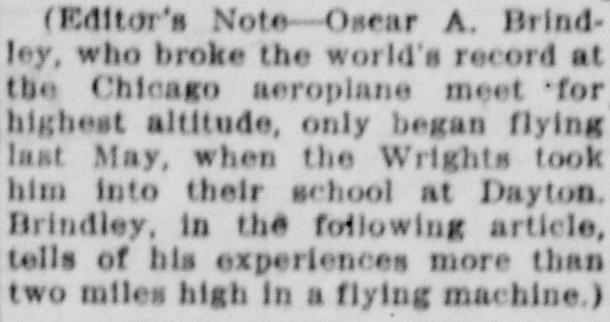
Oscar Brindley was a brand-new pilot in 1911. The Seattle Star, Seattle, Washington, August 25, 1911, page 4. Library of Congress, Chronicling America. Click the clipping to read it full size.
On Monday morning, the biplane was rolled out of its hangar, which is a big shed for an airplane. People crowded around Brindley and asked him everything they could think of. The Caller said they “bombarded him with good natured queries concerning every detail of the flying business, some of the questions being even beyond the capacity of the expert to answer.” In other words, even the pilot didn’t know all the answers.
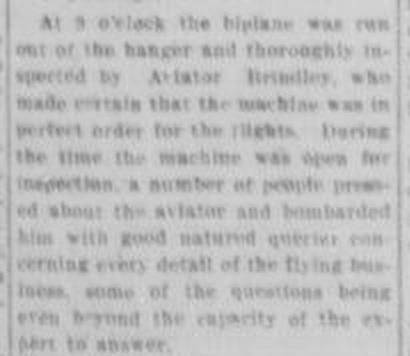
The crowd’s questions. The Weekly Corpus Christi Caller, Corpus Christi, Texas, July 7, 1911, page 2. The Portal to Texas History, via Wikimedia Commons. Click the clipping to read it full size.
Like a bird, but no song
Brindley gave the crowd a show. He climbed high, then came down in tight circles called a spiral glide. Near the ground he swooped back up again.
The Wright planes didn’t have wing flaps like airplanes today. To turn, the pilot pulled a lever that twisted the tips of the wings, a trick called wing warping. Brindley made the plane bob up and down over the field, which the Caller called “a sort of aerial gallop,” like a running horse. The Caller said he did it “until the machine’s bird nature was brought out so convincingly that only the warble was missing.” A warble is a bird’s song. The plane looked like a bird, but it couldn’t sing.
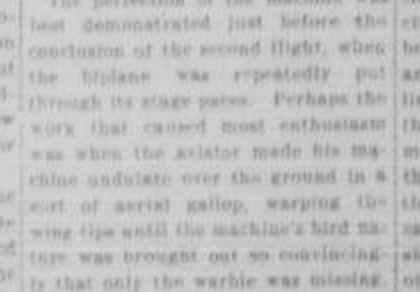
“Only the warble was missing.” The Weekly Corpus Christi Caller, Corpus Christi, Texas, July 7, 1911, page 1. The Portal to Texas History, via Wikimedia Commons. Click the clipping to read it full size.
The man who built a town
On Tuesday afternoon, Brindley made the last flights of the show. For one of them he took a passenger. The Caller said “F. Z. Bishop, the founder of the city bearing his name, volunteered as a passenger.”
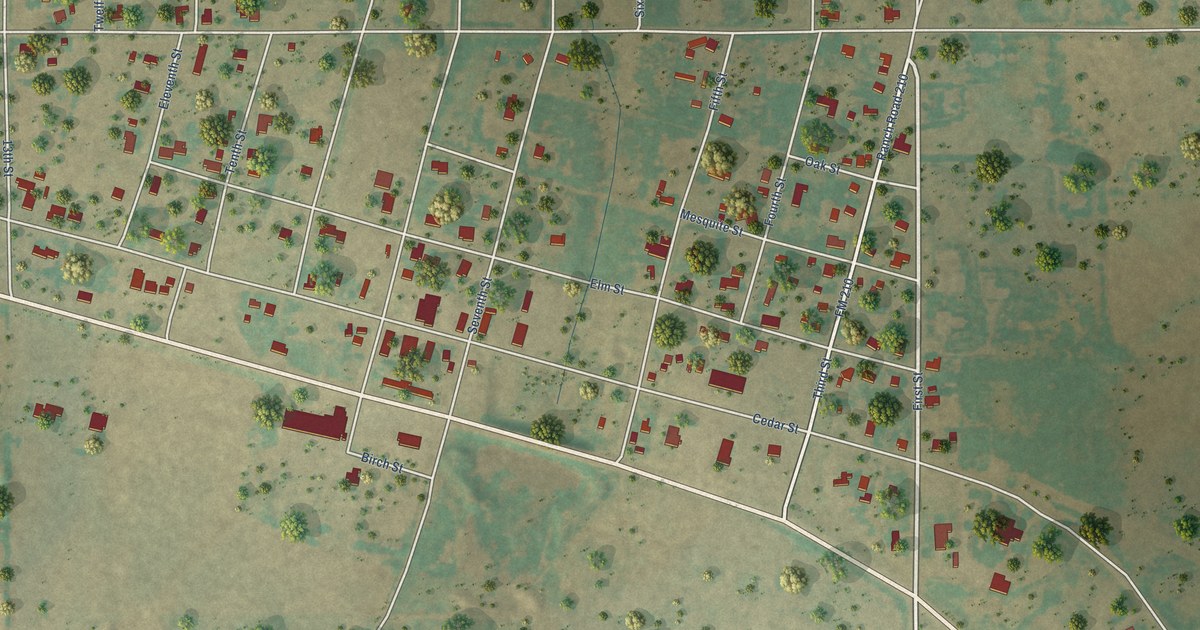
Bishop sold insurance and land in Corpus Christi. In 1910, the Texas State Historical Association says, he bought a big piece of ranch land southwest of the city and started a town there. Before the first lots went on sale on May 30, 1910, he had streets graded, sidewalks poured and an electric light and water plant built. When the school opened that September, sixteen children came. That town is still on the map: Bishop, Texas.
Bishop was also a big man. The Caller said “Mr. Bishop is said to be the heaviest man ever taken up in an aeroplane.” A wire story printed in Laredo said he was “weighing well up toward the three hundred mark.” Brindley said it was a world’s record for the most weight ever carried by an airplane. Nobody official checked that. But the Caller put it in its biggest headline anyway.
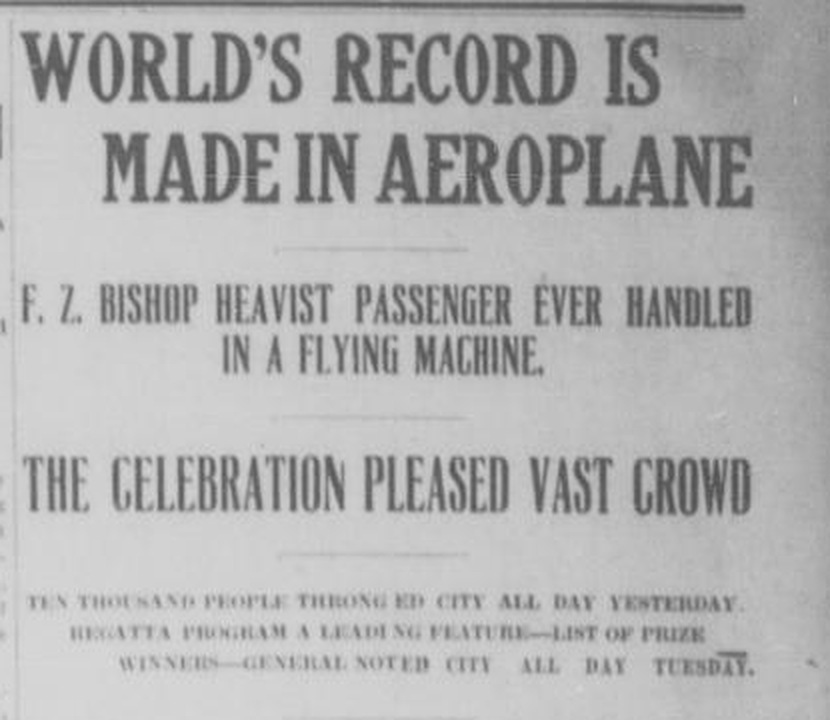
“World’s Record Is Made in Aeroplane. F. Z. Bishop Heavist Passenger Ever Handled in a Flying Machine.” (The paper misspelled “heaviest.”) The Weekly Corpus Christi Caller, Corpus Christi, Texas, July 7, 1911, page 1. The Portal to Texas History, via Wikimedia Commons. Click the clipping to read it full size.
“Real estate is going up”
In 1911, a passenger didn’t ride inside a Wright plane. There was no inside. The pilot and the passenger sat side by side on the front edge of the bottom wing, with their feet on a bar and the wind in their faces. The photo at the top of this story shows two other flyers sitting that way in 1911. It is not Brindley and Bishop.
Bishop made a joke about it. Real estate means land and buildings, and selling it was his job. The Caller said “the big real estate man only said, ‘real estate is going up.'” The paper said it did go up, “to the dizzy height” of more than 2,000 feet. That’s about as tall as seven football fields standing on end.
His friends were not surprised. One man who knew him well summed it up for the Caller: “Bishop is a thoroughbred and likes new sensations.” A thoroughbred is a fine racehorse. He meant Bishop was brave and loved trying new things.
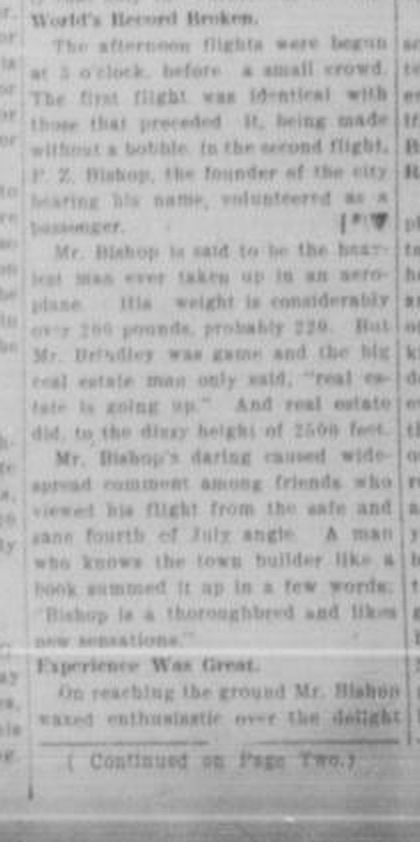
“Real estate is going up.” The Weekly Corpus Christi Caller, Corpus Christi, Texas, July 7, 1911, page 1. The Portal to Texas History, via Wikimedia Commons. Click the clipping to read it full size.
As easy as a feather bed
When the plane came back down, Bishop was all smiles. He told the Caller that flying “was better than speeding in an automobile or selling a dozen lots in that little town of mine.” A lot is a piece of land for one house or store.
He wasn’t scared one bit. “Danger? There wasn’t any. The trip was as easy as sleeping on a feather bed.”
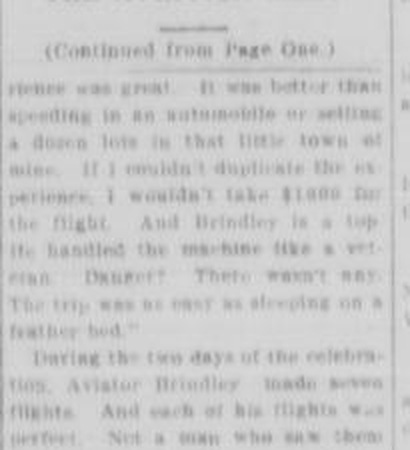
“As easy as sleeping on a feather bed.” The Weekly Corpus Christi Caller, Corpus Christi, Texas, July 7, 1911, page 2. The Portal to Texas History, via Wikimedia Commons. Click the clipping to read it full size.
Seven flights for the price of four
The town’s Commercial Club had hired Brindley for four flights. The club’s secretary, a man named Miller, said Brindley gave them more: “Although the contract agreed upon called for but four flights, Mr. Brindley made seven.” He said Brindley did it “in order to help us strive to meet our financial obligations.” That means he flew extra to help the club pay its bills.
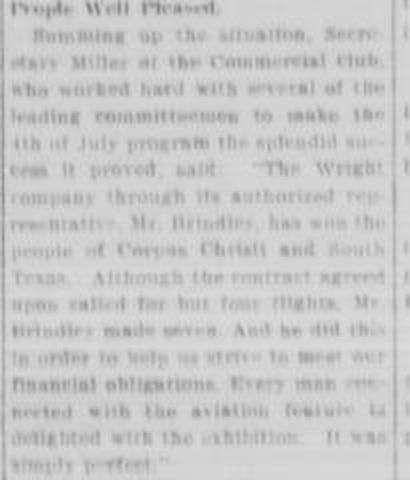
“Mr. Brindley made seven.” The Weekly Corpus Christi Caller, Corpus Christi, Texas, July 7, 1911, page 2. The Portal to Texas History, via Wikimedia Commons. Click the clipping to read it full size.
The visitors from Laredo, Texas, went home happy. They complained about the high price of a room in a crowded town. But they told their own paper that “the aeroplane flights were the best yet seen in the state.”
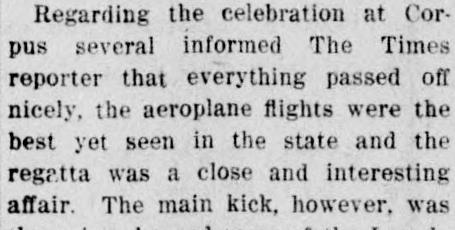
What the Laredo visitors said. Laredo Weekly Times, Laredo, Texas, July 9, 1911, page 9. Library of Congress, Chronicling America. Click the clipping to read it full size.
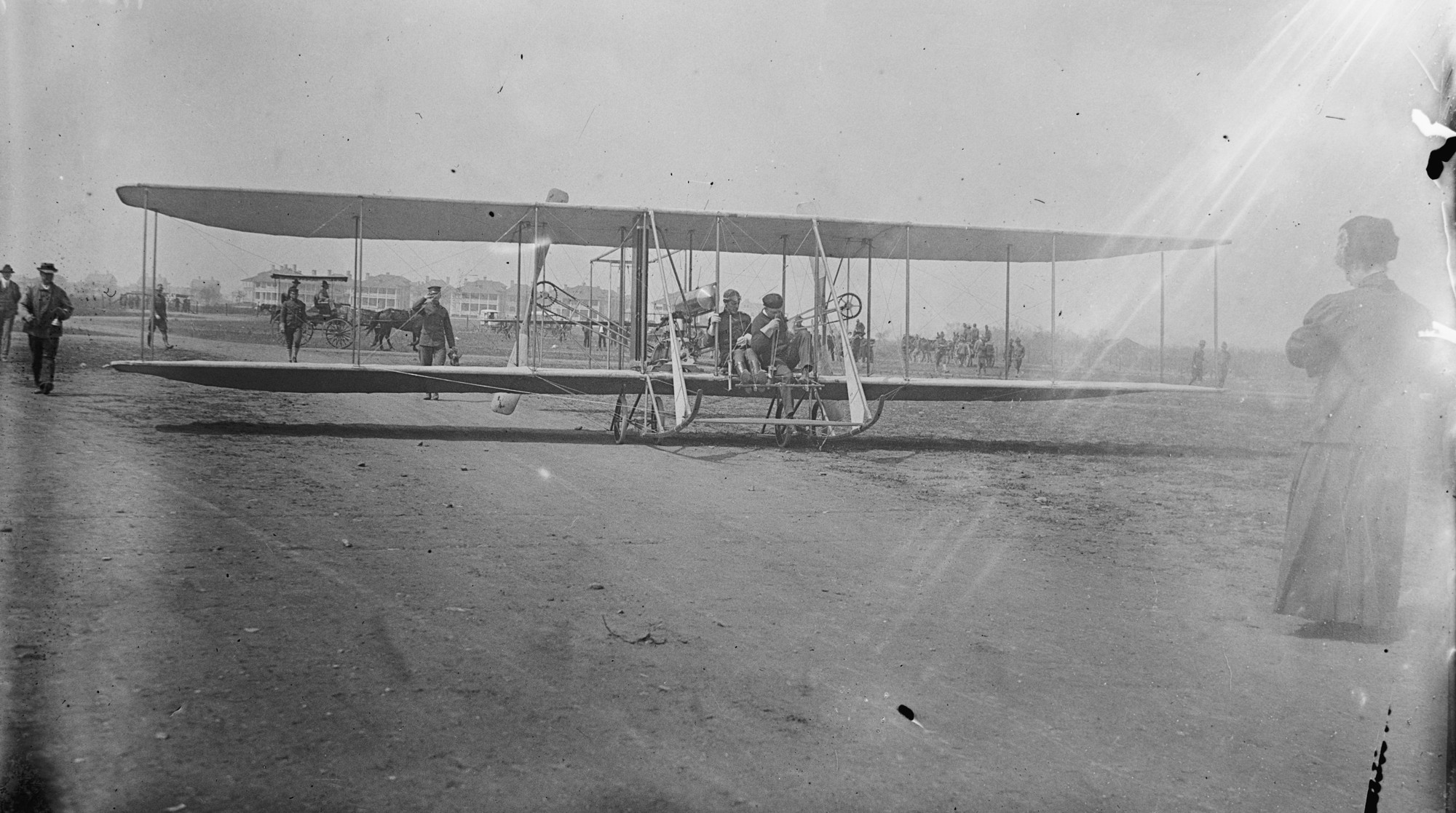
A Wright biplane at San Antonio, Texas, with two men on its front seat. Bain News Service called it an “Aeroplane used for army messages” (between about 1910 and 1915). Library of Congress. Click the picture to see it full size.
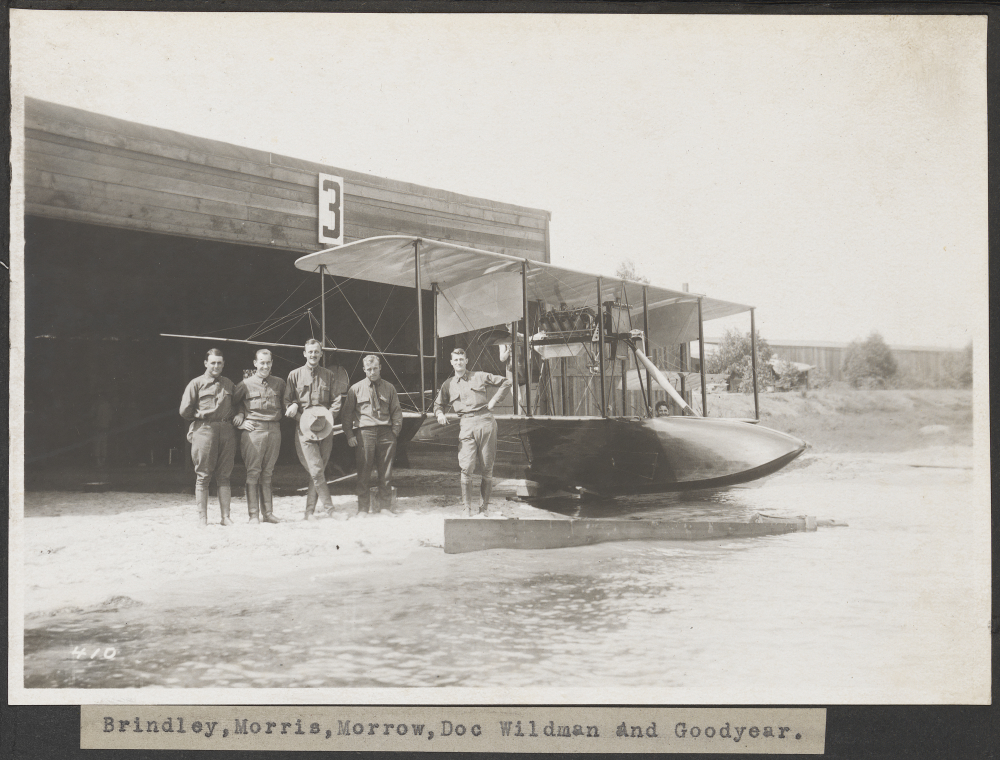
Oscar Brindley (far left) with four other flyers beside a flying boat in 1914, three years after Corpus Christi. Harry A. Erickson, SMU Libraries Digital Collections, via Wikimedia Commons. Click the picture to see it full size.
Next to town building
A few days later, Brindley went out to Bishop’s new town to see his big passenger. The wire story said Bishop was “well over the sensation of his exciting experience.” He had a new dream, too. He was “declaring that next to town building he would be a bird man.”
So F. Z. Bishop went up a real estate man and came down wanting to be a bird man. His town is still there, and so is the joke he told on the way up. Real estate really did go up that day in Corpus Christi, a little more than 2,000 feet.
Sources
- “Corpus Aeroplane Flight,” Laredo Weekly Times (Laredo, Texas), July 9, 1911, page 11 and “Excursionists Returned Home,” same issue, page 9. Library of Congress, Chronicling America.
- The same wire story: “Aviation Extraordinary at Corpus Christi,” Bryan Daily Eagle and Pilot (Bryan, Texas), July 7, 1911, page 2 and “New Record Is Made in Aeroplane Flight,” Waxahachie Daily Light (Waxahachie, Texas), July 7, 1911, page 1. Library of Congress, Chronicling America.
- The Weekly Corpus Christi Caller (Corpus Christi, Texas), July 7, 1911: “World’s Record Is Made in Aeroplane,” page 1 and “The Aviation Meet,” page 2. The Portal to Texas History (University of North Texas), page scans on Wikimedia Commons by way of the Digital Public Library of America.
- “How I Broke the World’s Record in Flying to the Sky,” The Seattle Star (Seattle, Washington), August 25, 1911, page 4. Library of Congress, Chronicling America.
- “Bishop, TX,” Handbook of Texas Online, Texas State Historical Association, for when and how F. Z. Bishop started his town.
- Photos: “Al Welsh & G.W. Beatty” (the cover, 1911) and “San Antonio Aeroplane used for army messages” (between about 1910 and 1915), Bain News Service, Library of Congress Prints and Photographs Division, no known restrictions on publication. “Brindley, Morris, Morrow, Doc Wildman and Goodyear” (1914), Harry A. Erickson, SMU Libraries Digital Collections, no known copyright restrictions.