On Tuesday, May 16, 1882, a newspaper reporter climbed aboard a British steamship tied up on the East River in New York City. In the after cabin, the room at the back of the ship, a tiny monkey was standing on the table. It was white from head to tail, with pink eyes. It held a newspaper up in its hands, “which it apparently was reading intently.” Then it saw the reporter. It dropped to the floor, “ran rapidly up his cane, thence to his hat,” leaned over the brim and looked him right in the eyes.
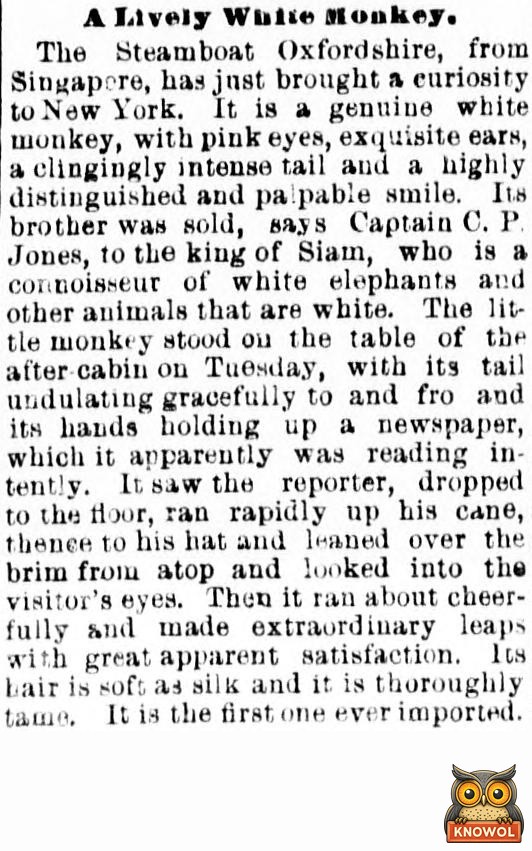
“A Lively White Monkey.” The New York Sun’s story about the reporter’s visit, as reprinted in the Daily Republican, Wilmington, Delaware, May 18, 1882, page 2. Library of Congress, Chronicling America. Click the clipping to read it full size.
A long trip from Singapore
The ship was the Oxfordshire, and its captain was C. P. Jones. The New-York Tribune’s shipping news shows how far the little monkey had come. The Oxfordshire left Yokohama, Japan, on February 8. It stopped in Shanghai, Hong Kong and Singapore, then crossed the Indian Ocean to Aden. It steamed through the Suez Canal and past Gibraltar, and it reached New York on May 11, 1882. That’s three months at sea.
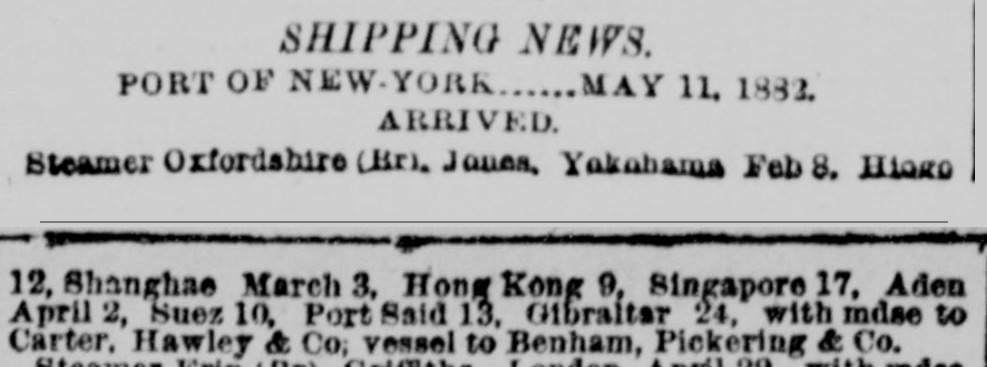
The Oxfordshire’s trip, in the shipping news: Yokohama, Hiogo, Shanghai, Hong Kong, Singapore, Aden, Suez, Port Said, Gibraltar. New-York Tribune, New York, New York, May 12, 1882, page 8 (the notice runs into the next column; the two pieces are joined). Library of Congress, Chronicling America. Click the clipping to read it full size.
The captain had bought the monkey in Singapore. The New York Sun said it was “the first one ever imported,” meaning the first white monkey anyone had ever brought into the country.
Meet Jack
The New York Herald sent a reporter too. He found the monkey in a “snug little cage” on board, and he learned its name. The sailors called him Jack. The Herald said he was “snow white from the crown of his tiny thinking box to the tip of his long and prehensile tail.” A prehensile tail is one that can grab and hold on, almost like an extra hand. Jack’s “thinking box” was his head.
Standing up, Jack was 15 inches tall, a little taller than a 12-inch ruler. He weighed about four pounds, and he wasn’t even two years old. Jack was an albino. That means he was born without the coloring that makes fur dark. Without it, his fur was white and his eyes looked pink in the light.
Captain Jones told the Herald that Jack had been caught on the Malay Peninsula a year before. In Singapore, crowds came to stare at him, even though monkeys there were “as plenty there as felines are here.” In other words, monkeys were as common in Singapore as cats were in New York. The captain had collected animals for 25 years and had never seen one like Jack.
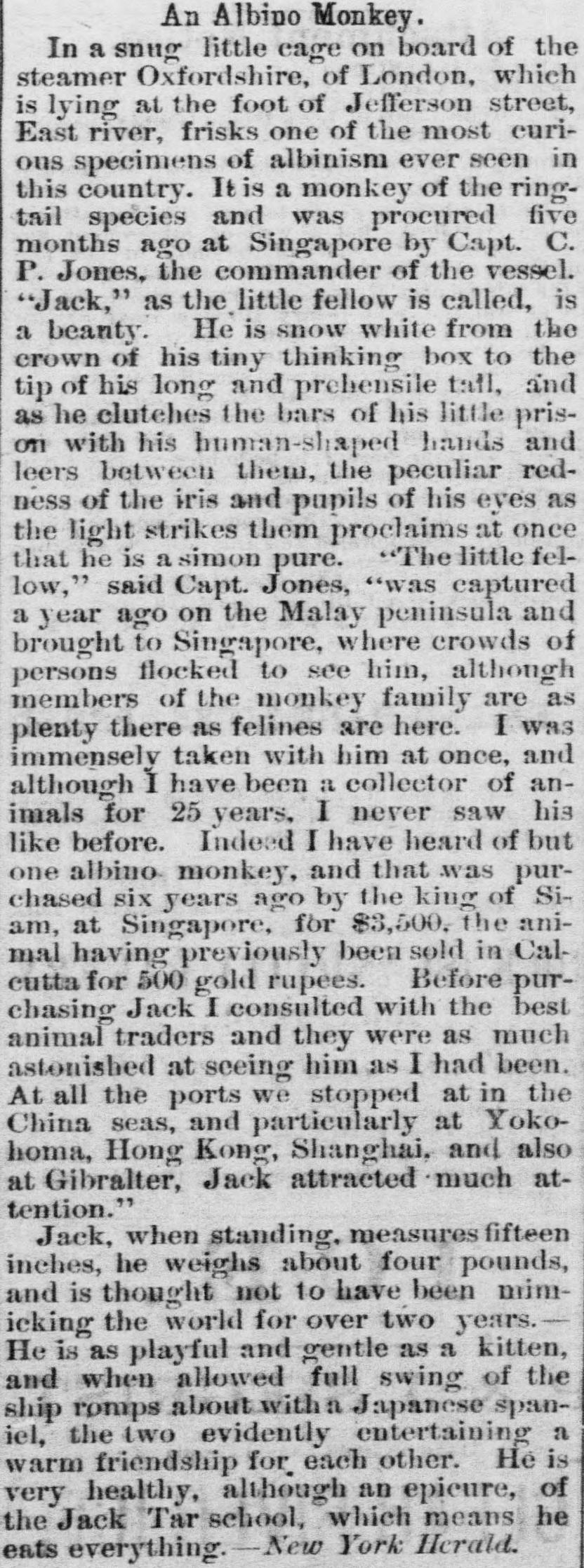
“An Albino Monkey.” The New York Herald’s visit with Jack and Captain Jones, as reprinted in the Rock Island Argus, Rock Island, Illinois, June 29, 1882, page 3. Library of Congress, Chronicling America. Click the clipping to read it full size.
Best friends on board
Jack was not a wild, scary animal. The Herald said “He is as playful and gentle as a kitten.” When the crew let him run loose around the ship, he played with a Japanese spaniel, a small fluffy dog. The two of them were good friends.
He wasn’t fussy about food, either. The Herald called him “an epicure, of the Jack Tar school, which means he eats everything.” An epicure is someone who loves fine food. “Jack Tar” was an old nickname for a sailor, and sailors ate whatever the ship’s cook made. So the joke was that Jack had a sailor’s appetite.
The king who collected white animals
Captain Jones had heard of only one other albino monkey. The King of Siam (the country we now call Thailand) had bought it in Singapore six years earlier. The Herald said the king paid $3,500. The Sun’s version said that monkey was Jack’s own brother. The two papers don’t agree, so we can’t say for sure.
The Sun called the king “a connoisseur of white elephants and other animals that are white.” A connoisseur is an expert collector. In Siam, white elephants were the most treasured animals in the kingdom.
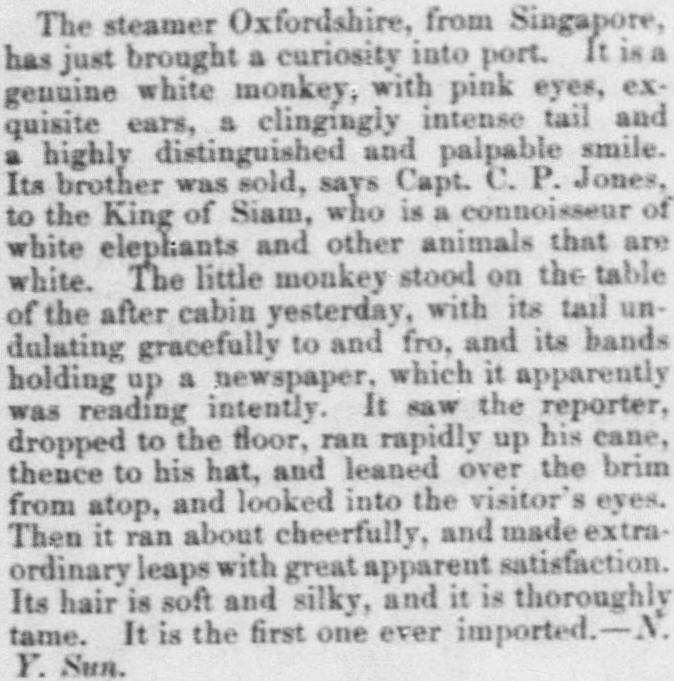
The same New York Sun story, with its credit line “N. Y. Sun.” The Democratic Advocate, Westminster, Maryland, May 27, 1882, page 3. Library of Congress, Chronicling America. Click the clipping to read it full size.
That same spring, the most famous showman in America wanted one. P. T. Barnum had just brought Jumbo, the giant elephant, over from London. Two weeks before Jack arrived, a New York paper wrote: “Mr. Barnum has secured Jumbo and yet he is not happy. The white elephants of the King of Siam will not let the great showman sleep.” Barnum had sent the king a package, including a fancy copy of his own life story, and asked to borrow a white elephant.
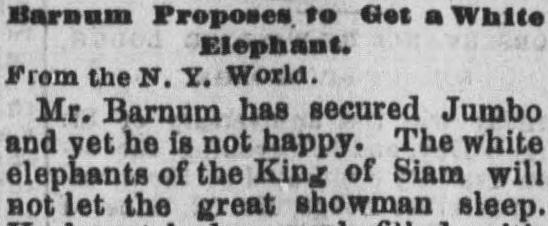
“Barnum Proposes to Get a White Elephant.” From the New York World, as reprinted in the Daily Gazette, Wilmington, Delaware, April 26, 1882, page 3. Library of Congress, Chronicling America. Click the clipping to read it full size.
From the docks to the joke page
Jack’s news traveled fast. Within days, the Sun’s story about the monkey with the newspaper was in other papers. By summer, the Herald’s story was being printed in Illinois, Ohio, Wisconsin and Minnesota.
Small-town joke columns had fun with it too. On June 15, 1882, the Bolivar Bulletin in Bolivar, Tennessee, printed a column called “Wit and Wisdom.” One line said: “A white monkey with pink eyes has just arrived in New York. It must make the society mashers nervous for their laurels.” A masher was a flashy young man who showed off for the ladies on city streets. The joke was that this stylish little monkey might steal their attention.
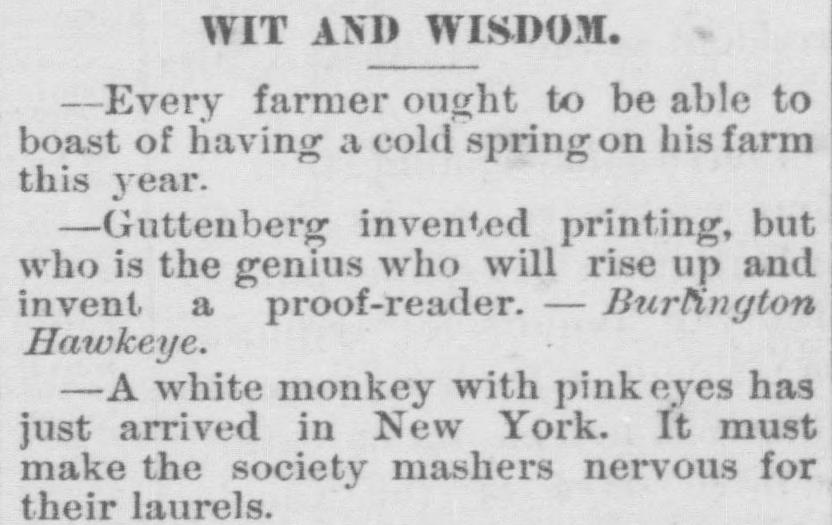
“Wit and Wisdom.” The Bolivar Bulletin, Bolivar, Tennessee, June 15, 1882, page 1. Library of Congress, Chronicling America. Click the clipping to read it full size.
A ship’s pet
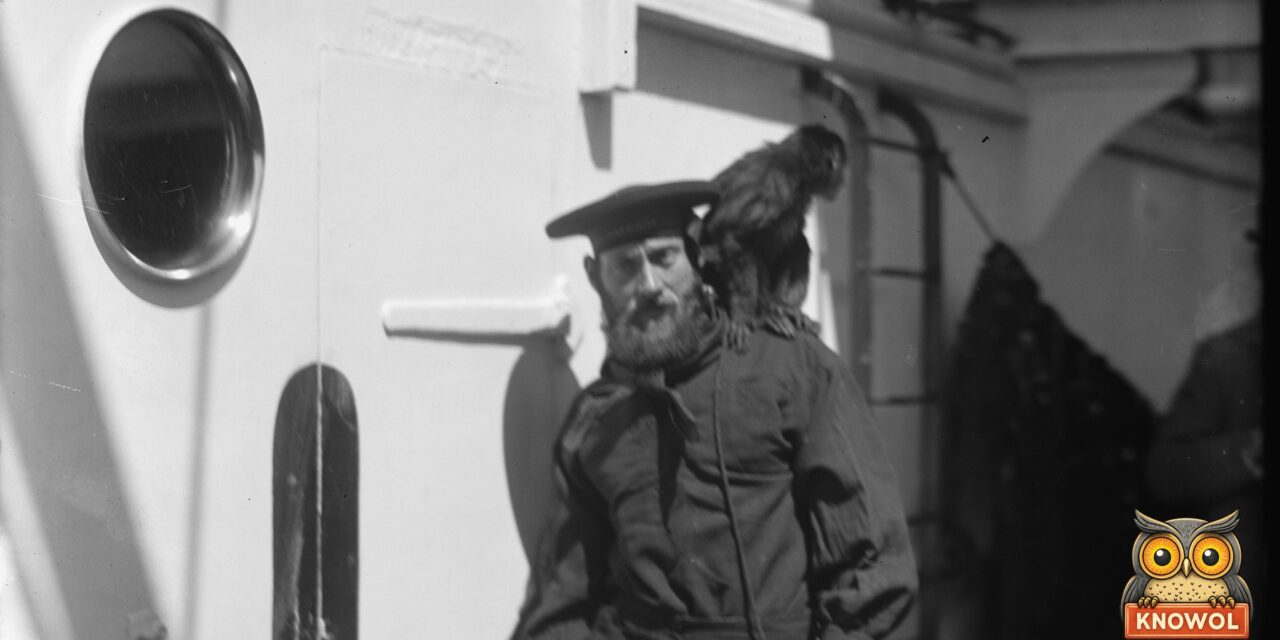
Lots of ships had pet animals in those days. Sailors kept dogs, cats, goats and monkeys on board for company on long trips. The photo at the top of this story is not Jack. It shows a bearded sailor on the USS Raleigh, a U.S. Navy ship, with the ship’s pet monkey on his shoulder in the 1890s. None of the papers we found said where Jack went after New York.
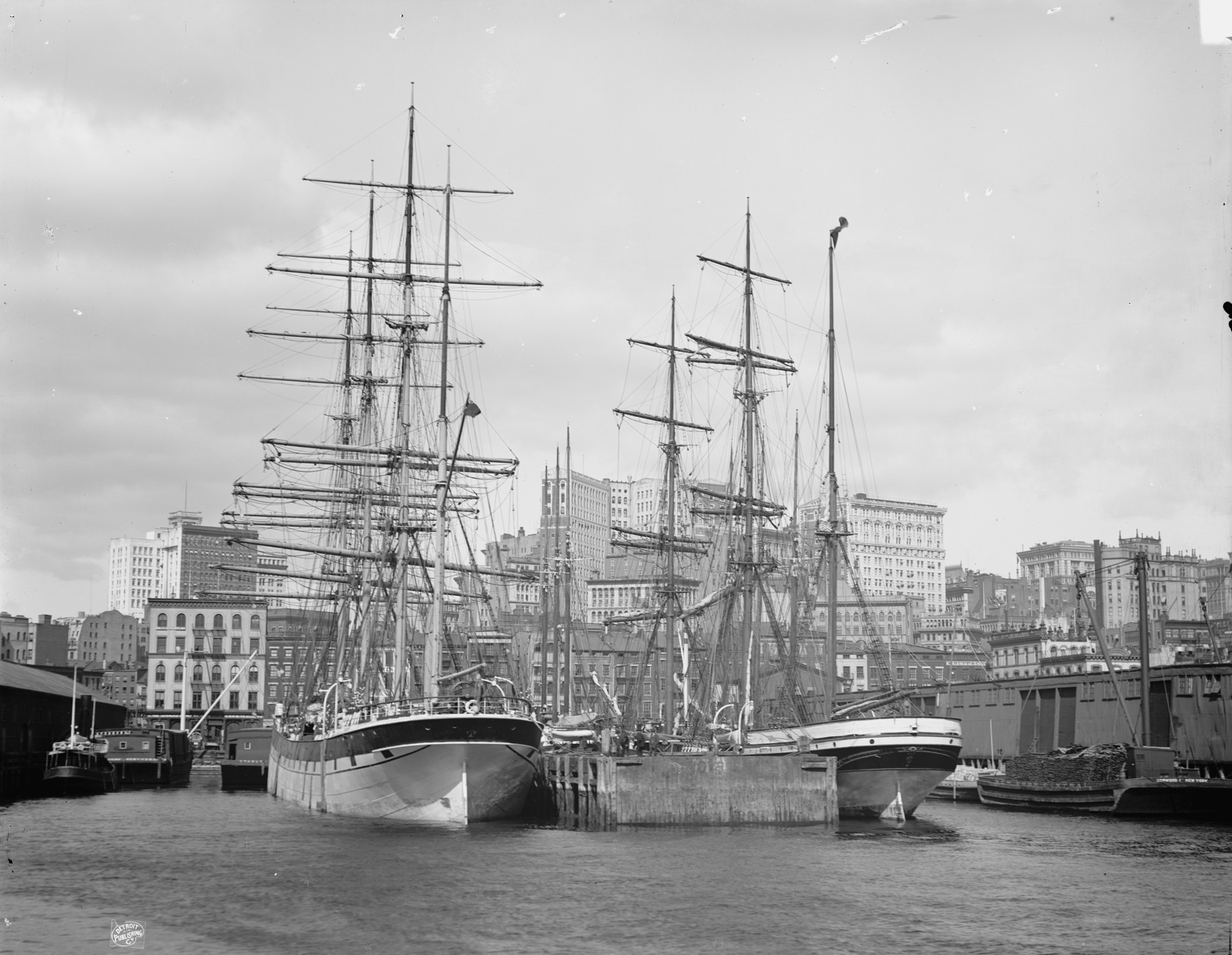
Sailing ships at the East River docks in New York City, about 1900, the same waterfront where the Oxfordshire tied up in 1882. Detroit Publishing Co., Library of Congress. Click the picture to see it full size.
Artists in Japan, where the Oxfordshire’s trip began, painted white monkeys too. The old Japanese scroll painting below shows two of them. A photographer from the Detroit Publishing Company took its picture around 1900.
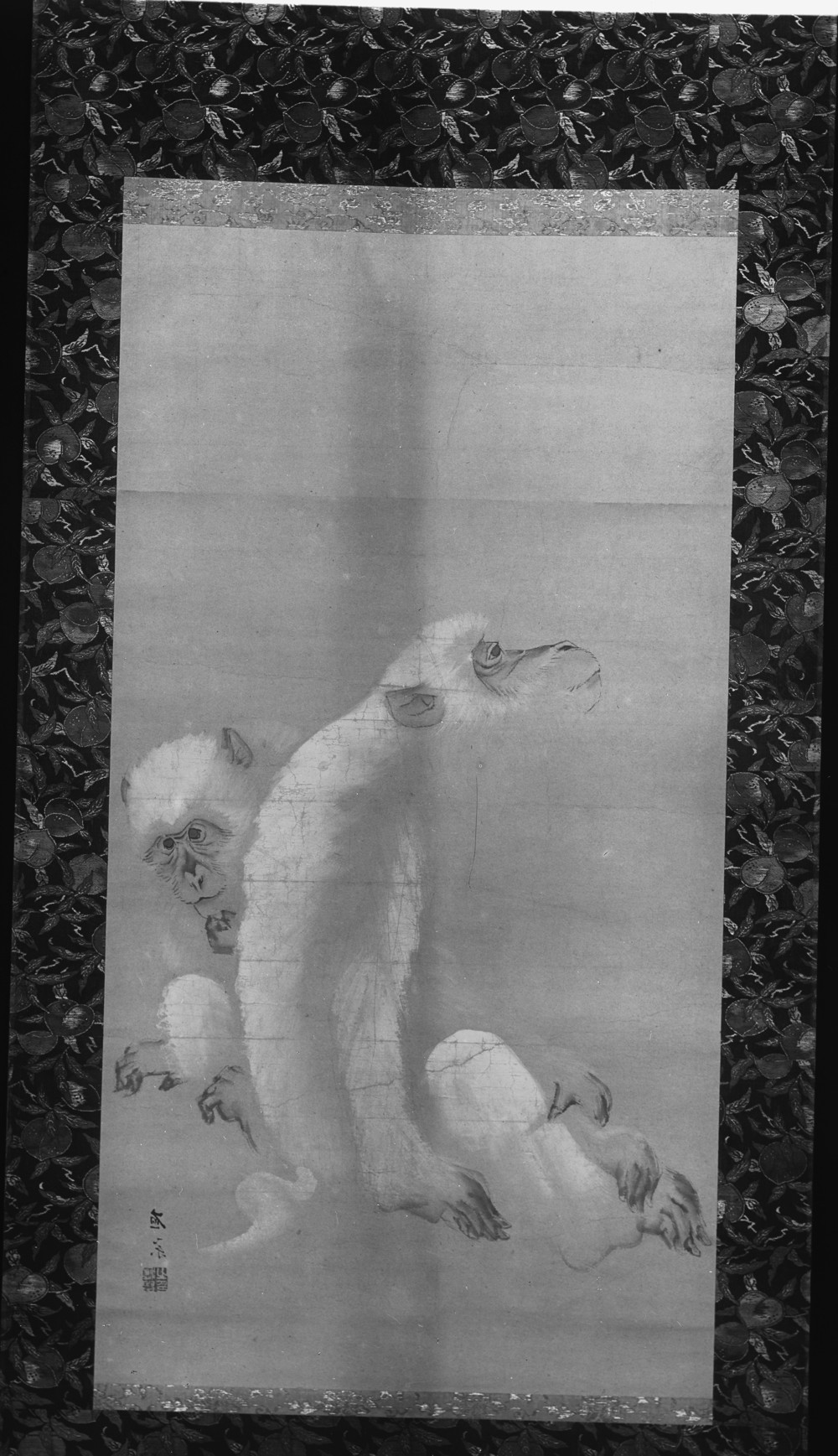
“White monkeys,” a photo of a Japanese scroll painting, about 1900 to 1912. Detroit Publishing Co., Library of Congress. Click the picture to see it full size.
So the best picture we have of Jack is the one the Sun’s reporter gave us: a four-pound monkey on a cabin table, holding up the newspaper. A few weeks later, Jack was in the newspapers himself, from New York all the way to Tennessee.
Sources
- The New York Sun’s story, as reprinted: “A Lively White Monkey,” Daily Republican (Wilmington, Delaware), May 18, 1882, page 2 and The Democratic Advocate (Westminster, Maryland), May 27, 1882, page 3. Library of Congress, Chronicling America.
- The New York Herald’s story, as reprinted: “An Albino Monkey,” The Rock Island Argus (Rock Island, Illinois), June 29, 1882, page 3. Library of Congress, Chronicling America.
- Shipping news, New-York Tribune (New York, New York), May 12, 1882, page 8. Library of Congress, Chronicling America.
- “Barnum Proposes to Get a White Elephant,” The Daily Gazette (Wilmington, Delaware), April 26, 1882, page 3. Library of Congress, Chronicling America.
- “Wit and Wisdom,” The Bolivar Bulletin (Bolivar, Tennessee), June 15, 1882, page 1. Library of Congress, Chronicling America.
- Photos: “U.S.S. Raleigh, the ship’s mascot” (the cover; between 1894 and 1901), “Shipping at East River docks, New York” (about 1900) and “White monkeys” (between 1900 and 1912), Detroit Publishing Co., Library of Congress Prints and Photographs Division, no known restrictions on publication.