In September 1917, a bottle came loose in the mail at the post office in Gettysburg, Pennsylvania. “Out of a mailbag rolled a bottle of catsup,” the Harrisburg Telegraph said. Catsup is the old spelling of ketchup. This bottle didn’t come from a store. Somebody at home had made it, and it was headed for a soldier. There was just one problem. Nobody could tell which soldier.
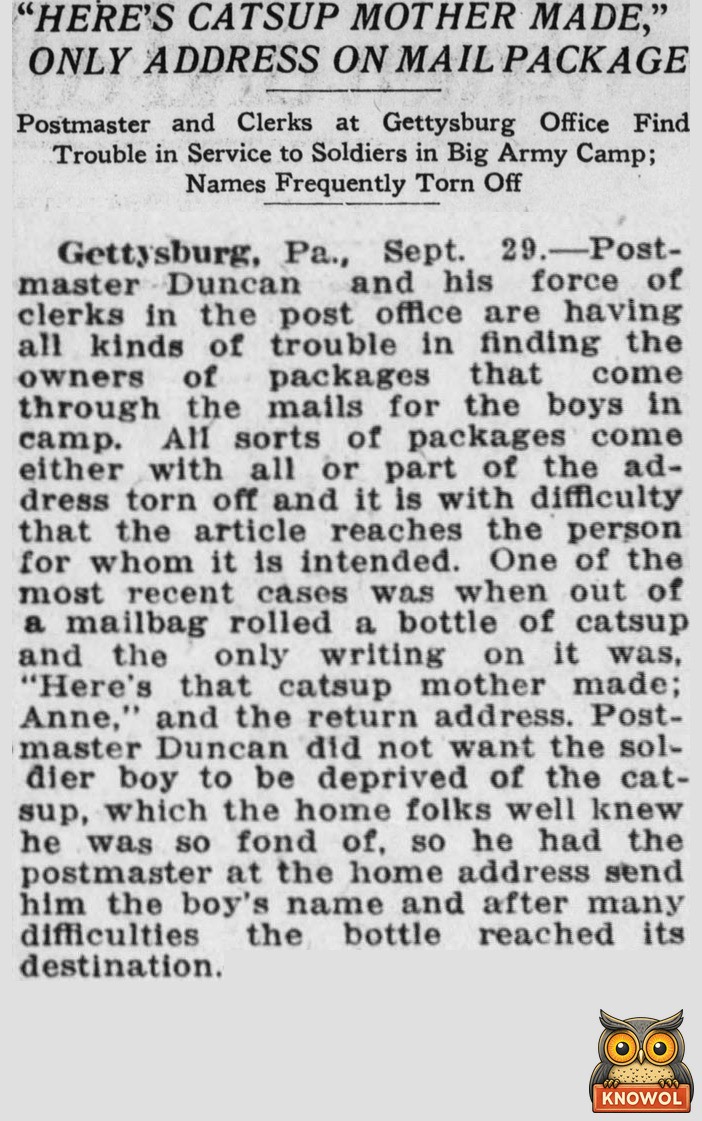
“Here’s Catsup Mother Made,” Only Address on Mail Package. Harrisburg Telegraph, Harrisburg, Pennsylvania, September 29, 1917, page 4. Library of Congress, Chronicling America. Click the clipping to read it full size.
A note, but no name
The only writing on the bottle was a little note: “Here’s that catsup mother made; Anne.” Under it was the address of the person who sent it. The soldier’s name wasn’t there at all. Anne knew exactly who would want it. Her note just didn’t say.
A bottle like that could easily have ended up at the Dead Letter Office, the place where mail went when nobody could deliver it. But the man in charge in Gettysburg had other ideas.
A small town full of soldiers
Gettysburg was a quiet college town, famous for the big Civil War battle fought in its fields in 1863. In April 1917, the United States entered World War I. By June, Army infantry regiments were camped right on the old battlefield, and new soldiers kept pouring in to train.
Every one of those soldiers had folks back home, and the folks back home wrote. By the end of June, business at the Gettysburg post office had “about doubled,” the Telegraph said. The post office hired three more clerks. Each regiment sent its own mail carrier to pick up the camp’s mail.
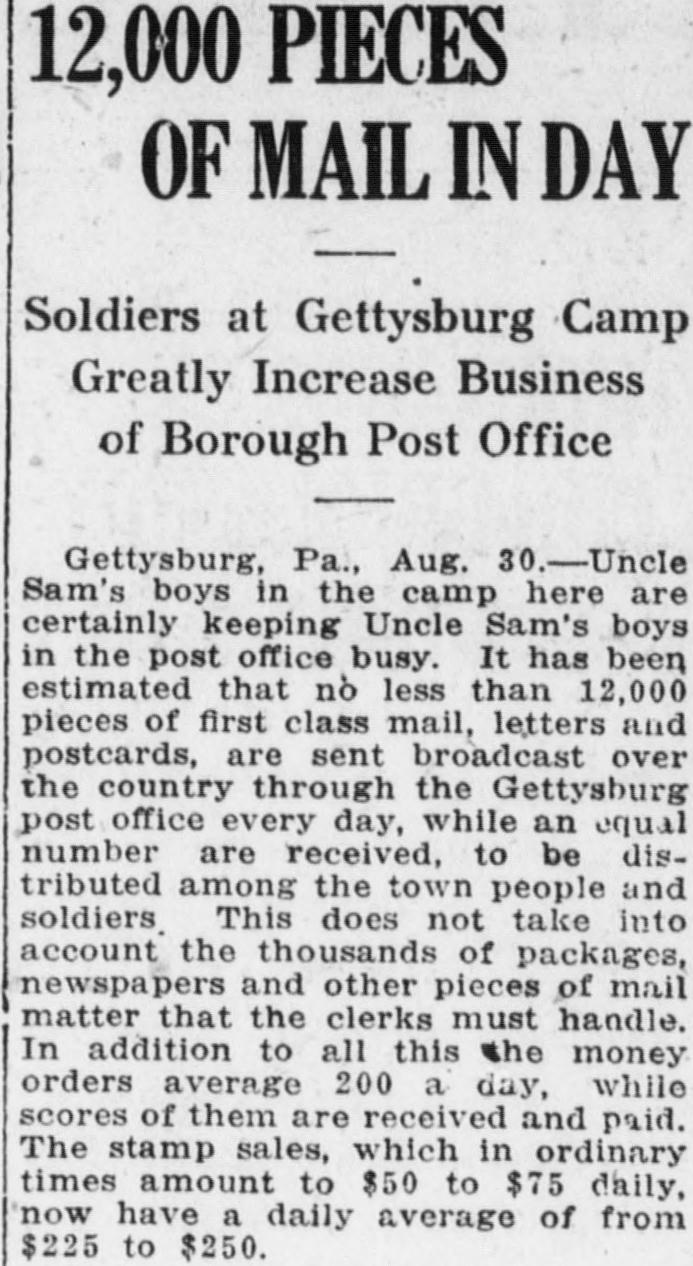
“12,000 Pieces of Mail in Day.” Harrisburg Telegraph, Harrisburg, Pennsylvania, August 30, 1917, page 2. Library of Congress, Chronicling America. Click the clipping to read it full size.
By the numbers
By late August, the paper said, “no less than 12,000 pieces of first class mail, letters and postcards,” went out of Gettysburg every day. Just as many came in. If a clerk could sort one letter every second, 12,000 letters would take more than three hours of nonstop work. And that was only the letters going out.
On top of that came “the thousands of packages, newspapers and other pieces of mail matter that the clerks must handle.” Money orders, a safe way to mail cash, averaged 200 a day. In ordinary times the office sold $50 to $75 worth of stamps a day. Now it sold $225 to $250.
Addresses were a headache, too. The Army formed four new regiments at the camp and moved many men out of the regiment they came with. So a letter could carry the wrong regiment on it. One clerk “spends his entire time dealing with the mail of this kind,” the paper said in June.
Packages had it worst
Packages took a beating in the mail. “All sorts of packages,” the Telegraph said, came “with all or part of the address torn off.” That’s how the catsup arrived.
The postmaster was a man the paper called Postmaster Duncan, and he didn’t give up on it. “Postmaster Duncan did not want the soldier boy to be deprived of the catsup,” the paper said, “which the home folks well knew he was so fond of.” To be deprived of something means to go without it.
How the bottle found its soldier
Postmaster Duncan used the one clue he had, the return address. He asked the postmaster in that home town to send him the boy’s name. Then the clerks still had to find that one young man in a big, busy Army camp. The paper doesn’t say how long it took. It says only that “after many difficulties the bottle reached its destination.”
The Telegraph never printed the soldier’s name, or Anne’s last name, or the town where the catsup was made. But it tells us the most important part. The bottle got there.
What was in the bottle
Homemade catsup was a lot of work. That August, the Edgefield Advertiser in South Carolina printed a recipe for it. You started with “ripe, red” tomatoes, boiled them soft, and pushed them through a sieve to get rid of the seeds and skins. Then you boiled the juice with salt, red pepper, two onions and a little flannel bag of spices: allspice, mustard seed, cloves, celery seed, cinnamon and ginger root.
Vinegar and sugar went in next. You kept it boiling until a spoonful on a saucer had no water running out of it. Then the hot catsup went into clean bottles, sealed or corked. Corked, the paper said, it would “keep indefinitely,” which means for a very long time. Food that keeps was just the thing to mail to a soldier far from his mother’s kitchen.
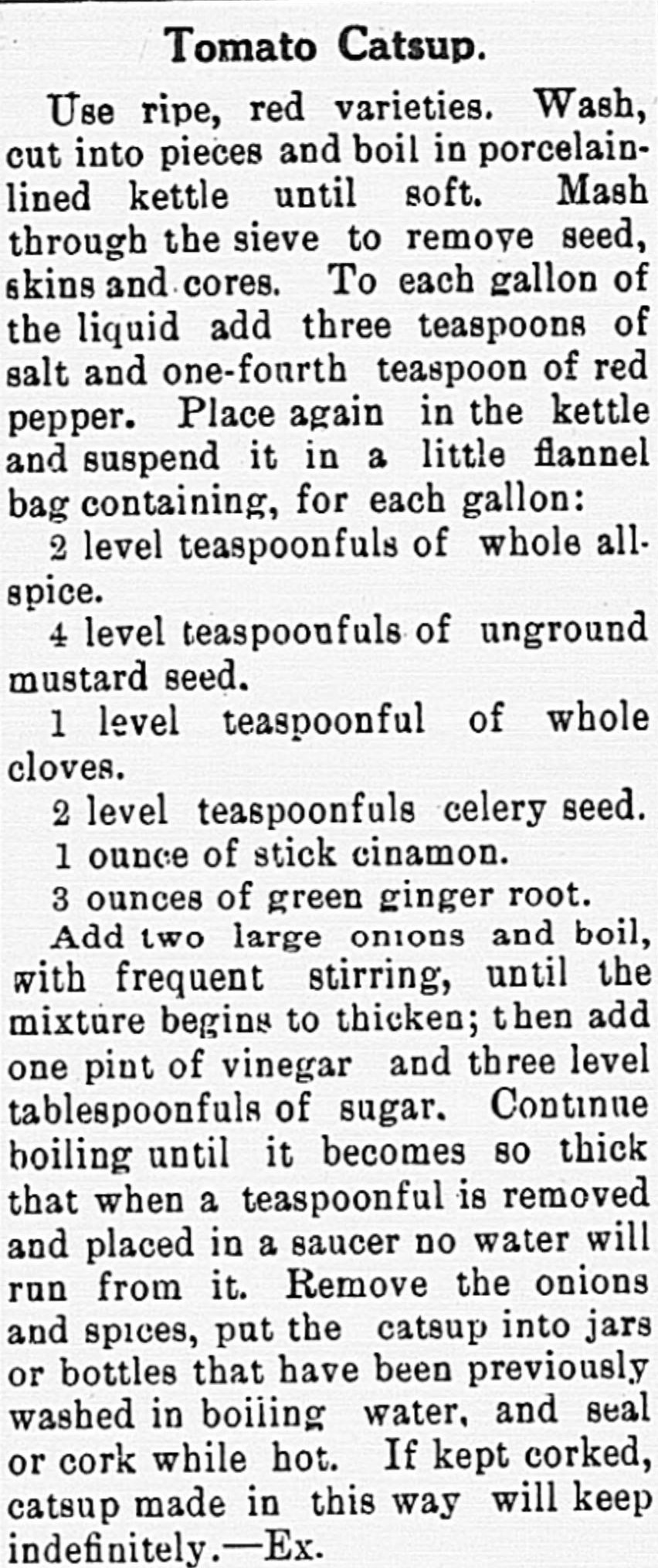
“Tomato Catsup.” A homemade recipe, Edgefield Advertiser, Edgefield, South Carolina, August 1, 1917, page 8. Library of Congress, Chronicling America. Click the clipping to read it full size.
Letters from worried families
The catsup wasn’t the only lost-and-found job in Gettysburg. That fall a Telegraph headline told of “Hundreds of Letters” from parents and relatives asking the post office to search the camp. Some young men had run away from home to join the Army, the paper said, and it believed many had signed up under made-up names.
Postmaster Duncan and his clerks took “great pains to do all in their power to find the loved ones wanted.” The paper said “not one of the requests has been left go unnoticed,” an old way of saying none were ignored. Some soldiers hadn’t written home “for weeks, months or even years.” The post office talked many of them into writing to their families again.
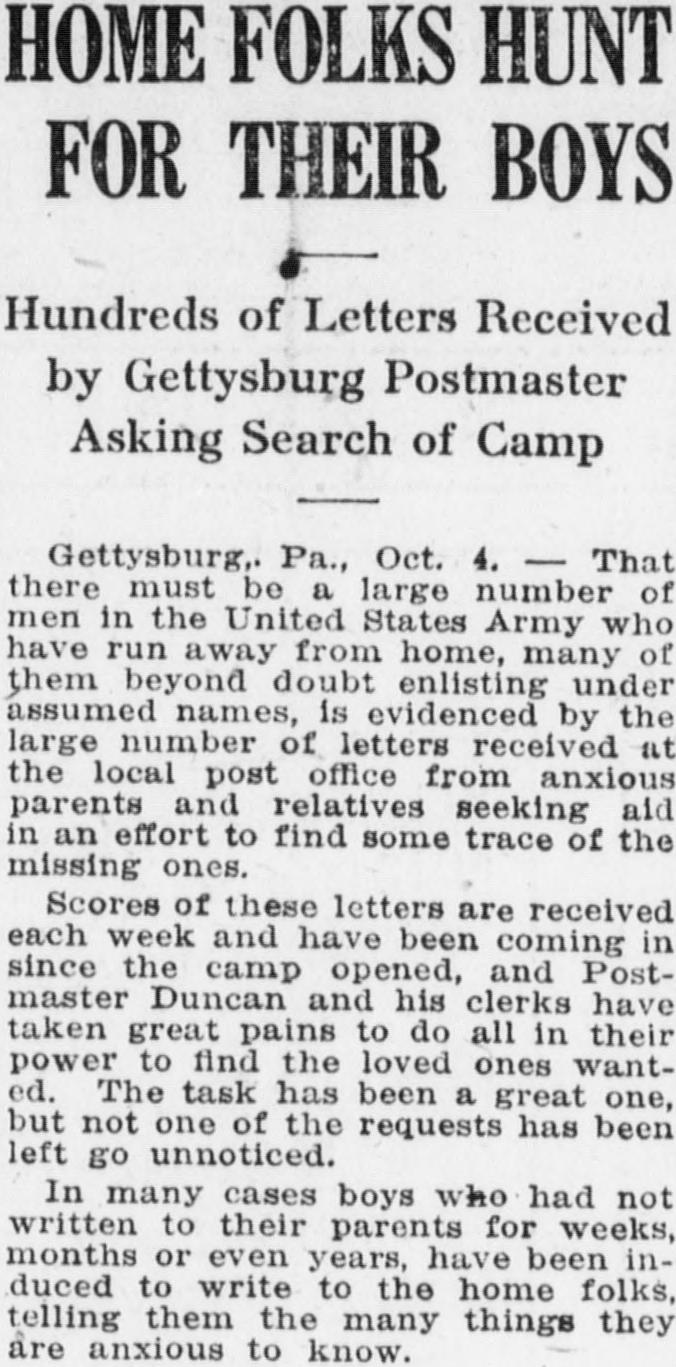
“Home Folks Hunt for Their Boys.” Harrisburg Telegraph, Harrisburg, Pennsylvania, October 4, 1917, page 2. Library of Congress, Chronicling America. Click the clipping to read it full size.
About the pictures
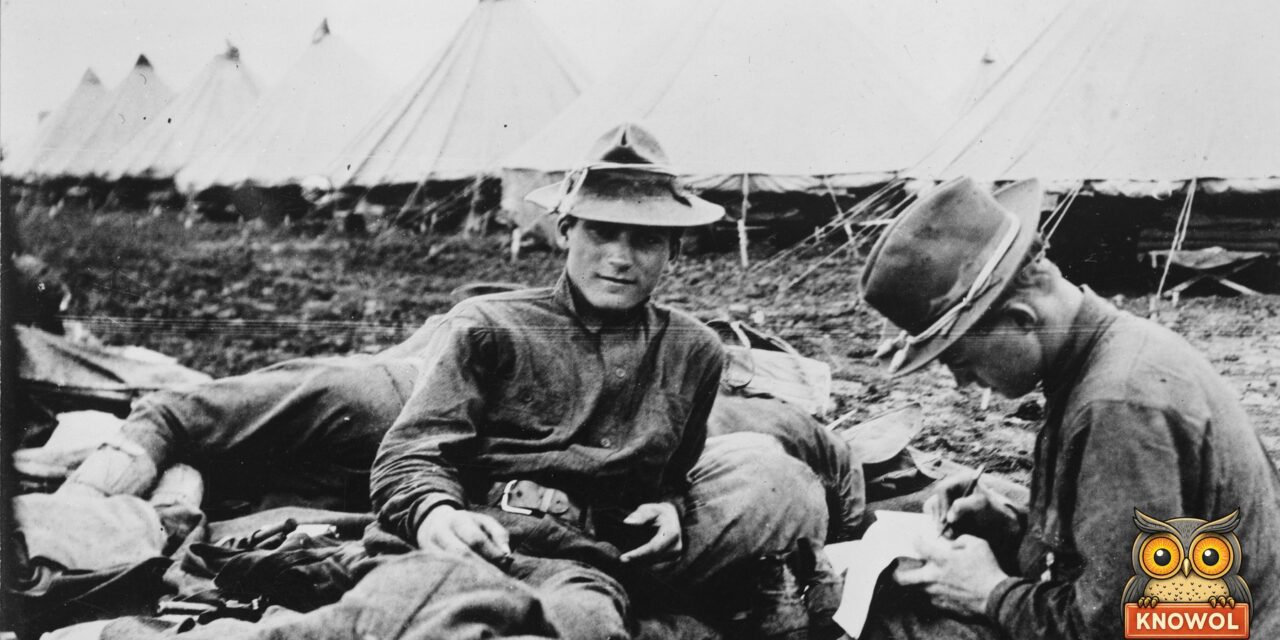
No photo of the Gettysburg post office or the catsup bottle turned up. The cover shows two soldiers in an Army tent camp in Texas in 1914, one of them writing a letter home, three years before the Gettysburg camp. Inside, clerks sort mail at the big New York post office in 1914. Gettysburg’s office was much smaller, but the job was the same.
[IMAGE: photos/ny-post-office-sorting-mail-1914-web.jpg | “N. Y. Post Office, assorting [sorting] mail,” 1914. This is the main post office in New York City, not Gettysburg. Bain News Service, Library of Congress. No known restrictions on publication.]
One bottle out of thousands
In a year when Gettysburg handled 12,000 letters a day, one bottle with no name on it would have been easy to set aside. Postmaster Duncan didn’t. We’ll never know the soldier’s name. But we know the bottle reached him, and we know who it came from: mother, and Anne.
Sources
- Harrisburg Telegraph (Harrisburg, Pennsylvania), September 29, 1917, page 4: “Here’s Catsup Mother Made,” Only Address on Mail Package. Library of Congress, Chronicling America
- Harrisburg Telegraph, June 30, 1917, page 10: Business of Gettysburg Postoffice Is Doubled. Library of Congress, Chronicling America
- Harrisburg Telegraph, August 30, 1917, page 2: 12,000 Pieces of Mail in Day. Library of Congress, Chronicling America
- Harrisburg Telegraph, October 4, 1917, page 2: Home Folks Hunt for Their Boys. Library of Congress, Chronicling America
- Edgefield Advertiser (Edgefield, South Carolina), August 1, 1917, page 8: Tomato Catsup. Library of Congress, Chronicling America
- Cover photo: Soldiers in Texas writing home, April 24, 1914. Bain News Service. Library of Congress. No known restrictions on publication.
- N. Y. Post Office, assorting [sorting] mail, 1914. Bain News Service. Library of Congress. No known restrictions on publication.
- Newspaper pages published in 1917 are in the public domain.