At one o’clock on a Sunday afternoon, November 8, 1908, hundreds of people lined Hohman Street in Hammond, Indiana. Scores of small boys crowded the Hohman Street bridge. They had come to see a barber named Oscar Plageman keep a promise. Oscar stood at the handles of a wheelbarrow. In it sat his friend Walter Wall. Both men wore tall silk hats and long dress coats. Then, with Pugh’s band out in front, Oscar started to push.
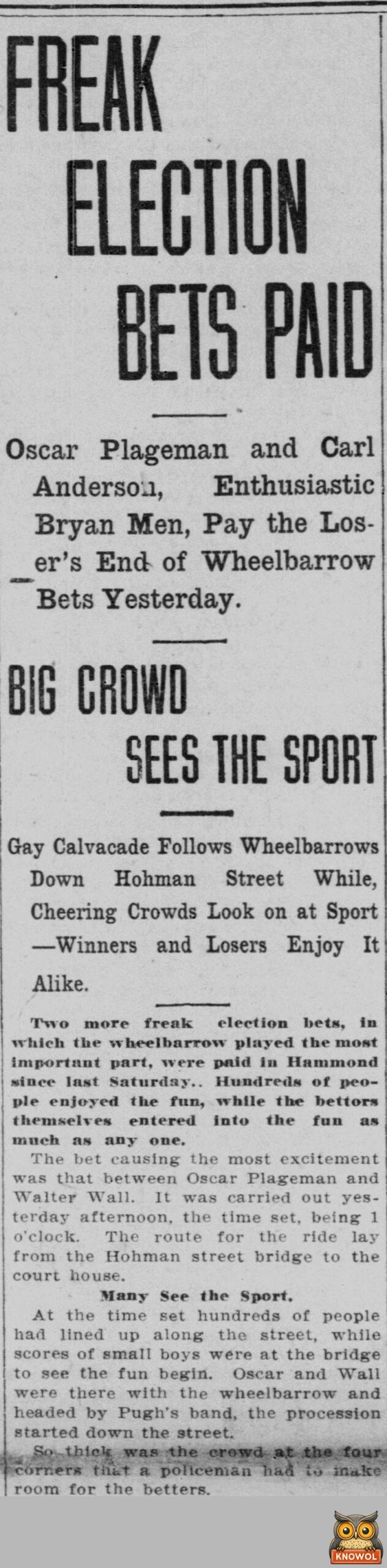
“Freak Election Bets Paid.” The Lake County Times, Hammond, Indiana, November 9, 1908, page 1. Library of Congress, Chronicling America. Click the clipping to read it full size.
A bet you paid with your arms
The country had voted the Tuesday before, on November 3. William Howard Taft, a Republican, ran for president against William Jennings Bryan, a Democrat. It was Bryan’s third try. Indiana picked a new governor that day too: James Watson, a Republican, or Thomas Marshall, a Democrat.
Lots of men in Lake County, Indiana, made what the papers called “freak” bets on the races. The point wasn’t money. The point was a show. If your man lost, you pushed the winner through the middle of town in a wheelbarrow, and the whole town came out to watch.
Oscar Plageman was a Hammond barber, and he was a Bryan man. Taft won. So Oscar owed Walter Wall a ride from the Hohman Street bridge to the court house.
The barber’s long push
The crowd was huge. “So thick was the crowd at the four corners that a policeman had to make room for the betters,” the Lake County Times reported the next day. The four corners was a busy crossing on the way.
A barber’s hands are used to scissors and combs, not wheelbarrow handles. The paper said there “was certainly enough sympathy expressed for the tender-handed barber.” The parade stopped again and again so “the knight of the razor” could rest. That was a joke name for a barber. At the four corners, somebody took a picture of the whole outfit.
Oscar had two more troubles. A picture of Bryan’s face hung in front of him, wrapped in black crepe. Crepe was the thin black cloth people hung up after a funeral, so the joke was that Bryan’s hopes were dead. The bet also had a fine print. Every “spill” would cost Oscar $5. So two friends, Will Parker and Lew Sheffield, walked beside the wheelbarrow as “body guards.” Walter Wall never fell out once.
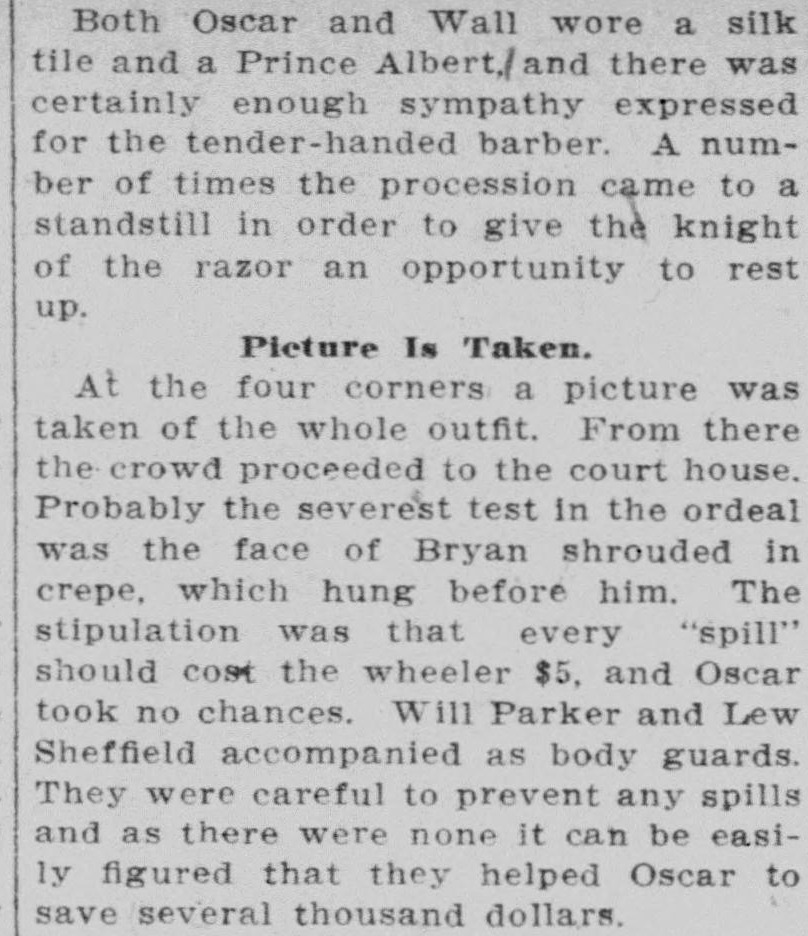
The silk hats, the crepe and the $5 spills. The Lake County Times, Hammond, Indiana, November 9, 1908, page 1. Library of Congress, Chronicling America. Click the clipping to read it full size.
Oscar wasn’t the only one. The night before, Carl Anderson, a middleweight boxer and another Bryan man, pushed City Councilman Tom Swanton from the post office to Hohman Street. Tom’s wheelbarrow was decorated in red, white and blue. He even got a cushion, and his route ran down State Street, which the paper called “comparatively smooth.” The crowd cheered for both men.
Next door: “Buster” and a twelve-piece band
A few miles east, the twin towns of East Chicago and Indiana Harbor were having the same kind of fun. Today Indiana Harbor is part of East Chicago, Indiana. On Thursday afternoon, November 5, about four hundred people watched W. L. Cherry, a builder, push lawyer Pat Keenan “through the heart of the city in a wheelbarrow.” Cherry had bet on Watson for governor. Keenan had bet on Marshall, and Marshall won. A three-piece band of Mose Specter, Louis Greenfield and F. J. Ault marched in front.
Indiana Harbor planned something even bigger. John Kamradt, the town’s gas company man, was “well known all over the county as ‘Buster.'” He weighed about 300 pounds. He had bet that Bryan would win Indiana. Louis Houtschilt, a 200-pound builder, bet that he wouldn’t, and won. So Buster had to push Louis from the Harbor hotel to Auditorium hall, behind “a brass band of at least twelve pieces,” with fireworks lighting up the main street. The wheelbarrow, the Times promised, would be “rickety, half-broken.”
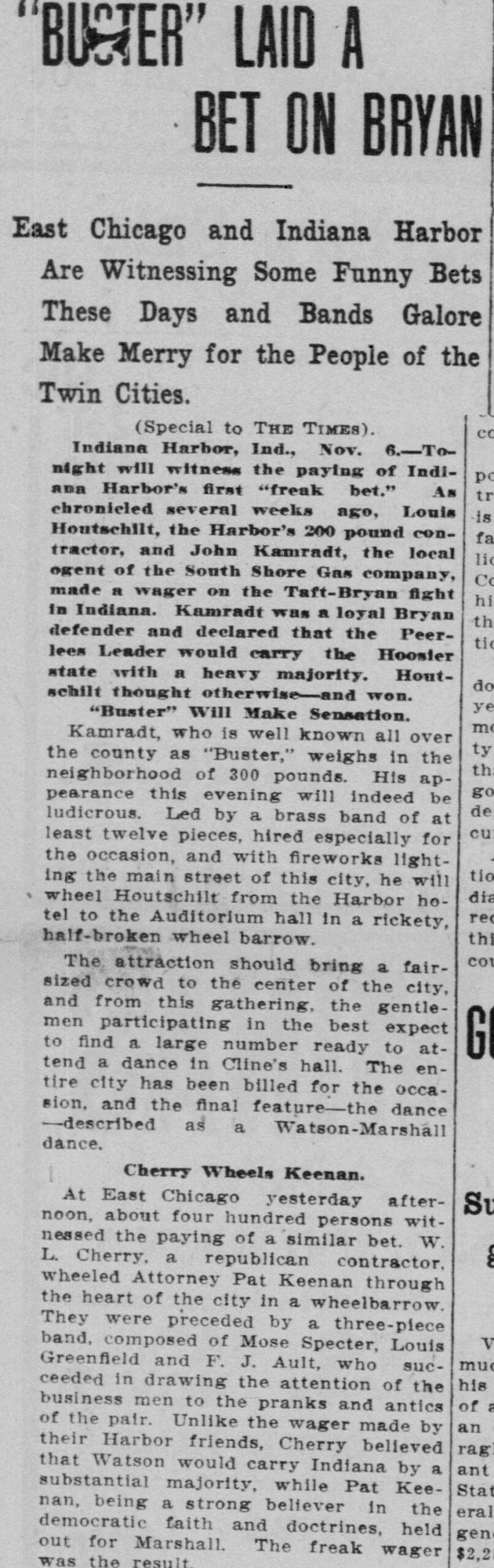
“‘Buster’ Laid a Bet on Bryan.” The Lake County Times, Hammond, Indiana, November 6, 1908, page 1. Library of Congress, Chronicling America. Click the clipping to read it full size.
Training for the big push
The big night had to wait one more day because the two men weren’t ready. Buster used the time to get in shape. He “has been taking physical culture exercises for several days,” the paper said on November 7. Physical culture was the 1908 word for workouts. Buster said he felt “perfectly competent to trundle his opponent the long, weary half mile.”
After the ride, the whole town was invited to “a big democratic-republican ball” at Cline’s hall, with an orchestra playing until late. A ticket cost 50 cents. Winners and losers, Republicans and Democrats, would all dance in the same room. The Times never printed how Buster’s half mile went, so that part of the story is lost.
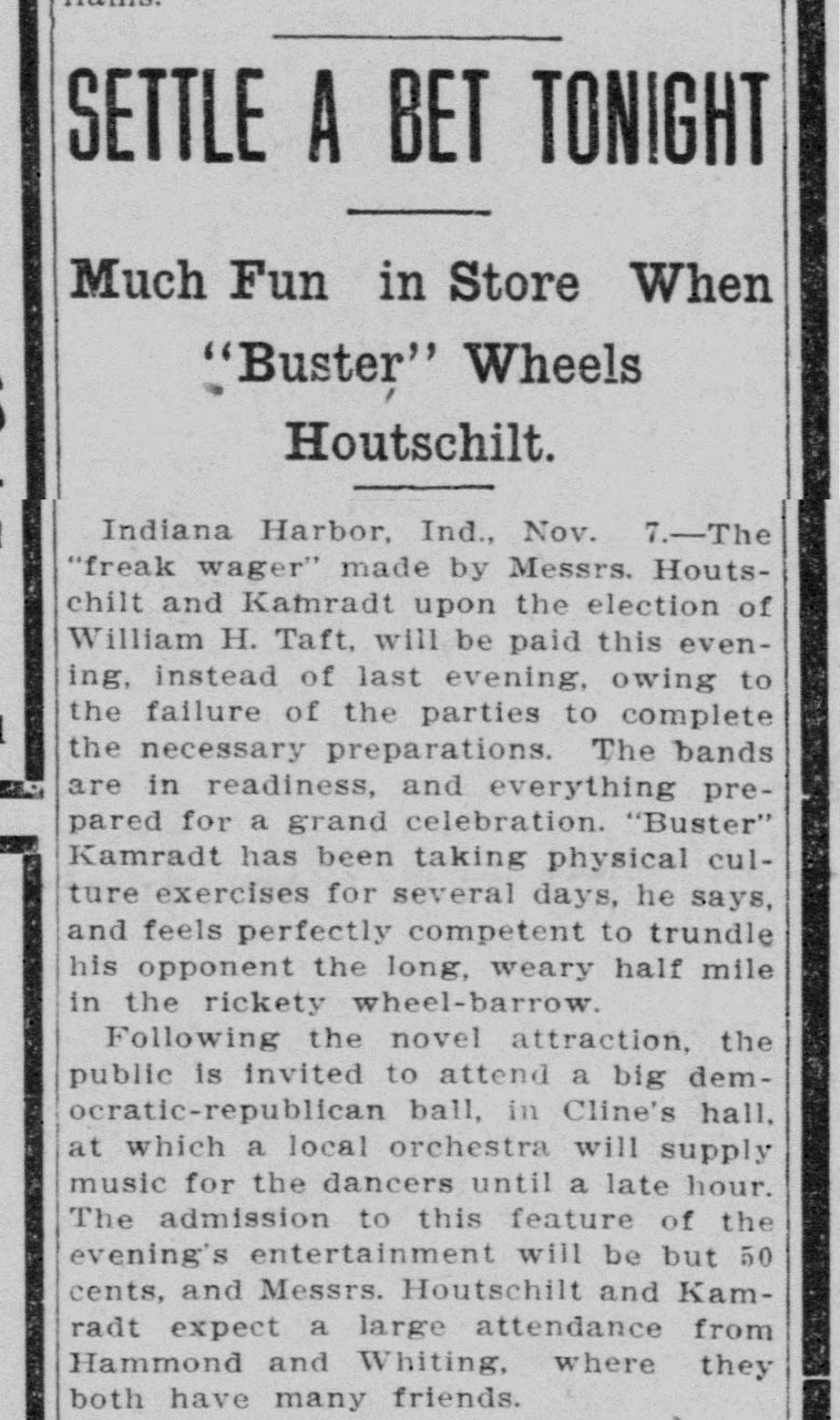
“Settle a Bet Tonight.” The Lake County Times, Hammond, Indiana, November 7, 1908, page 8. Library of Congress, Chronicling America. Click the clipping to read it full size.
An old American joke
Wheelbarrow bets were already an old joke by 1908. Bryan had lost his first race in 1896, and that week the New York humor magazine Puck put a wheelbarrow bet on its cover. A big, grinning winner rides along with a flag that says “Victory,” while a gray-bearded man does the pushing. Under it, a boy says, “Yes, it was an election bet and Dad won. Ain’t he making an awful fool of the other fellow?” A stranger answers, “Yes! Which one is your Dad?”
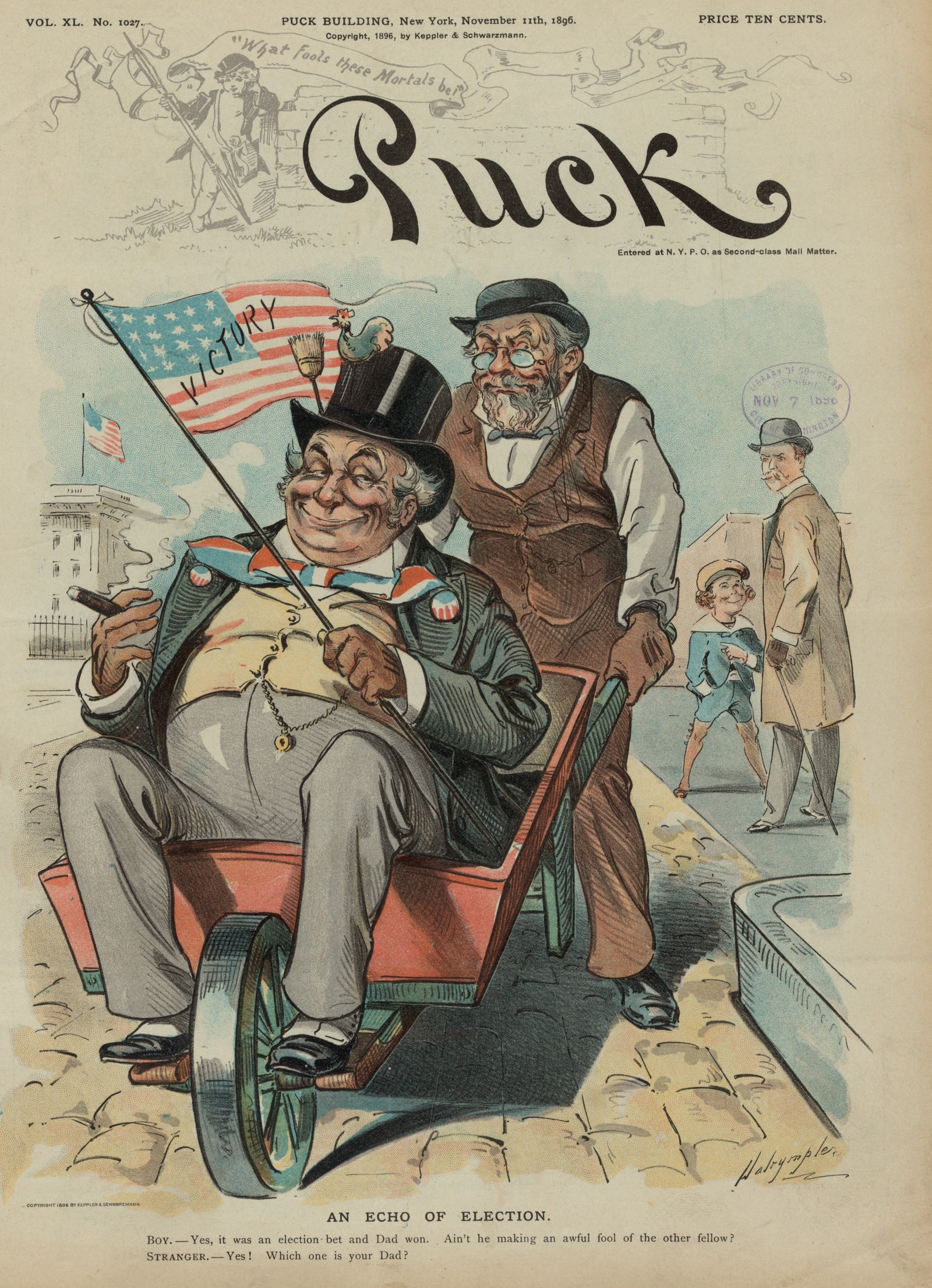
“An Echo of Election,” by Louis Dalrymple, cover of Puck, New York, November 11, 1896. Library of Congress. Click the picture to see it full size.
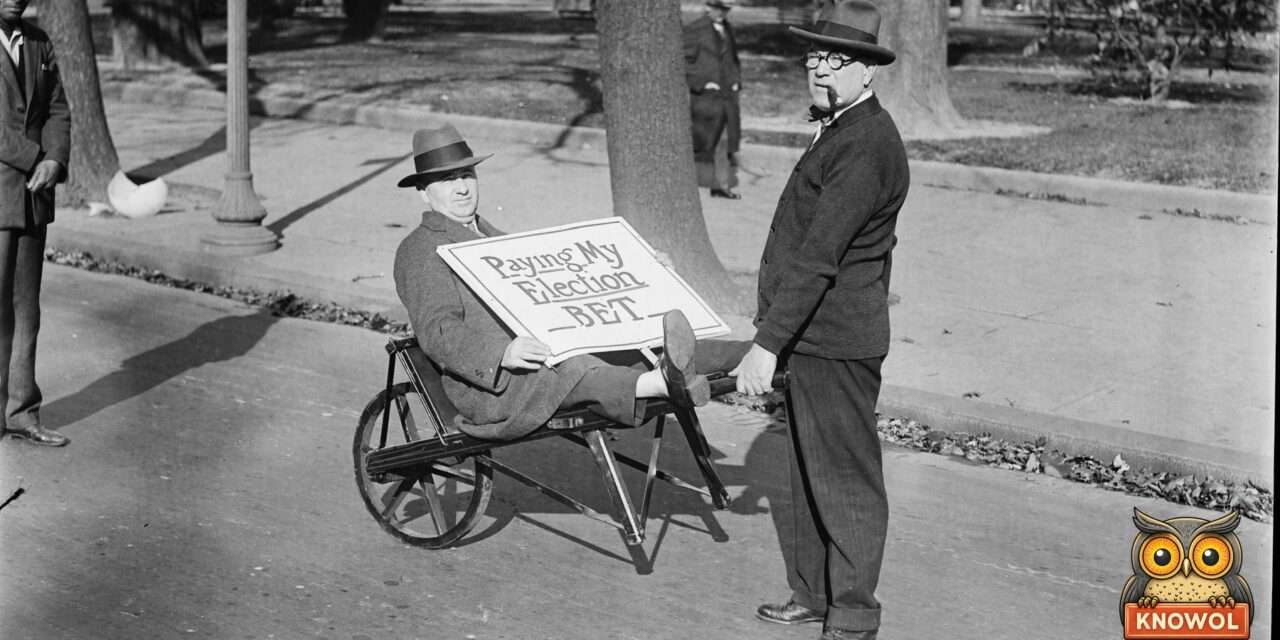
The cover photo at the top of this page shows the custom twenty years after Hammond’s bets. In Washington, D.C., in 1928, a man who bet on Al Smith for president paid up with a wheelbarrow ride up Pennsylvania Avenue to the White House.
Good game fellows
Hammond in 1908 was a busy factory town. That October, a few weeks before the election, the photographer Lewis Hine took a picture of boys heading home from a Hammond factory at 5:30 in the evening. Hine was photographing children at work for a group that wanted to end child labor. It shows what Hammond’s working boys looked like that fall.
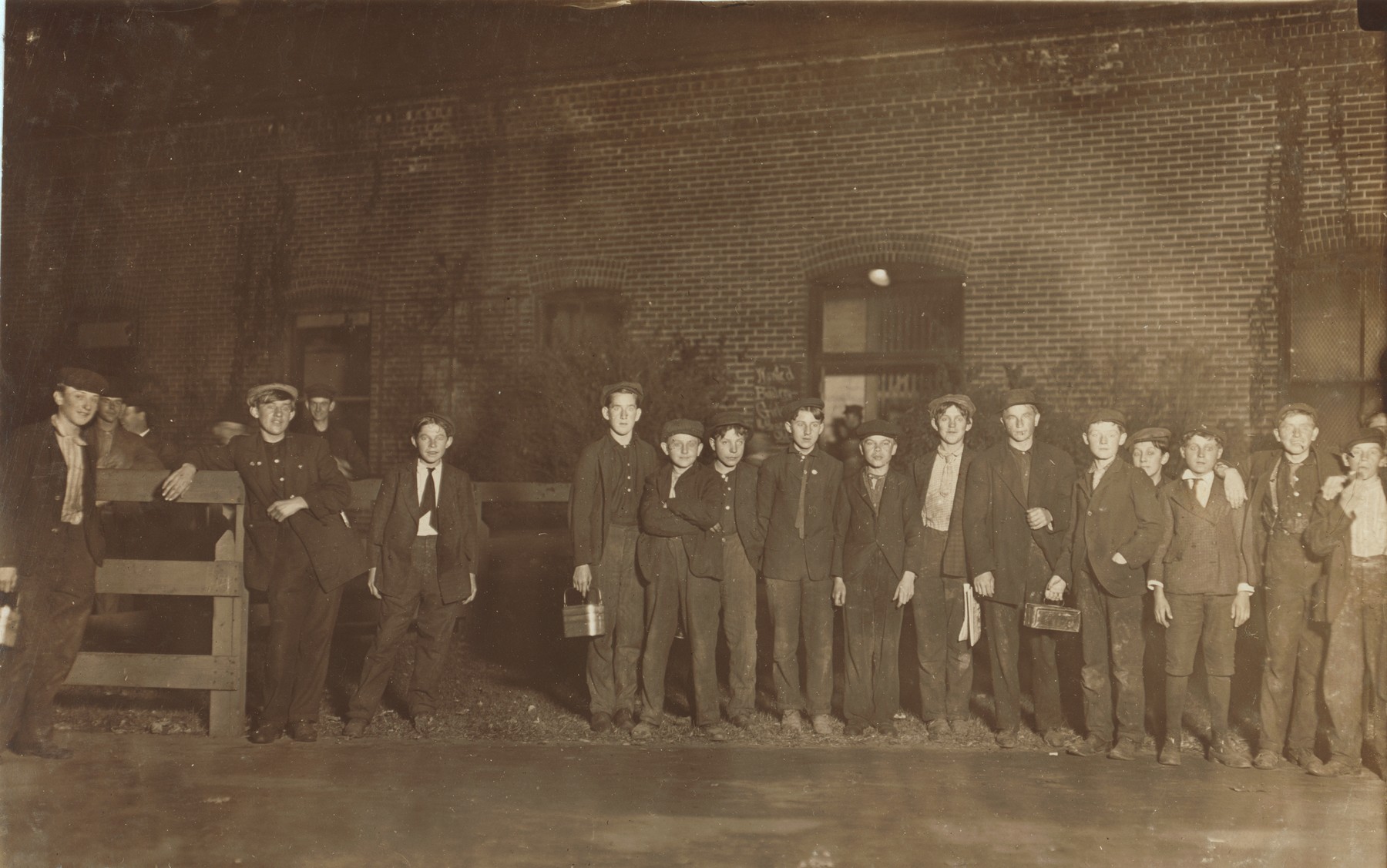
“W. B. Corkey Co. Going home 5:30 P.M. Lots of boys here.” Hammond, Indiana, October 1908. Photo by Lewis Hine, National Child Labor Committee collection, Library of Congress. Click the picture to see it full size.
Oscar Plageman made it all the way to the court house with no spills. The Lake County Times summed up the whole week in one sentence. The crowds “were satisfied with two facts, one that a bet of such a nature might as well be lost as won, and the other that the betters, especially the losers, are good game fellows.” In 1908, a good loser in Hammond got a band, a crowd and a front-page story.
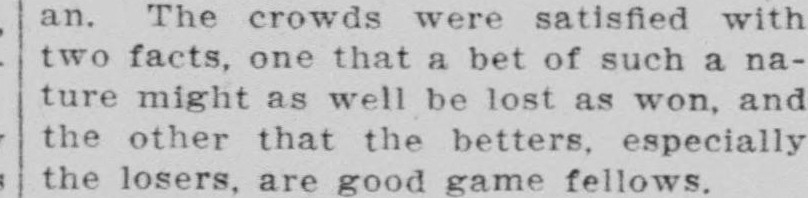
The verdict. The Lake County Times, Hammond, Indiana, November 9, 1908, page 1. Library of Congress, Chronicling America. Click the clipping to read it full size.
Sources
- The Lake County Times (Hammond, Indiana): November 9, 1908, page 1 (“Freak Election Bets Paid”).
- The Lake County Times (Hammond, Indiana): November 6, 1908, page 1 (“‘Buster’ Laid a Bet on Bryan”).
- The Lake County Times (Hammond, Indiana): November 7, 1908, page 8 (“Settle a Bet Tonight”).
- Louis Dalrymple, “An Echo of Election,” Puck, November 11, 1896, Library of Congress, no known restrictions on publication.
- Lewis Hine, “W. B. Corkey Co. Going home 5:30 P.M.,” Hammond, Indiana, October 1908, Library of Congress, no known restrictions on publication.
- All newspaper images: Library of Congress, Chronicling America. Published 1908.
- Cover: Harris & Ewing, “Another election loser pays,” Washington, D.C., November 9, 1928, Library of Congress, no known restrictions on publication. It shows a 1928 election bet in Washington, not Hammond.