On the evening of November 14, 1849, a crowd gathered in Corinthian Hall in Rochester, New York. On the stage sat a teenage girl named Maggie Fox and her grown-up sister, Leah Fish. The crowd had come to hear one small sound: a knock. It came from the floor, or the wall, or a door, whenever the Fox sisters were near. Nobody in Rochester could say what made it, and for three days the city’s sharpest people tried to find out.
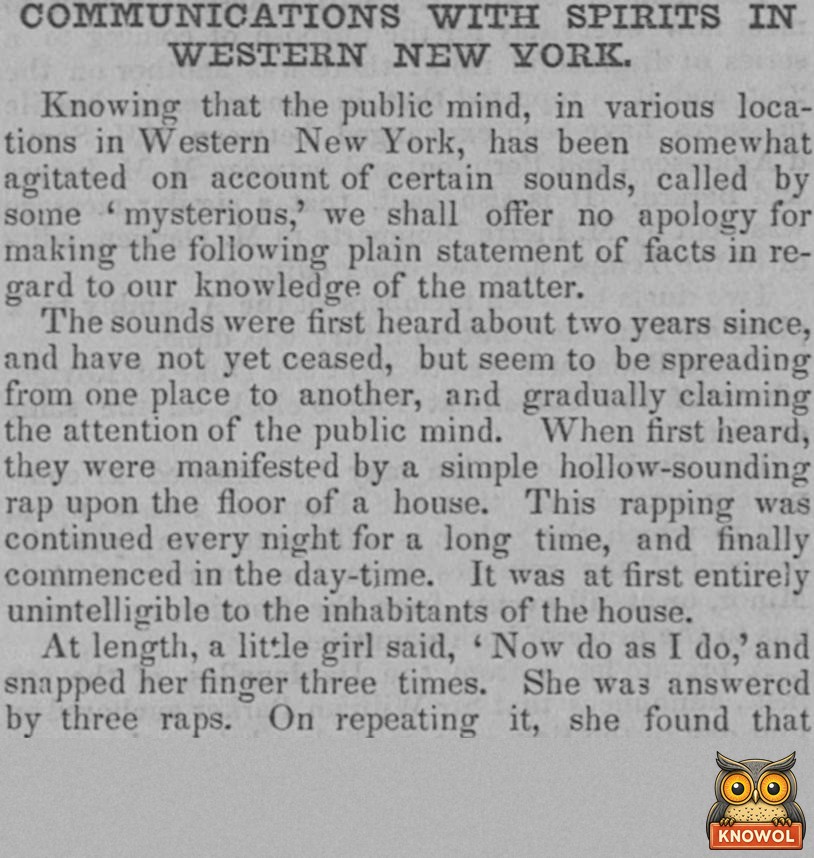
“Communications With Spirits in Western New York.” The Liberator, Boston, Massachusetts, December 14, 1849, page 4, reprinted from the New York Tribune. Library of Congress, Chronicling America. Click the clipping to read it full size.
Three snaps, three knocks
The knocking began in a small wooden farmhouse in Hydesville, a crossroads near Newark, New York. John Fox, a blacksmith, moved his family in during December 1847. His two youngest girls were Maggie and Kate. An 1884 history of Rochester says Maggie was twelve that winter and Kate was nine. Other old accounts give younger ages.
Night after night, the family heard raps they couldn’t explain. Then, on March 31, 1848, Kate decided to talk back. As one report told it, “a little girl said, ‘Now do as I do,’ and snapped her finger three times. She was answered by three raps.” She tried again, and the knocks copied her every time.
Soon the knocks were answering questions. A rap meant yes, and silence meant no. Then someone called out the alphabet, A, B, C, and the knocks rapped at the right letters to spell out words. The report said “nearly or quite three hundred persons assembled” to find the sound. They searched the house “from garret to cellar,” attic to basement, but “no one ever discovered the operator.”
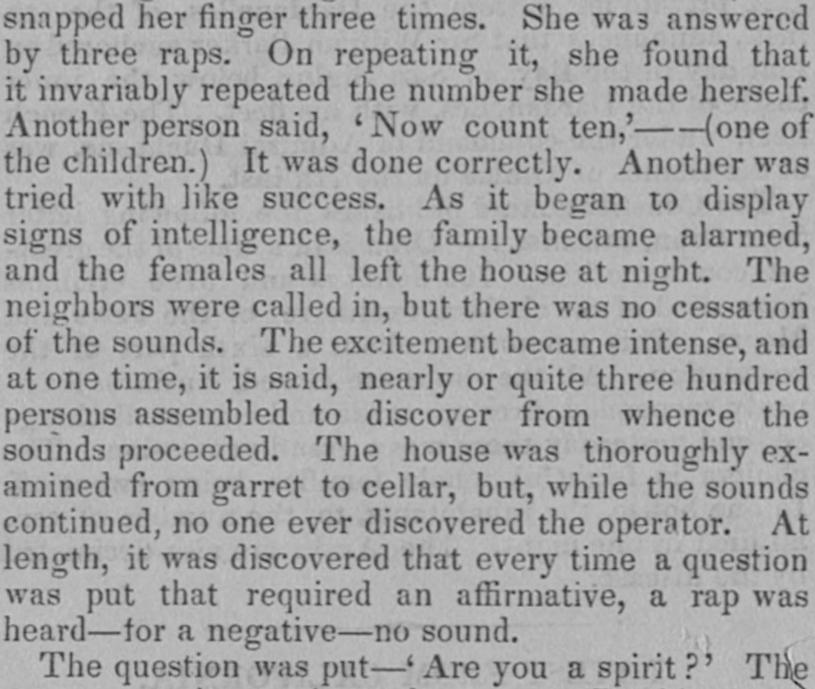
Three hundred people and a search from garret to cellar. The Liberator, Boston, Massachusetts, December 14, 1849, page 4. Library of Congress, Chronicling America. Click the clipping to read it full size.
The knocks move to Rochester
Their big sister Leah taught music in Rochester. She took Kate home with her on a canal boat to calm things down. The 1884 history says the knocks rang out on the cabin floor before the boat had gone more than a few miles. Before long, friends in Rochester were holding quiet meetings to listen to the raps.
In November 1849 those friends held a public meeting in Corinthian Hall. E. W. Capron, a family friend from Auburn, New York, told the whole story. Then he asked the audience to choose a committee of five men to test the sisters and report back the next night.
Three committees, three days
The first committee came back stumped. The men had heard knocks on the floor, the walls and a closet door. One man held his hands on the sisters’ feet and on the floor at the same time. The feet never moved, but he felt the floor jar with every knock.
The crowd didn’t like that answer, so it picked a second committee. This one had a doctor named Langworthy with a stethoscope, the tube doctors use to listen inside your chest. He wanted to know if the girls were throwing their voices, like a ventriloquist. He found no sign of it. The second committee said the sounds “could not have been made by machinery.”
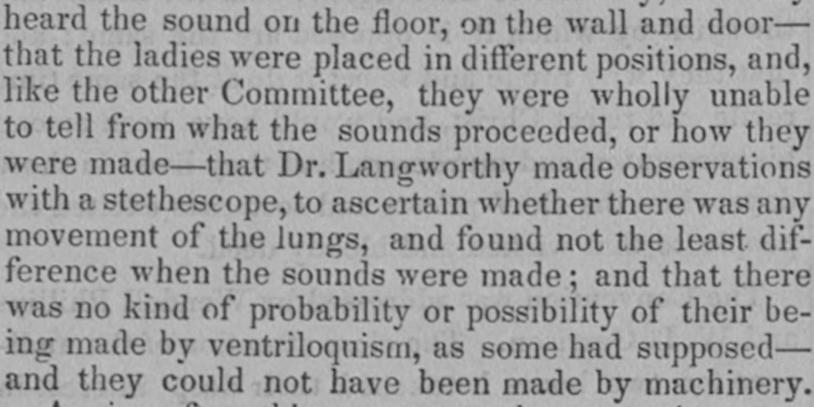
The doctor and his stethoscope. The Liberator, Boston, Massachusetts, December 14, 1849, page 4. Library of Congress, Chronicling America. Click the clipping to read it full size.
So the crowd picked a third committee, made of people who were sure it was a trick. One of them, W. L. Burtis, said he would pay $100 if he couldn’t expose it. This group asked three women to help. The women checked the sisters’ shoes and every piece of their clothing. Then they tried an experiment of their own, and signed their names to the result: “When they were standing on pillows, with a handkerchief tied round the bottom of their dress, tight to the ancles, we all heard the rapping on the wall and floor distinctly.”
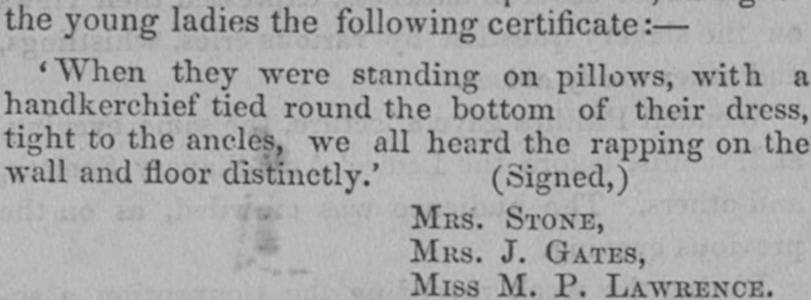
The note signed by the committee of women. The Liberator, Boston, Massachusetts, December 14, 1849, page 4. Library of Congress, Chronicling America. Click the clipping to read it full size.
They even stood the sisters on glass. That time the knocks stopped. Later, in front of a bigger crowd, they came back “as loud and distinct as before.” After “three days of the strictest scrutiny,” wrote Capron and George Willets of Rochester, the sisters were “acquitted of all fraud.” The New York Tribune printed their letter, and on December 14, 1849, the Liberator, Boston’s antislavery weekly, printed it again.
Famous sisters
The Fox sisters became famous, and people all over the country wanted to hear the knocks. Many believed the raps were messages from loved ones who had died. A new faith called Spiritualism grew out of those knocks. In 1852, the New York printmaker Nathaniel Currier sold a picture of the three sisters, copied from a photograph.
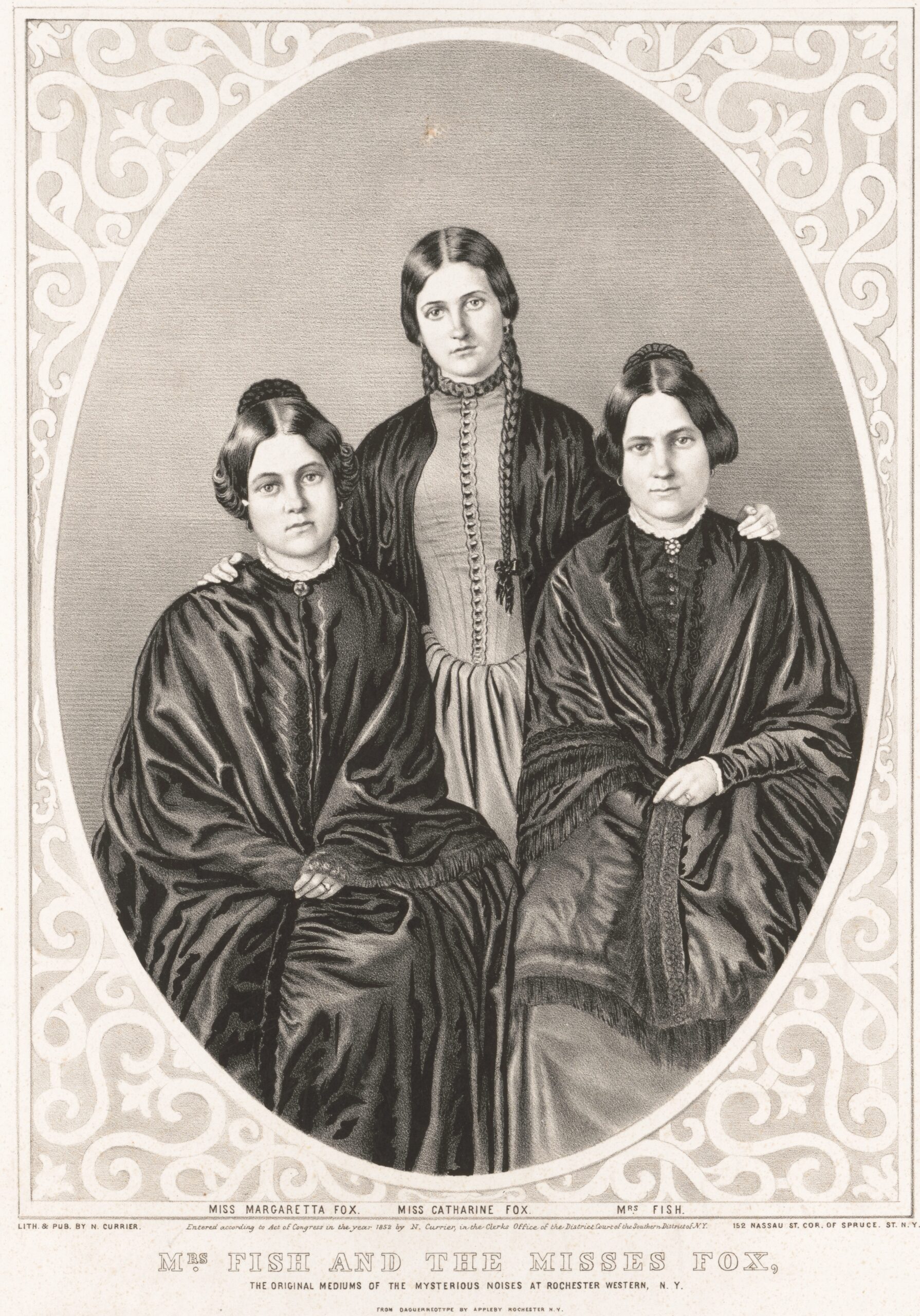
“Mrs. Fish and the Misses Fox: the original mediums of the mysterious noises at Rochester Western, N.Y.” From left: Margaretta Fox, Catharine Fox and Mrs. Fish. Lithograph by N. Currier, New York, 1852, after a daguerreotype by Appleby of Rochester. Library of Congress. Click the picture to see it full size.
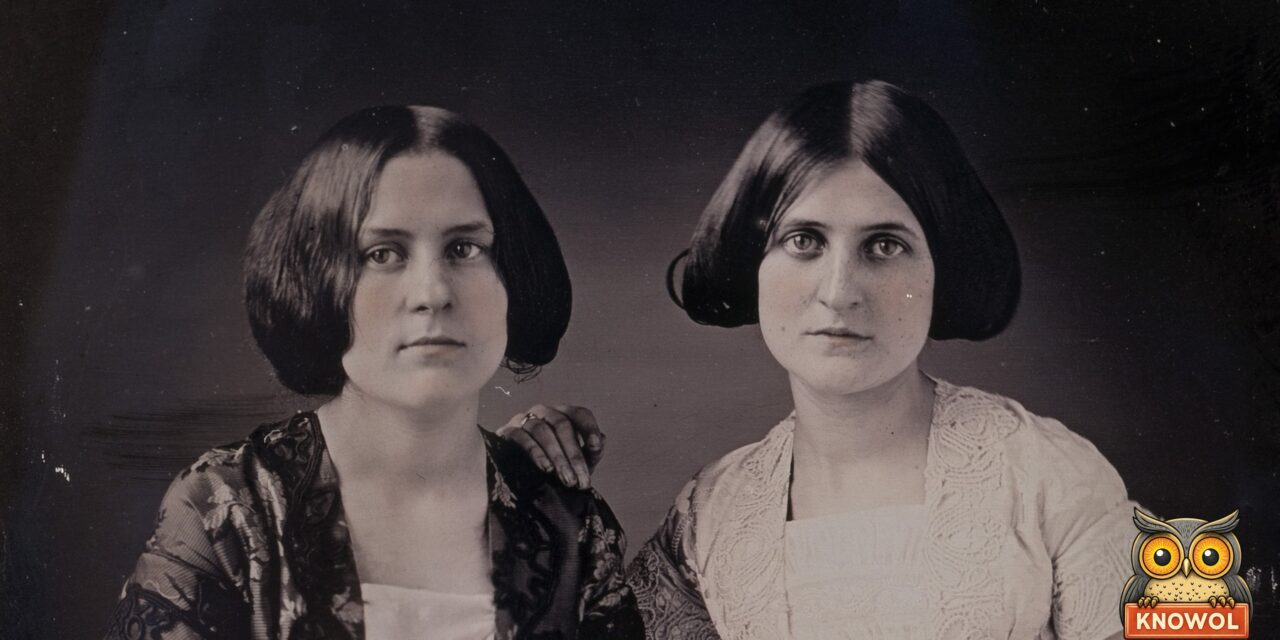
The photo at the top of this page is a real daguerreotype, an early kind of photo made on a silver-coated plate. Its maker, Thomas M. Easterly, inscribed the words “Kate and Maggie Fox” along its bottom edge. The Missouri History Museum dates it to 1852.
The shoe comes off
Nearly forty years later, on Sunday night, October 21, 1888, Maggie Fox stood on another stage, at the Academy of Music in New York City. She was Mrs. Kane now. Kate watched quietly from a box seat. Maggie read a statement saying the knocks had been a trick from the start. Then she showed how.
She sat in a chair with her feet on a sounding board, a thin wooden board that makes small sounds louder. Doctors from the audience looked at her feet “amid titters and blushes.” According to the New-York Tribune, “She had slipped off a shoe,” and the crowd heard “rat-tat-tat-tat-tat,” growing louder and seeming to climb up the wall. The Tribune’s headline said it plainly: “She did the rapping with her big toe.” One joker in the crowd said spiritualism “isn’t worth a rap any longer.”
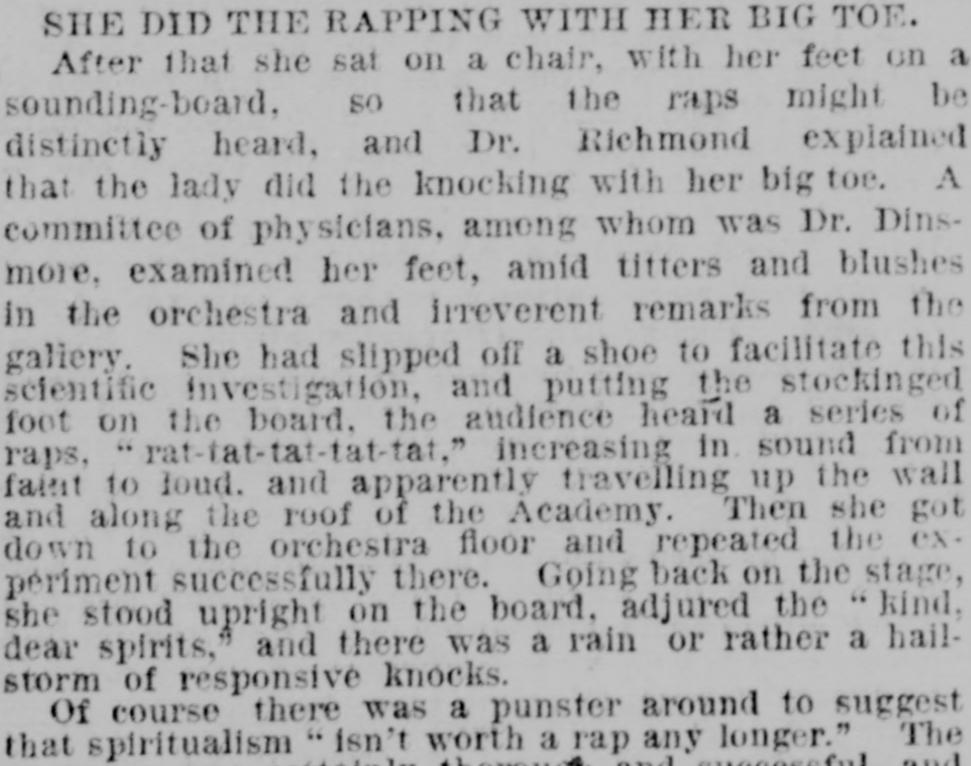
“She Did the Rapping With Her Big Toe.” New-York Tribune, New York, New York, October 22, 1888, page 7. Library of Congress, Chronicling America. Click the clipping to read it full size.
An apple on a string
Maggie’s own story of how it started came out that week. The Springfield Republican in Massachusetts wrote that the girls “were roguish creatures,” which means they loved mischief. They wanted to tease their mother, who was “a good woman, and easily frightened.” At night, up in their little room under the roof, they made noises by “bumping on the floor an apple tied to a string.”
Then they found a better way. They learned they “could snap their great-toe joints, and made much better raps in that way.” Some people can pop a knuckle loud enough to make you jump. The Fox girls learned to do it with their toes. Back in 1849, the committee man who held their feet never felt them move.
[IMAGE: clips/I-springfield-republican-1888-10-26-apple-on-a-string.jpg | The apple on a string. Springfield Republican, Springfield, Massachusetts, October 26, 1888, page 2. Library of Congress, Chronicling America.]
## The last word
The story had one more turn. When a Rochester paper looked back on Maggie’s life in 1893, it said her exposure “was subsequently retracted.” In plain words, she later took her confession back.
Believers stood firm through all of it. In 1900, a South Carolina paper reported that even after the sisters’ confession, “the faith of believers in spiritualism is in no wise shaken.” People still argue over which Maggie told the truth, the girl of 1849 or the woman of 1888. What the old papers tell for sure is how it began: one night, a little girl in a farmhouse snapped her fingers three times, and a whole country leaned in to listen.
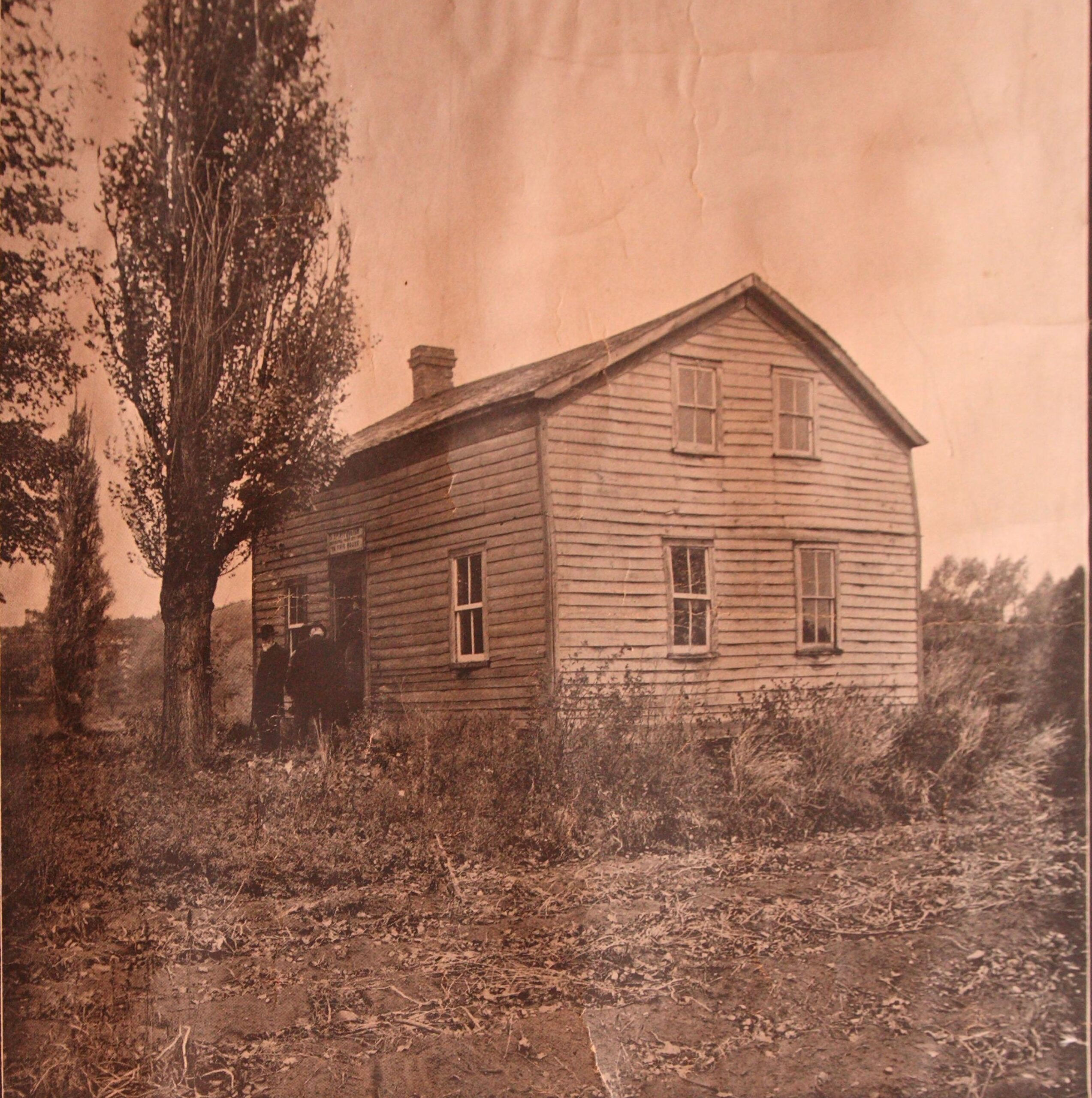
The Fox family’s old house in Hydesville, near Newark, New York, from a poster sold by the Austin Publishing Company of Rochester around 1909. A sign over its front door read “Spiritualism was born March 31, 1848 in this house.” Camp Chesterfield collection, Indiana Memory. Click the picture to see it full size.
Sources
- The Liberator (Boston, Massachusetts): December 14, 1849, page 4 (“Communications With Spirits in Western New York,” a letter from E. W. Capron and George Willets, Rochester, November 22, 1849, reprinted from the New York Tribune).
- New-York Tribune (New York, New York): October 22, 1888, page 7 (“Lively Rappings in the Academy of Music”).
- Springfield Republican (Springfield, Massachusetts): October 26, 1888, page 2 (“Exposure of ‘Rochester Rappings'”).
- The Morning Call (San Francisco, California): March 22, 1893, page 3 (“Margaret Fox Kane,” from the Rochester Union and Advertiser).
- The People’s Journal (Pickens, South Carolina): April 19, 1900, page 1 (“The First Spirit Rappings”).
- William F. Peck, Semi-Centennial History of the City of Rochester (1884), chapter “The Rochester Rappings,” pages 508 to 516, Internet Archive.
- N. Currier, “Mrs. Fish and the Misses Fox,” lithograph, 1852, Library of Congress, no known restrictions on publication.
- Poster, “The Old Fox Cottage, Hydesville, N.Y.,” Austin Publishing Company, Rochester, about 1909, Camp Chesterfield collection, Indiana Memory, no copyright in the United States.
- All newspaper images: Library of Congress, Chronicling America. Published 1849 to 1900.
- Cover: Thomas M. Easterly, “Kate and Maggie Fox, Spirit Mediums from Rochester, New York,” daguerreotype, 1852, Missouri History Museum (public domain; copy on Wikimedia Commons).