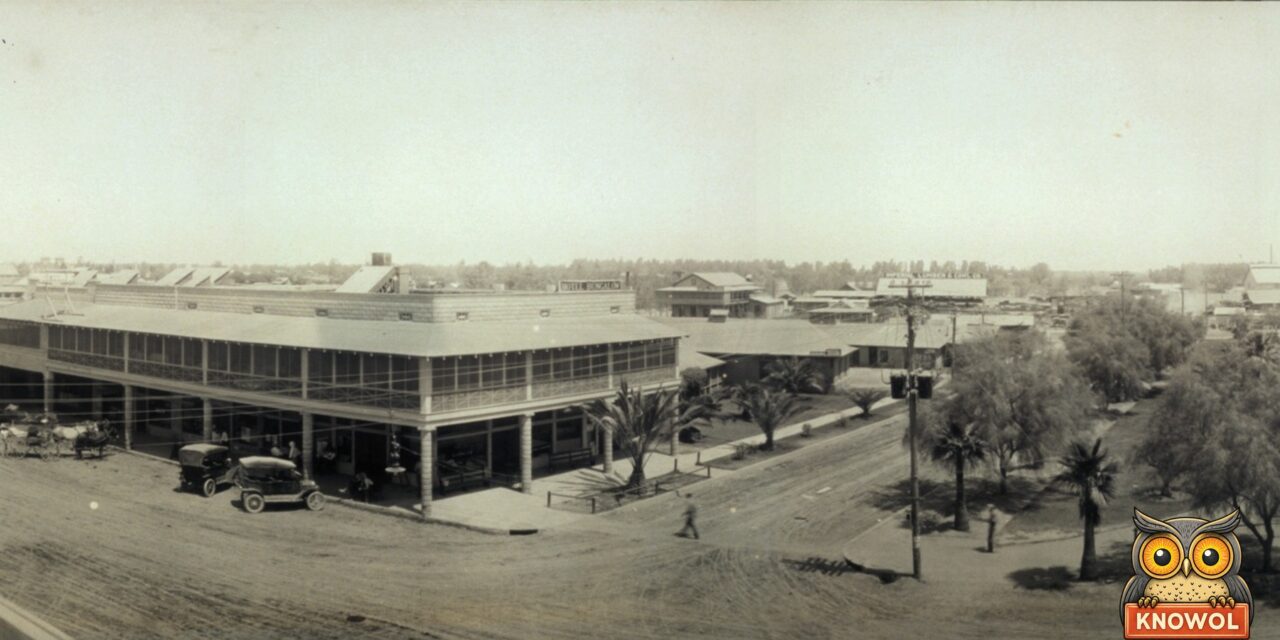
On the evening of Wednesday, June 27, 1917, hundreds of people gathered on the grass in front of the city hall in Brawley, California. Somebody was handing out cold cantaloupe. There was ice cream and punch. And everybody was waiting for the same thing: for the new street lights to come on. The next day the Imperial Valley Press, the daily paper in nearby El Centro, put the party on its front page under the headline “MELONS, CREAM, CIGARS, ALL FREE.”
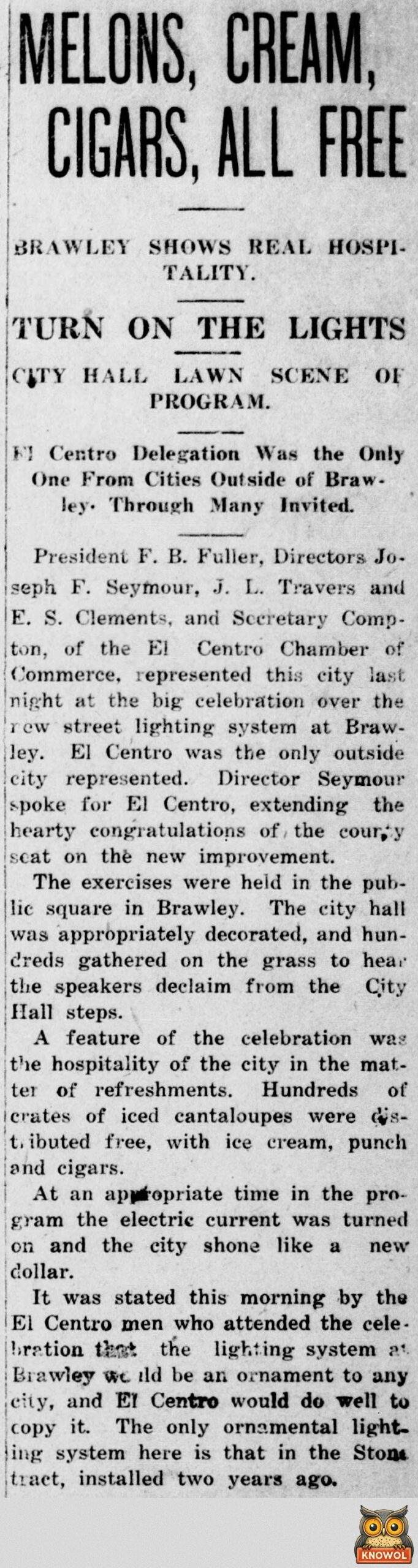
“Melons, Cream, Cigars, All Free.” Imperial Valley Press, El Centro, California, June 28, 1917, page 1. Library of Congress, Chronicling America. Click the clipping to read it full size.
A hot week in a melon town
Brawley sits in the Imperial Valley, in the desert at the south end of California. That June the valley had two things on its mind. One was the heat. The other was cantaloupes.
The heat came first. On Tuesday, June 26, the Press ran a little story headed “CHANGE WEATHER TUBE.” The valley’s official government thermometer, at a place called Meloland, had read 111 degrees three days in a row. It hit 111 again that day. The paper joked that the thermometer must be the trouble: “there seems to be dissatisfaction with the official government thermometer at Meloland.” A new one, made in Chicago, was already on its way.
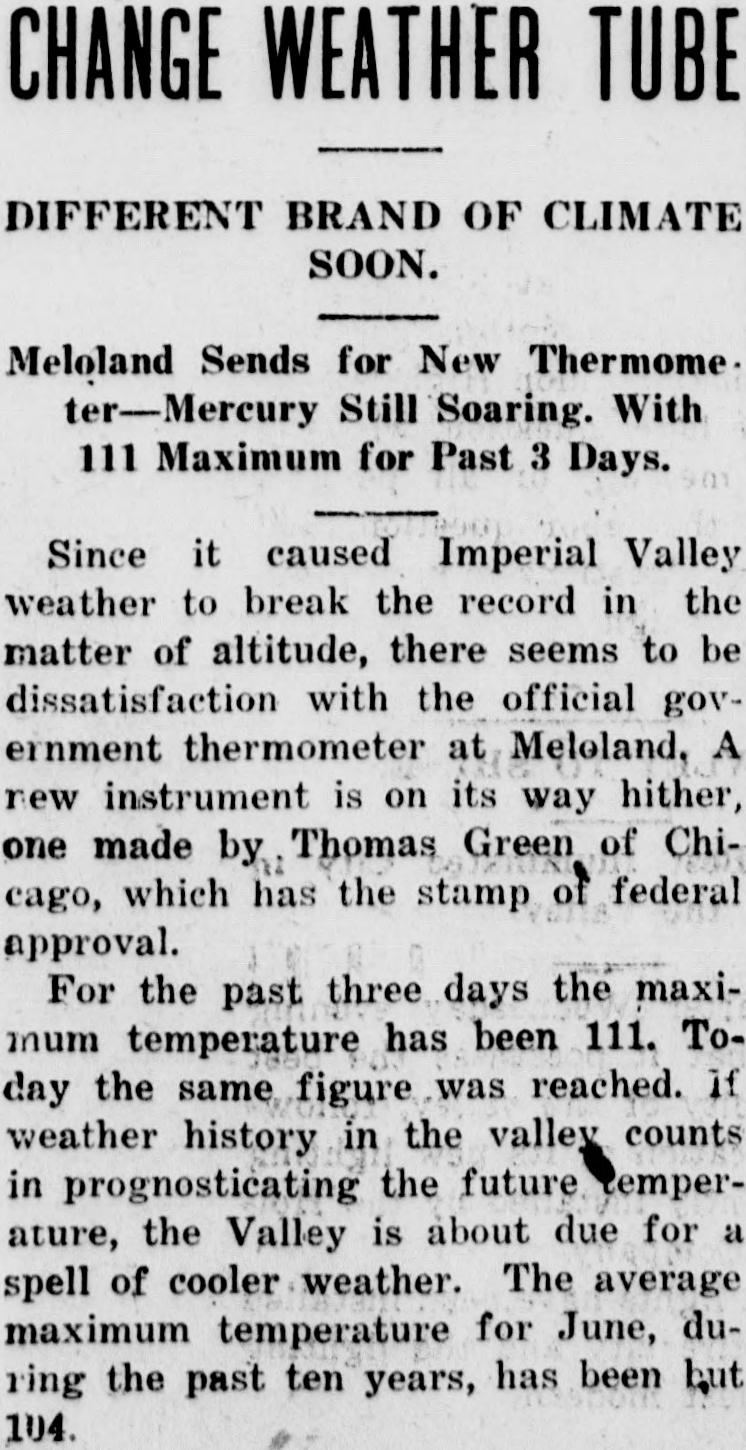
“Change Weather Tube.” Imperial Valley Press, El Centro, California, June 26, 1917, page 1. Library of Congress, Chronicling America. Click the clipping to read it full size.
Then there were the melons. A government report in 1916 called the Imperial Valley “the earliest and probably the most important muskmelon-growing district in the United States to-day.” Muskmelon was its word for cantaloupe. June was shipping season, and the melons left by train. On June 22 the Press described one record night this way: “Six long trains bearing breakfasts for 3,000,000 people rolled out of the valley, most of the melons going east.”
Five days later that record fell. On Tuesday, June 26, at least 250 railroad cars of cantaloupes rolled out in a single day. Railroad men in Brawley called it “the largest shipment of cantaloupes ever sent out on one railroad line in the history of the West.” So when Brawley planned a party for the next night, nobody had to wonder what to serve.
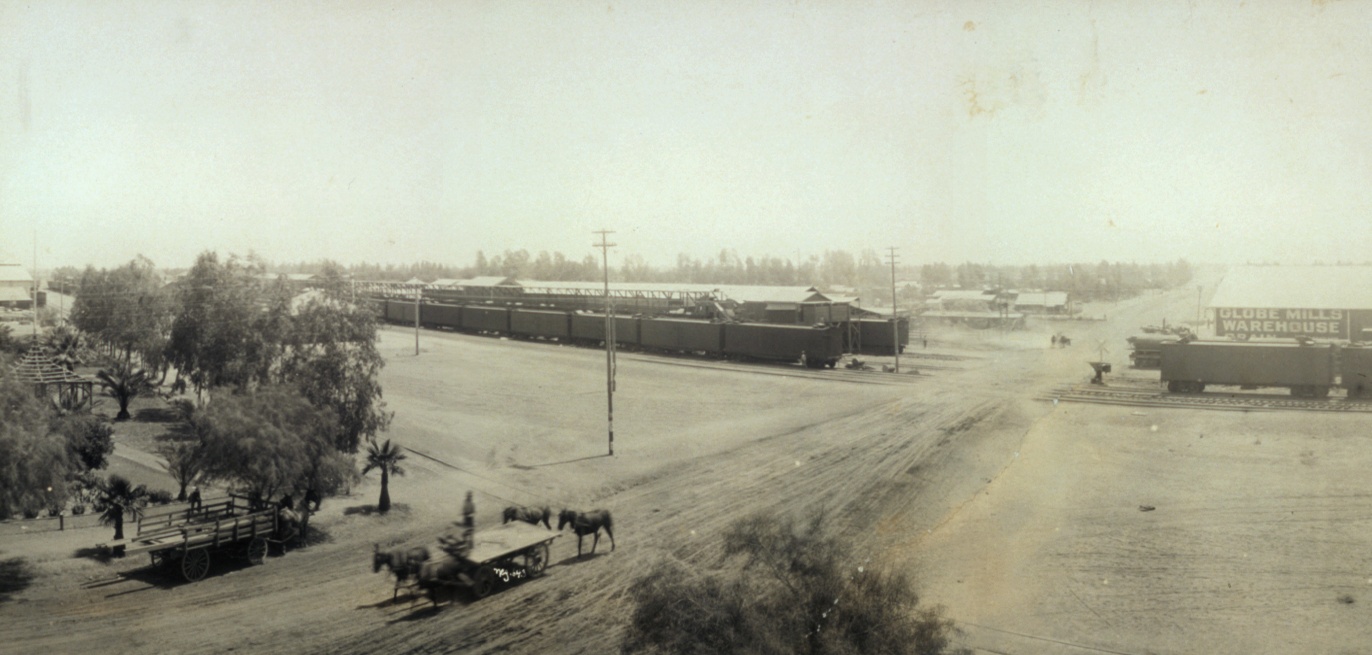
Brawley, California, in June 1913, four years before the party: a shady park with palm trees, horse-drawn wagons, and a long line of railroad cars. Part of a panoramic photo by S. U. Bunnell. Library of Congress. Click the picture to see it full size.
Lamp posts that weighed 1,200 pounds
Brawley had been waiting for its lights since winter. On March 8 the Press reprinted a story from the Brawley News under a hopeful headline: “LIGHT SYSTEM AT BRAWLEY IS READY.” It was not quite ready. The electrical work was nearly done, but the system “waits only for material that was ordered long ago.”
The best part of that story is the posts. They were made of concrete by a local outfit, the Imperial Valley Concrete Company. Each one stood “Fourteen feet high and two feet in diameter at the paneled base.” Fourteen feet is four feet higher than a basketball hoop. Each post weighed 1,200 pounds before its foundation was added, which is more than half a ton.
The base of every post had “panels for the street names,” so each lamp post was a street sign too. The company’s manager, Carl Arfwedson, tried several ways of finishing the concrete, and the city’s officials picked “the plain stone effect.” Brawley needed 28 of these posts for the part of town with paved streets. By late June the Holton Power Company had the whole system in place. “Additional lights have been installed over the entire city,” the Press reported.
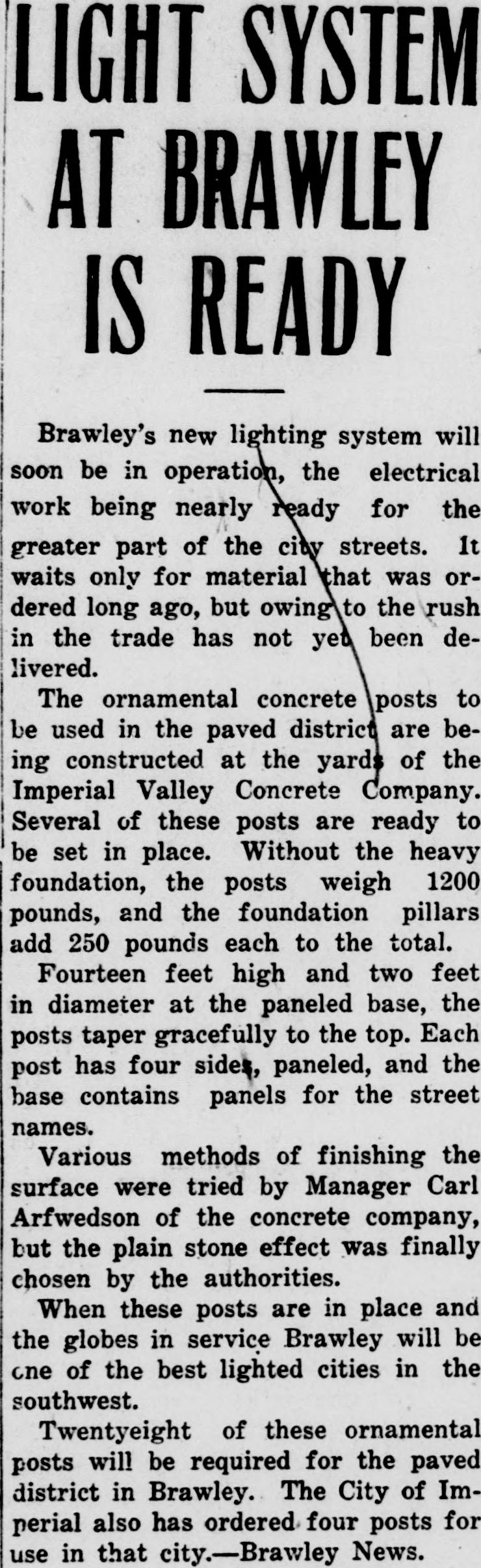
“Light System at Brawley Is Ready,” reprinted from the Brawley News. Imperial Valley Press, El Centro, California, March 8, 1917, page 4. Library of Congress, Chronicling America. Click the clipping to read it full size.
Melons, cream and a switch
Brawley invited the neighbors. Its invitation to El Centro, the county seat, ran in the Press on Monday. It even gave the travel plan: “Machines will leave the Barbara Worth hotel” on Wednesday night. Machines meant automobiles. Five men from the El Centro Chamber of Commerce made the trip, their president, F. B. Fuller, among them. Many towns were invited, the paper said, but El Centro was the only one that came.
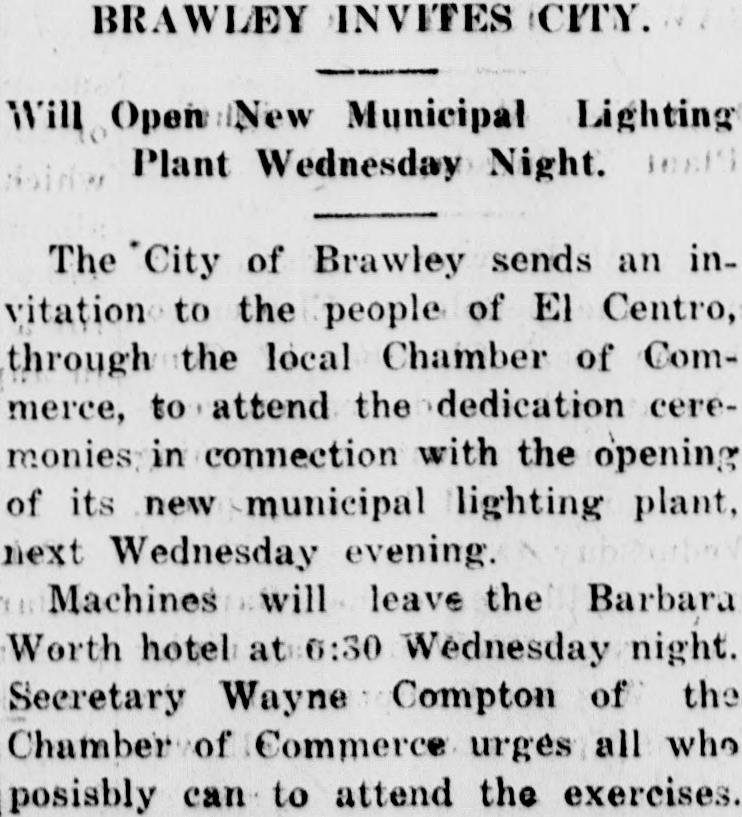
“Brawley Invites City.” Imperial Valley Press, El Centro, California, June 25, 1917, page 1. Library of Congress, Chronicling America. Click the clipping to read it full size.
The party was held in Brawley’s public square. The city hall was decorated, and the crowd gathered on the lawn to listen to “the speakers declaim from the City Hall steps.” To declaim is to give a speech in a big, grand voice. Joseph F. Seymour spoke for El Centro and brought the county seat’s congratulations.
Then came the part the headline writer liked best. “Hundreds of crates of iced cantaloupes” were given away, “with ice cream, punch and cigars.” A standard shipping crate held 45 cantaloupes, according to the 1916 government report. If Brawley used crates like that, even 200 of them would come to 9,000 melons.
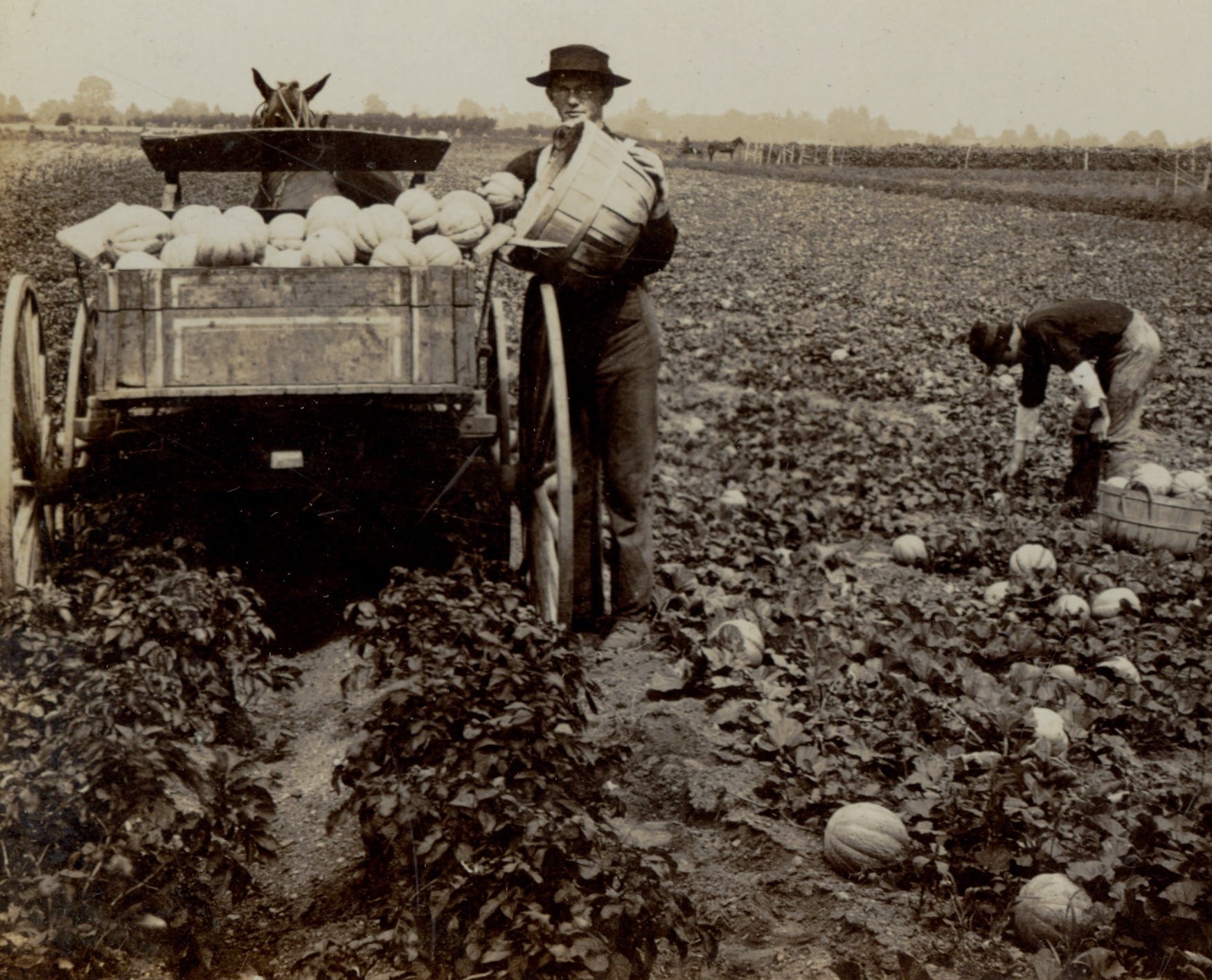
Picking and loading cantaloupes near Buffalo, New York, about 1905. This is a stand-in from the other side of the country, not Brawley. Keystone View Company stereograph, Boston Public Library, public domain. Click the picture to see it full size.
And then the lights. The Press told it in one sentence: “At an appropriate time in the program the electric current was turned on and the city shone like a new dollar.” Picture a brand-new silver dollar and you have the idea.
By the numbers
- 111 degrees: the reading on the valley’s official thermometer four days in a row, through June 26
- At least 250: railroad cars of cantaloupes shipped on June 26, a record
- 28: concrete lamp posts ordered for Brawley’s paved streets
- 14 feet and 1,200 pounds: the height and weight of one post, without its foundation
- 45: cantaloupes in a standard shipping crate
- More than 200: people at the cantaloupe sundae social the next night
Cantaloupe sundaes the next night
The El Centro men went home impressed. The next morning they told the Press that Brawley’s lights would be “an ornament to any city, and El Centro would do well to copy it.”
Brawley was not finished with its melons, either. The very next night more than 200 people came to the town plaza for a church social put on by the valley’s Baptists. The pastor from El Centro, Walter S. Reed, “made the record for brevity,” which means he gave the shortest speech. All he said was, “We are mighty glad to be here.” Then came dessert: “ice cream in cantaloupes.” The headline called them “Cantaloupe Sundaes.”
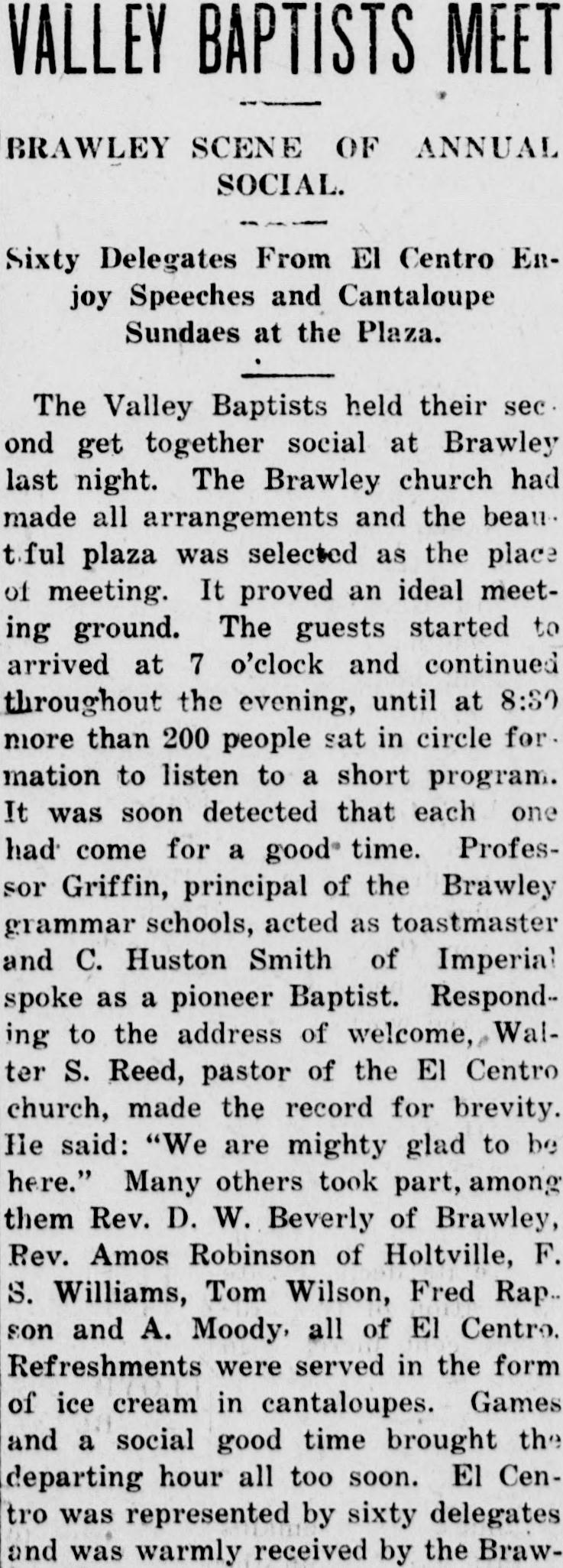
“Valley Baptists Meet.” Imperial Valley Press, El Centro, California, June 29, 1917, page 1. Library of Congress, Chronicling America. Click the clipping to read it full size.
The photo at the top of this story shows Brawley in June 1913, four summers before the lights. A sign on the roof of the big building with the long porch reads Hotel Bungalow. In 1917 the government men who counted the melon trains had their office in the Bungalow hotel. Outside, in a week of 111-degree days, their town was giving cantaloupes away cold. Then somebody threw a switch, and Brawley lit up, as the paper put it, “like a new dollar.”
Sources
- Imperial Valley Press (El Centro, California): June 28, 1917, page 1 (“Melons, Cream, Cigars, All Free”); June 25, 1917, page 1 (“Brawley Invites City”); June 26, 1917, page 1 (“Brawley to Shine” and “Change Weather Tube”); June 27, 1917, page 1 (“Record Shipment of Melons Sent”); June 22, 1917, page 1 (“Record Shipment of Cantaloupes”); June 29, 1917, page 1 (“Valley Baptists Meet”); March 8, 1917, page 4 (“Light System at Brawley Is Ready,” reprinted from the Brawley News).
- O. W. Schleussner and C. W. Kitchen, Marketing and Distribution of Western Muskmelons in 1915, U.S. Department of Agriculture Bulletin No. 401 (Washington, 1916): the Imperial Valley’s rank among melon districts (page 2) and the 45-melon standard crate (page 4).
- Cover and the park photo: S. U. Bunnell, “View of Brawley, Cal., June 1913,” panoramic photograph, Library of Congress, no known restrictions on publication. Both are parts of the same long print.
- Keystone View Company, “Picking and Loading Cantaloupes, near Buffalo, N.Y., U.S.A.,” stereograph, copyright 1905, Boston Public Library, Digital Commonwealth, no known copyright restrictions.
- All newspaper images: Library of Congress, Chronicling America. Published 1917.