On Saturday morning, November 3, 1855, the Worcester Daily Spy cost two cents, and its front page was filled with ads and notices. There were ads for tea, for pianos, for clothing and for corn medicine. Down the first column, between an iron dealer and an umbrella maker, was a notice for a shop that made something you cannot buy today.
The shop was in Worcester, Massachusetts, at “No 207 Main St., (up stairs,)”. The man upstairs signed himself J. G. Arnold, and what he made was “Models of all kinds.” They were small machines, built to show how a big new invention worked. His notice promised they would be “working if required, and warranted to answer the requisition of the Patent Office.” In plain words, his tiny machines really ran, and the government would accept them.
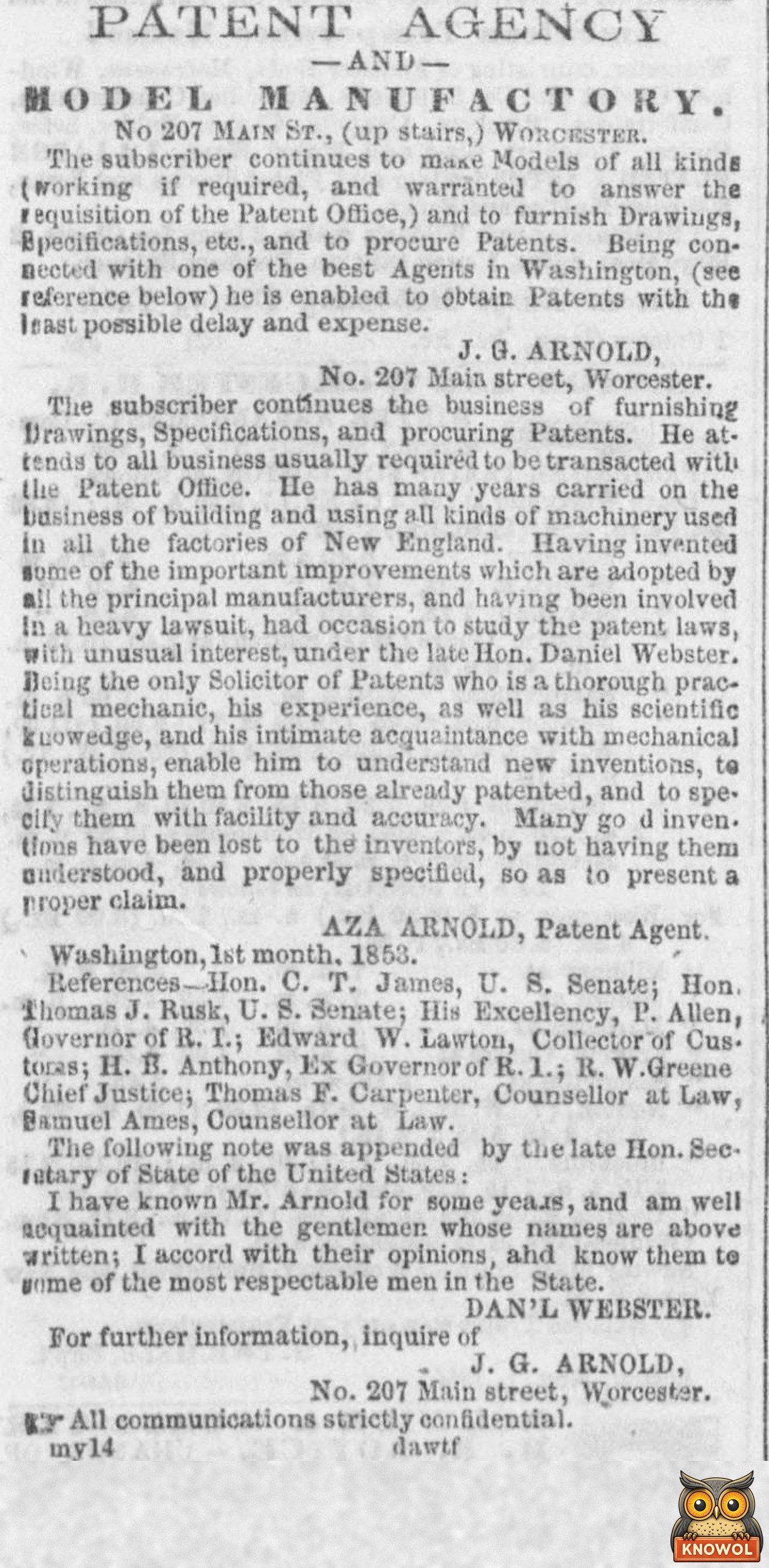
“Patent Agency and Model Manufactory,” the Arnolds’ notice in the Worcester Daily Spy, Worcester, Massachusetts, November 3, 1855, page 1. Library of Congress, Chronicling America. Click the clipping to read it full size.
Why an Inventor in Worcester Needed a Tiny Machine
An inventor in Worcester, Massachusetts, in 1855 could not get a patent with words and drawings alone. A patent is the government’s promise that nobody else may copy your invention for a number of years. To get one, you had to send the Patent Office in Washington a model of the thing.
The Patent Office printed its rules in a small book in 1854. “The model must be neatly and substantially made of durable material, and not more than one foot in length or height,” it said, unless the office agreed to a bigger one. A model that ran was best: “A working model is always desirable.” And the inventor’s name had to be “fixed upon it in a permanent manner,” because models sent “without a name are liable to be lost or mislaid.”
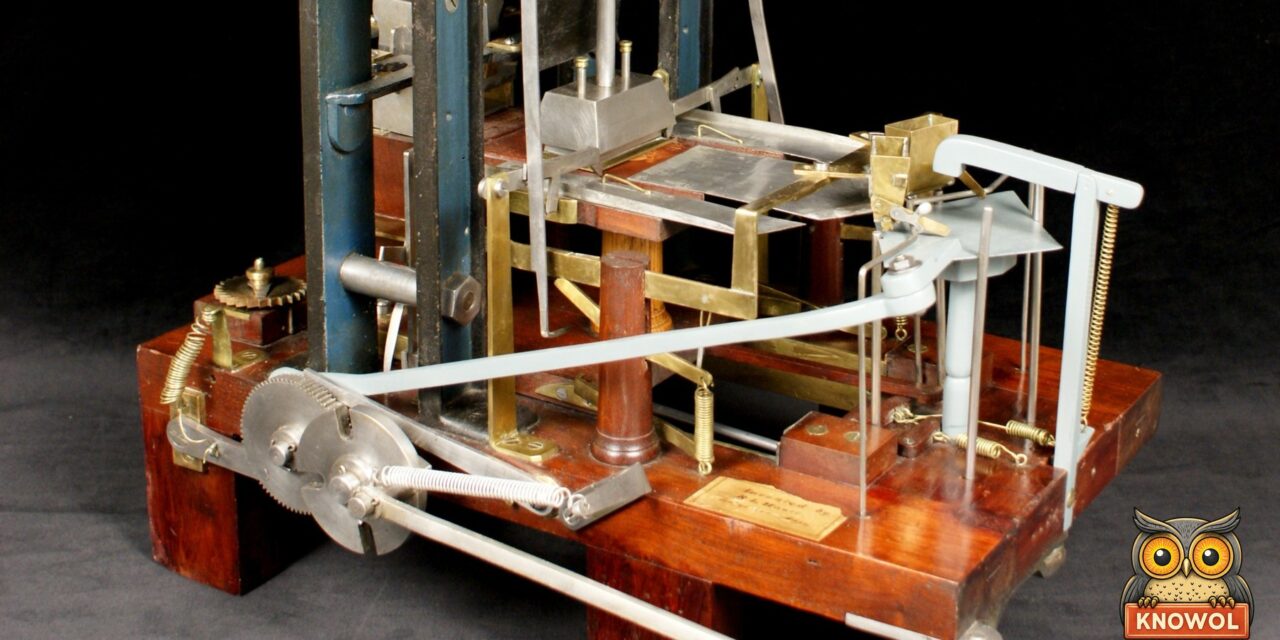
The picture at the top of this page shows one that was not lost. It is the model that Dr. Russell L. Hawes of Worcester sent to Washington for his envelope-folding machine, patented on June 21, 1853. It is made of metal and dark wood and stands about two feet tall, bigger than the one-foot rule. A small label on its base still reads “Invented by R. L. Hawes. Worcester Mass.” We do not know who built it, but it is just the kind of work the shop upstairs on Main Street was offering.
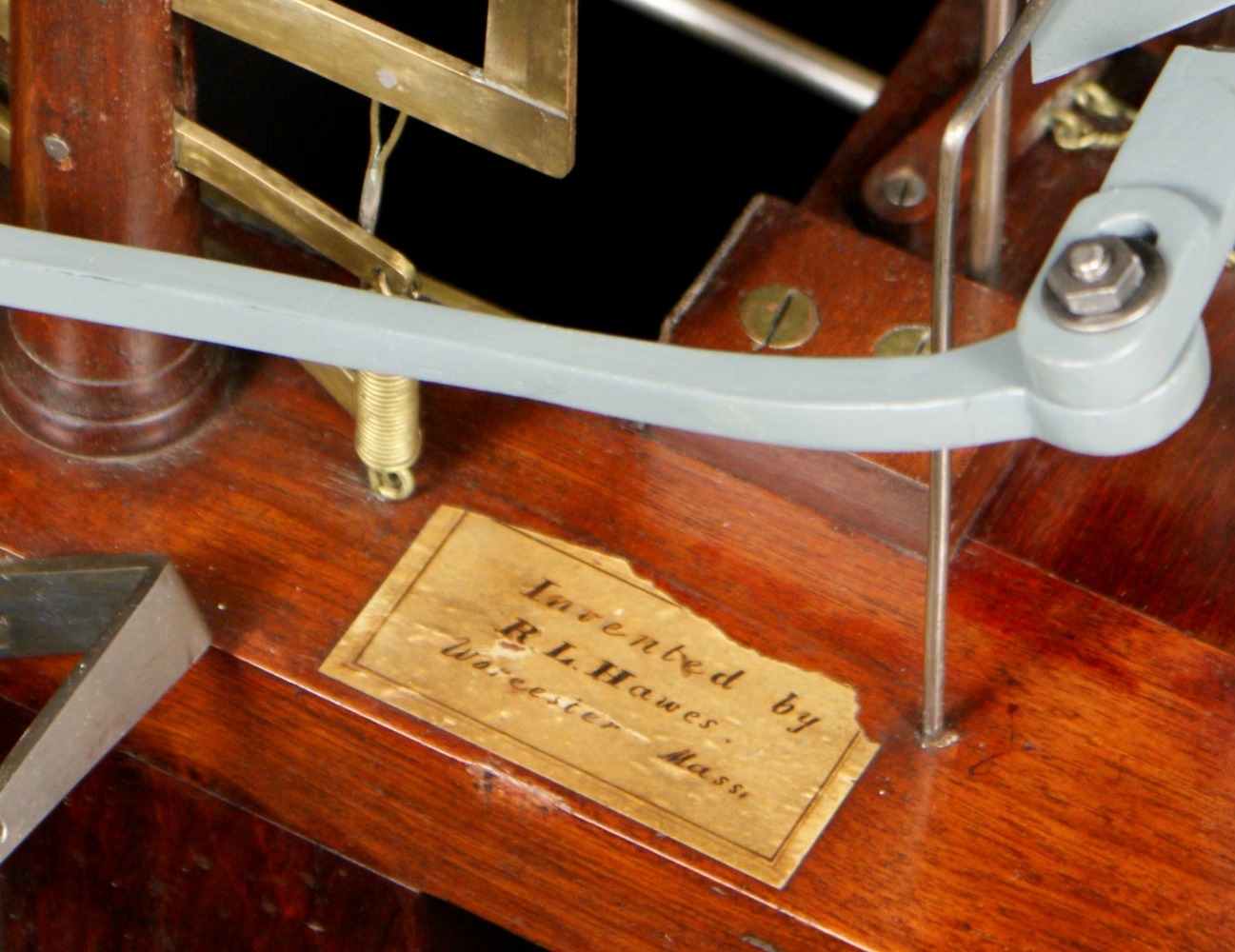
The label on the base of the model at the top of this page: “Invented by R. L. Hawes. Worcester Mass.” The Patent Office wanted every model to carry its inventor’s name. National Postal Museum, Smithsonian Institution (CC0). Click the picture to see it full size.
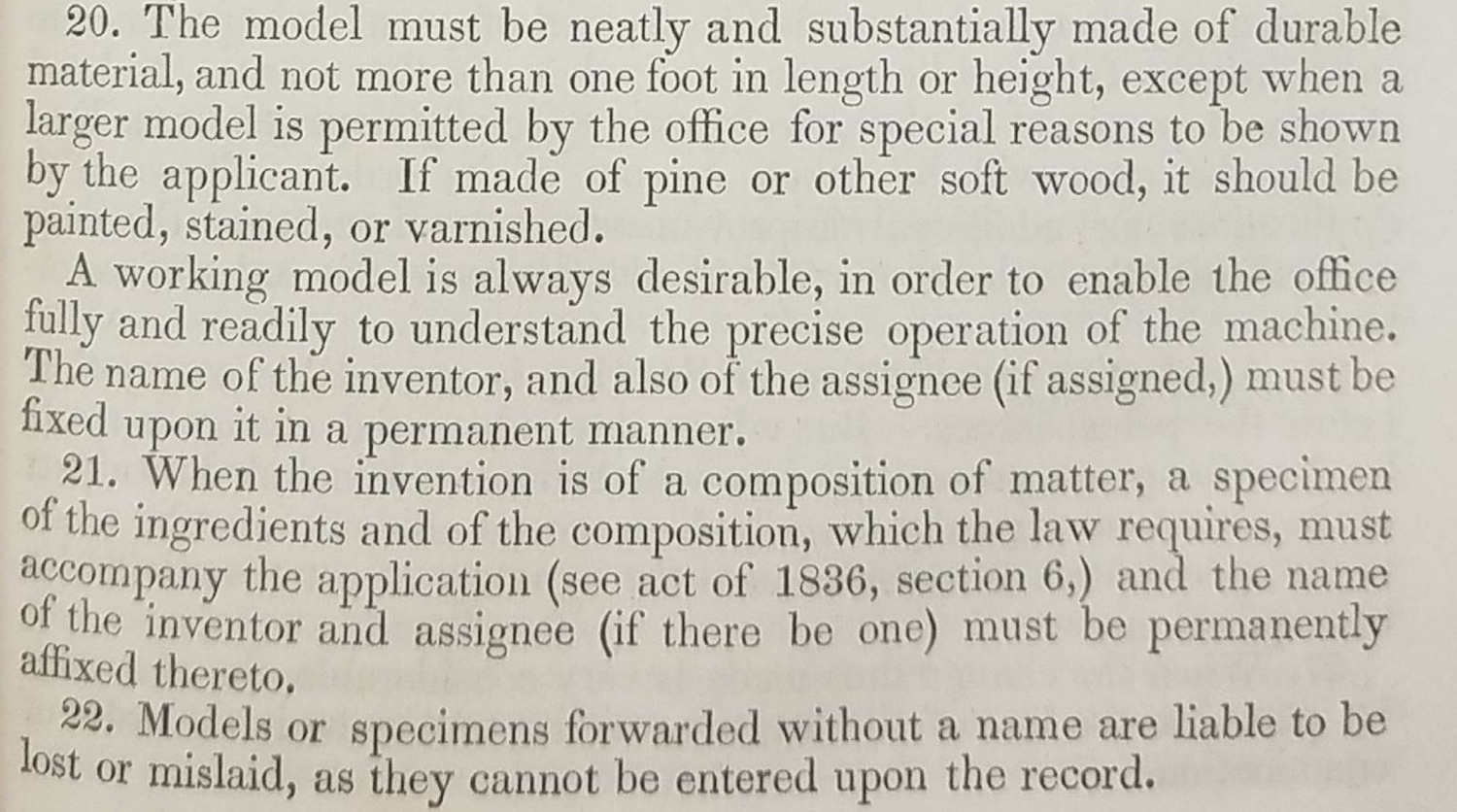
The model rules from “Rules and Directions for Proceedings in the Patent Office,” 1854, page 5. Internet Archive, public domain. Click the clipping to read it full size.
The Best Agent in Washington Was His Father
The model maker in Worcester, Massachusetts, did more than build. His notice said he would also “furnish Drawings, Specifications, etc., and to procure Patents.” Then came a small boast. He was “connected with one of the best Agents in Washington, (see reference below)”.
The reference below was a second notice, signed “AZA ARNOLD, Patent Agent.” and dated “Washington, 1st month, 1853.” The matching last name was no accident. A family history printed in 1903 says James Greene Arnold “was a patent attorney, and was son of Aza Arnold, a Quaker of Portsmouth, R. I.” Quakers numbered the months instead of naming them, so “1st month” meant January. James was 31 years old that fall, and his father was in his late sixties.
So this was a family business with one desk in each city. The son built the model and made the drawings in Worcester. The father, in Washington, took care of “all business usually required to be transacted with the Patent Office.” His notice ended with a note that Daniel Webster, the famous senator, had written for him. “I have known Mr. Arnold for some years,” it said. Webster had died a few months before the notice was dated.
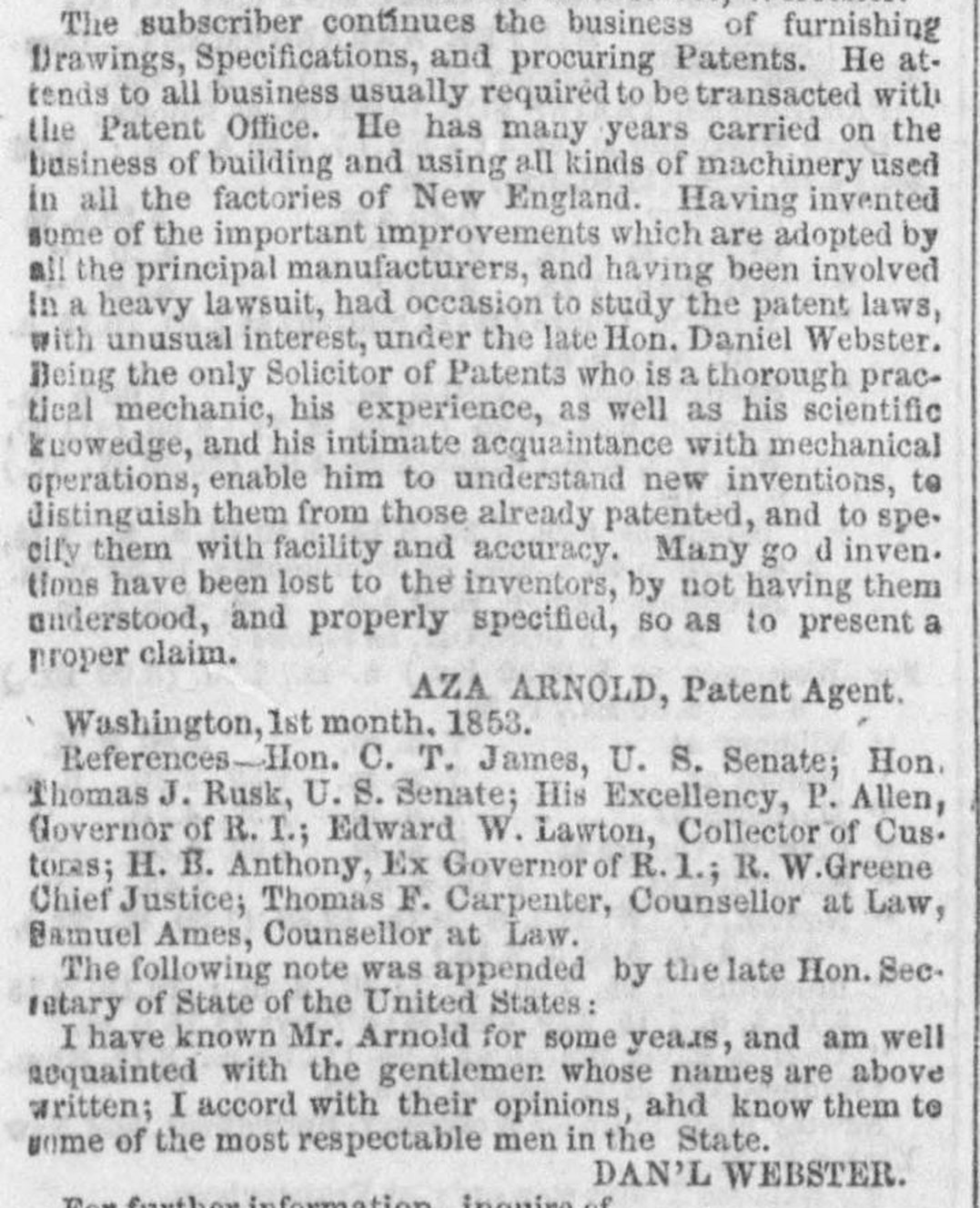
Aza Arnold’s part of the notice, with Daniel Webster’s note at the end. Worcester Daily Spy, Worcester, Massachusetts, November 3, 1855, page 1. Library of Congress, Chronicling America. Click the clipping to read it full size.
How Aza Arnold Lost His Own Invention
Aza Arnold, the father of the Worcester model maker, had been an inventor first. He was a Rhode Island machinist, and in 1823 he patented a set of gears for cotton mills.
Here is the problem his gears solved. Before cotton is spun into thread, a machine winds it onto a big spool as a soft, loose rope. Every layer makes the spool fatter, so it has to turn a little slower each time to keep the pull even. Arnold’s gears slowed it by just the right amount, all by themselves. An 1892 article in the magazine American Machinist said a mill owner with the gears could “turn off three skeins where he formerly had two.”
Then the idea got away from him. A history of cotton mills printed in 1863 says “a model was taken to Manchester by an American in 1825,” and the next January an Englishman named Henry Houldsworth Jr. patented the same thing in England. A British writer, Dr. Ure, called it “the most ingeniously combined apparatus in the whole range of productive industry,” and gave Houldsworth the credit.
At home, some mill owners paid Arnold to use his gears. Others would not, so he took them to court. The 1892 article says the other side found a flaw in his specification, which is the written description of an invention. A phrase in one part “was not repeated in another part.” The judge said Arnold could hand in his patent, have the wording fixed and “come back here in two weeks.” But the Patent Office kept it for months, the article says. In that time the patent law changed, and Arnold could no longer sue under the old one. The 1863 book says the court fight ate up most of what he had earned, and “he acquired neither fame nor wealth” from his gears.
The 1892 article adds one more turn. Years later, as a patent agent in Washington, Arnold is said to have found an old letter from the other side’s lawyer in the Patent Office files. It said, “Hold on to that patent till you hear from me.” That story was printed 27 years after Arnold died, and we could not check the letter ourselves.
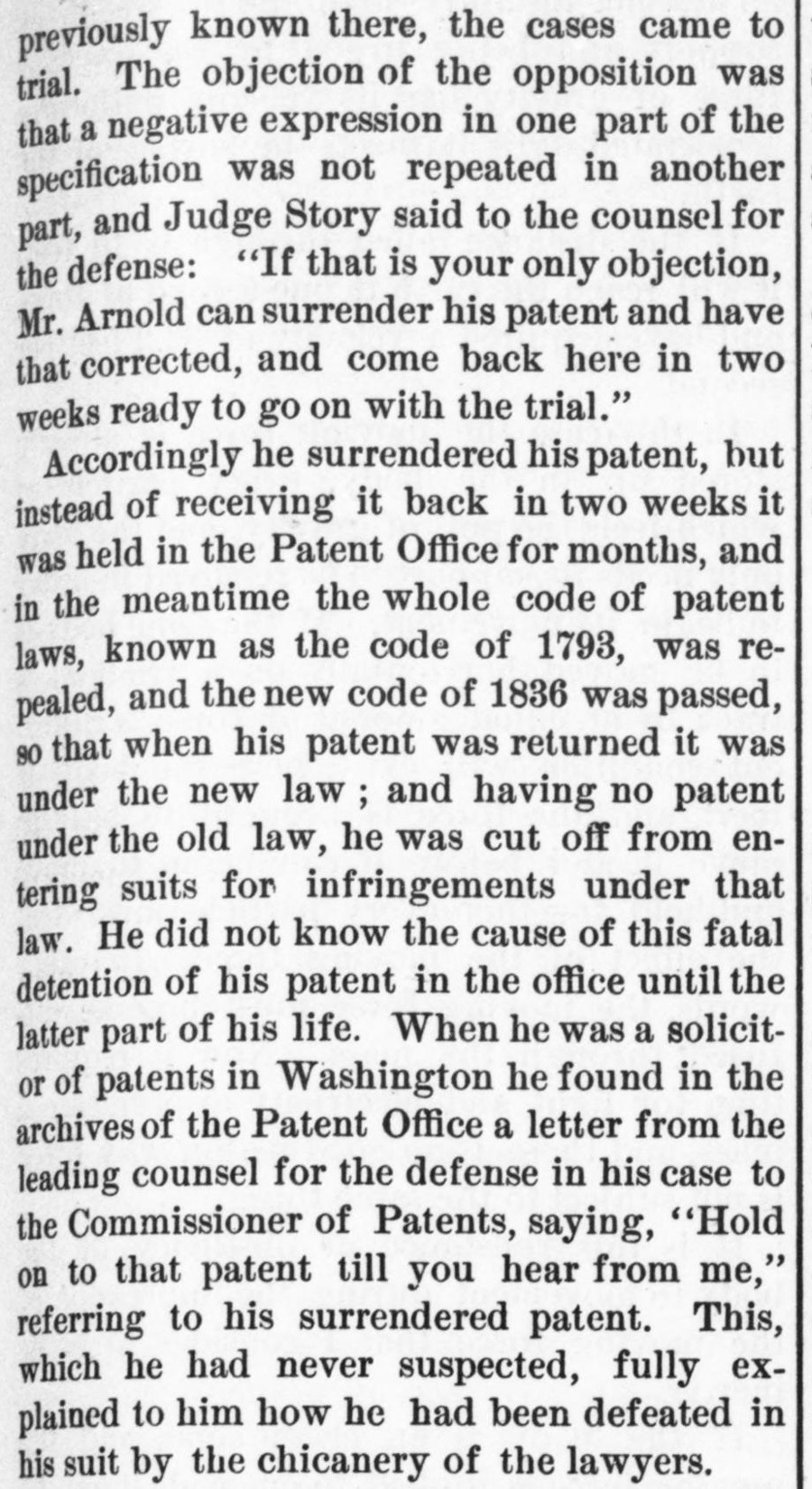
“Hold on to that patent till you hear from me.” From “Rhode Island Inventors,” American Machinist, September 8, 1892, page 5. Internet Archive, public domain. Click the clipping to read it full size.
What the Worcester Notice Promised Inventors
Aza Arnold’s notice in the Worcester, Massachusetts, paper reads differently once you know all that. He wrote that he had been “involved in a heavy lawsuit,” and so “had occasion to study the patent laws, with unusual interest, under the late Hon. Daniel Webster.”
Then comes the line that carries his whole story. “Many good inventions have been lost to the inventors, by not having them understood, and properly specified, so as to present a proper claim.” He did not say that one of them was his. So the Arnolds sold what Aza had learned the hard way: a model built right, and every word of the paperwork written right.
The Model Maker of Worcester Invents Something Himself
James G. Arnold kept his office over 207 Main Street in Worcester, Massachusetts. In a book of Worcester businesses printed in 1856, his ad still promised models “made and warranted to answer the requisitions of the Patent Office.” It also carried the family warning: “Thousands of dollars are lost to inventors” by badly written papers.
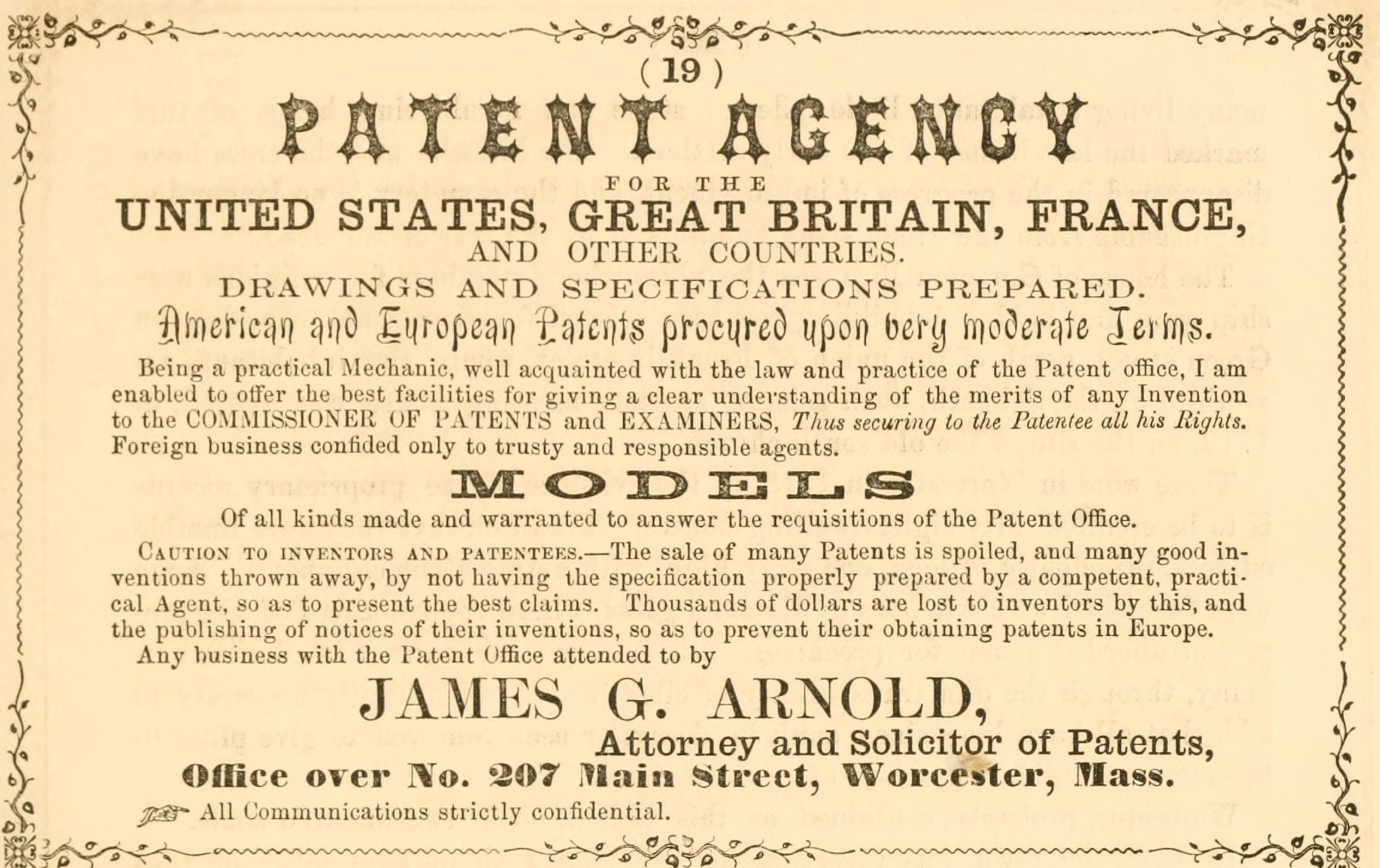
James G. Arnold’s ad in “The Heart of the Commonwealth,” a guide to Worcester, Massachusetts, businesses, 1856, page 19. Internet Archive, public domain. Click the picture to see it full size.
Two years later, the man who built other people’s inventions built one of his own. A 1917 history of Worcester’s factories says that in 1858 he “devised a machine for cutting the material for an envelope from a roll of paper, which also gummed and folded the envelope complete in one operation.” Gum was the glue on the flap. Until then, workers put it on with a brush.
The same book is honest about how it went. “Mr. Arnold’s machine was not a practical success,” it says, but it “had in it the foundation principles” of the envelope machines that came after. In 1864 a Worcester man named G. Henry Whitcomb started an envelope business on one of the Arnold machines. By January 1866 he was “making one hundred thousand envelopes per day.”
Where the Little Models Went
The models built in Worcester, Massachusetts, went to the Patent Office in Washington and stayed there. The photograph below shows its model room in the 1860s: a long hall with a curved ceiling, and tall glass cases down both sides.
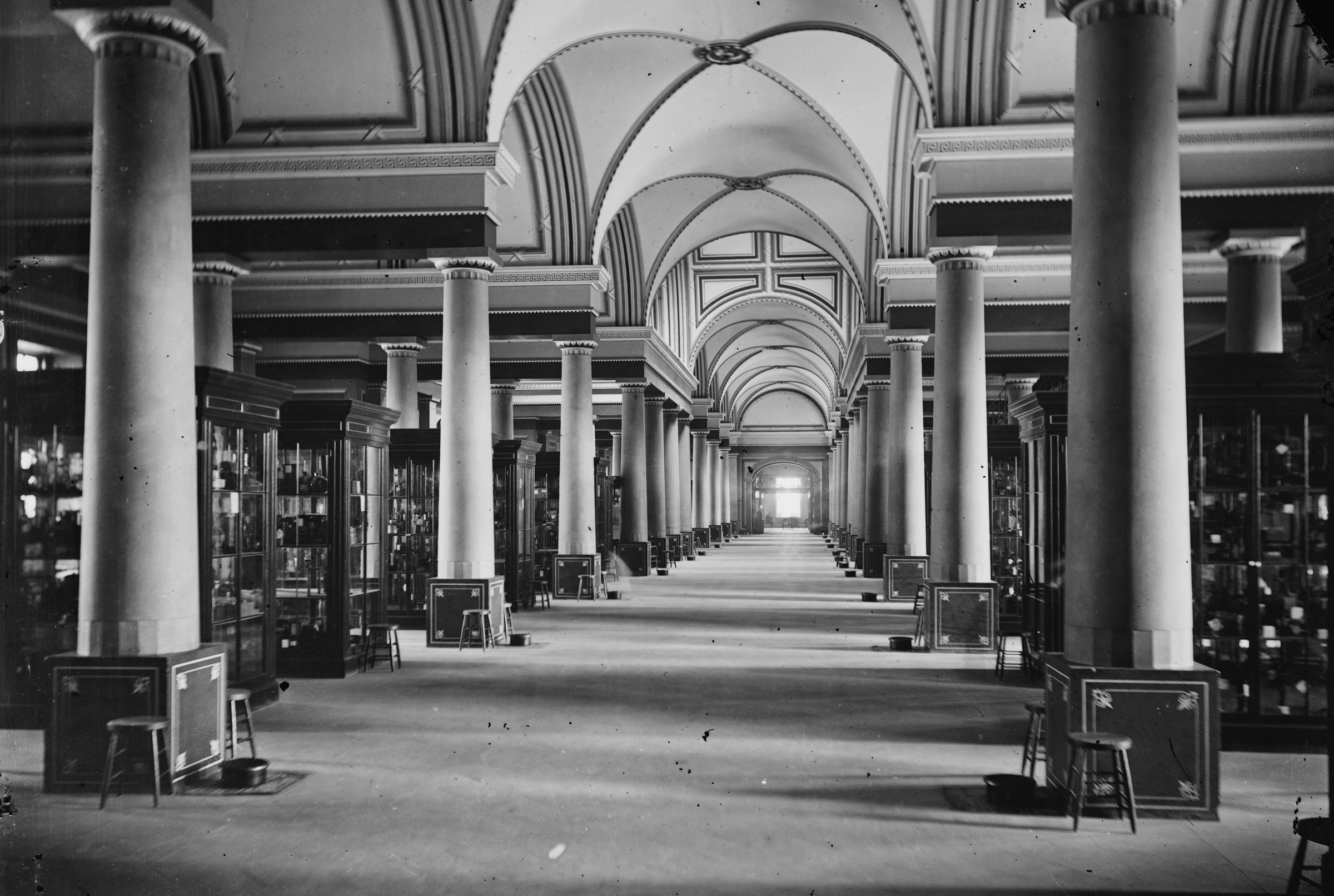
The model room of the Patent Office in Washington, with its glass cases, photographed in the 1860s. The Library of Congress titles the negative “Old Patent Office – model room (1861-65).” Brady-Handy Collection, Library of Congress. Click the picture to see it full size.
Aza Arnold died in Washington in 1865, at the age of 77. James stayed in Worcester and died in 1892, the same year American Machinist printed his father’s story. By then the rule that had kept his shop busy was gone. A guide for inventors printed in 1885 said, “A model will not be required or admitted as a part of the application,” unless a patent examiner asked for one.
That is what makes one two-cent newspaper from 1855 worth a second look. It caught the years when a new idea had to be built small before it could be protected. And it caught a father and son, one in Washington and one up the stairs on Main Street, working to keep each idea with the person who had it.
Sources
- “Patent Agency and Model Manufactory,” notice of J. G. Arnold and Aza Arnold, Worcester Daily Spy (Worcester, Massachusetts), November 3, 1855, page 1. Library of Congress, Chronicling America.
- “Rules and Directions for Proceedings in the Patent Office,” U.S. Patent Office, 1854, page 5, rules 20 to 22. Internet Archive.
- Patent model of an envelope-folding machine, Russell L. Hawes, patent number 9812, June 21, 1853. National Postal Museum, Smithsonian Institution. Photographs CC0.
- Samuel Batchelder, “Introduction and Early Progress of the Cotton Manufacture in the United States,” 1863, pages 80 to 83. Internet Archive.
- “Rhode Island Inventors,” American Machinist, September 8, 1892, pages 4 and 5. Internet Archive.
- “The Greenes of Rhode Island,” 1903, page 454 (James Greene Arnold). Internet Archive.
- “Representative Men and Old Families of Rhode Island,” 1908, volume 3, pages 1563 and 1564 (Aza Arnold). Internet Archive.
- Henry J. Howland, “The Heart of the Commonwealth,” Worcester, 1856, page 19 (James G. Arnold’s ad). Internet Archive.
- Charles G. Washburn, “Industrial Worcester,” 1917, pages 198 and 199 (envelope machines). Internet Archive.
- Schuyler Duryee, “Plain Directions for Securing Patents,” Boston, 1885, page 13. Internet Archive.
- Old Patent Office, model room (1861-65), Brady-Handy Collection. Library of Congress Prints and Photographs Division. No known restrictions on publication.
- The newspaper, books and magazine pages were printed before 1931 and are in the public domain.