On May 5, 1922, a newspaper in Baton Rouge, Louisiana, called the Woman’s Enterprise ran a big headline across the top of page three: “Choosing a Profession.” Under it, in bold type, was a question every child gets asked sooner or later. “What Are You Going to be When You Grow Up?”
The answers did not come from bankers or judges. They came from freshmen, the first-year students at Louisiana State University in Baton Rouge. The first one to answer was a young man named Lawrence T. Phelan, and he started with the family clock.
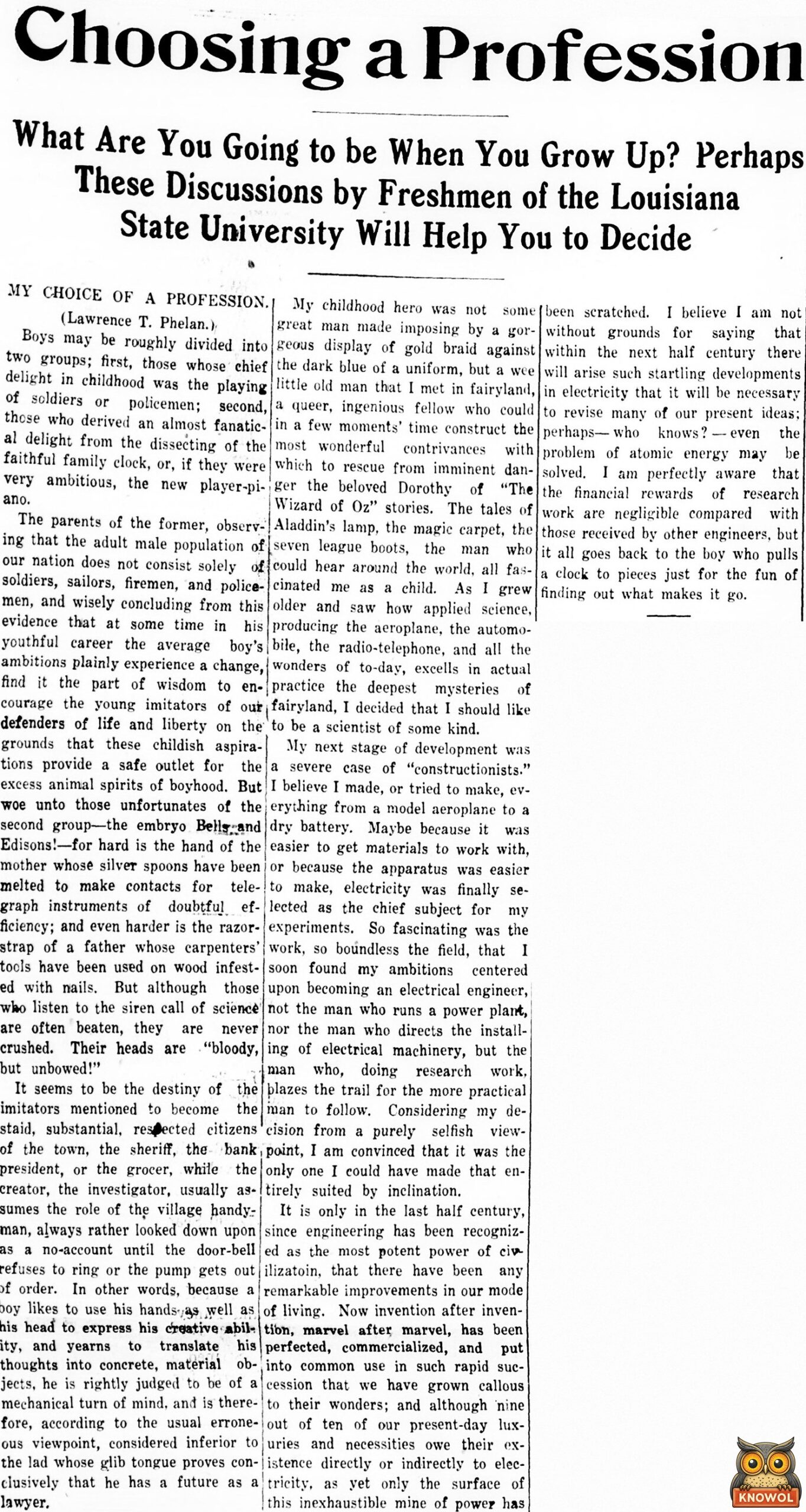
“Choosing a Profession,” with Lawrence T. Phelan’s whole essay. Woman’s Enterprise, Baton Rouge, Louisiana, May 5, 1922, page 3. The next student’s essay, lower in the third column, is left out here. Library of Congress, Chronicling America. Click the clipping to read it full size.
The Boy Who Takes the Clock Apart
Lawrence Phelan, the Baton Rouge freshman, wrote that boys come in two kinds. The first kind plays soldier or policeman. The second kind gets “an almost fanatical delight from the dissecting of the faithful family clock, or, if they were very ambitious, the new player-piano.” Dissecting means taking a thing apart to see what is inside. A player piano played songs by itself, so it had a lot inside to take apart.
Phelan knew what such a boy had coming. In his words, “hard is the hand of the mother whose silver spoons have been melted to make contacts for telegraph instruments of doubtful efficiency.” Put plainly, a boy has melted his mother’s good spoons to build a telegraph, and the telegraph doesn’t even work very well. He grows up to be the town handyman, “looked down upon as a no-account until the door-bell refuses to ring or the pump gets out of order.”
A Hero From the Oz Books
Phelan told the Baton Rouge paper that his childhood hero was no great man in a uniform. He was “a wee little old man that I met in fairyland,” who could build “the most wonderful contrivances” in a few moments, just in time to rescue Dorothy in the Oz books. A contrivance is a clever machine. Phelan never gave the little man’s name.
Then he got older, and real life passed the fairy tales. He listed “the aeroplane, the automobile, the radio-telephone, and all the wonders of to-day.” So he started building. “I believe I made, or tried to make, everything from a model aeroplane to a dry battery,” he wrote. He settled on electricity, and he did not want to run a power plant. He wanted to be the man who, “doing research work, blazes the trail for the more practical man to follow.”
Phelan’s Guess About Atomic Energy
Near the end of his essay, the Baton Rouge freshman made a guess. He believed that “within the next half century there will arise such startling developments in electricity that it will be necessary to revise many of our present ideas.” Then he went one step more. Perhaps, he wrote, “even the problem of atomic energy may be solved.”
Atomic energy is the power locked inside atoms, the tiny bits that everything is made of. In 1922, nobody knew how to set it loose and keep it under control. But on December 2, 1942, in a squash court under the stands of a football field at the University of Chicago, a team led by the scientist Enrico Fermi started the first atomic reaction that kept itself going. The U.S. Department of Energy’s history of that day says it made about half a watt of power, hardly enough to light a small bulb. Phelan had given the world half a century. It took a little more than twenty years.
He knew research would not make him rich, and that was fine with him. As he put it in his last line, “it all goes back to the boy who pulls a clock to pieces just for the fun of finding out what makes it go.”
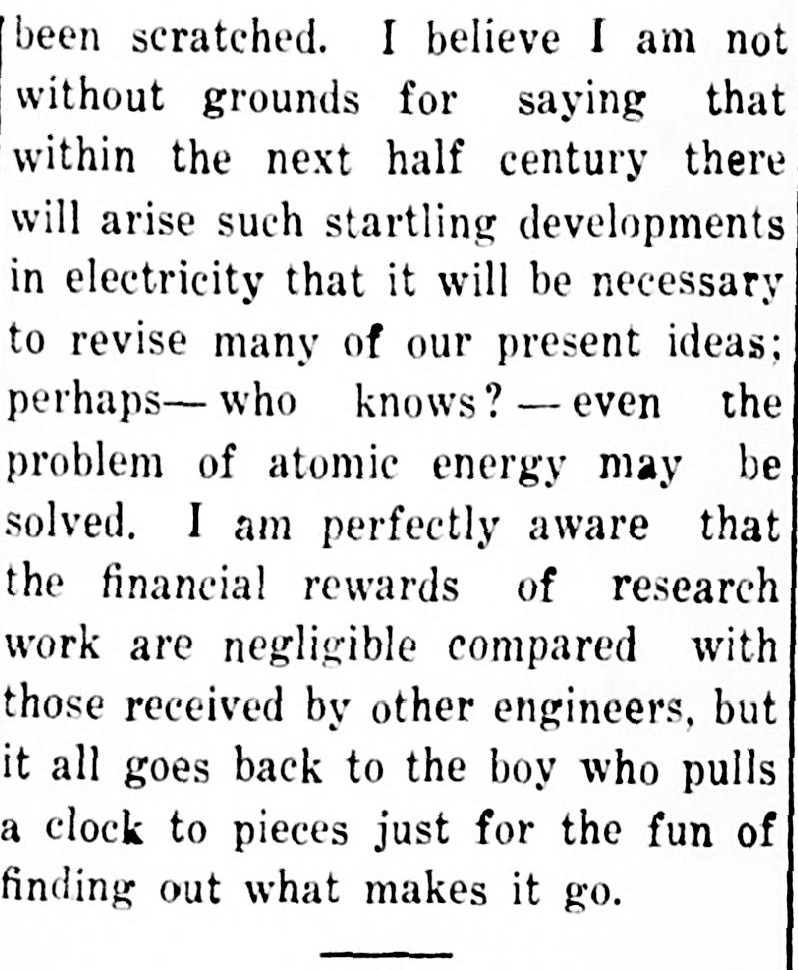
The end of Lawrence T. Phelan’s essay, with his guess about atomic energy. Woman’s Enterprise, Baton Rouge, Louisiana, May 5, 1922, page 3. Library of Congress, Chronicling America. Click the clipping to read it full size.
The Girl Who Tried to Kiss Her Elbow
The Baton Rouge paper printed more answers on June 1, 1922, and the funniest came from a freshman named Etta V. Higdon. She called hers “Why I Became a Farmerette.” A farmerette was a girl or woman who farmed.
As a little girl, she wrote, she “wanted worse than anything else in the world to be a boy.” The reason was pigs. “All the little boys I knew were joining Pig Clubs,” she explained. Those were clubs where each member raised a pig. “I felt myself an outsider, all because I was a girl.”
So she tried magic. “One day, grown desperate with longing, I recklessly tried to kiss my elbow,” she wrote. That, “as every one knows, is the magic formula for instantly changing a girl to a boy.” It was a safe sort of magic, since hardly anybody can get their lips to their own elbow. Somebody bumped into her anyway, “just in time.”
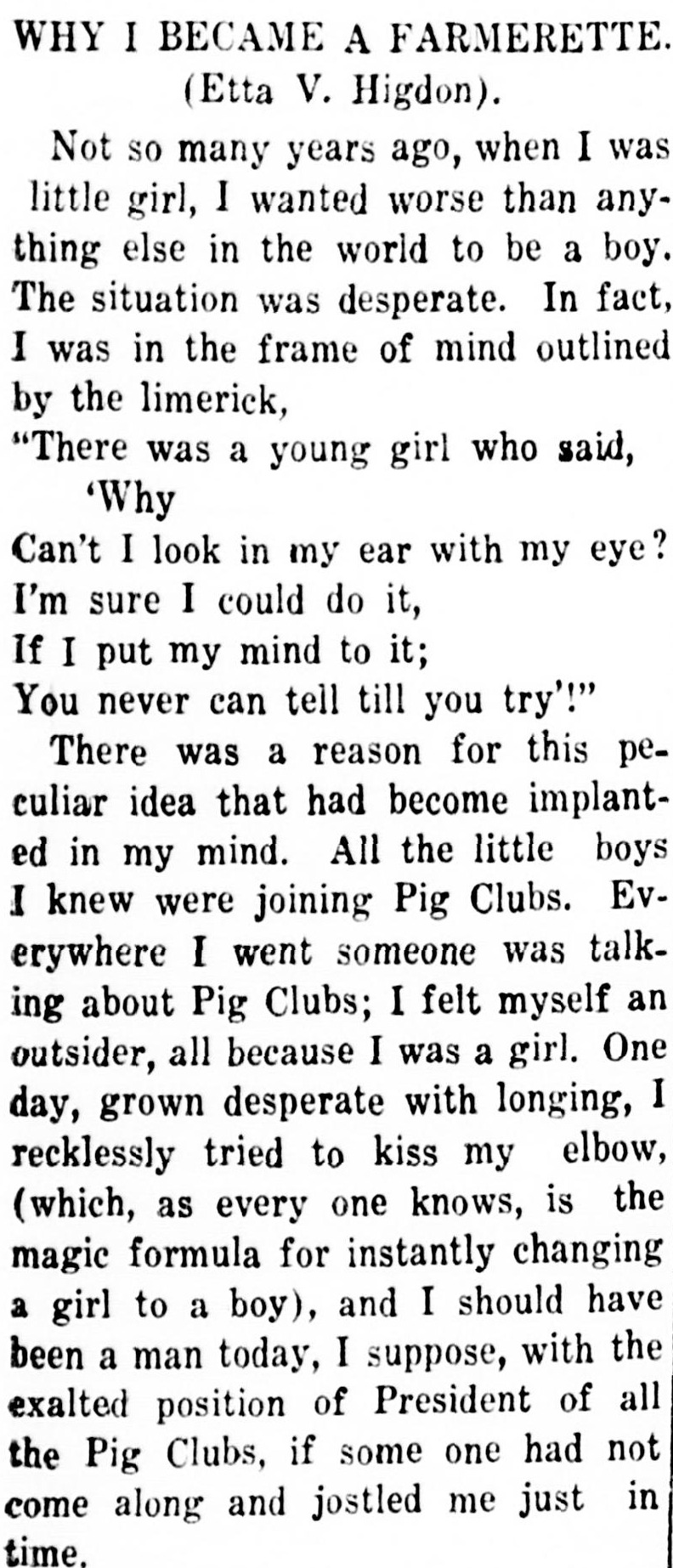
“Why I Became a Farmerette,” by Etta V. Higdon. Woman’s Enterprise, Baton Rouge, Louisiana, June 1, 1922, page 12. Library of Congress, Chronicling America. Click the clipping to read it full size.
Later, at the Edwin T. Merrick School in New Orleans, Louisiana, each girl got a small garden of her own. Etta planted “carrots, radishes, and onions.” When the radishes came up, she had “a sudden desire to pull them up and eat them.” Her teacher caught her, “just in time to keep me from pulling up the carrots too.”
Those carrots went to the city vegetable contest, where “the Mayor and other big men of the city” were the judges. Then she heard her own name called: “winner of carrot contest!” Walking home with a blue ribbon, she wrote, “I suddenly realized how glad I was that I had never kissed my elbow.”
Cowboys, Pirates and One Hungry Cow
Other freshmen at the Baton Rouge university had started out with big dreams too. T. T. Dunn had “great hopes of becoming a cow-boy,” thanks to Western movies. Then he read books like “Treasure Island,” and “My greatest ambition was to become a pirate and search for buried gold.” He ended up in mechanical engineering.
Jennie Stubbs wanted to be “a cowgirl with a six-shooter on each hip, angora chaps on my legs.” Chaps are leg covers that riders wear. She practiced “riding on the banisters with the aid of my mother’s best sofa pillows.” When it was time to pick a real job, her father said that “as I would inevitably marry before I reached twenty-three, I might as well take law, as it was good training and would give me a good education, and I liked to talk anyway.” She signed up for law.
E. A. Goldsby planned to be a farmer until “one dreary night our cow got into my garden and ate the growing things I had tended so carefully.” After that he set his sights on being “a great surgeon.”
What the First Eight Baton Rouge Freshmen Picked
The Woman’s Enterprise printed eight of these essays on May 5 and June 1, and more of them on July 3. Here is what each of the first eight Louisiana State University freshmen chose.
- Lawrence T. Phelan: electrical engineer, the kind who does research.
- Winnie D. Reid: stenographer, a worker who takes down letters in shorthand.
- “John Doe,” who kept a real name out of the paper: journalism. The family wanted sugar chemistry.
- Etta V. Higdon: a “farmerette” in grade school. The yearbook lists her college course as Arts and Sciences.
- T. T. Dunn: mechanical engineer.
- E. A. Goldsby: doctor.
- Jennie Stubbs: lawyer.
- S. D. Watson: farmer.
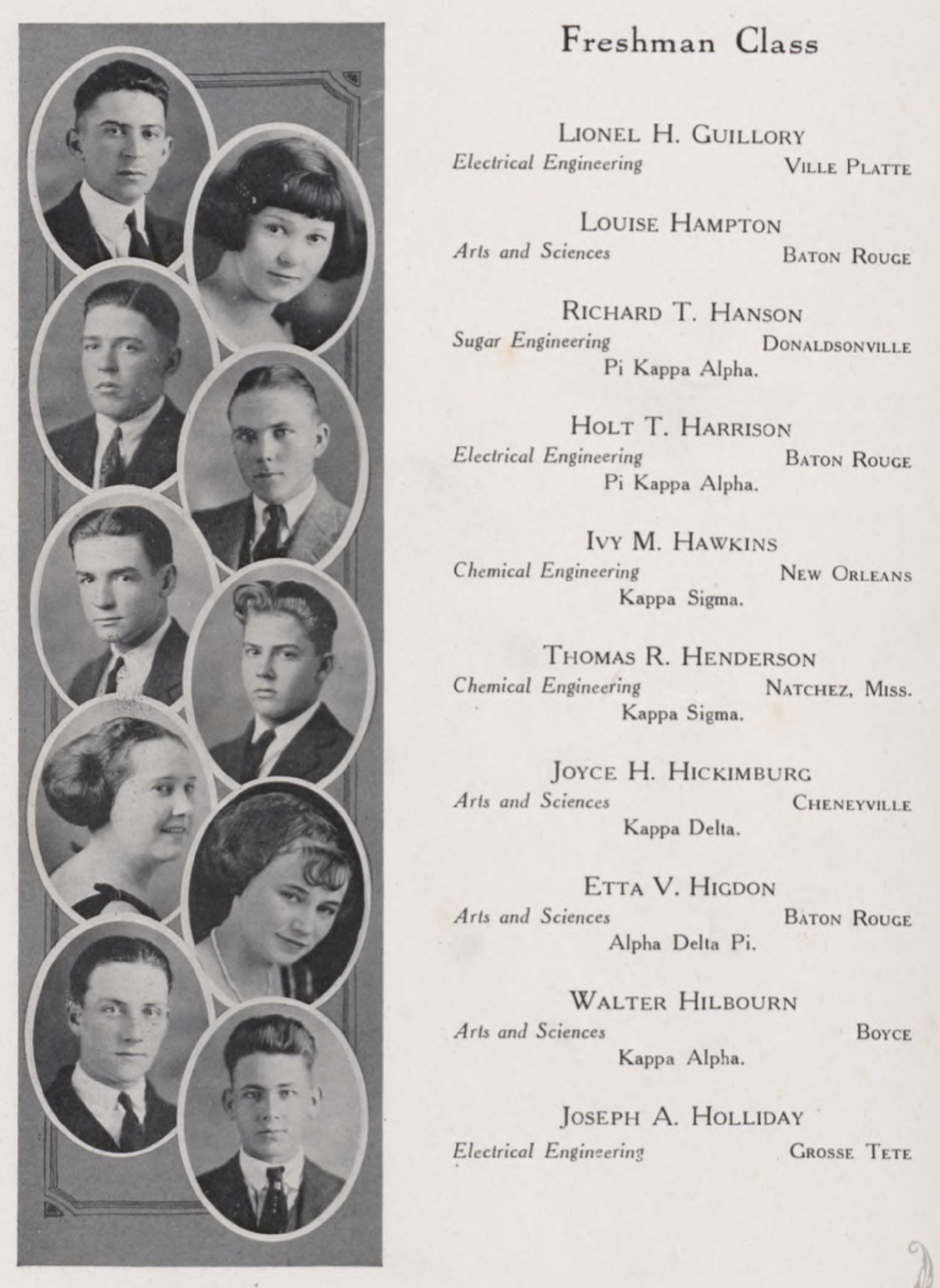
A Freshman Class page from the 1922 Gumbo, the Louisiana State University yearbook. Etta V. Higdon of Baton Rouge is the eighth name. Under each name is the course that student chose. Lawrence Phelan is not on this page. Louisiana State University, LSU Scholarly Repository; published in 1922, public domain. Click the picture to see it full size.
What the Louisiana State University Yearbooks Show
The freshmen of Louisiana State University were probably doing homework. Two months before, on March 10, 1922, the same paper had printed book reviews “submitted as assignments in Freshman English by students of the Louisiana State University,” and one of them was “Reviewed by L. T. Phelan.”
The university’s yearbook, the Gumbo, tells a little more. In 1923 it lists a Lawrence Phelan of the class of 1925 in the Scribblers, a club for student writers. We did not find him among the 1925 seniors, and we could not learn whether he ever got his laboratory. Etta Higdon is there, in a cap and gown. The girl who once wanted to raise pigs was Society Editor of the Reveille, the student newspaper.
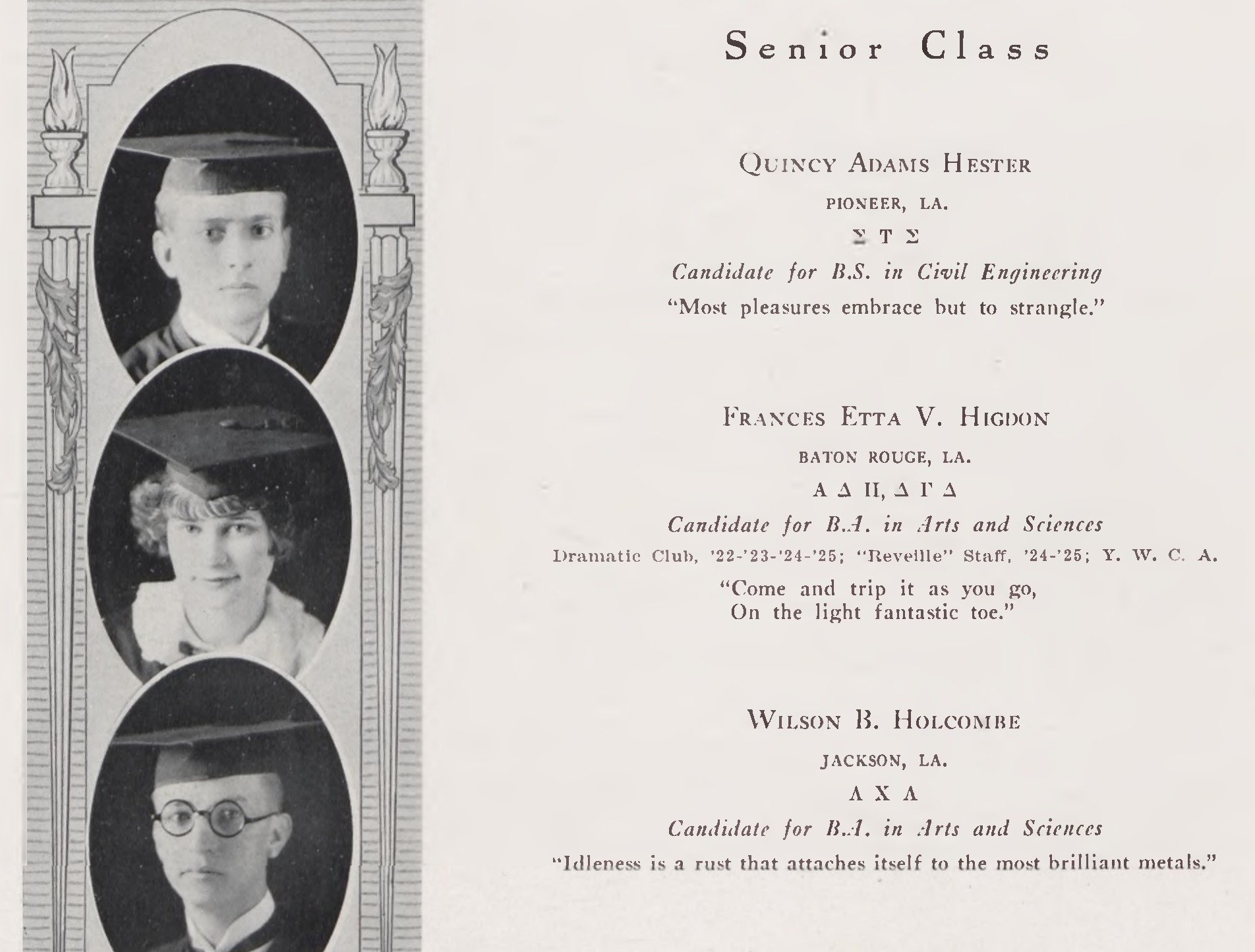
Etta V. Higdon of Baton Rouge (middle picture) on a Senior Class page of the 1925 Gumbo, the Louisiana State University yearbook. Louisiana State University, LSU Scholarly Repository; published in 1925, public domain. Click the picture to see it full size.
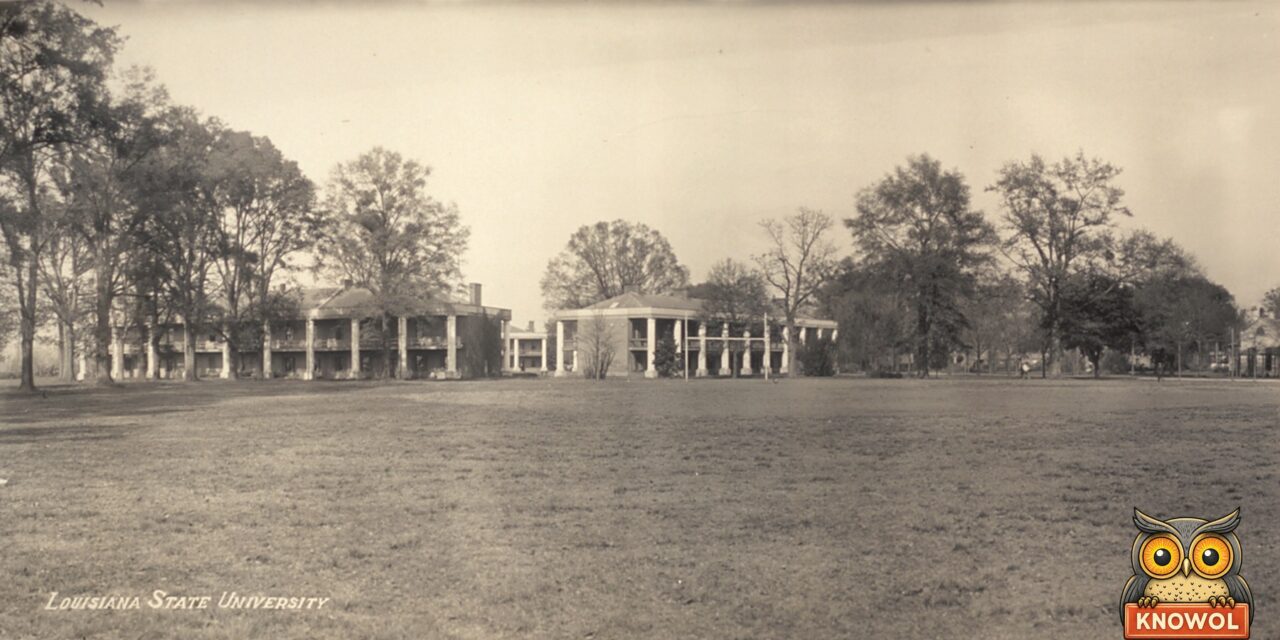
The picture at the top of this page shows the university’s campus in Baton Rouge in 1909, thirteen years before the essays. The school was still on that ground in 1922. That is where a freshman who loved the Oz books wrote his answer. His guess about the atom came true with almost thirty years to spare. His best line was still the last one, about the boy who takes a clock apart “just for the fun of finding out what makes it go.”
Sources
- “Choosing a Profession,” Woman’s Enterprise (Baton Rouge, Louisiana), May 5, 1922, page 3: the essays of Lawrence T. Phelan, Winnie D. Reid and “John Doe.” Library of Congress, Chronicling America.
- “Choosing a Profession (Continued from last issue),” Woman’s Enterprise (Baton Rouge, Louisiana), June 1, 1922, page 12: the essays of Etta V. Higdon, T. T. Dunn, E. A. Goldsby, Jennie Stubbs and S. D. Watson. Library of Congress, Chronicling America.
- “Choosing a Profession,” Woman’s Enterprise (Baton Rouge, Louisiana), July 3, 1922, page 11: more essays in the same series. Library of Congress, Chronicling America.
- “Review of Books New and Old,” Woman’s Enterprise (Baton Rouge, Louisiana), March 10, 1922, page 7: the Freshman English book reviews, one by L. T. Phelan. Library of Congress, Chronicling America.
- The Gumbo, yearbook of Louisiana State University, LSU Scholarly Repository: 1922 (Freshman Class, page 86; “The Greater Louisiana State University,” page 6), 1923 (The Scribblers, page 196) and 1925 (Senior Class; Scribblers, page 306; The Reveille, page 314).
- U.S. Department of Energy, The Manhattan Project: an interactive history, “CP-1 Goes Critical”: the first self-sustaining chain reaction, Chicago, December 2, 1942.
- Cover photo: “Louisiana State University, Baton Rouge, La.” panoramic photograph, Haines Photo Co., copyright 1909. Library of Congress Prints and Photographs Division, no known restrictions on publication.
- The newspapers, yearbooks and photograph were all published before 1931 and are in the public domain in the United States.