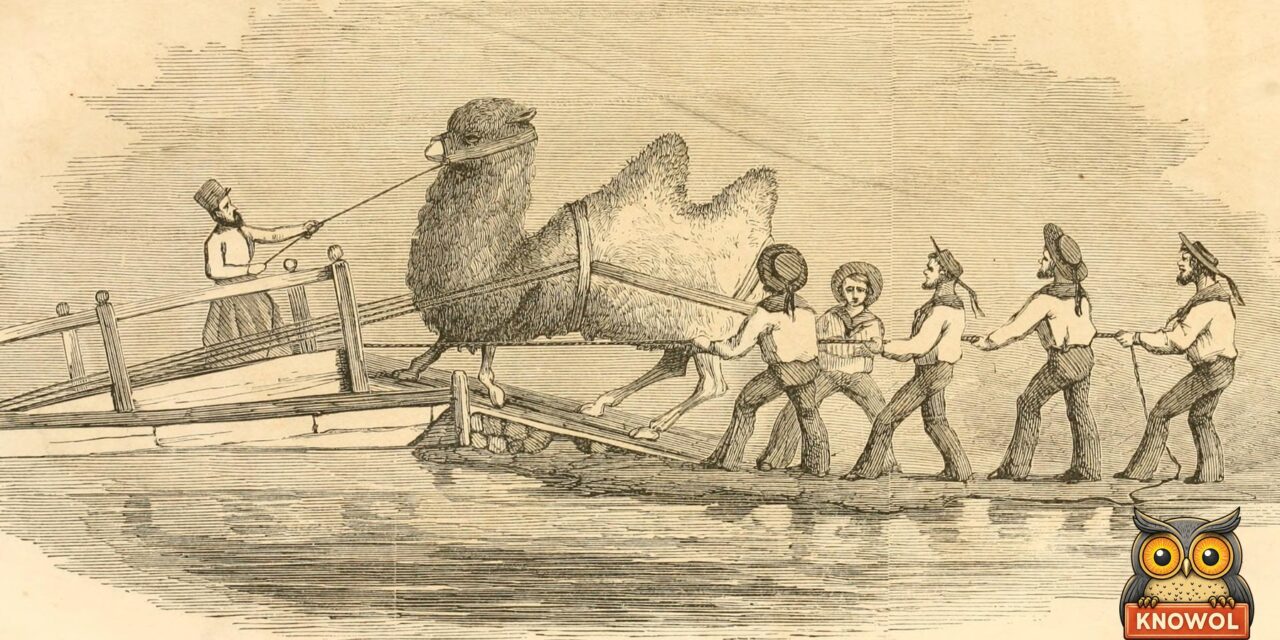
Around the end of 1892, a rancher named Mizoo Hastings woke up in his cabin above a gold camp on the San Francisco River in Arizona Territory, looked out the window, and saw a big red camel eating his turnips. “Mizoo took a dead rest over the window sill and blazed away. He got the camel.” Walking out to look, he found it wrapped in a net of knotted rawhide strips, on so long that some had cut into its flesh. The newspapers soon reported that he had killed the Red Ghost.
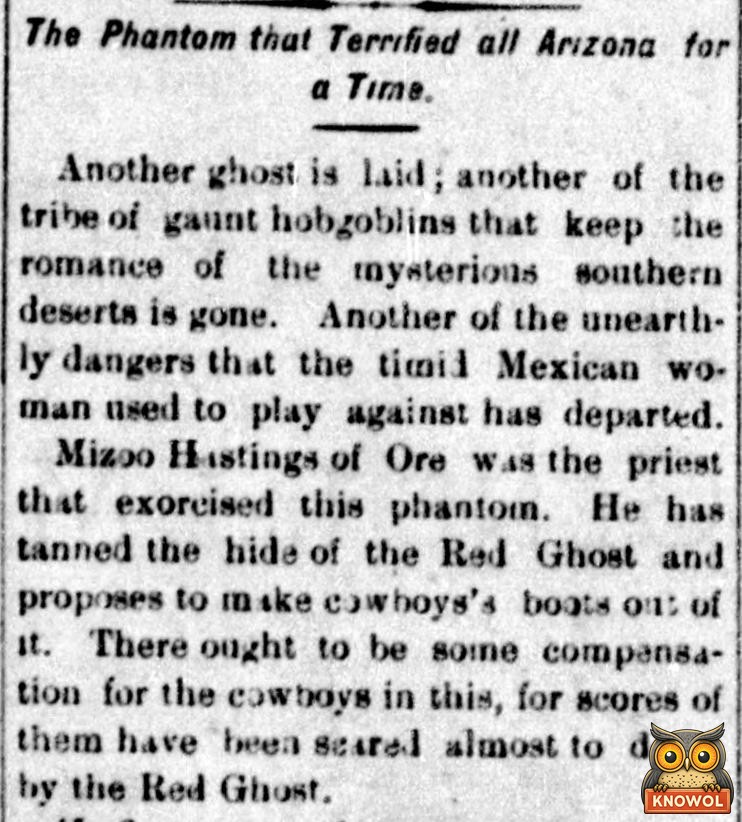
“The Phantom That Terrified All Arizona for a Time,” Mohave County Miner, Mineral Park, Arizona, February 25, 1893, page 3, reprinted from the San Francisco Examiner. Library of Congress, Chronicling America. Click the clipping to read it full size.
Ten years of a phantom
Nearly everything known about the Red Ghost comes from one long story, printed in early 1893 by the San Francisco Examiner and picked up by the Mohave County Miner. It said the Ghost first showed up about ten years earlier, in 1883, not long after a raid by Geronimo’s Apaches. Two Mexican miners washing for gold on a creek near Clifton woke up in the night with their tent knocked down on top of them. They heard pounding hoofs and a terrible shriek and saw something taller than two horses crash into the brush.
Its next stop was a sheep ranch on Eagle Creek. The herders were out with the flocks, and two women were home alone with the children. One went to the spring for water. The other heard the dogs, ran to the door, and saw something tear through the fence. The men came home that night and found the first woman dead at the spring, trampled. When the coroner rode up from Solomonville, the only witness did her best. “It was red, she said, very tall and ridden by a devil.”
A camel with a rider
About a month later, a hunter named Si Hamlin, up in the Salt River country, came to the top of a ridge and saw a big animal moving through the chaparral half a mile away. When it crossed a burned patch, he could see it plainly. It was a camel, and on its back was a load that looked to him like a man, though he wasn’t sure.
Then two prospectors on the Verde River fired at it while it was feeding on a mesa. They missed, the camel bolted, and something dropped off its back. They followed and found “a man’s head, dry and withered, but with flesh and hair still on it.”
Later, at dusk one evening, a cowboy from the Anchor-J outfit surprised a great red camel in an old branding corral and roped it out of habit. “In about two minutes he wished that he hadn’t.” The camel charged, took horse and rider down, and ran off dragging sixty feet of his rawhide rope. Back at camp, the cowboy said the thing on its back was nearly gone, but it had once been a man.
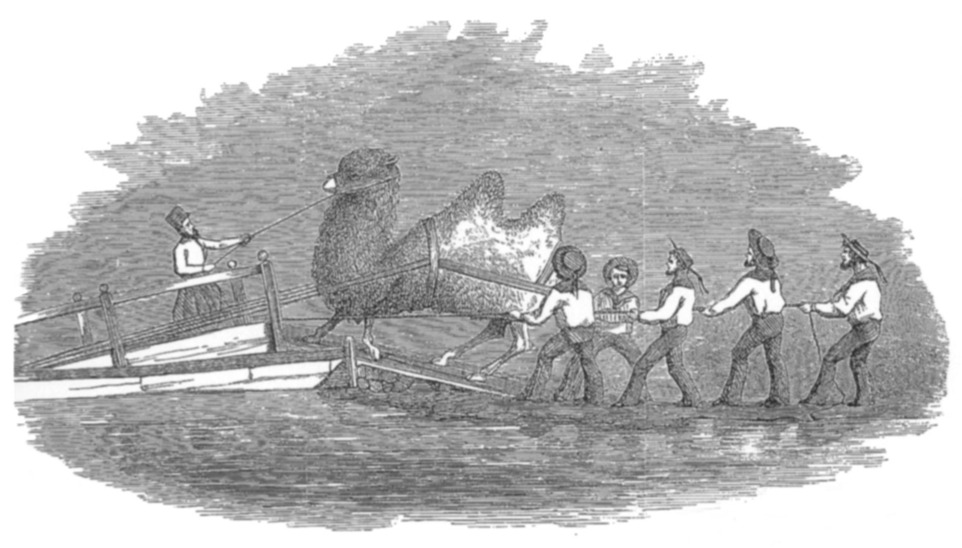
“Embarkation of Camels,” drawn by Gwinn Heap for the Secretary of War’s report to Congress on the Army’s camels, 1857. Public domain. Click the picture to see it full size.
Where the camels came from
Arizona really did have wild camels, and the U.S. Army brought them. In 1856, a Navy ship brought the first camels to Indianola, Texas, and a second load of 41 followed. Their job was to carry supplies across the southwestern deserts. In 1857, Edward Beale took 25 of them along the 35th parallel to Fort Tejon, California, while surveying a wagon road. The experiment never caught on. The camels in California were sold at auction in 1863, others got loose to roam the desert, and in 1866 the government auctioned off the rest in Texas.
Camel hunts and camel jerky
By 1883, Arizona’s papers treated wild camels as ordinary news. In August, a Tucson paper said some gentlemen in Los Angeles were organizing a camel hunt along the Gila River, where the camels had become a nuisance to prospectors and settlers. A Phoenix paper answered that only two were left in Arizona, too wild to catch. Several had been caught and shipped east for a show, and two had been killed at Webb’s ranch, “and their meat converted into carne seco,” the dried meat of the Southwest.
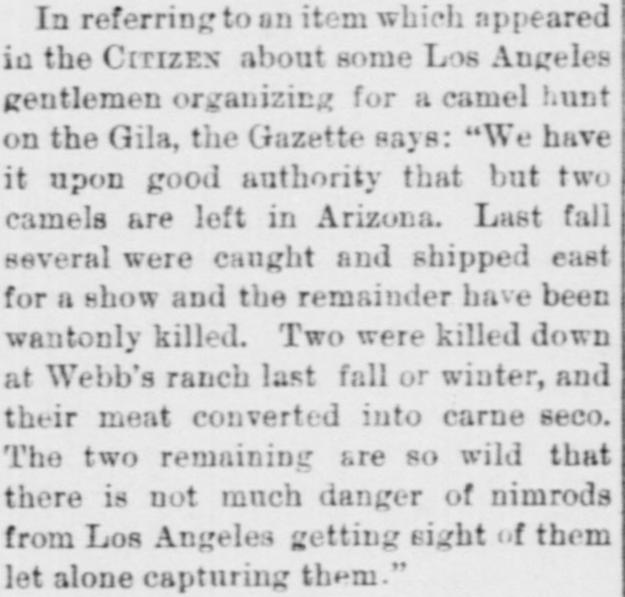
Arizona Weekly Citizen, Tucson, Arizona, September 1, 1883, page 3. Library of Congress, Chronicling America. Click the picture to see it full size.
The hide and the mystery
Mizoo Hastings tanned the Red Ghost’s hide and planned to make cowboy boots out of it. Nobody ever learned who the man on its back had been, and the Examiner couldn’t solve it either. (In Lord Byron’s poem “Mazeppa,” a man is tied to a wild horse and turned loose.) “Now everybody down in that country is wondering whether the man was tied on there Mazeppa fashion for deviltry or revenge, whether it was some lunatic’s hideous scheme of suicide, or merely an ugly piece of humor of somebody who had a camel and a corpse for which he had no use.”
Sources
- Mohave County Miner (Mineral Park, Ariz.), February 25, 1893, page 3, “The Phantom That Terrified All Arizona for a Time,” from the San Francisco Examiner.
- Arizona Weekly Citizen (Tucson, Ariz.), August 25, 1883, page 3 and September 1, 1883, page 3.
- Texas State Historical Association, Handbook of Texas, “Camels”, for the 1856 and 1857 shipments, Beale’s 1857 survey and the auctions.
- Robert Froman, “The Red Ghost,” American Heritage, April 1961, which also notes that the Miner story is the only account from the time.
- Illustration: Gwinn Heap, “Embarkation of Camels,” in the Secretary of War’s 1857 report to the Senate on the purchase of camels, via Wikimedia Commons. Public domain.
- All newspaper images: Library of Congress, Chronicling America. No known copyright restrictions.
- Cover: Gwinn Heap, “Embarkation of Camels” (No. 15), in the Secretary of War’s 1857 report to the Senate on the purchase of camels, page 179, Internet Archive (cropped). Public domain.