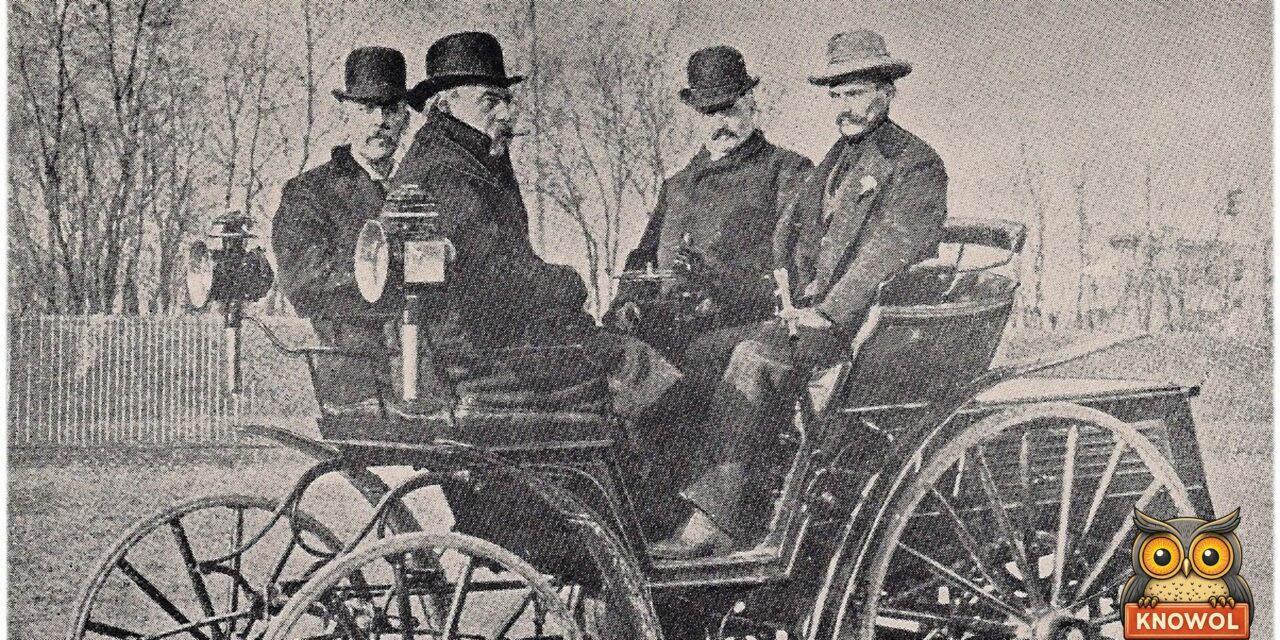
At 7:15 on Thanksgiving morning, November 28, 1895, a buggy with no horse rolled out of a barn in Chicago, Illinois under its own power. On the seat with its driver sat A. W. White, the umpire assigned to ride along and write down everything that happened. Ahead of them was a 54-mile race to Evanston and back, and a city still buried by a blizzard.
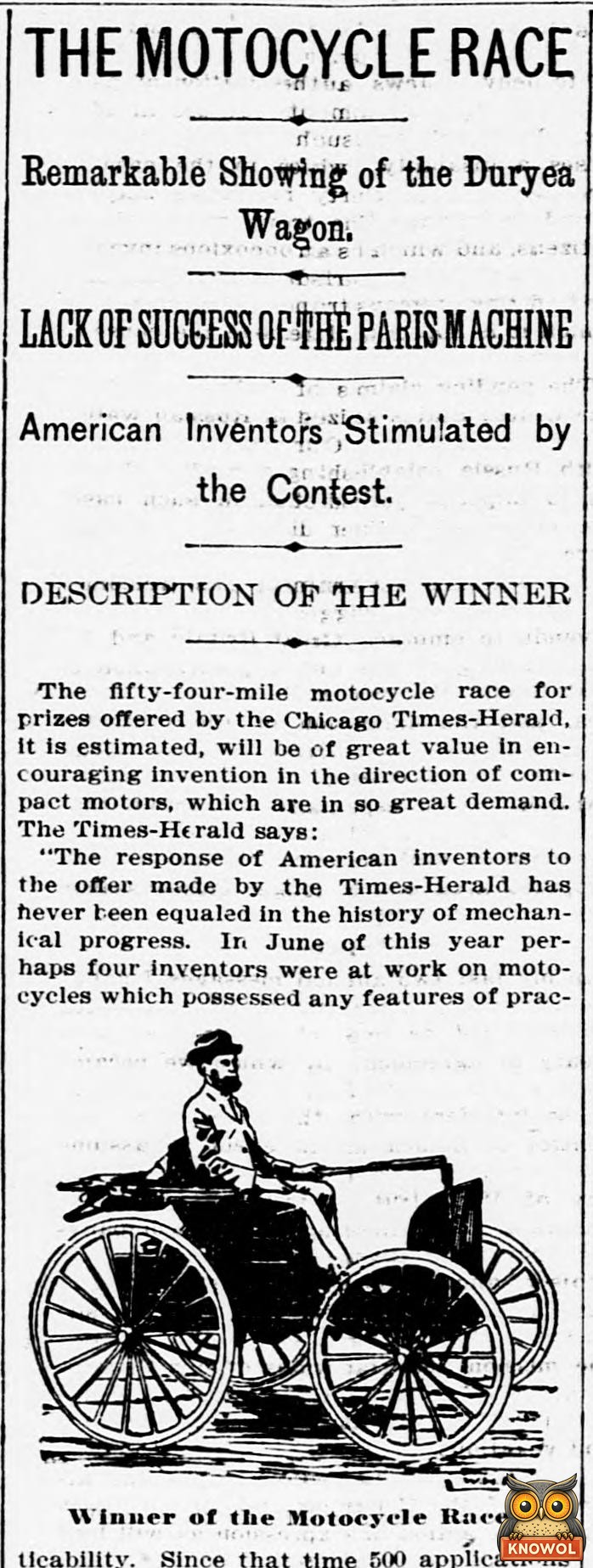
“The Motocycle Race,” with a drawing of the winning Duryea wagon, Evening Star, Washington, D.C., December 3, 1895, page 10. Library of Congress, Chronicling America. Click the clipping to read it full size.
“Twelve inches deep in snow, slush and mud”
The Chicago Times-Herald had put up $5,000 in prizes for the contest. That summer the paper had even made up a word for the new machines. “The name to be applied to the new vehicle is motocycle,” the Topeka State Journal told its readers in July.
Then the weather turned. “Monday night Chicago was visited by a blizzard of snow and slush that buried the roads and prostrated half of the telephone and fire alarm wires in the city,” the race-day dispatch said. By Thursday morning “the streets were twelve inches deep in snow, slush and mud.” Eleven machines had promised to start. Six showed up at Jackson Park: the Duryea wagon from Springfield, Massachusetts, two electric carriages from Philadelphia and Chicago, and gasoline wagons from Decatur, Illinois, and the R. H. Macy company and the De la Vergne company of New York. Nobody expected much. “The prediction was freely made that no one of the contestants would make five miles.”
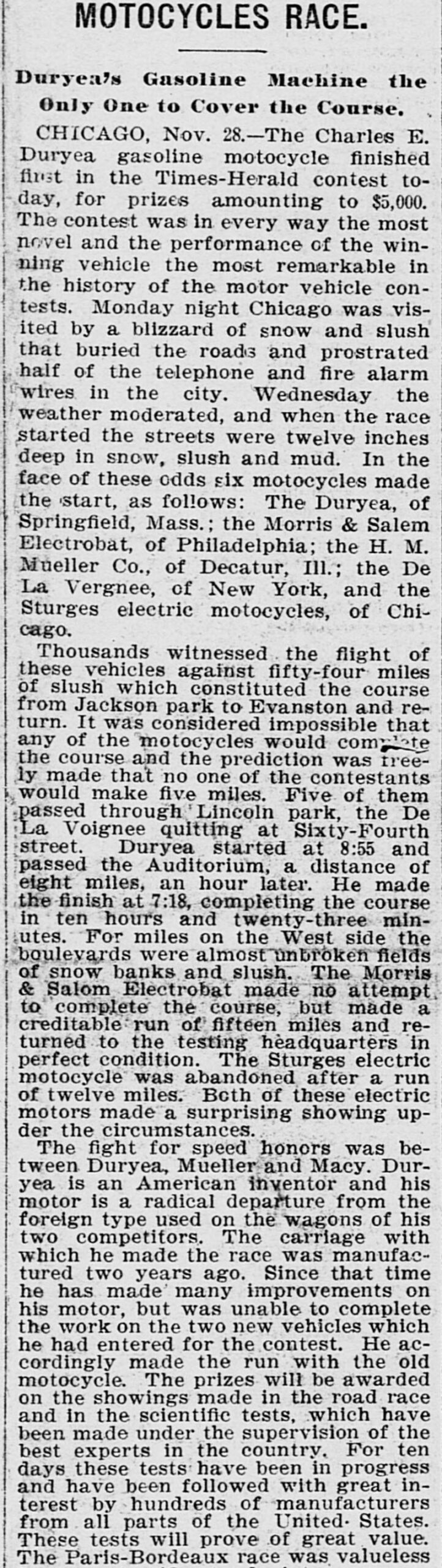
The race-day report from Chicago, St. Paul Daily Globe, Saint Paul, Minnesota, November 29, 1895, page 1. Library of Congress, Chronicling America. Click the clipping to read it full size.
A broken steering gear and a tipped-over sleigh
The De la Vergne wagon couldn’t push through the snow and quit almost at once. The two electric carriages turned back after 12 and 15 miles. The Duryea wagon had its own trouble right away. “We ran without a stop to the corner of Erie and Rush streets,” White wrote in his log. “Here we broke our steering gear by running over a high crossing covered with snow. A wait of fifty-five minutes ensued.”
Once it was fixed, the wagon ran all the way to Evanston, arriving at 12:35. On the way back, it was held up four minutes on Chicago Avenue in Evanston “by a sleigh that had tipped over in the street.” Then it got lost. With no sign at the corner of Lawrence Avenue and Clark Street, the crew took the wrong road and drove about two extra miles before they found the route again. Near Clark and Diversey, White wrote, “we broke our ‘sparker,’ and spent fifty-five minutes repairing it.”
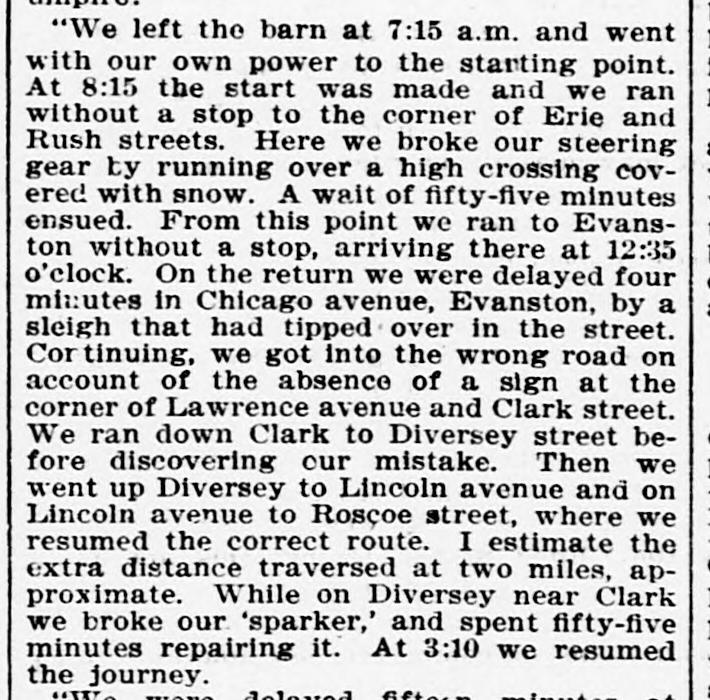
Umpire A. W. White’s account of the Duryea’s run, Evening Star, December 3, 1895. Library of Congress, Chronicling America. Click the clipping to read it full size.
Home after dark
The Duryea crossed the finish line at 7:18 that night, 10 hours and 23 minutes after it started. Take out the stops and repairs, and White figured its running time at seven hours and 53 minutes. Hardly anyone saw it come in. Its hometown paper, the Springfield Weekly Republican, said there were “very few people on the streets at the finish of the race, as it was much later than expected.” The Mueller wagon from Decatur came in second; Scientific American said it needed an hour and 35 minutes more to cover the course. The Macy wagon broke down about halfway. Only two of the six finished.
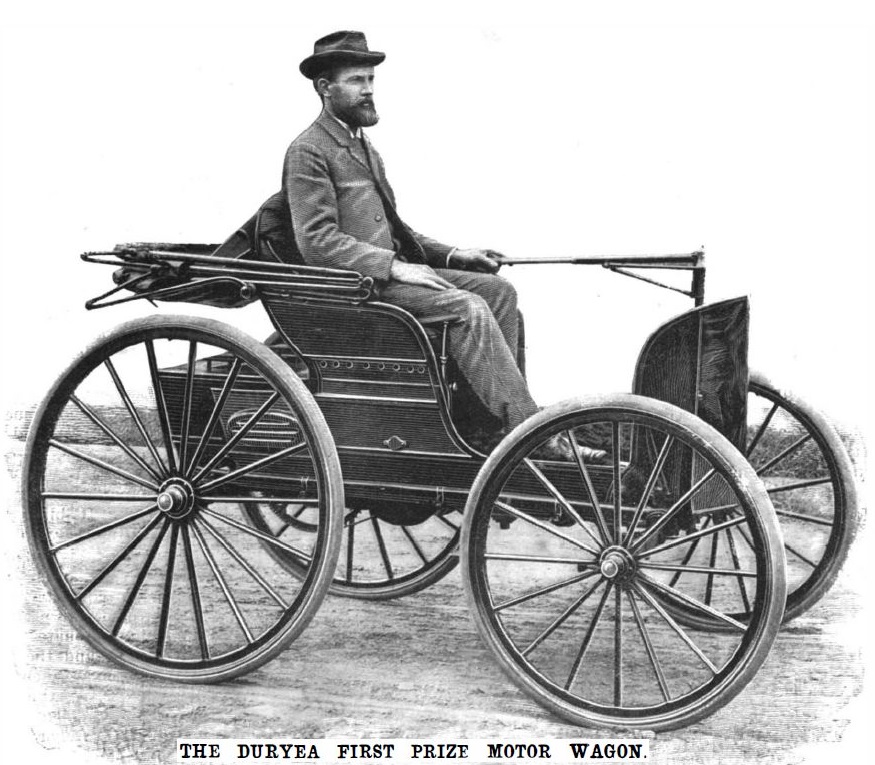
“The Duryea First Prize Motor Wagon,” Scientific American, December 7, 1895. Public domain, via Wikimedia Commons. Click the picture to see it full size.
Three and a half gallons of gasoline
White also kept track of the fuel, and his numbers read like a modern trip log. “Three and one-half gallons of gasoline and nineteen gallons of water were consumed,” he wrote. The water kept the engine cool. He guessed that the same effort would have carried the wagon 120 miles on smooth roads.
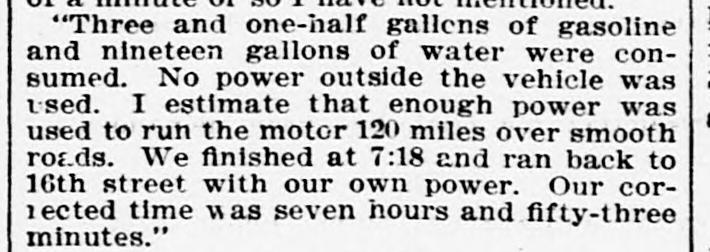
Evening Star, December 3, 1895. Library of Congress, Chronicling America. Click the clipping to read it full size.
The Springfield paper did the math for its readers. Running a gasoline motor cost “from a quarter to half a cent a mile, a gallon being all that is needed for a 30-mile run.”
The company that came next
The newspapers gave the win to Charles E. Duryea of Springfield. His hometown paper said the carriage was the work of two brothers, C. E. and J. F. Duryea. The Times-Herald claimed the contest had set inventors racing, too: in June, it said, perhaps four people had been working on a practical motor carriage, and since then “500 applications have been filed in the patent office at Washington.” The word “motocycle” never caught on.
The Duryea brothers did. In 1896 they and their backers started the Duryea Motor Wagon Company, which the Smithsonian calls the first American company that manufactured and sold automobiles. It built thirteen of them.
Sources
- St. Paul Daily Globe (Saint Paul, Minn.), “Motocycles Race,” November 29, 1895, page 1.
- New-York Tribune (New York, N.Y.), November 29, 1895, page 1.
- Evening Star (Washington, D.C.), “The Motocycle Race,” December 3, 1895, page 10.
- Springfield Weekly Republican (Springfield, Mass.), December 6, 1895, page 9.
- The Topeka State Journal (Topeka, Kan.), July 29, 1895, page 4.
- All newspaper images: Library of Congress, Chronicling America. No known copyright restrictions.
- Scientific American, “The Chicago Times-Herald Motor Race,” December 7, 1895, Internet Archive, for the second-place finish and the Macy breakdown. Picture via Wikimedia Commons.jpg). Public domain.
- Smithsonian National Museum of American History, Duryea Motor Carriage, 1893, for the Duryea Motor Wagon Company.
- Cover: Oscar Mueller’s Benz motor wagon with race officials Col. Marshall I. Ludington, Henry Timken and C. F. Kimball, 1895, reproduced in Charles B. King’s A Golden Anniversary, via Wikimedia Commons. Public domain.